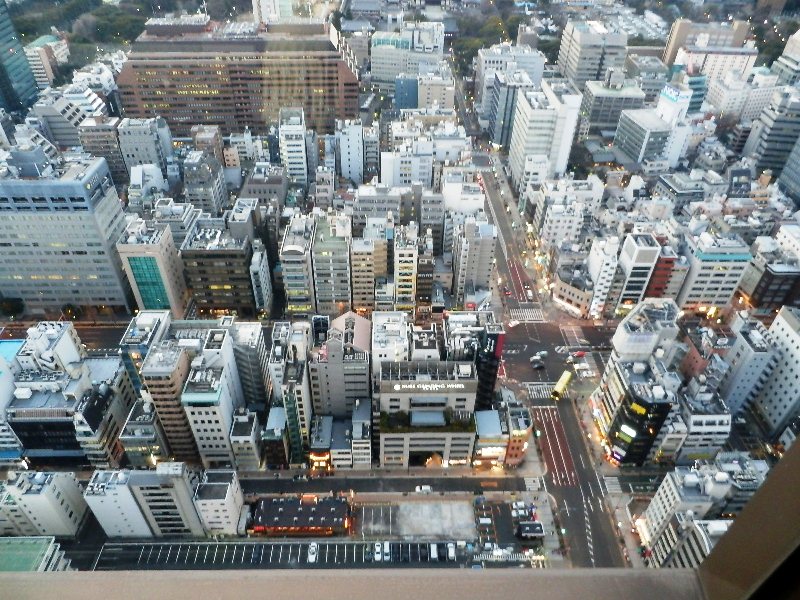
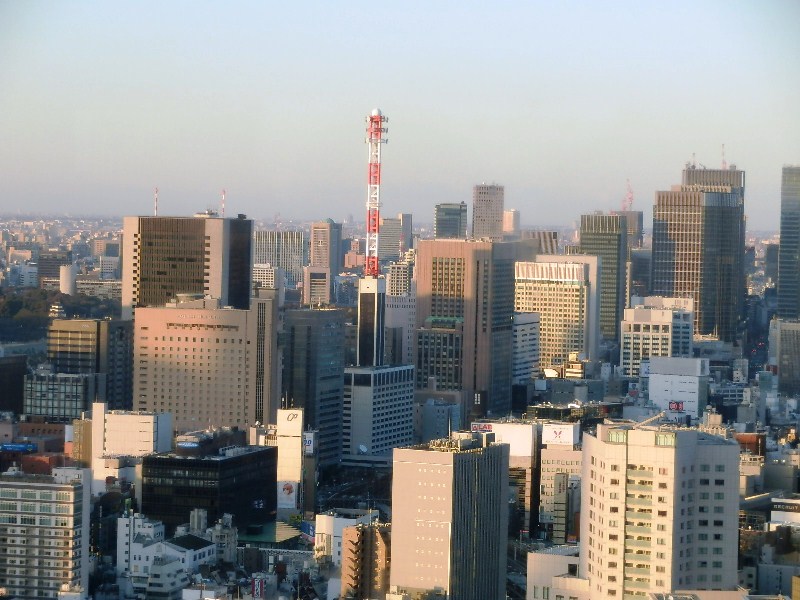
Tuesday, February 28, 2012

"the Son of man is Lord" - Syrian Christians


Tokyo Imperial Palace Plaza (old Edo Castle)

Syrian Christians

Christianity substantially started from Antioch:

The Church of Antioch is considered to be the most ancient and widely known of all churches after the Church of Jerusalem. After the destruction of Jerusalem in 70 AD by the Roman Emperor Titus, the Christians in Jerusalem were scattered and many made their way to Antioch. It was from Antioch that the disciples went to the then known parts of the world, spreading the Gospel and establishing churches, monasteries and schools. These monasteries and schools produced many illustrious scholars who enlightened the world with their religious and scientific achievements.22 The fathers of the Syrian Church of Antioch made great and memorable contributions in the study of the Holy Bible, both Old and New Testaments. It was their translation of the Holy Bible into the Syriac language that came to be known as (Peshitto) or 'simple'. They also translated the Bible into Arabic,Persian and Malayalam (a South Indian language).23 Their work was not limited to translation; it included commentaries and exegesis of the Holy Scriptures. They have left behind them a rich heritage that should be counted as unique by today's scholars. This church played a great role in spreading the Gospel to many nations of the world such in Arabia, Armenia, India, Ethiopia. In the process, it suffered the loss of thousands who laid down their lives as martyrs for the faith.24
http://www.nadamelchurch.org/churches-and-monasteries/syrian-orthodox-church-antioch-glance

It further expanded as far as East Asia, since Christ Jesus Himself spoke Syriac Language.

http://en.wikipedia.org/wiki/Syriac_language

Accordingly, Syrian Orthodox Church has prevailed even in India.
It is estimated that the (Syrian Orthodox) church has about 7,000,000 members globally including around 5,600,000 members in India.[16] There are 680,000 Syriac Orthodox members in Syria and 5,000 in Turkey, 2,000 in Israel and the Palestinian Territories (500 in Jerusalem and 1,500 Bethlehem) (numbers in Iraq is unknown). In Lebanon they number up to 50,000. In the diaspora, there are approximately 80,000 members in the United States, 80,000 in Sweden, 50,000 in Germany, 15,000 in the Netherlands, and thousands of members in Brazil, Switzerland, and Austria.[17] 
http://en.wikipedia.org/wiki/Syrian_Orthodox_Church

And, somebody has discovered that Christ Jesus appears every month in the Syrian Orthodox church in Jerusalem of today.


http://www.filination.com/blog/2010/12/03/syriac-orthodox-church-discovering-jerusalem/

Back to Antioch, its importance should be more reviewed as it was the third largest city in the Roman Empire.

  
During the first century, Antioch was the third biggest city in the Roman Empire (after Rome and Alexandria). Its population was over 500,000 (significant because we would not have a city of a million people until 1850). 
It was the third largest city but by far the most ethnically diverse. To large degree this was due to its location (see map). It had two interstate highways running by it; the north-south route connected it to Egypt and the east-west highway linked it to Rome. Antioch also had a major river that cut through it that was the starting point of the trade route to central Asia. This led to an incredibly cosmopolitan and diverse city. You had large numbers of Africans, Asians, and Europeans
http://danielgaryhill.wordpress.com/2010/05/21/the-energy-of-heaven-produces-the-church-in-antioch/

So, Syria is important in terms of history, religion, and language.

The bloodshed in Syria must be stopped.

*** *** *** ***


Mar 2:28 Therefore the Son of man is Lord also of the sabbath.

Monday, February 27, 2012

"as I received of my Father" - God and Economy

Tokyo Imperial Palace Plaza Park


GOD And Economy

So many people are talking about economy nowadays.

But, nobody has established his economic theory based on his belief or faith in God.  Yet, does economy has nothing to do with God, while economy is a key to welfare and well-being of human beings any believers would pursue?

I think the most reasonable and appropriate economic theory can be established if economists and other parties concerned study economy based on their faith and belief in God, if they have any.

In this context, it is interesting that Islamic nations suffer economically while the mainstream of global economy is now governed by Anglo-Saxon, European, or Western paradigms of economy.  So, how India will succeed might be interesting from a viewpoint of religion.  And, how Japan has succeeded while it is a non-Christian nation is very significant, since Japan has paved the way for economic success of other East Asia nations and regions, including Taiwan, South Korea, and China.

Economy must not serve money but God.

*** *** *** ***


Rev 2:26 And he that overcometh, and keepeth my works unto the end, to him will I give power over the nations:
Rev 2:27 And he shall rule them with a rod of iron; as the vessels of a potter shall they be broken to shivers: even as I received of my Father.
Rev 2:28 And I will give him the morning star.

Saturday, February 25, 2012

"ye have already hold fast till I come" - Socialism vs Capitalism

Tokyo...Mt. Fuji and Tokyo Bay


False Socialism vs Honest Capitalism

Communism and socialism that flourished in the 20th century were not originally based on false or evil motivation.

But they all failed.  The Soviet Union collapsed and China changed its paradigm just to survive and succeed.  They just focused on the material aspect of individuals, organizations, and a state.  Their justice was mainly limited in this scope.  If the society and a nation were governed based on material fairness, people would become happy.  This was their paradigm.  As long as the society and a nation were governed based on material fairness, any control, restriction, and political discipline would not make people unhappy,  This was their paradigm.   As long as the society and a nation were governed based on material fairness, restriction on freedom of speech, thought, and behaviors would be forgiven.  This was their paradigm.  And, to achieve and protect the society or nation that were governed based on material fairness, they had to fight against capitalist countries which were suppressing communism and socialism; and this war could be carried out by neglecting any spiritual value of people, since spirit was the secondary matter.  This was their paradigm.  So, communists and socialists in the 20th century came to be so anti-humanitarianism to fail and collapse, though they were based on some derivative aspects of traditions of Judaism and Christianity.

American or Anglo-Saxon capitalists were honest in the 20th century.  And, American or Anglo-Saxon capitalists respected democracy.  Indeed, capitalism and democracy were both rooted in the same European or Anglo-Saxon traditions.  It was freedom from the Vatican.  To be free from rotten and rigid rule by the Vatican, some Europeans and especially Anglo-Saxon people needed democracy and capitalism. In this framework, they could pursue what they wanted: spiritual freedom and material success.  (That is also mainly why Japan adopted the American-style democracy and capitalism after WWI to the full extent to be so successful.  Japan is still not a Christian country.)   But, in having done so, they sacrificed some important part of teaching of the Vatican.  Accordingly, evil of capitalism prevailed to a large extent.  But, there were materially and spiritually poor people in the Anglo-Saxon countries in a far smaller number than in the Soviet Union and China in the 20th century.  Evil of the honest capitalism turned out to be less destructive than evil of false and material communism and socialism.

Now in the 21st century, Russia has introduced a more democratic and free framework into the nation.  China has adopted capitalistic economy in spite of controlling people through dictatorial rule by the Chinese Communist Party.  But, they are no more countries based on the 20th-century type of communism and socialism.  Yet, they will have to struggle to allow their people to enjoy more freedom, democracy, and spiritual value to the extent the US, the EU, and Japan allow their citizens.

And, the biggest question is how the US, other Anglo-Saxon countries, and advanced European countries can correct the simply honest capitalism by leveraging democracy and Christianity.  To do so, they might need even Judaism and Islam (for example, Mr. Barack Obama, a son of a Muslim became US President).  But, their ultimate goal must be to become a new Vatican.  It is because it is the logical consequence, reviewing their origin in history.


*** *** *** ***


Rev 2:24 But unto you I say, and unto the rest in Thyatira, as many as have not this doctrine, and which have not known the depths of Satan, as they speak; I will put upon you none other burden.
Rev 2:25 But that which ye have already hold fast till I come.
Rev 2:26 And he that overcometh, and keepeth my works unto the end, to him will I give power over the nations:
Rev 2:27 And he shall rule them with a rod of iron; as the vessels of a potter shall they be broken to shivers: even as I received of my Father.
Rev 2:28 And I will give him the morning star.

Friday, February 24, 2012

"because he knew all men" - Japan in the First Century

Tokyo Buildings and Railways


Japan in the First Century

In 1983 old clay vessels were found in a hill in Izumo City, Japan.

The clay vessels were believed to be created between the third century and the seventh century, namely the tumulus period in Japan when great kings (later called emperors), kings, chiefs and powerful local families built huge tumulus as their graves.  This era is unique in the Japanese history as it clearly showed northern Asian cultural traits (probably because the climate was cold).  So, full excavation was conducted in the next two years to discover 358 bronze swords, 6 bronze bell-shaped vessels, and 16 bronze pikes.  Especially, the number of the bronze swords was staggering as it surpassed the total of bronze swords that had been previously excavated in Japan as archaeological relics.  This discovery changed history of Japan literally.

The region Izumo, facing the Sea of Japan and situated 250 km northwest of Kyoto, is the main location depicted by the Japanese myth.  Before the imperial power was established in Yamato, 30 km south of Kyoto around the third century, Japan was described in the myth as having been in the era of gods.  And, key gods flourished in Izumo, according to the Japanese myth depicted in the old imperial history books Kojiki and Nihon-Shoki.  So, though the present imperial family is believed to have started its history in Yamato, presently Nara Prefecture, there is a long history of Japanese gods preceding it who lived and worked in Izumo, according to the Japanese myth.  But there had been no material evidence.  While famous ancient spots had many bronze swords, bronze bell-shaped vessels, and bronze pikes buried and excavated, Izumo produced only a small number of those relics important in the ancient era of Japan.  Nonetheless, in 1984 and 1985, 358 bronze swords, 6 bronze bell-shaped vessels, and 16 bronze pikes were excavated in a hill in the middle of the agricultural fields outside Izumo City.  The Japanese myth was substantiated.

But when were those relics made?

It is now believed that they were cast in the second or the first century BC.

When were they buried apparently for some ritual?

It is now believed that they were put and set in the ground in the latter half of the first century of the Christian era.

So, those bronze relics of the old Japan or Japan before establishment of the imperial authority, in historical context but not according to the myth, were used for some mysterious ritual and consigned to the ground almost at the same period when the Christian Gospels were written.

Ancient Japanese did not write a history but left such a monument in the slope of a humble hill in Izumo facing the Sea of Japan.


 http://inoues.net/ruins/koujin.html
 http://inoues.net/ruins/koujin.html
http://inoues.net/ruins/koujin.html

But still an enigma remains as to why they happened to be discovered around 1985.

What happened in 1985?

http://www.yoshinogari.jp/contents5/detail.php?id=143&latest_flg=1

http://jp.bloguru.com/kai/query/?pg=18


*** *** *** ***

The hill where so many bronze relics were discovered is called Koiin-Dani.  Dani is another form of Tani which means a valley in Japanese.  Indeed down a slope of a hill is a kind of valley.  But, Kojin is a name of a god which is regraded as a wild and miracle-working spirit, yet sometimes evil.  Or Kojin is otherwise regraded as a spirit that protects a house or a man behind the scene.

Indeed the hill Kojin-Dani protected those great relics for 2000 years like the Vatican did for Gospels.


Joh 2:23 Now when he was in Jerusalem at the passover, in the feast day, many believed in his name, when they saw the miracles which he did.
Joh 2:24 But Jesus did not commit himself unto them, because he knew all men,
Joh 2:25 And needed not that any should testify of man: for he knew what was in man.

Thursday, February 23, 2012

"to pluck the ears of corn" - Japanese Arrogance for Nuclear Power Plants

Some of Tokyo Business Districts

Japanese Arrogance for Nuclear Power Plants

Mr. Kevin Maher wrote a book on Japan The Japan That Can't Decide, since he was an expert on Japan in the State Department of the United States.

Mr. Maher was about to leave the State Department due to some complicated trouble before the 3/11 Earthquake/Tusnami hit Japan on March 11, 2011.  But as the disaster shook Japan so badly and the US, as the biggest ally to Japan, had to get prepared in case, Mr. Maher continued his function till the situation was settled down.  So, he was in the vanguard of the US efforts to help and support Japan immediately after the occurrence of the great tsunamis and the subsequent Fukushima Daiichi nuclear accident.

Mr. Maher claimed that Japan was a little arrogant assuming that it had more advanced unclear power generation technology than the US, since Japan built more nuclear reactors in these decades than the US that stopped most of construction projects of nuclear power generation facilities after the Three Mile Island Accident that occurred in 1979.  For this reason, probably, the Kan Cabinet would not try to ask help of the US in the wake of the Fukushima Daiichi accident on March 11, 2011.  Prime Minister Mr. Kan and his aids were said to have turned down an US offer of support and assistance.

But, on March 15, the situation changed.  PM Mr. Kan and his aids started to be afraid of the accident as three of the four reactor units underwent hydrogen explosions and the rest got fire in the Fukushima Daiichi Plant.  A small explosion of the No. 2 Reactor Unit in the morning of March 15 led to a large-scale discharge of radioactive material around the Fukushima Daiichi plant, which made Fukushima Daiichi as destructive as Chernobyl.  The radioactive influence was measured even around Tokyo, though the doses in Tokyo were not at a dangerous level.  Accordingly, PM Mr. Kan and his aids started to invite American experts to Tokyo and hold meetings and consultation with Americans the US Government dispatched almost everyday in the governmental office in Tokyo.

Though Mr. Maher's counterparts in Japan had been always politicians of the conservative and pro-American Liberal Democratic Party before 2009, the regime change that occurred through a general election in September of the year paved the way for administration by the liberal or socialistic Democratic Party of Japan.  So, communications between the ruling DPJ of Japan and the US Government were not so smooth as symbolized by frictions over the Futenma Base, Okinawa Prefecture, used by the US Marines.  

But, even in the era of the LDP administration, Mr. Maher found unbelievable attitudes in Japanese high-ranking officers.  In one meeting with a Japanese elite-track officer, an American official who came from Washington pointed at poor security around Japanese nuclear power plants.  As it was the era of the Bush Administration, the US official voiced concerns about a possible terror attack.  Then the Japanese ranking officer said, "There is no need to post armed guards around a nuclear power plant in Japan, because no citizens are allowed by law to possess guns in Japan."  So, the American high officer, in an undertone, asked Mr. Maher sitting with him whether he should laugh at this joke.  Mr. Maher advised not to do so, since the Japanese was serious.


*** *** *** ***


Mar 2:23 And it came to pass, that he went through the corn fields on the sabbath day; and his disciples began, as they went, to pluck the ears of corn.
Mar 2:24 And the Pharisees said unto him, Behold, why do they on the sabbath day that which is not lawful?
Mar 2:25 And he said unto them, Have ye never read what David did, when he had need, and was an hungred, he, and they that were with him?

Wednesday, February 22, 2012

"they brought him to Jerusalem" - Nuclear Accident Report by the US

Tokyo View


Nuclear Accident Report by the US

The US agency in charge of nuclear safety issued a report on Fukushima Daiichi yesterday.

It was a document consisting of records of its activities over 10 day or so after the 3/11 Tsunami occurred in Japan.  Every Japanese concerned is now checking it.

But in Japan, former Prime Minister Mr. Kan did not order to take notes, memos, records, and minutes of every meeting and conversation done in Prime Minister's Office in the wake of the Fukushima Daiichi accident.  The most authentic official aid to the prime minister, the Nuclear Safety Commission did not also keep detailed logs on what was discussed in PM Office during the time of the Fukushima Daiichi crisis, though its chairman Mr. Madarame was almost continuously present in PM Office to give any advice and support to PM Mr. Kan.  Such record-keeping is of course compulsory according to law.  But, nobody in PM Office tried to follow the law.
 
Anyway, remember that it was evening of March 11, 2011 that an M9.0 earthquake occurred and the 15-meter high tsunami hit the Fukushima Daiichi nuclear power plant where six reactor units were installed and run by TEPCO.  And it was March 15 that a small explosion at the No. 2 reactor unit triggered a decisive large-scale discharge of radioactive material to the air.  This accidental release of radiation doses is the main event that made Fukushima Daiich as dangerous as Chernobyl.

So, two committees formed by the Government and the parliament of Japan are now still reviewing the accident and probing the past situations to find what exactly happened at the Fukushima Daiichi Plant in early days of the catastrophic accident.  We expect a final report from each investigative committee around this summer.

*** *** *** ***


Luk 2:20 And the shepherds returned, glorifying and praising God for all the things that they had heard and seen, as it was told unto them.
Luk 2:21 And when eight days were accomplished for the circumcising of the child, his name was called JESUS, which was so named of the angel before he was conceived in the womb.
Luk 2:22 And when the days of her purification according to the law of Moses were accomplished, they brought him to Jerusalem, to present him to the Lord;
Luk 2:23 (As it is written in the law of the LORD, Every male that openeth the womb shall be called holy to the Lord;)
Luk 2:24 And to offer a sacrifice according to that which is said in the law of the Lord, A pair of turtledoves, or two young pigeons.

Tuesday, February 21, 2012

"the LORD God caused a deep sleep" - A Tragedy around Tokyo

What is that mountain while it is Tokyo?

A Tragedy around Tokyo

Today it was reported in Japan that a family starved to death in a city close to Tokyo.

A father at his 60s and a mother died with their son at his 30s in a humble apartment house.  It was found that they failed to pay rent for months.  Electricity and gas were stopped at the end of the last year.  No foods and money except a very few coins were found in their room.  It seems that both the father and the son got ill but could not commit themselves to the doctor's care.  They did not even apply for welfare benefits, probably because they did not register themselves as local citizens in the city office.

In Japan, though you can receive welfare benefits from a city office if you don't register yourself in a city where you live and lose every means to earn money, some people in need cannot apply and fulfill necessary conditions.  If you do not live in a place where you register yourself in a city office, it is difficult to receive various public services, including obtaining a certificate of public health insurance.  But, if you are chased by some bad guys, they will find where you hide through official registration information they might obtain by any means.  If you don't want to be found, you will not transfer your registration to the new city where you move and start to live.

So, if you live or hide yourself working secretly, you cannot fall into illness.  Nobody will help you. In this way, 100 or so Japanese citizens are estimated to die of hunger.  Indeed, in cities of Japan, you can really live alone without communications personally or publicly with anybody.

The point at issue is that this incident has become a national news item today in Japan as a symbolic case for risky modernization and urbanization of Japan.

Trend of Welfare Recipients in Japan
(Unit: 10,000;  Now 2,022,333 Japanese live on social welfare without jobs; The year 26 is 1951; Other years must be converted to the western calender by adding 1988, thus 7 =  1995; 23 = 2011.)

Social Welfare Notebook Used by Officials in City Office of Japan

Demonstration by Social Welfare Recipients in Japan
http://hotplus2011.blog.fc2.com/blog-entry-78.html

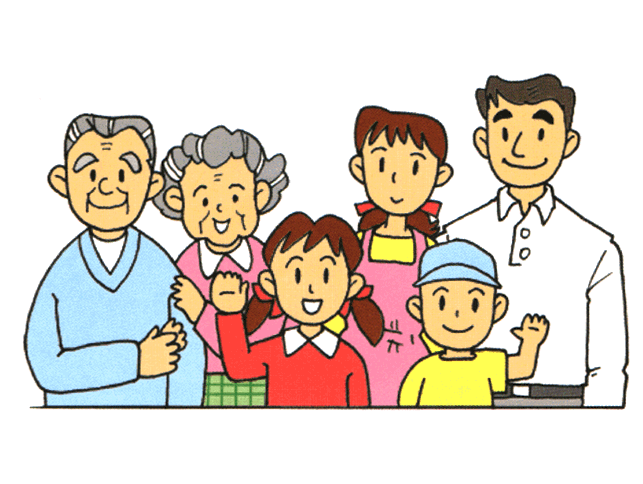
Image of a Sound Family in Japan
http://www.city.kawasaki.jp/35/35kikaku/home/fukushi/seido/j5/j30/j35/index.html


*** *** *** ***


Gen 2:21 And the LORD God caused a deep sleep to fall upon Adam, and he slept: and he took one of his ribs, and closed up the flesh instead thereof;
Gen 2:22 And the rib, which the LORD God had taken from man, made he a woman, and brought her unto the man.
Gen 2:23 And Adam said, This is now bone of my bones, and flesh of my flesh: she shall be called Woman, because she was taken out of Man.
Gen 2:24 Therefore shall a man leave his father and his mother, and shall cleave unto his wife: and they shall be one flesh.

Monday, February 20, 2012

"go into the land of Israel"

 Tokyo Winter Evening...


*** *** *** ***


Mat 2:18 In Rama was there a voice heard, lamentation, and weeping, and great mourning, Rachel weeping for her children, and would not be comforted, because they are not.
Mat 2:19 But when Herod was dead, behold, an angel of the Lord appeareth in a dream to Joseph in Egypt,
Mat 2:20 Saying, Arise, and take the young child and his mother, and go into the land of Israel: for they are dead which sought the young child's life.
Mat 2:21 And he arose, and took the young child and his mother, and came into the land of Israel.
Mat 2:22 But when he heard that Archelaus did reign in Judaea in the room of his father Herod, he was afraid to go thither: notwithstanding, being warned of God in a dream, he turned aside into the parts of Galilee:
Mat 2:23 And he came and dwelt in a city called Nazareth: that it might be fulfilled which was spoken by the prophets, He shall be called a Nazarene.

Saturday, February 18, 2012

"told them by the shepherds" - Samurai Voyage to America in 1860

Tokyo Electric Power Co. (TEPCO) Building Tower


Samurai Voyage to America in 1860 

The first Japanese ship, though purchased from the Netherlands, that sailed across the Pacific Ocean to the US is Kanrin Maru.

The ship, a 300t screw-driven steam corvette, accompanied an American ship that carried a Japanese samurai mission the Tokugawa shogun sent to Washington DC.  However, Kanrin Maru returned to Japan soon after its arrival at San Francisco as its main purpose was to prove to the world that Japanese could manipulate a ship across the Pacific Ocean.

Yet the samurai owed their success to an American Naval officer on board Kanrin Maru with 10 or so his men to support Japanese crews.

In the middle of February, 1860, the Kanrin Maru and the Powhatan set out from the Bay of Yedo for America. It was not long before Lieutenant Brooke's journal entries began to complain not only of the inadequate training but of the indifference of the officers and crew of the Kanrin Maru; only Manjiro continued to command the American respect. And yet, for all his misgivings, Brooke had faith that the native ability of the Japanese would somehow see them safely through.

But Brooke had failed to reckon on the violent whim of the elements. Before very long, the two ships ran into a typhoon: the worst storm ever encountered in the Pacific, reported a seasoned officer on the Powhatan. To make matters worse, the captain of the Kanrin Maru became incapacitated with seasickness; Brooke was forced to assume command. Fortunately, the American officer could rely on Manjiro, who was an experienced navigator. Had it not been for these two men and a remnant of the crew from the wrecked Fenimore Cooper, the ship might well have gone down.

From here on, Brooke's verbatim journal tells the story of the Kanrin Maru's ordeal:

Two seamen only in each watch. There does not appear to be any such thing as order or discipline onboard. In fact the habits of the [Japanese] do not admit of such discipline and order as we have on our men of war. The Japanese sailors must have their little charcoal fires below, their hot tea and pipes of tobacco. The Saki [sic] is not very carefully kept from them. Add to this that the orders are all given in dutch and that very few of the seamen understand that language and one may form some idea of the manner in which duty is carried on. The Capt is still confined to his bed, the Commofdore], also. [Brooke here refers to Kimura Settsuno Kami, Japan's Secretary of Naval Affairs, who was another of the Kanrin Maru passengers] The officers leave the doors open which slam about, leave their cups dishes & kettles on the deck to roll and slide about so that there is nothing but confusion. We must remember however that this is their first sailing cruise, that the weather is heavy, and that they were taught by the Dutch. Manjiro is the only Japanese onboard who has any idea of what reforms the Japanese Navy requires.

We are badly off for barometer; the Adie oscillates about an inch at each roll, and one of the Japanese put his hand through the face of the aneroid. I have the remnants in my room now. Another put his foot through the sky light and today we shipped a sea which nearly reached the Chronometers. Tis a high old cruise. But I like the novelty. I shall endeavor to improve the Japanese navy and will aid Manjiro in his efforts.

It blew very violently from SSE until midnight. Several times I thought the sails would leave the yard. At 12 PM it rained in torrents, the air white. Wind hauled to Westd and soon came on strong, but that being the last change to be anticipated I felt relieved. At 3 turned in. We made 96 miles from noon to midnight. I had hardly laid down before I was called again. Squalls heavy. I was much struck by the apathy of the Japanese early in the evening. There was every appearance of a gale [yet] the hatches were not properly secured and the light in the binnacle was very dim. The officer of the deck was below [and] two or three Japanese sailors [were] crouching about the deck. I sent to Manjiro and finally succeeded in getting not only the officer whose watch it was but all the officers who clustered aft.

I proposed today to watch, quarter & station men and officers. But an unexpected difficulty occurred; of 6 officers of the grade of Lieutenant some are totally ignorant of their profession. The Commo: is unwilling to give [watches to] those who are competent as they are not of as high shore rank as some who are incompetent.

Manjiro is intensely disgusted; he is forced to yield to the Commo. But he has convinced the officers of the propriety of putting them in watches. I asked him what the Commo would do if I took my men off watch and refused to work the vessel. Let her go to the bottom, he replied. He said [that] for his part he had some regard for life.

On the 1st [of March], I had an understanding with the officers & Capt. It has been necessary heretofore to keep a constant lookout myself and to have our men on watch as the Japanese are totally incompetent. The wind being ahead I proposed to show the officers how to tack ship. They were too lazy to come on deck, made various excuses etc. I therefore , called all my men and sent them below with orders to do nothing without my consent. I then informed the Capt that I should not continue to take care of the vessel unless his officers would assist. He gave them a lecture [and] put them under my orders, and I sent my watch on deck.

Manjiro tells me that the Japanese sailors threatened to hang him at the yard arm last night when he insisted upon their going aloft. I told him that in case of any attempt to put that threat into execution to call upon me, that in case of mutiny on the part of the Japanese sailors if the Capt. would give authority I would hang them immediately.

So great was the fury of the storm that the Powhatan changed course and headed toward Honolulu for repairs. Meanwhile the Kanrin Maru plodded ahead; on March 17, after a voyage of thirty-seven days, she finally dropped anchor in San Francisco harbor. The Powhatan did not arrive until twelve days later.

Writing to the Secretary of the Navy, Isaac Toucey, Lieutenant Brooke related without rancor the difficulties encountered during the voyage. He also took the opportunity to praise Manjiro, whom he described as a Japanese of singular ability.

In his journal, however, Brooke was even more lavish in his praise of the man who had been the first from his country to see America. Manjiro, Brooke wrote, he is certainly one of the most remarkable men I ever saw. He has translated Bowditch [Nathaniel Bowditch's New American Practical Navigator] into the Japanese language He is very communicative and I am satisfied that he has had more to do with the opening of Japan than any man living.

http://www.gianhien.com/model/retail/all/kanrin_maru.htm

Kanrin Maru is taught in all the Japanese schools.  Every Japanese citizen knows Kanrin Maru, the first Japanese ship, though purchased from the Netherlands, that sailed across the Pacific Ocean to the US while being piloted an run only by Japanese crews.  But only few people knew that this feat in the Japanese history was only made possible with support from an American Naval officer.

The captain of Kanrin Maru was Katsu Kaisyu who is very popular in Japan as every textbook describes him as a great hero on Meiji Restoration of the Imperial Authority in 1868, though Katsu was a high-ranking samurai officer on the Tokugawa shogun side which was against the imperial samurai camps.  Katsu also contributed to modernization of Japan in the Meiji Government after the fall of the last samurai regime he served so honestly.

On board Kanrin Maru was also Yukichi Fukuzawa, a great educator of the Meiji era, and the very unique Japanese hero (John) Manjiro who was originally a young fisherman but faced a shipwreck to be saved by an American ship, go and live in America for years, finally come back to Japan in the samurai era and contribute to dissemination of information about the US among samurais and later education in the Meiji era.

So, if all these key Japanese in the era of Meiji Restoration had sunk deep into the North Pacific Ocean with Kanrin Maru, the Japanese history must have been more low-key.  Lieutenant Brooke really helped Japan in 1860.

Eventually, Brooke joined the Civil War, but finally became a professor at the Virginia Military Institute, at Lexington, Virginia.
http://en.wikipedia.org/wiki/John_M._Brooke#Later_career


Reconstructed Kanrin Maru
http://nihonaruku.exblog.jp/14141364/

Captain of Kanrin-Maru Katsu Kaisyu (who was ill during the voyage)
http://blog.sensya.com/manyu/index.php?ID=220

Interpreter Manjiro
http://homepage3.nifty.com/kaientaidesu/html/ziken3.htm

Samurai-Turned Meiji Educator Yukichi Fukuzawa (with an American girl in San Francisco)
http://tavi.seesaa.net/article/50337389.html

US Naval Officer Brooke
http://tozenzi.cside.com/brooke.html (University of Press of Virginia, 1980)

Finally, it took 40 years for Japanese to learn and master the modern naval art and technique to fight and defeat the Imperial Russian Navy in the Battle of Tsushima (the Naval Battle in the Sea of Japan).  In this context Katsu Kaisyu and Manjiro are still today highly regarded as early founders of the Imperial Navy of Japan and subsequent success of the Japanese shipping industry.


The first modern navy ship built in Japan Sloop Seiki (898t) which was completed in 1876 and successfully sailed to Europe in 1878.
http://military.sakura.ne.jp/navy/o_seiki.htm


*** *** *** ***


Recently many small earthquakes have occurred around Tokyo.

They mostly happened northeast of Tokyo or specifically in the region between the epicenter of the 3/11 M9.0 earthquake and Tokyo Bay.  The Pacific Plate sinking into the North American Plate on which the east part of Japan is situated seems to be still pushing the Japan's main island Honsyu to the southwest.  Sooner or later a relatively large earthquake might occur around Tokyo.

Yet, Japan is a country that has survived numerous disasters and tragedies like any other countries.  Indeed, God does not bless a person twice.  So, Japan enjoys peace and prosperity while suffering so many perils natural and man-made.


Luk 2:17 And when they had seen it, they made known abroad the saying which was told them concerning this child.
Luk 2:18 And all they that heard it wondered at those things which were told them by the shepherds.
Luk 2:19 But Mary kept all these things, and pondered them in her heart.
Luk 2:20 And the shepherds returned, glorifying and praising God for all the things that they had heard and seen, as it was told unto them.

"the tree of the knowledge of good and evil" - Japanese Politics

Tokyo Evening...

Japanese Politics

Now the approval rating of Prime Minister Mr. Yoshihiko Noda has fallen to 30% or even to 25%.

It is partly because Mr. Noda has apparently no ability, talent, and passion to help victims of the 3/11 tsunami and evacuees from the vicinity to Fukushima Daiichi and to solve the large-scale radioactive  contamination problems.

It is also because Mr. Noda has proposed a rise of the consumption tax rate from 5% to 10% and a plan to join the controversial Trans-Pacific Partnership (TPP).

Now the Japanese Parliament, called the Diet, is open to deliberate a budget proposal.  When the budget bill is passed before April, the political focus will be on his movement.  As the consumption-tax rate rise bill, the most hot issue in his political agenda, is expected to be rejected by the Oppositions, he will be forced to resign or hold a snap election.  Otherwise, Mr. Noda will simply continue his function till September when the ruling party DPJ plans to hold the election to choose a new head.  For this party election, Mr. Noda will not probably run. Then, ex-Foreign Minister Maehara or current Vice Premier Okada can be elected as the new head and then as the new prime minister.  

Anyway, if the approval rating of the prime minister is between 20% and 30%, he cannot dissolve the Diet to hold a general election (for the Lower House that has a virtual right to elect the prime minister) .  But, whenever a new prime minister assumes office, his approval rating is over 50% or 60% in Japan. So, the general election might be held in this September when Mr. Noda steps down and the new DPJ head takes a position of Prime Minister.  But the ruling party DPJ might opt to hold a general election in the summer of 2013 together with a periodical Upper House election (to be held in every three years), since the so-called double election is advantageous for a ruling party.

In any case, the liberal ruling party DPJ has already lost the trust of the Japanese voters, more conservative regime is expected to emerge in Japan through the next general election that can be held in this April at the earliest or in the summer of 2013 at the latest.

*** *** *** ***


Gen 2:17 But of the tree of the knowledge of good and evil, thou shalt not eat of it: for in the day that thou eatest thereof thou shalt surely die.
Gen 2:18 And the LORD God said, It is not good that the man should be alone; I will make him an help meet for him.

Friday, February 17, 2012

"with the sword of my mouth"

The Tokyo Tower...


*** *** *** ***


Rev 2:16 Repent; or else I will come unto thee quickly, and will fight against them with the sword of my mouth.
Rev 2:17 He that hath an ear, let him hear what the Spirit saith unto the churches; To him that overcometh will I give to eat of the hidden manna, and will give him a white stone, and in the stone a new name written, which no man knoweth saving he that receiveth it.

Wednesday, February 15, 2012

"Out of Egypt have I called my son" - Kenzaburo Oe

The Tokyo Sky Tree Tower

Kenzaburo Oe

Mr. Kenzaburo Oe, one of the two Japanese authors who won the Nobel Prize for literature, is against use of nuclear energy for generation of electricity since he is against militarism.
The New Yorker 
History Repeats
by Kenzaburo Oe
MARCH 28, 2011  
By chance, the day before the earthquake, I wrote an article, which was published a few days later, in the morning edition of the Asahi Shimbun. The article was about a fisherman of my generation who had been exposed to radiation in 1954, during the hydrogen-bomb testing at Bikini Atoll. I first heard about him when I was nineteen. Later, he devoted his life to denouncing the myth of nuclear deterrence and the arrogance of those who advocated it. Was it a kind of sombre foreboding that led me to evoke that fisherman on the eve of the catastrophe? He has also fought against nuclear power plants and the risk that they pose. I have long contemplated the idea of looking at recent Japanese history through the prism of three groups of people: those who died in the bombings of Hiroshima and Nagasaki, those who were exposed to the Bikini tests, and the victims of accidents at nuclear facilities. If you consider Japanese history through these stories, the tragedy is self-evident. Today, we can confirm that the risk of nuclear reactors has become a reality. However this unfolding disaster ends—and with all the respect I feel for the human effort deployed to contain it—its significance is not the least bit ambiguous: Japanese history has entered a new phase, and once again we must look at things through the eyes of the victims of nuclear power, of the men and the women who have proved their courage through suffering. The lesson that we learn from the current disaster will depend on whether those who survive it resolve not to repeat their mistakes.
...
I was ten years old when Japan was defeated. The following year, the new Constitution was proclaimed. For years afterward, I kept asking myself whether the pacifism written into our Constitution, which included the renunciation of the use of force, and, later, the Three Non-Nuclear Principles (don’t possess, manufacture, or introduce into Japanese territory nuclear weapons) were an accurate representation of the fundamental ideals of postwar Japan. As it happens, Japan has progressively reconstituted its military force, and secret accords made in the nineteen-sixties allowed the United States to introduce nuclear weapons into the archipelago, thereby rendering those three official principles meaningless. The ideals of postwar humanity, however, have not been entirely forgotten. The dead, watching over us, oblige us to respect those ideals, and their memory prevents us from minimizing the pernicious nature of nuclear weaponry in the name of political realism. We are opposed. Therein lies the ambiguity of contemporary Japan: it is a pacifist nation sheltering under the American nuclear umbrella. One hopes that the accident at the Fukushima facility will allow the Japanese to reconnect with the victims of Hiroshima and Nagasaki, to recognize the danger of nuclear power, and to put an end to the illusion of the efficacy of deterrence that is advocated by nuclear powers....
http://www.newyorker.com/talk/2011/03/28/110328ta_talk_oe

Mr. Kenzaburo Oe has pursued and explored existentialism.

Existentialism claims that "the human being—through his consciousness—creates his own values and determines a meaning for his life because, in the beginning, the human being does not possess any inherent identity or value. By posing the acts that constitute him, he makes his existence more significant." ( http://en.wikipedia.org/wiki/Existence_precedes_essence )

And, politically, especially in Japan after WWII, this philosophy has extended to pro-Chinese and pro-North Korean attitudes.  Mr. Oe is one of those prominent liberal/progressive or leftist pundits or intellectual celebrities in Japan. 


Some intellectual people of Japan, especially authors and professors, after WWII enjoyed American-style freedom and democracy the U.S. introduced into Japan. It was a result of a backlash against the extreme militarism and totalitarianism exercised in the Empire of Japan during WWII.  During WWII, no socialism and communism are allowed to be followed or expressed by Japanese people.  Strong militarism centered around shintoism and the Imperial regime governed total spiritual domains of the Japanese people during WWII.  No freedom of expression and ideology existed since Pearl Harbor Attack in the Japanese society.  Every spiritual and material resource of the Empire were dedicated for the all-out war against the U.S.  But, this suffocating state of the society ended as the Empire of Japan surrendered to the U.S. after the Hiroshima/Nagasaki atomic bomb attacks.  Then, American-style freedom and democracy were introduced into Japan by the U.S. that occupied Japan for seven years since August 1945.  Accordingly, some intellectual people of Japan, especially authors and professors, came to enjoy freedom of ideology.  Socialists and communists were elected as parliament members.  Even the literary arena came to be filled with leftist authors one of whom was Mr. Kenzaburo Oe.           

So, the Hiroshima/Nagasaki atomic bomb attacks put an end to the Empire of Japan, paving the way for efflorescence of the liberal literature in Japan.  Mr. Oe owed his success to Hiroshima/Nagasaki.

Now, "who would owe his/her present or future success to the Fukushima Daiichi nuclear accident?" I wonder.


*** *** *** ***


Mat 2:15 And was there until the death of Herod: that it might be fulfilled which was spoken of the Lord by the prophet, saying, Out of Egypt have I called my son.
Mat 2:16 Then Herod, when he saw that he was mocked of the wise men, was exceeding wroth, and sent forth, and slew all the children that were in Bethlehem, and in all the coasts thereof, from two years old and under, according to the time which he had diligently enquired of the wise men.
Mat 2:17 Then was fulfilled that which was spoken by Jeremy the prophet, saying,
Mat 2:18 In Rama was there a voice heard, lamentation, and weeping, and great mourning, Rachel weeping for her children, and would not be comforted, because they are not.

Tuesday, February 14, 2012

"And he arose and followed him" - Dallas in 1963

Tokyo Bay Area...


Dallas in 1963

Something is still wrong with an incident that happened in Dallas in 1963.

Here's another view of Dealey Plaza in 1967, taken on the same day as the photo above it.http://kennedy-photos.blogspot.com/

It is because a rifle alleged to belong to Oswald was found in the Texas School Book Depository building on November 1963.

http://kennedy-photos.blogspot.com/

http://kennedy-photos.blogspot.com/

http://mcadams.posc.mu.edu/factoid6.htm

However, this rifle might not be an Italian rifle but a German rife as used as a mortal weapon to hit JFK.

Top: Mauser. Bottom: Mannlicher-Carcano
http://oswaldsmother.blogspot.com/2011/07/mauser-is-mauser-is-mannlicher-carcano.html

As for detailed information about the linkage between Oswald and the rifle:
When Oswald was given a paraffin test to see if he had fired a rifle that day, the test showed that there was no trace of nitrates on his cheek. Nitrates produced from a discharged rifle could possibly be found on the cheek of anyone who had fired a rifle, but the Dallas police couldn't find any. Lt. Day claimed he lifted prints located around the trigger housing of the Mannlicher-Carcano but was not able to identify them as Oswald's. He was able to lift a palm print under the stock and identify it as Oswald's. Day claims he told FBI agent Vince Drain of the palm print. Drain said he was never told of the print and Day responded in a 1993 interview with "I guess he didn't hear me, but I told him." [10] The FBI never identified the palm print but was able to find several prints of one of its FBI agents, who was subsequently suspended from duty for mishandling the evidence. The HSCA confirmed the palm print that Day found was lifted from the Mannlicher-Carcano, as Lt. Day had claimed. PBS's Frontline documentary on Oswald reinvestigated the prints Day lifted around the trigger housing. Three investigators reviewed the prints; two investigators were unable to confirm an identification and one investigator claiming that the prints were definitely Oswald's
Oswald's Mannlicher-Carcano was officially linked by government investigators to shots fired into the presidential limousine. The HSCA confirmed these findings, as well as the fact that the three expended cartridge cases found on the sixth floor of the depository were fired from Oswald's rifle. [11] Marina Oswald stated that Lee had confessed to her that he had shot at retired General Edwin Walker only weeks before the Kennedy assassination. The Walker bullet was compared microscopically with bullets test fired by the FBI from Oswald's rifle, though "no gross differences were noted ... the panel concluded that the Walker bullet was too damaged to allow conclusive identification of the bullet with a particular firearm." [12] Some critics have questioned whether the mounting of the telescopic sight on the left side of the rifle was really a mounting designed for a left-handed person. Oswald was right-handed, but the HSCA found that the mounting on the left side "was done as a matter of necessity because the bolt action is on the right side." [13]http://www.acorn.net/jfkplace/09/fp.back_issues/11th_Issue/guns_dp.html
Anyway, if Oswald had planned to hit JFK and run away successfully, he should have rather hid in, aimed at, and shot from the Grassy Knoll.  He would not have used the sixth floor of the building he worked in as a sniper nest.  And why did Oswald know that nobody would be on the floor of the TSBD building between 12:00 PM and 1:00 PM?  He must have avoided the sixth floor of the building he worked in absolutely on Nov. 22, 1963, if Oswald had been the sniper or one of the snipers, since he could be so easily suspected.  Indeed, it was just a month after he was employed by the Texas School Book Depository.

The very smart guy Oswald, as he had been recruited by CIA years before when he was just around 20, would not have used the sixth floor of his workshop and the rifle he personally owned.

He must have shot from the Grassy Knoll with a different rifle, such as a German one.

Oswald is not the perpetrator or one of the perpetrators who shot and hit JFK at Dallas in 1963.

Besides, Oswald was hired by CIA.  How could he be ordered to shoot the President?  Or how would he accept such an order, if any?

So, Oswald is not the perpetrator or one of the perpetrators who shot and hit JFK at Dallas in 1963.

(However, Oswald must have had some connection with the perpetrators, since the assassination of President Kennedy happened just a month after Oswald was employed by the Texas School Book Depository.)

Finally, another big problem for Oswald is that he had no alibi when JFK was hit.  Nobody was with Oswald while it was lunch time or there was a chance to watch JFK in the car on the street.  Where was Oswald?  This is the big mystery in the whole JFK assassination scenario.
11:45-11:50 AM (Friday, Nov. 22, 1963) -- Bill Shelley sees Lee Harvey Oswald downstairs on the first floor. ....  
11:50-11:54 AM -- Oswald goes from the first floor to the sixth floor. Just a few minutes after getting to the sixth floor, the five other men who are on the 6th Floor break for lunch and race the two freight elevators downstairs. Oswald remains on the sixth floor...  
11:55 AM -- Charles Givens comes back up to the sixth floor to
retrieve his jacket and cigarettes. He sees Oswald, with clipboard in
hand, on the east end of the floor. Per Givens' testimony, it's during
this "cigarette trip" back up to the sixth floor when Oswald asks
Givens to close the elevator gate and to send the elevator back up to
him. This differs in chronology from the other witnesses who said they
heard Oswald requesting the elevator during the "racing" of the
elevators downstairs...i.e., BEFORE Givens went back up by himself.
In any event, it's fairly certain that (at some point just prior to
12:00) Oswald did ask for an elevator to be returned back up to him on
the sixth floor...
 
11:55 AM-12:05 PM (estimated) -- Oswald has the whole sixth floor to
himself. This is just prior to Bonnie Ray Williams coming back up to
the 6th Floor to eat his lunch. It's my belief that Lee Oswald, during
this (approx.) 10-minute time period around noon or shortly after,
probably went to the west end of the sixth floor (where he had his
rifle hidden in the brown bag)... 
 
Oswald unwraps the rifle at the west end of the sixth floor and
assembles the rifle at the west end (hence, Arnold Rowland sees a
white man with a rifle at the west end of the building at approx. this
time, maybe a little later, 12:15 or so, but keep in mind the
approximation of all times)...
 
12:05-12:15 PM (estimated) -- Oswald can hear Bonnie Ray Williams in the middle portion of the sixth floor, near the south windows, as Williams eats his lunch. I think, therefore, it's logical to assume that Oswald would have been trying to remain extra quiet as he hides within his "Nest" of boxes (whether the Nest is totally complete or not, we cannot know; but we do know that some boxes in that southeast corner are prohibiting Williams from seeing deep into that corner).....  
12:10-12:15 PM (estimated) -- Bonnie Ray Williams finishes his
"chicken-on-the-bone" sandwich (~LOL~) and his Dr. Pepper soft drink
and vacates the sixth floor (after Williams heard some activity on the
5th Floor below him). Williams takes an elevator down one flight to
join two other employees on the fifth floor to watch the motorcade... 
 
Lee Oswald now is alone, once again, on the Texas School Book
Depository's sixth floor. He has approximately 15 minutes to wait
until the President will come into his view on the street below him.
During these last few minutes prior to 12:30 PM, it's possible that
Oswald puts some finishing touches on his Sniper's Nest....and/or his
rifle-rest cartons... 
 
Regarding the 5th-Floor witnesses (Harold Norman, James Jarman, and
Bonnie Ray Williams), and what they heard..... 
 
Norman stated positively that he heard three rifle shots being fired
from directly above him. And he told Vincent Bugliosi in 1986 that he
heard precisely three "hulls" (shells) hitting the floor as the
shooting was taking place above him.... 
 
Lee Oswald is able to perform his deadly deed at 12:30, as he fires
three of his four bullets from his 6th-Floor SN window, killing JFK
with shot #3. I'm guessing that Oswald, too, like the rest of the world, was very surprised indeed that he had actually been able to pull off this task in total secrecy from his workplace (not counting Mr. Brennan outside the building). I'm doubting LHO thought he'd REALLY get a golden chance to do it...
 
But, unfortunately, he was given that chance when Williams vacated the
sixth floor....and Oswald was aided further, as it turns out, when no
other employees decided they would use the SIXTH floor as a parade-
watching perch that Friday... 
 
12:30:30 PM -- Lee Harvey Oswald's task is completed. He pauses at the window for just a moment (per Brennan's account), and then disappears from Brennan's view... 
12:31-12:32 PM -- Oswald travels quickly down to the second floor of the TSBD via the back stairway. (It's possible that the reason he ducked off at Floor #2 is because he heard the footsteps of the approaching Roy Truly and Marrion Baker.) ... 
Oswald is then stopped at gunpoint in the 2nd-Floor lunchroom by Officer M.L. Baker. LHO is then immediately cleared as an employee and is let go by Baker...  
Oswald is calm, silent, and unflustered during his encounter with
Baker (per Baker's testimony). This reaction, IMO, is much more
indicative of GUILT than with INNOCENCE... 
 
If innocent, isn't it quite likely that Oswald would have been a bit
scared, rattled, and probably would have at least said to Baker, "What
the hell is this?! What's going on?! I didn't do anything! Why are you
stopping me?!"... 
 
Oswald, instead, is dead-quiet. Never changing his expression one bit
(per Baker)... 
 
12:32 PM -- Oswald then buys a soft drink from the soda machine in the
lunchroom, and then strolls casually and unhurriedly toward the stairs
near the 2nd-Floor offices (after having just been cleared as a worker
in the building, thereby probably allowing Oswald to relax a little
bit more at that point in time)... 
 
Mrs. Robert A. Reid sees Oswald with a full beverage bottle. She says
to him "The President's been shot". Oswald mumbles something
incoherent and continues toward the front stairs, which lead to the
first-floor TSBD entrance... 
 
12:40 PM -- Oswald boards a bus on Elm Street, east of the TSBD. He
stays on the bus about 4 minutes, gets a transfer from driver Cecil
McWatters, and then exits the bus. Mary Bledsoe positively identifies
Oswald as having been on board McWatters' bus on 11/22/63... 

http://groups.google.com/group/alt.conspiracy.jfk/msg/3a3d654f3c43ed16?pli=1
Oswald had no plan to shoot and kill the US President and to run away very safely forever.

Then who were the shooters?  Somebody must know them.

*** *** *** ***


Mar 2:14 And as he passed by, he saw Levi the son of Alphaeus sitting at the receipt of custom, and said unto him, Follow me. And he arose and followed him.

Monday, February 13, 2012

"with the angel a multitude of the heavenly host" - What the Buddha Said

Tokyo Bay in Winter...


What the Buddha Said

The Buddha said, "Don't rely on anything but yourself and the truth of the universe."

Christ Jesus said to love your God with all your heart, mind, ability, and power and love your neighbors as you love yourself.

What I think is that you had come to be owned by somebody before you came to own yourself, and if that somebody is God while you rely on yourself or love yourself, their teachings simply mean that what is God's must love God or rely on God only.

If you don't love your neighbors, it means what is God's doesn't love another entity that is also God's. As it is a big discrepancy, you would naturally love your neighbor.

So, the Buddha said, "Don't rely on anything but yourself and the truth of the universe, since others might not be your neighbors or might be an enemy of the truth of the universe," in my interpretation.


*** *** *** ***


Luk 2:13 And suddenly there was with the angel a multitude of the heavenly host praising God, and saying,
Luk 2:14 Glory to God in the highest, and on earth peace, good will toward men.
Luk 2:15 And it came to pass, as the angels were gone away from them into heaven, the shepherds said one to another, Let us now go even unto Bethlehem, and see this thing which is come to pass, which the Lord hath made known unto us.