Monday, August 19, 2013

"he may receive the Holy Ghost"- Sweet Potatoes to Replace Oil and Uranium


Tokyo Views around Bunkyo Ward


Sweet Potatoes to Replace Oil and Uranium


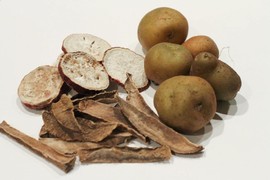
A Japanese professor is recommending use of sweet potatoes for generation of electricity.

According to his calculation, it is possible to replace uranium fuel and fossil fuel for providing electricity for Japan with sweet potatoes to be grown in Japan.

Professor of Kinki University Takahiro Suzuki estimates that 20 kg of sweet potatoes can become fuel to generate 10 kWh of power which is equivalent to an mount of electricity consumed by an ordinary household per day.  He also emphasizes that sweet potatoes can be produced at lower costs and in a larger quantity than other plants for fuels such as corns and algae.

As Japan produced, before the Fukushima Daiichi accident of 2011, electricity of 280 billion kWh in nuclear power plants, the amount of sweet potatoes to replace this nuclear energy is 560 million tons.  By adding electricity produced by all the electric power plants using fossil fuels to this amount, the amount of electricity becomes 870 billion kWh which can be replaced by 1.74 billion tons of sweet potatoes.

Fortunately there are 400,000 hectares of rice fields which are currently not used for rice production due to a Japanese Government policy of cutting rice acreage.  If we cultivate sweet potatoes in these idle farmlands, we can harvest 1.8 billion tons of sweet potatoes that can cover the above specified 1.74 billion tons.

As Japan spends $200 billion to import crude oil and other forms of fossil fuels, sweet potatoes can greatly improve the balance of trade of Japan.


http://www.eco-online.org/2011/11/14/%E8%8A%8B%E3%82%A8%E3%83%8D%E3%83%AB%E3%82%AE%E3%83%BC%E3%81%AF%E6%97%A5%E6%9C%AC%E3%82%92%E6%95%91%E3%81%86/


Of course this method of using sweet potatoes for power generation can apply to any countries that want to reduce an mount of CO2 emission.


*** *** *** ***


Act 8:18 And when Simon saw that through laying on of the apostles' hands the Holy Ghost was given, he offered them money,
Act 8:19 Saying, Give me also this power, that on whomsoever I lay hands, he may receive the Holy Ghost.
Act 8:20 But Peter said unto him, Thy money perish with thee, because thou hast thought that the gift of God may be purchased with money.

Saturday, August 17, 2013

"of his own accord he went unto you" - Fukushima Daiichi Contaminated Water Leakage to Sea


Ginza Street, Tokyo


Fukushima Daiichi Contaminated Water Leakage to Sea

Tokyo Electric Power Co. (TEPCO), the owner of the Fukushima Daiichi nuclear power plant, announced that it had completed in early August an underground wall in the premises near the Pacific Ocean to prevent leakage of radioactively contaminated water to the sea.

Experts concerned recently pointed that some contaminated water was still flowing into the sea, even though it was more than two years after the start of the Fukushima Daiichi accident.  That is why TEPCO started to build this wall this July.

The wall, 100 meters wide and 16 meters deep, was constructed by infusing liquid glass into the ground.  But there left is a gap of 1.8 meters between the top of the wall to the surface of the ground.

On the other hand, there is a trench in the ground under buildings housing crippled nuclear reactors.  In it, radioactively contaminated water is kept.  But groundwater also flows into this trench.  Accordingly, an increased amount of contaminated water flows to the underground wall.  Very unluckily the depth of this water flow is 1.2 meters from the surface of the ground.  Consequently the radioactively spoiled water runs over the wall to the Pacific Ocean eventually.

In this way 300 tons of problematic water flows into the sea every day from the Fukushima Daiichi nuclear plant which is still under recovery work after its drastic destruction in the wake of huge tsunamis triggered by an M9.0 earthquake of March 11, 2011.

 (What is worse, it is also recently that TEPCO could correctly measure how much water is leaking to the sea.  This amount 300 tons gave a great shock to the society when it was made public.)


TEPCO plans to abolish this nuclear power plant, taking probably scores of years.  But this leakage has apparently made the situation more complicated.

For example, in response to this situation, fishermen's unions in ports around the Fukushima Prefecture have voluntarily stopped fishing activities in sea areas off the Prefecture, though they were gradually resuming their business in the sea after the Fukushima Daiichi accident, taking time and measuring carefully doses of fishes they caught.  

However, dose levels at some points, though not all the locations, recently measured in the seabed around the Fukushima Daiichi plant are several thousand becquerels per kilo gram of soil at most.  It is not yet catastrophic though the allowable dose for fishes is 100 Bq/kg now in Japan.


*** *** *** ***


2Co 8:15 As it is written, He that had gathered much had nothing over; and he that had gathered little had no lack.
2Co 8:16 But thanks be to God, which put the same earnest care into the heart of Titus for you.
2Co 8:17 For indeed he accepted the exhortation; but being more forward, of his own accord he went unto you.
2Co 8:18 And we have sent with him the brother, whose praise is in the gospel throughout all the churches;

Thursday, August 15, 2013

"And he touched her hand" - East Asia since 1868


Hie Shrine, Tokyo, Close to Parliament Bldg. 


East Asia since 1868

When the samurai era ended in 1868 through a civil war, Japan started to fully open the nation to the world and modernize and westernize the nation.

Subsequently Japanese succeeded in its own industrial revolution to build up strong military forces.  But at the time Japan was threatened by the Russian Empire coming down to the south through Siberia.

Other western powers, including the UK which defeated China in the Opium War (1842) and the US which compelled samurai Japan to have a diplomatic tie with the US, also forced Japan to accept  unequal treaties (1854).  Japan could not, of course, rely on these western colonizing powers to take preventive measures against the imminent threat from Russians.  Japan had to rely on its inherent samurai (warrior) spirit.

On the other hand, the Korean Kingdom was still in its seclusion policy like samurai-era Japan.  Koreans were desperately split between farmers and noble men.  The rotten Korean court was unable to boost its economy and enrich the nation.  Korean farmers were left in a state of illiteracy and ignorance mostly due to the discriminatory social system of Korea built on extreme Confucianism.  It was apparent that Korea could not modernize and westernize itself.  What is worse, Korea nominally belonged to China.  Corrupt Yi-Dynasty Korea was a tributary to more corrupt Ching Dynasty of China.  And Ching itself could not modernize itself even after the defeat by the UK in the Opium War.

So, when Japan put an end to the rule by sword of samurai in 1868, East Asia was, like South East Asia and South Asia, about to be directly and indirectly colonized by the UK, France, Germany, the US, etc.  What is worse, the Russian Empire was for real trying to move its mighty troops from Siberia into Manchuria and North Korea.  But Ching Dynasty and Yi-Dynasty Korea could not stop this military invasion as they had no strong military and modern industry.  They could not carry out their own industrial revolution.

At the time leaders of the Empire of Japan thought that it was a matter of time that strong and modern Russian troops would occupy Manchuria, part of northeast China, the Korean Peninsula, and then eventually the Japanese Archipelago.  Tokyo had to do something to prepare for a coming showdown with the Russian Empire.

As the first step, Tokyo tried to educate Koreans so that they would sever its centuries-long subordinate relationship with China and get fully independent.  Japanese politicians expected that new Korea would join Japanese efforts to keep independence of East Asia from western powers and Russians.  But as Korea's old tie with Ching was so strong that the Empire of Japan had to make a war against Ching China to free Koreans from the Chinese rule.  This is the First Japanese-Sino War which was fought from 1894 to 1895.

The defeat of Ching Dynasty eventually led to its all-out fall in 1912.  But Korea could not advance its society all by itself after the war, so that the Korean Kingdom was eventually fully annexed to the Empire of Japan in 1910 (though some Japanese leaders were against this measure imposing a heavy financial burden on Tokyo).  And most importantly the Empire of Japan fought the Empire of Russia between 1904 and 1905, extensively using its military bases in the Korean Peninsula built after the First Japanese-Sino War.  The victory of the Empire of Japan over the Russian Empire took away the threat of brutal invasion and inhuman colonization by Russians from East Asia.

This is the basics for understanding current situations and relationships among Japan, South/North Koreas, and China as well as Taiwan and Mongolia.

Indeed the 21st century is based on the 20th century which was a kind of extension of the 19th century and preceding centuries.


*** *** *** ***


Mat 8:15 And he touched her hand, and the fever left her: and she arose, and ministered unto them.

Wednesday, August 14, 2013

"choked with cares and riches and pleasures of this life" - Short History of Yasukuni Shrine


Tokyo Haneda International Airport Facing Tokyo Bay


Short History of Yasukuni Shrine


1868  The last samurai regime falls through a civil war, and the Emperor (Meiji) starts to reign Japan with ex-samurais on his side.  Japan starts to open the nation and promote westernization and modernization.

1869  Yasukuni's Predecessor Tokyo Syo-kon Shya (Tokyo Shrine to Invite Spirits) is founded as a national shrine.

1879  Tokyo Syo-kon Shya is renamed Yasukuni Jinjya (Yasukuni Shrine).

1941  WWII for Japan starts with Pearl Harbor Attack, Hawaii.

1945  The Empire of Japan surrenders to the US; US General MacArthur who starts to govern Japan orders separation of shinto from the government.

1946  Yasukuni Shrine becomes a private religious body.

1951  San Francisco Peace Treaty is signed to put an end to a state of the War for Japan.

1952  Japan becomes fully independent again.

1975  The Emperor (Showa) visits Yasukuni Shrine as his last visit to the shrine though he visited the shrine often before WWII and in 1945, 1952, 1954, 1957, 1959, 1965, and 1969 after WWII.

1978  Former Prime Minister Tojo and other A-class war criminals (former top leaders of the Empire of Japan) who were executed by US troops through the Tokyo Tribunal of War Criminals are enshrined in Yasukuni Shrine, joining other more than 2.4 million fallen soldiers of the Empire since 1868.

1985  Prime Minister Nakasone visits Yasukuni Shrine as representative of the government on the anniversary of Japan's surrender in World War II, namely August 15.  (Prime ministers preceding Nakasone often visited Yasukuni Shrine after WWII even on August 15.)

Then, The Asahi Shimbun newspaper of Japan, a major liberal newspaper, objects against Nakasone's visit as a nationalist act.  Then China suddenly starts to have a strong hostile attitude towards Japanese prime minister's visit to Yasukuni on August 15.  As a result, most of Japanese prime ministers after Nakasone stop visiting Yasukuni Shrine on August 15.

1996 Prime Minister Hashimoto visits Yasukuni Shrine but not on August 15.

2001  Koizumi is elected as Prime Minister of Japan, starting to visit Yasukuni Shrine every year as prime minister of Japan but not on August 15 except in 2006.

2006  Prime Minister Koizumi visits Yasukuni Shrine on August 15.  Koizumi steps down from premiership in September, though he is still in his term of office.

2013  Prime Minister Abe decides not to visit Yasukuni Shrine on August 15, since some US politicians are against the idea, according to some speculation.


*** *** *** ***


Luk 8:14 And that which fell among thorns are they, which, when they have heard, go forth, and are choked with cares and riches and pleasures of this life, and bring no fruit to perfection.

Tuesday, August 13, 2013

"and in time of temptation fall away" - Boeing 787 Short Circuit


Yokosuka Naval (Maritime Self-Defense Force) Base, Japan


Boeing 787 Short Circuit

In my opinion, the battery problem of the Boeing 787 was caused by wrong connection of the battery to equipment of the jet plane.

The equipment works as a load to a power source.  If the main power source or the battery of a 787 is adequately connected to the load or the equipment, no excess electric current would flow.

But when a power source for the equipment is changed from the main power source to the battery, there can be a part of the path of electric current in the equipment, which must be broken or open so that the part does not work as a short circuit for current from the battery.

If this part is, however, left closed by mistake, there would be a short circuit.  Accordingly excess current would flow out of the battery and back to it.  The current would not flow into the equipment but go back to the battery through the short-circuit part and heat the battery up till it burns.


But the battery fire accident occurred when the battery was not expected to be used.  So, while the main power supply was providing power to the equipment, we can think, some mysterious factor caused wrong connection of the battery to the equipment with the short circuit part left as it was.

In this case the above last figure should be modified by connecting the current path from the main source to the equipment.

Put simply, there must have happened two unusual phenomena when the battery burnt up in a Boeing 787.  First, while the main power source, which is actually engines of the jet, was providing electric current to equipment, the battery was connected to the equipment by mistake.  Second, when some mysterious mechanism worked to link the battery at issue to the equipment, some short circuit part was left by mistake as it was, though the part was just a normal portion of the electric current path from the main power source.

In other word, when a power source for the equipment is normally changed from the main power source to the battery, the short circuit part is made open so as to avoid wrong setting of a possible short circuit segment for the battery.  However, the part is just a normal part of the path and not a short circuit for electric current from the main power source.  

It can be regraded as a mistake in logic of design of this power feeding system.  No matter what condition makes the battery connected to the equipment regardless ongoing provision of power from the main power source, the possible short circuit portion must be made open so as to avoid occurrence of an electric short circuit accident.  A mechanism must be installed that connecting of the battery to equipment inevitably makes the possible short circuit part open.

The lack of this mechanism must have led to the battery fire accident in some Boeing 787 jet planes.  Engineers must check specifically what part of real electric circuits in or around the battery, a power control unit, and various devices fall into this possible short circuit portion.


http://engtechmag.wordpress.com/2013/03/19/boeing-dreamliner-787-battery-fix-an-annotated-graphic/


*** *** *** ***


Luk 8:13 They on the rock are they, which, when they hear, receive the word with joy; and these have no root, which for a while believe, and in time of temptation fall away.

Sunday, August 11, 2013

"he had bewitched them with sorceries" - Aftereffects of Radiation


Tokyo Haneda International Airport on Tokyo Bay


Aftereffects of Radiation


The Tokyo Shimbun Newspaper reported that a British scientist claimed that more people died from radiation in Hiroshima and Nagasaki than the US estimated in a specialist conference held in London in December 1945.

The US tried to persuade that most of Japanese victims in Hiroshima and Nagasaki had been killed by heat and a bomb blast when a nuclear bomb was dropped from a B29 bomber each on the two cities in August 1945.

The effect of radioactive rays discharged from the atomic bombs was neglected in official reports released by the US military.  They tried to conceal the dehumanizing and inhuman nature of the new type of bombs.

When the atomic bomb blew up in Hiroshima on August 6, 1945, there were 350,000 people in the major city in western Japan.  By the end of 1945, Hiroshima lost 140,000 people due to the effect of the atomic bomb.  Nagasaki with 240,000 population on August 9, 1945 lost 74,000 citizens in the same condition.

There were many victims in Hiroshima and Nagasaki who died days, weeks,  months, and years after the nuclear bomb attacks due to aftereffects of radiation.


*** *** *** ***


Act 8:9 But there was a certain man, called Simon, which beforetime in the same city used sorcery, and bewitched the people of Samaria, giving out that himself was some great one:
Act 8:10 To whom they all gave heed, from the least to the greatest, saying, This man is the great power of God.
Act 8:11 And to him they had regard, because that of long time he had bewitched them with sorceries.
Act 8:12 But when they believed Philip preaching the things concerning the kingdom of God, and the name of Jesus Christ, they were baptized, both men and women.

Friday, August 09, 2013

"how excellent is thy name" - Nagasaki and Downburst


National Diet (Parliament) Bldg., Tokyo


Nagasaki and Downburst

Two minutes past 11 o'clock on August 9, 1945 a nuclear bomb was blasted over Nagasaki City, Japan, as it was released down from a B29 bomber of the US Air Force.

Then on August 15 the Empire of Japan surrendered to the US and other allied nations.  The Second World War ended for Japan.

Tow weeks after the end of WWII, a university in Fukuoka Prefecture, northeast of Nagasaki, sent an investigation team to Nagasaki.  They studied how the atomic bomb destroyed the port city in a scientific manner.  Among the scientists of the team was assistant professor Tetsuya Fujita (1920-1998), a resident of Kokura Area, Fukuoka.  Fujita took pictures of the devastated state of the City, though taking pictures was forbidden by the Imperial authority.

Recently those pictures young scientist Fujita secretly took in Nagasaki were rediscovered in a house of a Fujita's relative who lives in Fukuoka.  There were 33 pictures vividly showing vastly damaged streets and buildings of Nagasaki City.  Some of them were apparently focused on trees, power poles and facilities to provide electricity for tram cars.  Trees at the ground zero however stood strangely while other trees around and far from the center of explosion were all knocked down.  Iron poles and structures for a municipal electric railway were violently twisted in some pattern.  They told how  bomb blasts attacked those objects on the ground while the nuclear bomb blew up 500 meters (1500 feet) above the ground.

In 1953 Tetsuya Fujita took a doctorate in the University of Tokyo and was subsequently invited to the University of Chicago.  Living in the US, he later contributed greatly to science in his study in meteorology, especially, specializing in tornadoes.

In 1975 Fujita joined an investigation team of an air accident at the John F. Kennedy International Airport, New York.  Then he became the first scientist that discovered a special air phenomenon which he named "downburst."

Today, parties concerned used the index called the Fujita scale to express the strength of a tornado.

Nonetheless if weather conditions over Kokura Area had been suitable for bombing on August 9, 1945, the B29 should have attacked Kokura with the nuclear bomb instead of Nagasaki according to priority order, since both Kokura and Nagasaki are on Kyusyu Island.  Then Tetsuya Fujita must have been killed so unfortunately.

Fujita is recognized as the discoverer of downbursts and microbursts and also developed the Fujita scale, which differentiates tornado intensity and links tornado damage with wind speed. 
Residing in Kokura, the primary target of the Fat Man bomb, during the war he was spared by cloudy weather forcing the bombers to move on to the secondary target at Nagasaki. Studying the damage caused by the nuclear blasts led to his understanding of downbursts and microbursts.
http://en.wikipedia.org/wiki/Ted_Fujita


Nagasaki after the Atomic Bomb Attack by US Army
http://www.page.sannet.ne.jp/mhvmhv/NagasakiAtomicBombDisaster.html


*** *** *** ***


Psa 8:9 O LORD our Lord, how excellent is thy name in all the earth!

Thursday, August 08, 2013

"All the words of my mouth are in righteousness" - Different Stories for Different Peoples


Seashore on the Pacific Ocean around Tokyo (where an M7.9 earthquake occurred in 1923 taking on 100,000 lives)


Different Stories for Different Peoples


Japanese readers love The Tragedy of Y (1932) the most among various works by Ellery Queen.  But Americans love Calamity Town (1942) the most.

Ellery Queen said when he visited Japan in 1977 that he could not see why Japanese fans liked The Tragedy of Y so much.  But I can explain why.

First of all Japanese are very sensible of sadness of handicapped people and innocence of children.  They are also very interested in the internal affairs of very rich families, especially of very rich American families.  And the Japanese are also keen in ethical issues partly due to an influence of Buddhism.  They will be surprised to read that murdering a child can be justified in a very special case.  The Tragedy of Y includes all these elements.

But Calamity Town is a very romantic or passionate novel, though so fraught with danger of losing human integrity.   Strength of love is a hidden main theme in this story whose stage was set in a very American local town.  And personalities of focal sisters, which are very American, are also the highlight of Calamity Town.

Accordingly Japanese readers love The Tragedy of Y more than Calamity Town while Americans love Calamity Town above all the works by Ellery Queen.


Of course I intensely read The Tragedy of Y but carefully Calamity Town, since I am Japanese.


*** *** *** ***


Pro 8:7 For my mouth shall speak truth; and wickedness is an abomination to my lips.
Pro 8:8 All the words of my mouth are in righteousness; there is nothing froward or perverse in them.
Pro 8:9 They are all plain to him that understandeth, and right to them that find knowledge.

Wednesday, August 07, 2013

"and brought up frogs upon the land of Egypt" - Solving the Apocalypse


A Tokyo Subway Line

Solving the Apocalypse

How was this modern era of history prophesied in the Bible, specifically in the Apocalypse?

Let's check the most significant passages.
Rev 8:7 The first angel sounded, and there followed hail and fire mingled with blood, and they were cast upon the earth: and the third part of trees was burnt up, and all green grass was burnt up.
Rev 8:8 And the second angel sounded, and as it were a great mountain burning with fire was cast into the sea: and the third part of the sea became blood;
Rev 8:9 And the third part of the creatures which were in the sea, and had life, died; and the third part of the ships were destroyed.
Rev 8:10 And the third angel sounded, and there fell a great star from heaven, burning as it were a lamp, and it fell upon the third part of the rivers, and upon the fountains of waters;
Rev 8:11 And the name of the star is called Wormwood: and the third part of the waters became wormwood; and many men died of the waters, because they were made bitter.
Rev 8:12 And the fourth angel sounded, and the third part of the sun was smitten, and the third part of the moon, and the third part of the stars; so as the third part of them was darkened, and the day shone not for a third part of it, and the night likewise.
The first angel must be concerned with Europe in the First World One.  The second angel must be related to the Pacific Theater of WWII; the third to the Cold War and the Chernobyl nuclear accident; and the fourth to social or economic crises in Japan, the Arabic world, the EU, China and the US.

Rev 8:7 depicts the tragedy of WWI in Europe where modern weapons were first used in a large scale after the Industrial Revolution.

Rev 8:8 and 8.9 explain how the most advanced nation in Asia the Empire of Japan symbolized by great and sacred Mt. Fuji collapsed through battles in WWII against the US having been fought in wider areas in and around the Pacific Ocean.

Rev 8:10 and 8.11 tell how the Soviet Union collapsed through the Cold War and finally lost its might and dignity along with the occurrence of the Chernobyl nuclear accident.

Rev 8:12 outlines how the sun (Japan), the moon (the Islamic world), the stars (the EU), the day (the US, the most Christian country), and the night (China, the most non-Christian country) would face social and economic hardship of their own.

Accordingly we had better check the Bible more carefully, since it includes other chapters and sections of the Apocalypse.

And finally some of us might end our mission with the fate so predicted in this mysterious part of the Bible.


*** *** *** ***


Exo 8:5 And the LORD spake unto Moses, Say unto Aaron, Stretch forth thine hand with thy rod over the streams, over the rivers, and over the ponds, and cause frogs to come up upon the land of Egypt.
Exo 8:6 And Aaron stretched out his hand over the waters of Egypt; and the frogs came up, and covered the land of Egypt.
Exo 8:7 And the magicians did so with their enchantments, and brought up frogs upon the land of Egypt.
Exo 8:8 Then Pharaoh called for Moses and Aaron, and said, Intreat the LORD, that he may take away the frogs from me, and from my people; and I will let the people go, that they may do sacrifice unto the LORD.
Exo 8:9 And Moses said unto Pharaoh, Glory over me: when shall I intreat for thee, and for thy servants, and for thy people, to destroy the frogs from thee and thy houses, that they may remain in the river only?
Exo 8:10 And he said, To morrow. And he said, Be it according to thy word: that thou mayest know that there is none like unto the LORD our God.
Exo 8:11 And the frogs shall depart from thee, and from thy houses, and from thy servants, and from thy people; they shall remain in the river only.
Exo 8:12 And Moses and Aaron went out from Pharaoh: and Moses cried unto the LORD because of the frogs which he had brought against Pharaoh.
Exo 8:13 And the LORD did according to the word of Moses; and the frogs died out of the houses, out of the villages, and out of the fields.

Tuesday, August 06, 2013

"the seven angels which had the seven trumpets" - Chinese Bubble Ending


Views from the Tokyo Tower


Chinese Bubble Ending

According to a Japanese newspaper account, China is now losing human resources and money.

The Sankei Newspaper released today posted a comment by its correspondent in Beijing: "A real estate bubble is about to burst in China.  The central government looks like being incapable of managing and controlling the situation.  No one can say what will happen in China, since local governments, banks, businesses and all other stake holders have been engaged in building up this bubble for so long."

A Chinese researcher the Japanese reporter met after 10 years said that though Japan is a country ruled by law and thus Japan suffered no social turmoils when its bubble collapsed in the early 1990s, China is different.  He added that he let his wife and children immigrate to Canada.

The four major Chinese national banks have lost about $170 billion in the last three weeks.  Chinese students today learning in the US and other advanced nations seem to have no intention to come back to China and help development of domestic economy, though such students came back to China after graduation from foreign universities to help Chinese economy grow in a higher rate 20 or 30 years ago.

So, parties concerned in Japan as well as in China are really worried about possible collapse of the Chinese bubble.

***


In my view, Chinese economic bubble may burst but its state will be different from other past examples in the world.

China is large in terms of population.  So, some part of China is going down into recession with a burst of the bubble but other parts must continue to expand their economy.  It must look like a kind of chaos.  Even today China is experiencing hundreds of riots in various local towns and villages.  More grave incidents must be happening underground.  But most of Chinese businesses will continue their operation, since China has a vast scale of market.

The years-long deflation in Japan is the very rare case for the human history, but this complicated crisis of the Chinese economy and its state structure will be also a very singular case in the history.

We have to carefully watch the on-going situation in China.


*** *** *** ***


Rev 8:5 And the angel took the censer, and filled it with fire of the altar, and cast it into the earth: and there were voices, and thunderings, and lightnings, and an earthquake.
Rev 8:6 And the seven angels which had the seven trumpets prepared themselves to sound.
Rev 8:7 The first angel sounded, and there followed hail and fire mingled with blood, and they were cast upon the earth: and the third part of trees was burnt up, and all green grass was burnt up.
Rev 8:8 And the second angel sounded, and as it were a great mountain burning with fire was cast into the sea: and the third part of the sea became blood;
Rev 8:9 And the third part of the creatures which were in the sea, and had life, died; and the third part of the ships were destroyed.
Rev 8:10 And the third angel sounded, and there fell a great star from heaven, burning as it were a lamp, and it fell upon the third part of the rivers, and upon the fountains of waters;
Rev 8:11 And the name of the star is called Wormwood: and the third part of the waters became wormwood; and many men died of the waters, because they were made bitter.
Rev 8:12 And the fourth angel sounded, and the third part of the sun was smitten, and the third part of the moon, and the third part of the stars; so as the third part of them was darkened, and the day shone not for a third part of it, and the night likewise.
Rev 8:13 And I beheld, and heard an angel flying through the midst of heaven, saying with a loud voice, Woe, woe, woe, to the inhabiters of the earth by reason of the other voices of the trumpet of the three angels, which are yet to sound!

Monday, August 05, 2013

"such should be stoned" - Significance of Okinawa


Tokyo Views


Significance of Okinawa 

Once it was often said that there was strong social discrimination in Japan.  Some types of Japanese or residents in Japan had been regarded as second-class citizens.

For example, before the end of WWII, the Japanese main stream citizens consisted of the imperial family, imperial branch families, noble class families, ex-samurai class families, authorized Buddhist monks and shinto priests, and descendants of ordinary families, townsman/craftsman families of the samurai era.

But Japanese people who did not belong to the above stated mainstream classes were socially discriminated.  In addition, Korean residents in Japan were also socially discriminated.  Furthermore Okinawa people who lived in Okinawa Prefecture, the most southern islands area of Japan, were also sometimes unjustly regarded as second-class citizens of Japan as with the Ainu people who lived in the most northern major island of Japan.

This sort of discrimination was really strong till introduction of the new constitution after the end of WWII.  Today such social discrimination is not so strong at all as before or it is almost conquered with expansion of awareness of human rights in the society.  There is an influence of the realization of the first African American President in the US, too.

In this context memory of the Battle of Okinawa (1 April – 22 June 1945) in WWII still makes Okinawa people suffer with a sense that they were used as a kind of sacrifice to defend the mainland Japan against the US military forces.  (In this Battle more than 90,000 Okinawa citizens were killed.)

But as the Senkaku Islands have been part of the Okinawa (Ryukyu) Kingdom for 1000 years or they have been within a range of sailing and fishing of Okinawa people since the Japanese race started to live in the Okinawa islands thousands of years ago, the central government of Japan is determined to protect the Senkakus from Chinese invasion.

If the Japanese Government should fail in this defense mission on the Senkaku Islands, Okinawa people might all the more hold a grudge against the mainstream Japanese, including the imperial family and politicians living in Tokyo.


(For truth of the Senkaku Islands, refer to http://eereporter.blogspot.jp/2010/10/yesterday-two-miracles-however-you.html)


*** *** *** ***


Joh 8:4 They say unto him, Master, this woman was taken in adultery, in the very act.
Joh 8:5 Now Moses in the law commanded us, that such should be stoned: but what sayest thou?
Joh 8:6 This they said, tempting him, that they might have to accuse him. But Jesus stooped down, and with his finger wrote on the ground, as though he heard them not.
Joh 8:7 So when they continued asking him, he lifted up himself, and said unto them, He that is without sin among you, let him first cast a stone at her.

Saturday, August 03, 2013

"he made havock of the church"


High School Baseball Game, Japan 


*** *** *** ***


Act 8:1 And Saul was consenting unto his death. And at that time there was a great persecution against the church which was at Jerusalem; and they were all scattered abroad throughout the regions of Judaea and Samaria, except the apostles.
Act 8:2 And devout men carried Stephen to his burial, and made great lamentation over him.
Act 8:3 As for Saul, he made havock of the church, entering into every house, and haling men and women committed them to prison

Friday, August 02, 2013

"thou canst make me clean"


The Tokyo Suburbs


*** *** *** ***


Mat 8:1 When he was come down from the mountain, great multitudes followed him.
Mat 8:2 And, behold, there came a leper and worshipped him, saying, Lord, if thou wilt, thou canst make me clean.
Mat 8:3 And Jesus put forth his hand, and touched him, saying, I will; be thou clean. And immediately his leprosy was cleansed.

Thursday, August 01, 2013

"Jesus called his disciples unto him" - iPS-based Brain


Tokyo Imperial Palace Plaza Park


iPS-based Brain

The iPS cell can be used to create any part of the human body.

But how can it be used to create the human brain?  If any other part of the human body, such as an eye ball, is damaged, you can in future create it with iPS cells to replace the damaged one.  Even the heart can be replaced with a new one created through the iPS cell technology.  But you cannot adopt this remedy for the brain.

Of course physically you can get an identical brain to what you have if you apply this medical technology.  But your brain has been programmed as you live.  Since you were born, your brain has been programmed through various interactions with the outer world while you have been living, acting and learning.  This process cannot be applied to the iPS-based brain.

An iPS cell-created brain is just a vessel of brain cells without intellectual functions and human emotions.  It is just an object.  No human spirit can be contained there.

But in future scientists may find a way and a method of programming an iPS cell-based brain.  It may be used for a brain of a robot.  Or they may use it to create a new species which looks like human beings but which has no human souls.

One thing clear is that it is a domain of God but not mankind.  We must be very careful to develop the iPS cell technology.


http://commons.wikimedia.org/wiki/File:Ips_cells.png


*** *** *** ***


Mar 8:1 In those days the multitude being very great, and having nothing to eat, Jesus called his disciples unto him, and saith unto them,
Mar 8:2 I have compassion on the multitude, because they have now been with me three days, and have nothing to eat:
Mar 8:3 And if I send them away fasting to their own houses, they will faint by the way: for divers of them came from far.
Mar 8:4 And his disciples answered him, From whence can a man satisfy these men with bread here in the wilderness?

Wednesday, July 31, 2013

"the men of this generation" - Mt Fuji Eruption


Around Imperial Palace Plaza, Tokyo


Mt Fuji Eruption

In 1707 Mt. Fuji erupted to darken the sky over Edo, presently called Tokyo, 100 km east of the highest mountain in Japan.

It was apparently triggered by a great earthquake of a magnitude 8.6 which occurred 49 days before the Mt. Fuji eruption.  The eructation continued for two weeks, causing huge damage to nearby villages and towns.  It was the last one of three major eruptions of Mt. Fuji which were recorded in past documents left in Japan.  

This eruption is called the Great Eruption of the Ho-ei Era.  The preceding one happened in 864.  So, Mt. Fuji might not come close to a dangerous state for a new eructation for 500 years or so if its eruption is so periodical.

But recently Japanese scientists find that Mt. Fuji is now in a dangerous condition.  A huge amount of magma is now accumulated under the ground of the mountain.  By analyzing air photos, they found that there are many dikes and concatenations of rocks on the mountain.  They seem to stop flow of magma from the underground to the surface.  But if a big earthquake in a scale of magnitude 8 should occur, those dikes would be broken and separated to allow magma to run up to the surface and to the air.  Energy being accumulated for 300 years can be released from Mt. Fuji with one big earthquake.   And Mt. Fuji is close to a big seismic source called the Nankai Trough.  
The Nankai Trough is a submarine trough located south of Japan's island of Honshū, extending approximately 900 km offshore. In plate tectonics, the Nankai Trough marks a subduction zone that is caused by subduction of the Philippine Sea Plate beneath Japan, part of the Eurasian plate (Kanda et al., 2004). 
The Nankai Trough is the near-surface extension of a zone of active seismicity that dips beneath SW Japan.
http://en.wikipedia.org/wiki/Nankai_Trough
According to study the probability is between 60 and 70% for an eruption with the magnitude of M8.0 or more to occur within 30 years in the Nankai Trough. (Nankai means a south sea in Japanese.)


http://www.fujisan-net.gr.jp/english/4_04.htm

In conclusion, it is very dangerous to hold Olympics in Tokyo in 2020.  It must be carried out in Istanbul.  The Fukushima Daiichi nuclear disaster, a higher possibility of occurrence of a big in-land earthquake around Tokyo and this possible Mt. Fuji eruption make the possible Tokyo Olympics so dangerous, though Tokyo was the venue of the 1964 Olympics when science was not so advanced as it is today.

The International Olympic Committee must choose Istanbul for the 2020 Olympics not only for peace and prosperity of the Islamic world but also for physical safety of Japanese and foreigners.


*** *** *** ***


Luk 7:31 And the Lord said, Whereunto then shall I liken the men of this generation? and to what are they like?
Luk 7:32 They are like unto children sitting in the marketplace, and calling one to another, and saying, We have piped unto you, and ye have not danced; we have mourned to you, and ye have not wept.

Tuesday, July 30, 2013

"an angel of the Lord in a flame of fire in a bush" - Origin of Astro Boy


Around Prime Minister Office Bldg., Tokyo


Origin of Astro Boy

In the summer of 1950 the managing editor of a Japanese monthly magazine called "Sho-nen" (Boy) asked Osamu Tezuka (1928-1989) to provide some work for the magazine.

Tezuka, the future Japanese king of "manga" (cartoons), could not easily come up with an idea for this work.  He took so many pains to come to think that nuclear energy could be a good theme.  The rising comic artist Tezuka wanted to depict a future country where nuclear energy would be used in a peaceful manner.  It was because Tezuka spotted an article in a newspaper about hydrogen-bomb tests being conducted by America in a Pacific Ocean island.

Accordingly he decided to use a title "Atom Continent" for the work.   In this context, Tezuka did not attach any meaning but a very basic physical entity which, in a multitude, constitutes a molecule to the word Atom.  But the editorial office of the magazine advised that the word continent was too large in a scale and thus the title should be focused on an individual character.  So, young Tezuka changed the title to "Ambassador Atom."  However he had no clear and concrete images and visions about the work titled Ambassador Atom.  It was just a passing idea.

As a deadline approached, Osamu Tezuka finally thought of a story: A great number of aliens visited the earth. They caused a big trouble with mankind.  But a man called Ambassador Atom adjusted the discord between the two species.  So the cartoon series of "Ambassador Atom" began.

But Ambassador Atom did not appear in the first three episodes.  The story became complicated with many personalities taking part in it.  And just before presenting Ambassador Atom in the fourth episode, Tezuka decided to make this central player a robot.

When this series ended, the managing editor of the magazine said to Osamu Tezuka, "You had better draw up a new title with a focus on the robot boy Atom.  Our readers seem to love Atom the most among many figures in the series."  But the future king of Japanese cartoons replied negatively: "But it is just a robot!"  The monthly magazine editor emphasized that Tezuka should depict the robot as something that expressed every human emotion and pursued justice with passion.  So, the manga or animation genius Tezuka realized that it was a very good idea, since he knew some preceding examples that a mere side player of a manga series became eventually a leading personality in a new title of work.

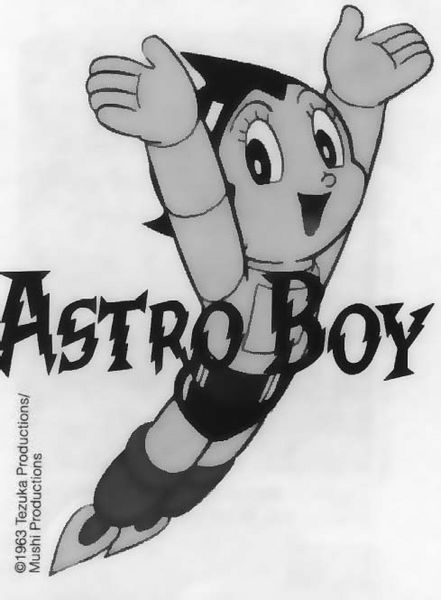
This is how Osamu Tezuka started to create the Japanese big-hit manga personality "Tetsuwan Atom" (Atom with iron arms).  The work was later presented in TV broadcasting as the first major animation product for TV in Japan.  Then in 1963 or so Robot-Boy Atom was introduced into the US through NBC under a new name of Astro Boy.


http://www.mxtv.co.jp/atom/

http://blogs.yahoo.co.jp/yacup/39936445.html


Osamu Tezuka is now respected by every manga or animation artist in Japan.  And undoubtedly one of his outstanding cartoon works is "Tetsuwan Atom" (Atom with iron arms), since it was first created and appeared in public as Ambassador Atom in 1951.


*** *** *** ***


Act 7:29 Then fled Moses at this saying, and was a stranger in the land of Madian, where he begat two sons.
Act 7:30 And when forty years were expired, there appeared to him in the wilderness of mount Sina an angel of the Lord in a flame of fire in a bush.
Act 7:31 When Moses saw it, he wondered at the sight: and as he drew near to behold it, the voice of the LORD came unto him,
Act 7:32 Saying, I am the God of thy fathers, the God of Abraham, and the God of Isaac, and the God of Jacob. Then Moses trembled, and durst not behold.

Monday, July 29, 2013

"with the baptism of John" - Japanese Engineers in Samsung


Prime Minister Office Bldg. in Tokyo

Japanese Engineers in Samsung

In Samsung, a big electronic business of South Korea, there are many head-hunted Japanese engineers.

Samsung has an R&D center in Yokohama, Japan, where Japanese engineers also work.  Including this Yokohama center, Samsung Group employed at least 458 Japanese engineers between 2002 and 2010, which can be confirmed by patent applications filed by Samsung Group.  Japanese engineers employed by the South Korean company wrote patent applications under their names, so that their status can be easily confirmed.  But of course there must be more Japanese engineers who have not drawn up patent applications.

According to study, those patent-applying Japanese engineers in Samsung were from the following Japanese businesses:

Original Japanese Business          Number of Engineers in Samsung
==============================================

1. Panasonic                           53

2. NEC                                   47

3. Toshiba                              39

4. Hitachi                               39

5. Sanyo                                35

6. Renesas                             31

7. Fujitsu                               27

8. Sony                                 26

9. Mitsubishi                          25

10. Canon                             20
==============================================

Samsung's founder Lee Byung-chul (1910 - 1987) learnt in Waseda University, Tokyo. He then started rice-cleaning mill business to provide rice for troops of the Imperial Army of Japan which were stationed in South Korea.  (Before WWII, Korea was part of the Empire of Japan.)

The second leader of Samsung Group Lee Kun-hee (1942 - ), a son of the founder, also graduated from Waseda University, Tokyo.  He spent several years in Japan going to Japanese elementary school and junior high school.  So, he can speak Japanese so fluently.  

The third leader of the Group Lee Jae-yong (1968 - ), a son of Lee Kun-hee, also learnt in a graduate school of Keio University, Tokyo. 

So, the root of Samsung is in Japan, and its current vitality is still being infused from Japan.

So, there is a joke that Samsung salesmen often say to their clients: "Trust us.  Our technology is supported by Japanese engineers."  And we, Japanese, don't care about it so much.


*** *** *** ***


Luk 7:28 For I say unto you, Among those that are born of women there is not a greater prophet than John the Baptist: but he that is least in the kingdom of God is greater than he.
Luk 7:29 And all the people that heard him, and the publicans, justified God, being baptized with the baptism of John.
Luk 7:30 But the Pharisees and lawyers rejected the counsel of God against themselves, being not baptized of him.

Sunday, July 28, 2013

"the dogs under the table" - Japanese Society


Parliament Member Office Bldg & Prime Minister Office, Tokyo


Japanese Society


Once or before the economic bubble around 1990, it was often said that Japanese households who thought they belonged to the middle class accounted for 90% of all.

At the time the middle class in Japan meant having graduated from high school, college or university, having a regular job or being employed by a reasonable business, that is a big company or their subsidiary or their business contract, living in a standalone house or a modern apartment, owning a car, a color TV and other home electronics, having overseas traveling experiences, etc.

(In 1970, Japan's GDP exceeded that of Germany.  Excluding the USSR, Japan was already the second largest economy in the world at the time.)

Anyway Japan has not been class society since the fall of the last samurai regime in the late 19th century and ultimately since the fall of the Empire of Japan at the end of WWII in 1945.

In the samurai dominant Japan farmers accounted for 85% of all the residents though the samurai class accounted for only 7%.  And there were only about 130 noble-class houses, including the imperial house, who all lived in Kyoto.  Most importantly not only samurais and noblemen but also many farmers could read and write.  In the early 19th century the literacy rates of the samurai class and the noble class were both 100%, while even farmers, tradesmen and artisans who could read and write accounted for 50% of all of those non-elite classes.

Between the fall of the samurai regime in 1868 and the fall of the Empire of Japan in 1945, there was the aristocracy in Japan, consisting of traditional noblemen directly subject to the emperor and the new nobility who had been elite samurais before.  But now there is no noble class in Japan except the imperial family, since the constitution adopted after WWII denies such a class system in the Japanese society.

So, the all-out democratic social system which has prevailed so thoroughly in the Japanese society after WWII is a key to the Japanese success, though the Empire of Japan had been the leading nation in Asia and one of five militarily strong nations in the world before WWII or even samurai-era Japan had been one of most advanced nations in terms of a literacy rate.

Japan's success in modern academy, science, technology, economy and business has given a great stimulus to Taiwan, South Korea and China.  Those countries are also featured by social structure where most of the people belong to the same and the only one class, in addition to tradition of Confucianism and Buddhism.

In this context, East Asia is more democratic than Europe or the EU.  Japan has been an equitable society to the similar extent of the US.  That is why Japanese businesses can design and manufacture modern and cutting-edge products which can be highly welcomed by US consumers.  They share the same view on goods and systems for promotion of a convenient and effective democratic life.

Nonetheless, it is so deeply interesting that once or during WWII Japanese soldiers in the Imperial Army and Navy dared to die fighting bravely without surrender or commit a suicide to avoid dishonor of becoming a prisoner of war.  The Empire of Japan and the US were so different before 1945 beyond imagination of people living today, which might be another underlying condition for the Japanese success.

Finally Japan is the first nation in the world that could achieve the industrial revolution among non-Christian and non-European race-based nations without being colonized by any Christian or European race-based nations.  Inevitably it is a very unique country in the human history.


*** *** *** ***


Mar 7:25 For a certain woman, whose young daughter had an unclean spirit, heard of him, and came and fell at his feet:
Mar 7:26 The woman was a Greek, a Syrophenician by nation; and she besought him that he would cast forth the devil out of her daughter.
Mar 7:27 But Jesus said unto her, Let the children first be filled: for it is not meet to take the children's bread, and to cast it unto the dogs.
Mar 7:28 And she answered and said unto him, Yes, Lord: yet the dogs under the table eat of the children's crumbs.
Mar 7:29 And he said unto her, For this saying go thy way; the devil is gone out of thy daughter.