Wednesday, August 28, 2013

"and others, One of the prophets" - Old Semiconductor War


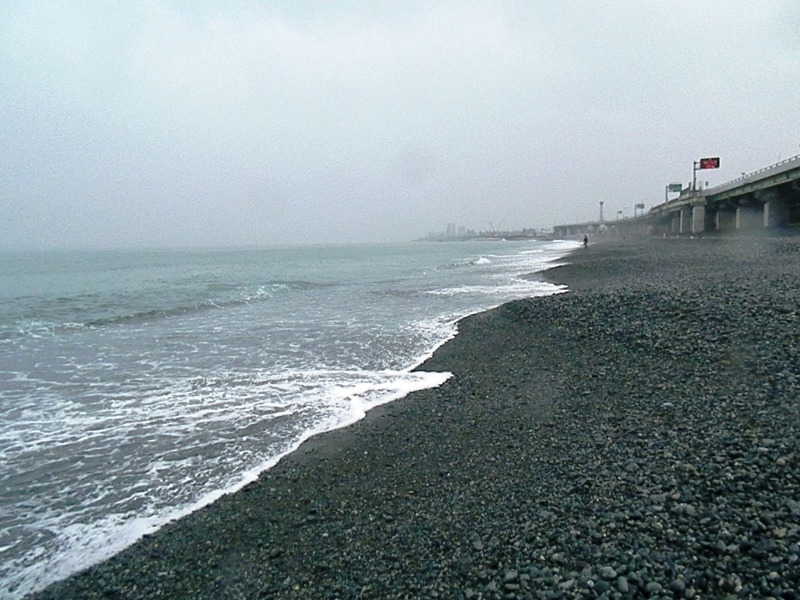
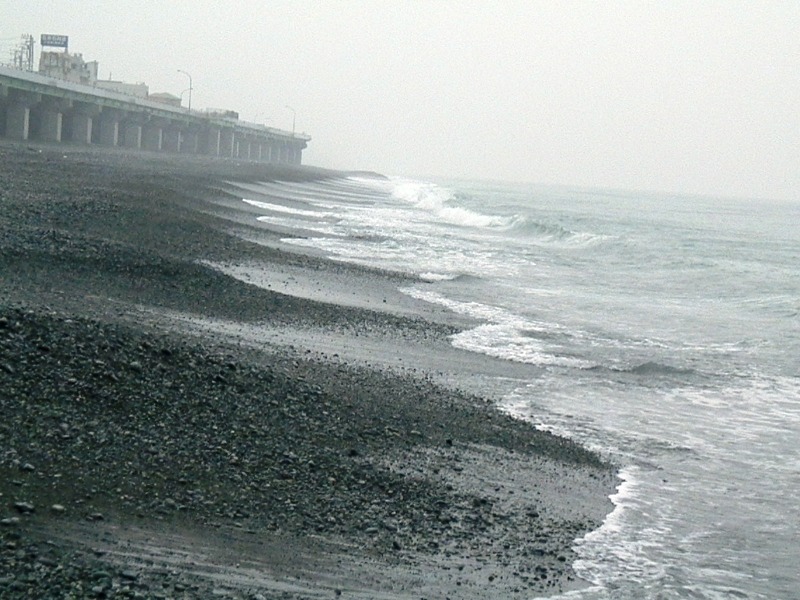
There Were Almost None in Raining August Beach of the Pacific near Tokyo!


Old Semiconductor War

Wealth meant agricultural products and domestic animals.

Then wealth and value were found in Gold and Silver.  But mankind discovered wealth in electric and electronic products in the middle of the 20th century.  Accordingly Japan and the US came to keenly compete with each other in the late 20th century.


A brief history of the semiconductor industry over the Pacific Ocean is as follows:

1947 - US Bell Laboratory invents a transistor.

1949 - Study on transistors starts in Japan.

1955 - Tokyo Tsushin Kogyo (currently Sony) launches a sale of its first transistor radio.

1958 - US Texas Instruments invents an Integrated Circuit (IC) consisting of several transistors in a form of a chip.

1959 - Japan becomes the largest producer of germanium transistor radio receivers.

1964 - Hayakawa Denki Kogyo (currently Sharp) starts to ship desktop electric calculators.

1971 - US Intel develops a microprocessor.

1975 - Den-Den Ko-sya (currently NTT) and Japanese makers start to develop an ultra Large-Scale IC (LSI) consisting of tens of thousands of transistors in a form of a chip.

1976 - The Japanese Government organizes an industrial association to develop ultra LSIs with Japanese manufacturers.

1980 - The share of Japanese businesses in the global DRAM market has sharply increased.

1985 - Nippon Electric Company (currently NEC) becomes the world No.1 semiconductor maker, replacing US Intel.


In this way Japan became the world leading country in the semiconductor field by 1990.


Semiconductor Production Share Ranking in 1990

No.          Company                 Nationality
==================  ========================
1            NEC                        JAPAN

2           Toshiba                    JAPAN

3           Motorola                    US

4           Hitachi                      JAPAN

5           Intel                          US

6          Fujitsu                       JAPAN

7          Texas Instruments       US

8         Mitsubishi                    JAPAN

9         Phillips                        Netherlands

10       Matsushita (Panasonic)  JAPAN
=====================  ========================

However, 20 years later the situation has changed drastically with Japanese getting stuck in the mire.


Semiconductor Production Share Ranking in 2012

No.          Company                 Nationality
=================  ========================
1            Intel                        US

2           Samsung                  S. Korea

3           Qualcomm                US

4          Toshiba                   JAPAN

5   Renesas         JAPAN

6           HYNIX                      S.Korea

7           STMicroelectronics    Switzerland

8           Broadcom                 US

9           Micron                      US

10        Sony                      JAPAN
=====================  ========================

Of course those South Korean makers, such as Samsung and HYNIX, rely on Japanese engineers they have recruited from Japanese companies.  In fact in 1990s, Korean manufactures started to recruit a large number of Japanese engineers who lost hope of or expectation in further career progress in Japanese companies.

Nonetheless, according to data of World Intellectual Property Organization, patent applications based on the Patent Cooperation Treaty shows strength of Japan in overall industries.

Patent Cooperaion Treaty International Applications – Top 15 countries

RANKING COUNTRY  2010    2011     EST. 2011 SHARE  2011 GROWTH
====================================================
1 USA                45'008   48'596 26.7% 8.0%

2 Japan 32'150   38'888 21.4%   21.0%

3 Germany 17'568 18'568 10.2%  5.7%

4 China              12'296  16'406 9.0%  33.4%

5 South Korea            9'669   10'447 5.7%  8.0%

6 France                   6'560   7'664               4.2%  5.8%

7 United Kingdom        4'891   4'844               2.7%  -1.0%

8 Switzerland             3'728  3'999                2.2%   7.3%

9 Netherlands            4'063   3'494                1.9%   -14.0%

10 Sweden               3'314   3'466                1.9%  4.6%

11 Canada               2'698   2'923                 1.6% 8.3%

12 Italy                   2'658    2'671                  1.5%   0.5%

13 Finland               2'138   2'080                 1.1%  -2.7%

14 Australia             1'772   1'740                  1.0%   -1.8%

15 Spain                 1'772   1'725                  0.9%   -2.7%

  All Others            13'346   14'389 7.9%   7.8%
  Total                164'316  181'900     10.7%

(by WIPO)
http://www.wipo.int/pressroom/en/articles/2012/article_0001.html
====================================================

As for China, it is well known that Chinese businesses have been engaged in illegal acquisition or violation of Japanese patents, designs, copyrights, and trademarks in a large scale in these decades.  One reports tells that Japan loses $30 billion every year in the Chinese market due to patent piracy conducted by Chinese companies.

When Japan, namely Sony, first imported US semiconductor patents, a fair amount of money was paid to US companies and reasonable contracts were concluded between Japanese makers and US makers.  So, it was a kind of fair industrial war.  But South Korea and China have obtained Japanese technologies through very biased, dubious, and apparently illegal channels.

Indeed before the 2001 terror attacks on the Pentagon and the World Trade Center, the world looked more decent in terms of industrial war between Japan and America.


*** *** *** ***


Mar 8:27 And Jesus went out, and his disciples, into the towns of Caesarea Philippi: and by the way he asked his disciples, saying unto them, Whom do men say that I am?
Mar 8:28 And they answered, John the Baptist; but some say, Elias; and others, One of the prophets.
Mar 8:29 And he saith unto them, But whom say ye that I am? And Peter answereth and saith unto him, Thou art the Christ.
Mar 8:30 And he charged them that they should tell no man of him.

Tuesday, August 27, 2013

"there met him out of the city a certain man" - Implementation Unit of JFK Assassination


Running on Tokyo Suburb Railway


Implementation Unit of JFK Assassination

As Mr. Oliver Stone has visited Japan recently to observe peace ceremonies in Hiroshima and Nagasaki, I just like to turn to JFK matters.

The story is like this: An implementation unit who had assassinated JFK consisting of secret operatives of CIA also tried to kill New Orleans District Attorney Jim Garrison using a strange criminal, since they were informed by Garrison's old friend, a lawyer who had supported Oswald, that Attorney Garrison was going to arrest and sue those operatives.  However, the criminal didn't take part in the plan.  So, no murder of Jim Garrison was carried out.
### 
 Edward Whalen, a professional criminal, told  Garrison
that  Ferrie  and  Shaw had offered him $25,000 to kill Garrison.
Whalen said that they had been tipped off by Dean  Andrews  about
Garrison's investigation.    Whalen  refused the offer because he
did not want to kill a district attorney.  
http://www.skeptictank.org/files/socialis/garevid.htm

###  
Oswald's 1963 New Orleans activities were later investigated by New Orleans District Attorney Jim Garrison, as part of his prosecution of Clay Shaw in 1967-1969. Garrison was particularly interested in an associate of Guy Banister—a man named David Ferrie[115] and his possible connection to Oswald, which Ferrie himself denied.[116] Ferrie died before Garrison could complete his investigation.[117] Charged with conspiracy in the JFK assassination, Shaw was found not guilty. 
In 1993, the PBS television program Frontline obtained a photograph taken in 1955 (eight years before the assassination) showing Oswald and Ferrie at a Civil Air Patrol cookout with other C.A.P. cadets.[118] (Whether Oswald's and Ferrie's association in the Civil Air Patrol in 1955 is relevant to their later possible association in 1963 is a subject of debate.)[118][119] 
http://en.wikipedia.org/wiki/Lee_Harvey_Oswald 

###
Dean Andrews 
Dean Andrews was a New Orleans attorney. One of his clients was mobster Carlos Marcello, and he also knew David Ferrie. 
Shortly after the assassination, Andrews received a phone call from Clay Bertrand, who wanted him to be Oswald's lawyer. 
See also: Clay Bertrand, Eugene C. Davis 
Extract from the Warren Report
Alleged association with various Mexican or Cuban individuals: ... which is inconsistent with other evidence that Oswald did not drink alcoholic beverages to excess. The Commission has also noted the testimony of Dean Andrews, an attorney in New Orleans. Andrews stated that Oswald came to his office several times in the summer of 1963 to seek advice on a less than honorable discharge from the Armed Forces, the citizenship status of his wife and his own citizenship status. Andrews, who believed that he was contacted on November 23 to represent Oswald, testified that Oswald was always accompanied by a Mexican and was at times accompanied by apparent...

http://www.jfk-fr.com/en/bio_17.php

###

Edward James Whalen was born in Philadelphia, Pennsylvania, on December 10, 1923. He left school after the 9th grade to help support his family. From that time on he has consistently been in trouble with the law, and has spent most of his adult life in prison. His specialty seems to be armed robbery and burglary. He has served time in the state penitentiary in Pennsylvania three times and has been sentenced to the Federal penitentiary at Atlanta, Georgia once. Since March, 1965, he has twice been declared incompetent to stand trial in the Federal Courts by members of the staff at the United States Medical Center for federal prisoners at Springfield, Missouri. Whalen also stated that he had received some psychiatric treatment at the state penitentiary in Pennsylvania. He is presently awaiting a compentency hearing on a federal charge of assaulting a United States Marshal and escape. 
After being paroled on December 10, 1964 from the Pennsylvania state penitentiary at Huntington, Pennsylvania, Edward Whalen went to Philadelphia to spend some time with his family. While there he became involved in some very serious criminal activity, and had to leave town immediately. He stole a car in upstate Pennsylvania and drove to Columbus, Ohio where he met a friend of his who told him he could make some big money. His friend, whose name he would not give me, placed a call to DAVID FERRIE in New Orleans. WHALEN spoke to FERRIE and FERRIE asked him to come to New Orleans. Before leaving Columbus, WHALEN was told that the big money was to be made by hitting the Jung HOtel and a small jewelry store at the intersection of Baronne and Gravier Streets. WHALEN definitely recalls being in Columbus on February 21, 1965... 
The next day, FERRIE met WHALEN at Moran's Restaurant at 10:30 in the morning. FERRIE suggested they take a ride and talk. While in the car FERRIE asked WHALEN if he had ever heard of Jim Garrison. WHALEN said he had not. FERRIE then told WHALEN that Garrison was the District Attorney and that this was the man SHAW and he wanted killed. WHALEN at this time told FERRIE he wanted absolutely nothing to do with the deal. FERRIE attempted to talk WHALEN into going through with the plan, but WHALEN persisted that he would not have anything to do with it. They then parted with the agreement to meet the next night at the Absinthe House. WHALEN spent that night at a motel on the Airline Highway. He does not remember the name of the motel or the name he registered under. 
WHALEN and FERRIE met at the Absinthe House the next night as planned. From there they went directly to SHAW's apartment in the 1300 block of Dauphine Street. WHALEN remembered the apartment was on the first floor but not the color of the front door. He did not remember the courtyard until specifically asked about it. He does not recall any of the interior of the apartment except that it was very lavish.
At first only SHAW, FERRIE and WHALEN were in the apartment, and SHAW and FERRIE were trying to persuade WHALEN to go through with the plan. About one half hour after WHALEN's and FERRIE's arrival, a short fat man wearing dark glasses arrived. This man was introduced to WHALEN by SHAW as DEAN ANDREWS. ANDREWS and SHAW had some conversation away from FERRIE and WHALEN and shortly thereafter ANDREWS left the apartment. SHAW then returned to WHALEN and continued to try to persuade him. SHAW said that he had done some checking on WHALEN and that he knew of WHALEN's crippled daughter - she suffered from polio. SHAW said that if WHALEN would go through with the plan he would get WHALEN's daughter the finest medical treatment money could buy, and also see to it that she was sent to college. However, WHALEN insisted that he would not kill a District Attorney, and he and FERRIE left. 
Once outside, FERRIE told WHALEN that CLAY BERTRAND could do a lot for him and that he was making a mistake. Also at this time FERRIE spoke of LEE OSWALD. He said that SHAW (BERTRAND) had done a lot for OSWALD, and that it was only because OSWALD fouled up that he was killed. He intimated that SHAW had given OSWALD some financial support and had contacted some people in Cuba and Mexico for him. 
At this time he also mentioned the name of SENATOR JOHN TOWER [Ed. note: This was the John Tower who headed the Tower Commission investigation of Iran-Contra. J.B.] of Texas and DANTE MAROCHINI. FERRIE boasted that he had set up the assassination of John Kennedy. WHALEN stated that he did not believe these statements. He felt FERRIE was merely boasting and name-dropping in an attempt to get him to change his mind. FERRIE also mentioned the meeting between SHAW, JACK RUBY, and LEE HARVEY OSWALD in Baton Rouge, Louisiana [Ed. note: This refers to the testimony of Clyde Johnson and Ed McMillan. J.B.]. FERRIE stated that OSWALD was an agent of the CIA and received money from them at one time. He seemed to take pleasure from the irony of the fact that OSWALD had worked for a United States Government agency at one time and that he later killed the leader of that government. FERRIE also stated that they had been given "inside" information from DEAN ANDREWS that Jim Garrison was about to start an investigation into the assassination of President John F. Kennedy. WHALEN insisted he wanted nothing to do with the plan before he left.

http://jfkassassination.net/russ/testimony/whalen.htm

###

According to unified theories, President John F Kennedy was assassinated through an initiative of Lyndon Johnson's aid who used secret CIA agents under Richard Nixon's influence.   New Orleans Attorney Garrison only tried to bring some field operatives of CIA before the court in vain.  Oswald was on the sixth floor of the Texas School Book Depository Bldg. to help another hit-man or he was just instructed to hide till 12:30 of the fatal moment so as to obscure his alibi.   Main snipers were exile anti-Castro Cubans or Chicago-based gangsters linked to CIA.  However Jack Ruby's killing of Oswald seems to have shown that something went wrong with Oswald who had no chance, from the beginning, of escaping a police net and investigation and thus was probably expected to be killed by the police soon after the JFK assassination, since Oswald himself was a secret low-order CIA agent.

Anyway their success in making Oswald get a job in the Texas School Book Depository through a plausible accidental sequence of events tells their high level of operation which must have acquired through experiences of planned (though failed) assassination of Fidel Castro of Cuba.


*** *** *** ***


Luk 8:27 And when he went forth to land, there met him out of the city a certain man, which had devils long time, and ware no clothes, neither abode in any house, but in the tombs.
Luk 8:28 When he saw Jesus, he cried out, and fell down before him, and with a loud voice said, What have I to do with thee, Jesus, thou Son of God most high? I beseech thee, torment me not.
Luk 8:29 (For he had commanded the unclean spirit to come out of the man. For oftentimes it had caught him: and he was kept bound with chains and in fetters; and he brake the bands, and was driven of the devil into the wilderness.)
Luk 8:30 And Jesus asked him, saying, What is thy name? And he said, Legion: because many devils were entered into him.

Monday, August 26, 2013

"Neither go into the town, nor tell it" - First Study on Nuclear Winter


Tokyo Suburb Railroad Line


First Study on Nuclear Winter

In January 2011, an old Japanese meteorologist expressed his theory about the global warming.

As the temperature gap between tropical areas and polar zones is getting smaller, the prevailing westerlies, a strong and continuous wind blowing from the west to the east 10 km or 30,000 feet above the ground, lose its strength to wind their way out of old almost-fixed courses around the earth.  This zigzagging flows of wind sometimes trap a cold air mass or a hot air mass, causing extreme coldness or hotness.

Of course it will be impossible that this temperature gap will be ultimately taken away.  But this climate condition must trigger a big change on the earth.  For instance, there would be little or no spring and autumn.  People would come to see a cold winter suddenly shifting to/from a hot summer without passing a spring or an autumn.    

This old meteorologist Yoshinobu Masuda (1923- ) once studied an effect of nuclear bomb tests carried out by the US in Bikini Atoll of the South Pacific.

After the US conducted hydrogen-bomb tests in Bikini Atoll in March 1954, air temperatures all over Japan strangely showed a decreasing trend.  Frost was formed in various regions of Japan while it was not in a very cold season.  So, Mr. Masuda, then working as head of a laboratory of Japan Meteorological Agency, doubted an influence of the Bikini hydrogen bomb testing which generated a huge amount of ashes.

Scientist Masuda paid attention to a low-temperature phenomenon which usually ensued from a large scale of volcanic eruption.  He collected temperature data from various locations in the world to conclude that the state of the Northern Hemisphere after the Bikini hydrogen-bomb tests resembled a state of an area being affected by eruption of a volcano

This pioneering work by Mr. Masuda was made public five months after the US nuclear testing in 1954.  However, next year many American and British scientists wrote and issued papers to deny Mr. Masuda's findings.  Eventually this theme soon ceased to be a matter of controversy among scientists.  Mr. Masuda's tentative theory is forgotten.

However in November 1983, US scientist Carl Segan presented his theory of "Nuclear Winter" in a special conference joined by US and USSR scientists.  Segan and his collaborator Richard P. Turco made public their theory in The Science next month, which widely shocked the general public in the world.  A nuclear war could not only kill so many soldiers and citizens but also destroy the environment and agriculture for years after the war due to clouds, made of ashes generated by nuclear blasts, which forcibly brought about a winter or cold temperature in the air.  

Mr. Masuda is now chagrined at his having abandoned his study on Nuclear Winter which was the world first in 1954.  


http://www.pahoo.org/culture/numbers/year/j1954-na.shtm


So, Mr. Masuda's work is omitted in most of expository writing on Nuclear Winter, unfortunately.
Nuclear winter (also known as atomic winter) is a hypothetical climatic effect of countervalue nuclear war. Models suggest that detonating nuclear weapons could have a profound and severe effect on the climate causing cold weather and reduced sunlight for a period of months or even years if the nuclear weapon strikes are on cities, comparable to Hiroshima, where it is modelled that large amounts of smoke and soot would be ejected into the Earth's stratosphere. 
Similar climatic effects can be caused by comets or an asteroid impact, also sometimes termed an impact winter, or by a supervolcano eruption, known as a volcanic winter.... 
Early work 
In June 1957, The Effects of Nuclear Weapons by Samuel Glasstone was published containing a section entitled "Nuclear Bombs and the Weather" (pages 69–71), which states: "The dust raised in severe volcanic eruptions, such as that at Krakatoa in 1883, is known to cause a noticeable reduction in the sunlight reaching the earth ... The amount of debris remaining in the atmosphere after the explosion of even the largest nuclear weapons is probably not more than about 1 percent or so of that raised by the Krakatoa eruption. Further, solar radiation records reveal that none of the nuclear explosions to date has resulted in any detectable change in the direct sunlight recorded on the ground." 
In 1974, John Hampson suggested that a full-scale nuclear exchange could result in depletion of the ozone shield, possibly subjecting the earth to ultraviolet radiation for a year or more.[38][39] In 1975, the United States National Research Council (NRC) reported on ozone depletion following nuclear war, judging that the effect of dust would probably be slight climatic cooling.[38][40] 
According to Dr. Vitalii Nikolaevich Tsygichko, a Senior Analyst at the Academy of Sciences, the author of the study, Mathematical Model of Soviet Strategic Operations on the Continental Theater, and a former member of the General Staff, military analysts discussed the idea of a "nuclear winter" (although they did not use that exact term) years before U.S. scientists wrote about it in the 1980s.[41] 
1982 
In 1981, William J. Moran began discussions and research in the NRC on the dust effects of a large exchange of nuclear warheads. An NRC study panel on the topic met in December 1981 and April 1982.[38] 
As part of a study launched in 1980 by Ambio, a journal of the Royal Swedish Academy of Sciences, Paul Crutzen and John Birks circulated a draft paper in early 1982 with the first quantitative evidence of alterations in short-term climate after a nuclear war.[38] In 1982, a special issue of Ambio devoted to the possible environmental consequences of nuclear war included a paper by Crutzen and Birks anticipating the nuclear winter scenario.[42] The paper discussed particulates from large fires, nitrogen oxide, ozone depletion and the effect of nuclear twilight on agriculture. Crutzen and Birks showed that smoke injected into the atmosphere by fires in cities, forests and petroleum reserves could prevent up to 99% of sunlight from reaching the Earth's surface, with major climatic consequences: "The normal dynamic and temperature structure of the atmosphere would therefore change considerably over a large fraction of the Northern Hemisphere, which will probably lead to important changes in land surface temperatures and wind systems."[42] An important implication of their work was that a "first strike" nuclear attack would have severe consequences for the perpetrator. 
1983 
In 1982, the so-called TTAPS team (Richard P. Turco, Owen Toon, Thomas P. Ackerman, James B. Pollack and Carl Sagan) undertook a computational modeling study of the atmospheric consequences of nuclear war, publishing their results in Science in December 1983.[43] The phrase "nuclear winter" was coined by Turco just prior to publication.[44] In this early work, TTAPS carried out the first estimates of the total smoke and dust emissions that would result from a major nuclear exchange, and determined quantitatively the subsequent effects on the atmospheric radiation balance and temperature structure. To compute dust and smoke impacts, they employed a one-dimensional microphysics/radiative-transfer model of the Earth's lower atmosphere (to the mesopause), which defined only the vertical characteristics of the global climate perturbation.
http://en.wikipedia.org/wiki/Nuclear_winter


*** *** *** ***


Mar 8:23 And he took the blind man by the hand, and led him out of the town; and when he had spit on his eyes, and put his hands upon him, he asked him if he saw ought.
Mar 8:24 And he looked up, and said, I see men as trees, walking.
Mar 8:25 After that he put his hands again upon his eyes, and made him look up: and he was restored, and saw every man clearly.
Mar 8:26 And he sent him away to his house, saying, Neither go into the town, nor tell it to any in the town.

Sunday, August 25, 2013

"he commandeth even the winds and water" - Young & Poor Ko-nosuke Matsushita


Pacific Ocean Beach in August Raining, Near Tokyo Prefecture


Young & Poor Ko-nosuke Matsushita


The founder of Japan's Panasonic Ko-nosuke Matsushita (1894-1989) did not graduate from elementary school.

He accomplished the fourth grade, but he had to quit school and go to work when he was only 9 years old.  It was because his father failed in business.

Matsushita started to work in a workshop making charcoal braziers and then in a bicycle shop.  When he became 16 years old, he wanted to be involved in business handling electricity as he was impressed by tram cars he saw in a big city Osaka.  So, he moved from his hometown in Wakayama Prefecture to Osaka so as to be employed by an electric lamp company which later became a big utility called Kansai Electric Power Co., Inc.

The young man Matsushita worked so honestly and diligently that he was promoted from a shop-floor worker to an office worker when he was 21 or so.  As Japanese industry kept a kind of class society within each company in those days, it is great success for an ordinary worker without higher educational background to be promoted from a status of an operative to the one of a clerical worker.

Matushita gladly started to work at desk in an office.  He didn't have to manipulate tools and machines anymore; he just had to fill foams and copy documents by writing.

But his boss soon found that letters ambitious Ko-nosuke wrote were so badly out of shape.  In Japan traditionally it was said that letters showed personality and integrity of the writer.  So, writing poor letters was a very serious disadvantage especially 100 years ago when young Ko-nosuke Matsushita was working hard in a modern company of the era.

His boss complained, so that Matsushita got ashamed of his lack of writing training in primary school.  Eventually poor Ko-nosuke with a wound on his pride voluntarily asked his boss to demote him to an operative in a workshop again.  Management of the company accepted his sad request.
   
Matsuhista remembered that when his father had forced him to quit elementary school, he said that Ko-nosuke should learn business as early as possible since he would be able to hire any learnt man in future if Ko-nosuke had succeeded in business.

So, the legendary founder of Panasonic Ko-nosuke Matsushita could not well write letters when he was around 20 years old.

Matsushita mentioned this episode later as an example of his hard life and extreme efforts.

Now we can refer to some of writing by Ko-nouske Matsushita:

 "Be Straight forward" by Ko-nosuke Matsushita

"Co-Existence and Co-Prosperity" by Ko-nosuke Matsushita

http://blog.livedoor.jp/juncomo/archives/51076443.html


So, you can be a founder of one of top 10 companies in Japan if you stop going to school when you are just nine years old, though it is compulsory for you to accomplish the third grade of junior high school in Japan nowadays.


*** *** *** ***


Luk 8:25 And he said unto them, Where is your faith? And they being afraid wondered, saying one to another, What manner of man is this! for he commandeth even the winds and water, and they obey him.

Friday, August 23, 2013

"I am from above" - Present Status of Fukushima Daiichi


Tokyo Sky-Tree Tower, Tokyo


Present Status of Fukushima Daiichi

The Tokyo Shimbun newspaper presented a recent aerial view of the Fukushima Daiichi Nuclear Power Plant where hundreds of tanks and containers are installed to contain radioactively contaminated water taken from damaged reactor buildings and pumped up from the underground to prevent its flow into the Pacific Ocean.


Recent View of Fukushima Daiichi Plant Full of Tanks to Contain Contaminated Water
(by The Tokyo Shimbun newspaper)

Some square buildings by tall towers beyond two white wall-like long buildings on the harbor are reactor buildings No. 1 to No.4 from the left to the right.

What has made the situation alarming again is leakage of contaminated water from some of tanks.

Scematic View of Leakage Locations
(by The Tokyo Shimbun newspaper)

The path marked with (1) is a drainage conduit leading to the sea.  The location marked with (2) is an area where leakage was found on August 19.  The spot (3) is a place with a doubt of new leakage.

How contaminated water in an estimated amount of  300 tons has traveled to the sea from one of 350 controversial tanks built without welding in these months is illustrated below.

Path of Leakage from a Tank
(The Sankei Shimbun newspaper)

Before the water enters the conduit, it showed a dosage of 96 milli Sieverts per hour.  The level of radiation of conduit water is 6 milli Sieverts.  It is said that if a man receives a dose of 100 milli Sv, it is said that he would surely have a cancer.

It was August 20 that Japanese newspapers first started to report this leakage of 300 tons.  Tokyo Electric Power Co. (TEPCO) did not strictly monitor leaking situations of those tanks.  So, leaking must be continuing for months.

TEPCO itself admits that the harbor annexed to the Fukushima Daiichi plant is now estimated to include maximum 10 trillion becquerels of strontium and 30 trillion Bq of cesium 137.  For example, the regulatory standard value for a dosage of the soil is 5000 Bq/kg in Japan.  

Once this plant produced electricity mainly for the Tokyo area but now it is outputting radioactive water to the environment.


(It is apparent that it is dangerous for Tokyo to win a right to hold Olympics in 2020 under this radioactive condition in Fukushima Daiichi just 220 km [140 miles] northeast of Tokyo.)


See also http://eereporter.blogspot.jp/2013/08/to-go-and-bury-my-father.html and http://eereporter.blogspot.jp/2013/08/of-his-own-accord-he-went-unto-you.html


*** *** *** ***

Joh 8:22 Then said the Jews, Will he kill himself? because he saith, Whither I go, ye cannot come.
Joh 8:23 And he said unto them, Ye are from beneath; I am from above: ye are of this world; I am not of this world.

Thursday, August 22, 2013

"day and night shall not cease" - Virtual Water Import


Tokyo Tower, Tokyo


Virtual Water Import


To harvest 1 kg (2.2 pounds) of wheat, you need 1,000 liters (250 gallos) of water.

In comparison with wheat, rice needs 1.8 times more water, poultry needs 2.25 times more, pork 3 times more, and beef 10 times more.

If a nation imports these agricultural products from other countries, it is virtually importing water contained in those products.

According to this calculation, Japan imports about 64 billion cubic meters (2 trillion 260 billion cubic feet) of water. When subtracting water included in products Japan exports from this imported water, we can get a net amount of imported water.  And, it was found that Japan is the largest net water importer in the world, since 120 million Japanese need foods grown in foreign countries due to higher prices of Japanese farm products.     

The order of nations in terms of a net amount of imported water:

No.1  JAPAN

No.2  Sri Lanka

No.3  Italy

No.4  South Korea

No.5  Netherlands


But from what countries how much water is Japan importing?

Water Exporter to Japan       Qty. of Water
============================================
No.1 USA                   38.9 billion tons

No.2 Australia              8.9 billion tons

No.3 Canada                 4.9 billion tons

No.4 Brazil/Argentina     2.5 billion tons

No.5 China                   2.2 billion tons

N.6 Denmark                 1.4 billion tons

No.7 Thailand               1.3 billion tons

No.8 South Africa           0.3 billion tons

No.9 Others                 3.6 billion tons  
============================================


As Japan has its inherent water resources in use of 90 billion  cubic meters, Japanese people consume total 150 billion cubic meters of water.  It means that Japan relies on foreign water in a ratio of 40% of all the consumed water within Japan.

This situation also implies that Japan is the most vulnerable country in the world against climate changes which might cause droughts and dry weather on the earth, especially in North America, Australia, South America, China, and even Europe.

http://www.waterworks.co.jp/vol13/page2.html


Anyway there are great virtual corridors of water from various regions in the world to Japan.  Japan might be the lowest place on the earth.  Every drop of water falling in the world gets together in Japan.  And something more than water might do.


*** *** *** ***


Gen 8:20 And Noah builded an altar unto the LORD; and took of every clean beast, and of every clean fowl, and offered burnt offerings on the altar.
Gen 8:21 And the LORD smelled a sweet savour; and the LORD said in his heart, I will not again curse the ground any more for man's sake; for the imagination of man's heart is evil from his youth; neither will I again smite any more every thing living, as I have done.
Gen 8:22 While the earth remaineth, seedtime and harvest, and cold and heat, and summer and winter, and day and night shall not cease.

Wednesday, August 21, 2013

"to go and bury my father" - Non-Welded Tanks in Fukushima Daiichi


Tokyo Views from Ikebukuro


Non-Welded Tanks in Fukushima Daiichi 

They use 350 of big barrel tanks to contain contaminated water in the Fukushima Daiichi nuclear plant.

It has a diameter of 12 meters (37 feet) and a height of 11 meters.  But this metal tank consists of four cylindrical parts, each of which is connected to others through rubber packing and bolts but not by welding.

And recently it was found that one of them is clearly leaking radioactively contaminated water.  At a small water pool (6 meter wide x 0.5 meter length x 1 cm deep) by the tank, a dosage is so strong that a worker can stay there only for half an hour so as to avoid receiving doses more than an allowable level per year.  If he stays near the pool for 30 minutes, he would receive an amount of radiation to which he is legally allowed to be exposed during one-year work.   Specifically the level is 80 million becquerels per liter.

Previously TEPCO, the operator of the Fukushima Daiichi plant, found three minor leaking cases, but this time it clearly shows a radiation leak which is probably contaminating the sea off the plant.

So, the Japanese public is again paying alarming attentions to the Fukushima Daiichi nuclear plant 2.5 years after the start of the tsunami-triggered Fukushima Daiichi nuclear accident on March 11, 2011.

http://www.jcp.or.jp/akahata/aik13/2013-08-20/2013082015_01_1.html


http://www.t-kizai.co.jp/lease/01/lease02.html

The lesson might be: "Don't use tanks not welded in a nuclear power plant!"


See also http://eereporter.blogspot.jp/2013/08/i-am-from-above.html


*** *** *** ***


Mat 8:21 And another of his disciples said unto him, Lord, suffer me first to go and bury my father.
Mat 8:22 But Jesus said unto him, Follow me; and let the dead bury their dead.

Tuesday, August 20, 2013

"the seven among four thousand" - Korea before 1945


Ochanomizu Station, Tokyo


Korea before 1945

In 1910 both the emperors of Japan and Korea finally agreed to merge the two empires into the Empire of Japan, mostly in a peaceful manner.

However in March 1919 Korean students first and then Korean commons started violent protest to the rule of the Korean Peninsula by the Imperial Government of Japan.  Those rebels were armed with weapons, attacking village offices, loan association offices, and the likes.  According to an estimate, some two million Koreans joined this violent movement.  So the Japanese Governor-General of Korea mobilized not only the police and military policemen but also regular troops of the Imperial Army of Japan to subdue and control these Korean insurgents in less than two months by May.  In this crush some Koreans were victimized cruelly by Japanese soldiers.  In one case 29 Koreans were killed in a Christian church where these victims were pushed in.  

Learning lessons from this incident, Tokyo started to take soft measures in its ruling of Korea.

From the beginning, different from colonial policies taken by major European countries in Africa and Asia, the Empire of Japan put Korea under its power and authority in order to prepare for a possible war against the Empire of Russia.  Tokyo had to modernize Korea enough so that Koreans would not be subject to the Chinese dynasty called Qing, a suzerain of Korea for centuries, and the Russian Empire.  It was not to economically exploit Korea and Koreans, like major European colonial rulers, that the Empire of Japan started to directly govern the Korean Peninsula.  In fact, Tokyo gave more than it took from Korea.

Accordingly the Empire of Japan made full efforts to reform the Korean landholding regime, introduce mass-production of agriculture products and improve rice farming in the Korean Peninsula, build modern education systems in Korea, etc.  For example, the literacy rate among Koreans was only 6% before Japan's annexation of the Korean Peninsula, but it jumped up to 22% 30 years after the annexation.      

Tokyo also stopped assigning an active-duty general of the Imperial Army/Navy of Japan to the Governor-General of Korea.  The Imperial Government of Japan lifted restrictions on speech and press in Korea.  Freedom of association was also introduced into the Korean society.  Japanese also built railroads in Korea, covering a total extension of 5,000 km.  Japan also built
its sixth Imperial University in Seoul, Korea, which was called the Keijyo Imperial University.

As the Empire of Japan wanted Koreans to become regular citizens of the Empire eventually, political leaders in Tokyo took various measures to modernize the Korean society through introduction of modern industrial systems, social systems, and educational systems into the Korean Peninsula.

Finally, though no violent insurgency occurred after the 1919 failed uprising, Koreans opted to separate from Japan after the end of WWII, since the Empire of Japan collapsed after it surrendered to the United States in 1945.
    
In summary, it will be no wonder if Koreans today showed their great appreciation to Japan even in a complicated or subtle manner due to their unfulfilled pride as a people whose history is as long as that of the Japanese.


So, the historical fact is that Koreans needed rule by the Empire of Japan for its modernization, good or bad, before 1945.


*** *** *** ***


Mar 8:19 When I brake the five loaves among five thousand, how many baskets full of fragments took ye up? They say unto him, Twelve.
Mar 8:20 And when the seven among four thousand, how many baskets full of fragments took ye up? And they said, Seven.
Mar 8:21 And he said unto them, How is it that ye do not understand?

Monday, August 19, 2013

"he may receive the Holy Ghost"- Sweet Potatoes to Replace Oil and Uranium


Tokyo Views around Bunkyo Ward


Sweet Potatoes to Replace Oil and Uranium


A Japanese professor is recommending use of sweet potatoes for generation of electricity.

According to his calculation, it is possible to replace uranium fuel and fossil fuel for providing electricity for Japan with sweet potatoes to be grown in Japan.

Professor of Kinki University Takahiro Suzuki estimates that 20 kg of sweet potatoes can become fuel to generate 10 kWh of power which is equivalent to an mount of electricity consumed by an ordinary household per day.  He also emphasizes that sweet potatoes can be produced at lower costs and in a larger quantity than other plants for fuels such as corns and algae.

As Japan produced, before the Fukushima Daiichi accident of 2011, electricity of 280 billion kWh in nuclear power plants, the amount of sweet potatoes to replace this nuclear energy is 560 million tons.  By adding electricity produced by all the electric power plants using fossil fuels to this amount, the amount of electricity becomes 870 billion kWh which can be replaced by 1.74 billion tons of sweet potatoes.

Fortunately there are 400,000 hectares of rice fields which are currently not used for rice production due to a Japanese Government policy of cutting rice acreage.  If we cultivate sweet potatoes in these idle farmlands, we can harvest 1.8 billion tons of sweet potatoes that can cover the above specified 1.74 billion tons.

As Japan spends $200 billion to import crude oil and other forms of fossil fuels, sweet potatoes can greatly improve the balance of trade of Japan.


http://www.eco-online.org/2011/11/14/%E8%8A%8B%E3%82%A8%E3%83%8D%E3%83%AB%E3%82%AE%E3%83%BC%E3%81%AF%E6%97%A5%E6%9C%AC%E3%82%92%E6%95%91%E3%81%86/


Of course this method of using sweet potatoes for power generation can apply to any countries that want to reduce an mount of CO2 emission.


*** *** *** ***


Act 8:18 And when Simon saw that through laying on of the apostles' hands the Holy Ghost was given, he offered them money,
Act 8:19 Saying, Give me also this power, that on whomsoever I lay hands, he may receive the Holy Ghost.
Act 8:20 But Peter said unto him, Thy money perish with thee, because thou hast thought that the gift of God may be purchased with money.

Saturday, August 17, 2013

"of his own accord he went unto you" - Fukushima Daiichi Contaminated Water Leakage to Sea


Ginza Street, Tokyo


Fukushima Daiichi Contaminated Water Leakage to Sea

Tokyo Electric Power Co. (TEPCO), the owner of the Fukushima Daiichi nuclear power plant, announced that it had completed in early August an underground wall in the premises near the Pacific Ocean to prevent leakage of radioactively contaminated water to the sea.

Experts concerned recently pointed that some contaminated water was still flowing into the sea, even though it was more than two years after the start of the Fukushima Daiichi accident.  That is why TEPCO started to build this wall this July.

The wall, 100 meters wide and 16 meters deep, was constructed by infusing liquid glass into the ground.  But there left is a gap of 1.8 meters between the top of the wall to the surface of the ground.

On the other hand, there is a trench in the ground under buildings housing crippled nuclear reactors.  In it, radioactively contaminated water is kept.  But groundwater also flows into this trench.  Accordingly, an increased amount of contaminated water flows to the underground wall.  Very unluckily the depth of this water flow is 1.2 meters from the surface of the ground.  Consequently the radioactively spoiled water runs over the wall to the Pacific Ocean eventually.

In this way 300 tons of problematic water flows into the sea every day from the Fukushima Daiichi nuclear plant which is still under recovery work after its drastic destruction in the wake of huge tsunamis triggered by an M9.0 earthquake of March 11, 2011.

 (What is worse, it is also recently that TEPCO could correctly measure how much water is leaking to the sea.  This amount 300 tons gave a great shock to the society when it was made public.)


TEPCO plans to abolish this nuclear power plant, taking probably scores of years.  But this leakage has apparently made the situation more complicated.

For example, in response to this situation, fishermen's unions in ports around the Fukushima Prefecture have voluntarily stopped fishing activities in sea areas off the Prefecture, though they were gradually resuming their business in the sea after the Fukushima Daiichi accident, taking time and measuring carefully doses of fishes they caught.  

However, dose levels at some points, though not all the locations, recently measured in the seabed around the Fukushima Daiichi plant are several thousand becquerels per kilo gram of soil at most.  It is not yet catastrophic though the allowable dose for fishes is 100 Bq/kg now in Japan.


*** *** *** ***


2Co 8:15 As it is written, He that had gathered much had nothing over; and he that had gathered little had no lack.
2Co 8:16 But thanks be to God, which put the same earnest care into the heart of Titus for you.
2Co 8:17 For indeed he accepted the exhortation; but being more forward, of his own accord he went unto you.
2Co 8:18 And we have sent with him the brother, whose praise is in the gospel throughout all the churches;

Thursday, August 15, 2013

"And he touched her hand" - East Asia since 1868


Hie Shrine, Tokyo, Close to Parliament Bldg. 


East Asia since 1868

When the samurai era ended in 1868 through a civil war, Japan started to fully open the nation to the world and modernize and westernize the nation.

Subsequently Japanese succeeded in its own industrial revolution to build up strong military forces.  But at the time Japan was threatened by the Russian Empire coming down to the south through Siberia.

Other western powers, including the UK which defeated China in the Opium War (1842) and the US which compelled samurai Japan to have a diplomatic tie with the US, also forced Japan to accept  unequal treaties (1854).  Japan could not, of course, rely on these western colonizing powers to take preventive measures against the imminent threat from Russians.  Japan had to rely on its inherent samurai (warrior) spirit.

On the other hand, the Korean Kingdom was still in its seclusion policy like samurai-era Japan.  Koreans were desperately split between farmers and noble men.  The rotten Korean court was unable to boost its economy and enrich the nation.  Korean farmers were left in a state of illiteracy and ignorance mostly due to the discriminatory social system of Korea built on extreme Confucianism.  It was apparent that Korea could not modernize and westernize itself.  What is worse, Korea nominally belonged to China.  Corrupt Yi-Dynasty Korea was a tributary to more corrupt Ching Dynasty of China.  And Ching itself could not modernize itself even after the defeat by the UK in the Opium War.

So, when Japan put an end to the rule by sword of samurai in 1868, East Asia was, like South East Asia and South Asia, about to be directly and indirectly colonized by the UK, France, Germany, the US, etc.  What is worse, the Russian Empire was for real trying to move its mighty troops from Siberia into Manchuria and North Korea.  But Ching Dynasty and Yi-Dynasty Korea could not stop this military invasion as they had no strong military and modern industry.  They could not carry out their own industrial revolution.

At the time leaders of the Empire of Japan thought that it was a matter of time that strong and modern Russian troops would occupy Manchuria, part of northeast China, the Korean Peninsula, and then eventually the Japanese Archipelago.  Tokyo had to do something to prepare for a coming showdown with the Russian Empire.

As the first step, Tokyo tried to educate Koreans so that they would sever its centuries-long subordinate relationship with China and get fully independent.  Japanese politicians expected that new Korea would join Japanese efforts to keep independence of East Asia from western powers and Russians.  But as Korea's old tie with Ching was so strong that the Empire of Japan had to make a war against Ching China to free Koreans from the Chinese rule.  This is the First Japanese-Sino War which was fought from 1894 to 1895.

The defeat of Ching Dynasty eventually led to its all-out fall in 1912.  But Korea could not advance its society all by itself after the war, so that the Korean Kingdom was eventually fully annexed to the Empire of Japan in 1910 (though some Japanese leaders were against this measure imposing a heavy financial burden on Tokyo).  And most importantly the Empire of Japan fought the Empire of Russia between 1904 and 1905, extensively using its military bases in the Korean Peninsula built after the First Japanese-Sino War.  The victory of the Empire of Japan over the Russian Empire took away the threat of brutal invasion and inhuman colonization by Russians from East Asia.

This is the basics for understanding current situations and relationships among Japan, South/North Koreas, and China as well as Taiwan and Mongolia.

Indeed the 21st century is based on the 20th century which was a kind of extension of the 19th century and preceding centuries.


*** *** *** ***


Mat 8:15 And he touched her hand, and the fever left her: and she arose, and ministered unto them.

Wednesday, August 14, 2013

"choked with cares and riches and pleasures of this life" - Short History of Yasukuni Shrine


Tokyo Haneda International Airport Facing Tokyo Bay


Short History of Yasukuni Shrine


1868  The last samurai regime falls through a civil war, and the Emperor (Meiji) starts to reign Japan with ex-samurais on his side.  Japan starts to open the nation and promote westernization and modernization.

1869  Yasukuni's Predecessor Tokyo Syo-kon Shya (Tokyo Shrine to Invite Spirits) is founded as a national shrine.

1879  Tokyo Syo-kon Shya is renamed Yasukuni Jinjya (Yasukuni Shrine).

1941  WWII for Japan starts with Pearl Harbor Attack, Hawaii.

1945  The Empire of Japan surrenders to the US; US General MacArthur who starts to govern Japan orders separation of shinto from the government.

1946  Yasukuni Shrine becomes a private religious body.

1951  San Francisco Peace Treaty is signed to put an end to a state of the War for Japan.

1952  Japan becomes fully independent again.

1975  The Emperor (Showa) visits Yasukuni Shrine as his last visit to the shrine though he visited the shrine often before WWII and in 1945, 1952, 1954, 1957, 1959, 1965, and 1969 after WWII.

1978  Former Prime Minister Tojo and other A-class war criminals (former top leaders of the Empire of Japan) who were executed by US troops through the Tokyo Tribunal of War Criminals are enshrined in Yasukuni Shrine, joining other more than 2.4 million fallen soldiers of the Empire since 1868.

1985  Prime Minister Nakasone visits Yasukuni Shrine as representative of the government on the anniversary of Japan's surrender in World War II, namely August 15.  (Prime ministers preceding Nakasone often visited Yasukuni Shrine after WWII even on August 15.)

Then, The Asahi Shimbun newspaper of Japan, a major liberal newspaper, objects against Nakasone's visit as a nationalist act.  Then China suddenly starts to have a strong hostile attitude towards Japanese prime minister's visit to Yasukuni on August 15.  As a result, most of Japanese prime ministers after Nakasone stop visiting Yasukuni Shrine on August 15.

1996 Prime Minister Hashimoto visits Yasukuni Shrine but not on August 15.

2001  Koizumi is elected as Prime Minister of Japan, starting to visit Yasukuni Shrine every year as prime minister of Japan but not on August 15 except in 2006.

2006  Prime Minister Koizumi visits Yasukuni Shrine on August 15.  Koizumi steps down from premiership in September, though he is still in his term of office.

2013  Prime Minister Abe decides not to visit Yasukuni Shrine on August 15, since some US politicians are against the idea, according to some speculation.


*** *** *** ***


Luk 8:14 And that which fell among thorns are they, which, when they have heard, go forth, and are choked with cares and riches and pleasures of this life, and bring no fruit to perfection.

Tuesday, August 13, 2013

"and in time of temptation fall away" - Boeing 787 Short Circuit


Yokosuka Naval (Maritime Self-Defense Force) Base, Japan


Boeing 787 Short Circuit

In my opinion, the battery problem of the Boeing 787 was caused by wrong connection of the battery to equipment of the jet plane.

The equipment works as a load to a power source.  If the main power source or the battery of a 787 is adequately connected to the load or the equipment, no excess electric current would flow.

But when a power source for the equipment is changed from the main power source to the battery, there can be a part of the path of electric current in the equipment, which must be broken or open so that the part does not work as a short circuit for current from the battery.

If this part is, however, left closed by mistake, there would be a short circuit.  Accordingly excess current would flow out of the battery and back to it.  The current would not flow into the equipment but go back to the battery through the short-circuit part and heat the battery up till it burns.


But the battery fire accident occurred when the battery was not expected to be used.  So, while the main power supply was providing power to the equipment, we can think, some mysterious factor caused wrong connection of the battery to the equipment with the short circuit part left as it was.

In this case the above last figure should be modified by connecting the current path from the main source to the equipment.

Put simply, there must have happened two unusual phenomena when the battery burnt up in a Boeing 787.  First, while the main power source, which is actually engines of the jet, was providing electric current to equipment, the battery was connected to the equipment by mistake.  Second, when some mysterious mechanism worked to link the battery at issue to the equipment, some short circuit part was left by mistake as it was, though the part was just a normal portion of the electric current path from the main power source.

In other word, when a power source for the equipment is normally changed from the main power source to the battery, the short circuit part is made open so as to avoid wrong setting of a possible short circuit segment for the battery.  However, the part is just a normal part of the path and not a short circuit for electric current from the main power source.  

It can be regraded as a mistake in logic of design of this power feeding system.  No matter what condition makes the battery connected to the equipment regardless ongoing provision of power from the main power source, the possible short circuit portion must be made open so as to avoid occurrence of an electric short circuit accident.  A mechanism must be installed that connecting of the battery to equipment inevitably makes the possible short circuit part open.

The lack of this mechanism must have led to the battery fire accident in some Boeing 787 jet planes.  Engineers must check specifically what part of real electric circuits in or around the battery, a power control unit, and various devices fall into this possible short circuit portion.


http://engtechmag.wordpress.com/2013/03/19/boeing-dreamliner-787-battery-fix-an-annotated-graphic/


*** *** *** ***


Luk 8:13 They on the rock are they, which, when they hear, receive the word with joy; and these have no root, which for a while believe, and in time of temptation fall away.

Sunday, August 11, 2013

"he had bewitched them with sorceries" - Aftereffects of Radiation


Tokyo Haneda International Airport on Tokyo Bay


Aftereffects of Radiation


The Tokyo Shimbun Newspaper reported that a British scientist claimed that more people died from radiation in Hiroshima and Nagasaki than the US estimated in a specialist conference held in London in December 1945.

The US tried to persuade that most of Japanese victims in Hiroshima and Nagasaki had been killed by heat and a bomb blast when a nuclear bomb was dropped from a B29 bomber each on the two cities in August 1945.

The effect of radioactive rays discharged from the atomic bombs was neglected in official reports released by the US military.  They tried to conceal the dehumanizing and inhuman nature of the new type of bombs.

When the atomic bomb blew up in Hiroshima on August 6, 1945, there were 350,000 people in the major city in western Japan.  By the end of 1945, Hiroshima lost 140,000 people due to the effect of the atomic bomb.  Nagasaki with 240,000 population on August 9, 1945 lost 74,000 citizens in the same condition.

There were many victims in Hiroshima and Nagasaki who died days, weeks,  months, and years after the nuclear bomb attacks due to aftereffects of radiation.


*** *** *** ***


Act 8:9 But there was a certain man, called Simon, which beforetime in the same city used sorcery, and bewitched the people of Samaria, giving out that himself was some great one:
Act 8:10 To whom they all gave heed, from the least to the greatest, saying, This man is the great power of God.
Act 8:11 And to him they had regard, because that of long time he had bewitched them with sorceries.
Act 8:12 But when they believed Philip preaching the things concerning the kingdom of God, and the name of Jesus Christ, they were baptized, both men and women.