Saturday, May 17, 2014

"the power of the Lord was present to heal them" - Mahayana Buddhism


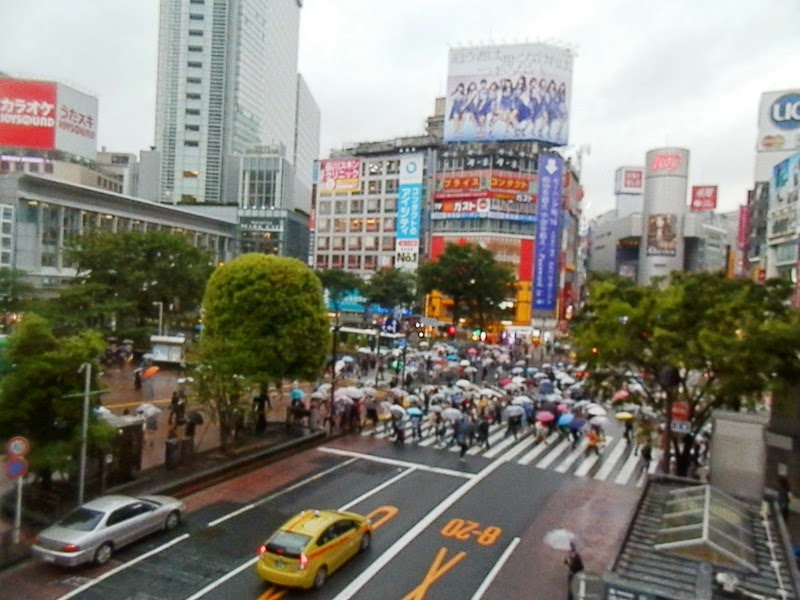
Government Office District, Tokyo


Mahayana Buddhism

A big change occurred in Buddhism in the first century.

A school called Mahayana came to grow, develop, and deploy to more vast regions.
Mahāyāna (literally the "Great Vehicle") is one of the three main existing branches of Buddhism and a term for classification of Buddhist philosophies and practice. Mahāyāna Buddhism originated in India, and some scholars believe that it was initially associated with one of the oldest historical branches of Buddhism, the Mahāsāṃghika. 
The Mahāyāna tradition is the largest major tradition of Buddhism existing today, with 56% of practitioners, compared to 38% for Theravāda and 6% for Vajrayāna. 
The origins of Mahāyāna are still not completely understood.[11] The earliest Western views of Mahāyāna assumed that it existed as a separate school in competition with the so-called "Hīnayāna" schools. 
Scholars have suggested that the Prajñāpāramitā sūtras, which are among the earliest Mahāyāna sūtras,[19][20] developed among the Mahāsāṃghika along the Kṛṣṇa River in the Āndhra region.[21] The earliest Mahāyāna sūtras to include the very first versions of the Prajñāpāramitā series, along with texts concerning Akṣobhya Buddha, which were probably written down in the 1st century BCE in the south of India. 
Few things can be said with certainty about Mahāyāna Buddhism,[note 11] especially its early Indian form, other than that the Buddhism practiced in China, Indonesia, Vietnam, Korea, Tibet, and Japan is Mahāyāna Buddhism.[note 12] Mahāyāna can be described as a loosely bound collection of many teachings with large and expansive doctrines that are able to exist simultaneously.
http://en.wikipedia.org/wiki/Mahayana

The Buddha lived and taught in the eastern part of India between the 6th and 4th centuries BCE.
His teaching was about the way in which an individual achieved enlightenment to conquer pains of living and existence and enter eternal peace and repose.  It was intended to be practiced by an individual for his own salvation of soul.

But around the first century a new movement emerged among Buddhists.  The background was that around the first century Buddhism became a religion for special people who could renounce the world and leave their families to devote themselves to practicing spiritual training.  Conversely, ordinary or poor people forced to work for their masters and families could not be saved.  Accordingly, people wanted another form of enjoying merit of Buddhism.

So, people came to revere followers of Buddhism who carried out hard spiritual training for salvation not only of their own souls but also of others' souls.  Those followers were respected as bodhisattvas.  And this school of Buddhism adopted a theory that people who continued to be engaged in worldly lives could also grasp the wisdom of Buddhism and reach enlightenment through their efforts.  The core of this teaching is wider salvation of souls.  

However, the largest difference between this school, called Mahayana, and other sects of Buddhism lies in that the former uses Mahayana sutras but the latter doesn't.

Yet, how this difference came to exist has been a mystery.  There is a huge gap between the direction Mahayana faces and that other sects do.  What made it possible for Buddhism to realize this quantum leap? 

One theory to solve this enigma is that around the first century Buddhists changed their method of handing down the teaching.  It was a change from an oral method to a writing and copying method.        
     
Wider introduction of religious texts as a means of keeping and communicating teachings paved the way for more detailed and structured study of Buddhism.  Different from a traditional practice of learning the teaching through individual ascetic practices where contents of the religion were stored in the brain of an ascetic monk, written teachings allowed for cooperation and discussion on the religion by many people, including laymen.  Further, documents opened a new space for human thinking.  It created a new world.  Religious practices were no longer restricted to individual's narrow space of his existence.  Study of Buddhism could now expand human and natural boundaries.    

For this reason,  Mahayana or Great Vehicle of Buddhism came to spread among peoples in different culture and traditions, such as Tibetans, Mongolians, Vietnamese, Chinese, Koreans, and Japanese.   
    
From a different perspective, the history of Mahayana is comparable with that of Christianity that began in the first century.  And Theravada (Hinayana or Small Vehicle) or other sects that keep more original form of the teaching of Buddhism might be comparable to Judaism in the analogy of the relationship of these religions.

Even Christianity probably could not spread without the Gospels or the New Testaments.  And the Old Testament could be accepted by Christians as it is written material.  There is no need to be Judaists to learn the teaching of Judaism.  

Therefore these 2000 years can be regarded as the era of sacred writings, though it was between 475 BC and 221 BC that Analects of Confucius were written and edited.


*** *** *** ***


Luk 5:16 And he withdrew himself into the wilderness, and prayed.
Luk 5:17 And it came to pass on a certain day, as he was teaching, that there were Pharisees and doctors of the law sitting by, which were come out of every town of Galilee, and Judaea, and Jerusalem: and the power of the Lord was present to heal them.
Luk 5:18 And, behold, men brought in a bed a man which was taken with a palsy: and they sought means to bring him in, and to lay him before him.
Luk 5:19 And when they could not find by what way they might bring him in because of the multitude, they went upon the housetop, and let him down through the tiling with his couch into the midst before Jesus.
Luk 5:20 And when he saw their faith, he said unto him, Man, thy sins are forgiven thee.

Friday, May 16, 2014

"Let your light so shine before men" - A Story of a Japanese Judaist


The Tokyo Station


A Story of a Japanese Judaist

Some Japanese really helped lives of thousands of Judaists in WWII.
Chiune Sugihara (1900 – 1986) was a Japanese diplomat who served as Vice-Consul for the Empire of Japan in Lithuania. During World War II, he helped several thousand Jews leave the country by issuing transit visas to Jewish refugees so that they could travel to Japan. Most of the Jews who escaped were refugees from German-occupied Poland and residents of Lithuania. Sugihara wrote travel visas that facilitated the escape of more than 6,000 Jewish refugees to Japanese territory, risking his career and his family's lives. Sugihara had told the refugees to call him "Sempo", the Sino-Japanese reading of the characters in his first name, discovering it was much easier for Western people to pronounce.[1] In 1985, Israel honored him as Righteous Among the Nations for his actions.
http://en.wikipedia.org/wiki/Chiune_Sugihara

However when 6,000 Judaists arrived at Vladivostok on the Sea of Japan through Siberia, the situation changed in Tokyo.  Then Imperial Government did not like to welcome these Judaists due to their alliance with Germany.  So, the Ministry of Foreign Affairs of the Empire of Japan sent an official notice to the deputy counsel general stationed in the port city of the USSR, requesting virtual prohibition of allowing the Judaists to sail to Japan.   Nonetheless, the deputy counsel general Saburo Nei, in compassion to poor Judaists, neglected this telegraphic instruction.  Nei authorized voyage to Japan for the Jewish asylum seekers.
 
The Judaiasts landed on Tsuruga, a port city of Japan on the Sea of Japan on October 1941.  Residents of Tsuruga helped them get foods and other necessities.  Then the band of refugees mainly from Poland moved by train to Kobe, another port city on the Pacific side where a humble community of Judaiats living in Japan existed.  But, they were allowed to stay in Japan only for 10 days.  It was impossible for them to find ships to the US or Shanghai in only such a short period of time.

So, a Japanese scholar of Judaism who could speak the Hebrew word, named Setsuzo Kotsuji, came to be involved as some of the Judaists once heard Kotsuji's lecture delivered in Manchuria and asked help from Kotsuji.   Kotsuji went to Tokyo to meet his old acquaintance Yosuke Matsuoka, the notorious Foreign Minister of the Empire who was regarded as a kind of friend of Nazi Germany.  A little surprisingly, Matsuoka gave a tip to Kotsuji, telling that it was the police but not the Foreign Ministry that could allow prolonged stay for the Judaists since they were now within Japan.   So, Kotsuji went back to Kobe to persuade top officials of the police department of Kobe City.  Kotusji could finally gain the goodwill from the police after several lucrative banquets with high raking police officers.  The Judaists could now have time enough to find ships that would carry them to the US or Shanghai.

Accordingly, before the Pearl Harbor Attack by the Imperial Navy in December 1941, most of the Judaists could sail to the US or Shanghai.  They could completely avoid the Holocaust.

In June 1945, Setsuzo Kotsuji and his family moved or fled from Japan to Manchuria, since he was suspected of having a dangerous ideology against the Empire by the police.  When the Empire of Japan surrendered to the US in August 1945, Soviet Union troops invaded Manchuria.  Kotsuji was about to be arrested by Russians like other Japanese soldiers and citizens then living in Manchuria, a virtual puppet country of the Japanese Empire.  But some Judaists living in Manchuria protected Kotsuji from the Russian authority.  Kotsuji and his family could return to Japan safely.

In 1959, Setsuzo Kotsuji visited Israel.  He converted to Judaism there after strict religious probation.  He changed his name to Abraham Kotsuji.  He was warmly welcomed by the survivors he had helped in Japan in 1941.

In 1974 Kotsuji died at the age of 73 in Japan.  Though Israel was at war at the time, his dead body was carried to Israel for burial as he wished so.  A minister of the Israeli Government took the trouble to arrange this extraordinary burial, as the minister was one of those Judaists whose lives had been saved by Kotuji in Japan in 1941.

So, this is a real story of a very rare Japanese Judaist.        


Setsuzo Kotsuji and Judaists in Japan
http://e-satoken.blogspot.jp/2013/04/nhk2013.html


*** *** *** ***


Mat 5:15 Neither do men light a candle, and put it under a bushel, but on a candlestick; and it giveth light unto all that are in the house.
Mat 5:16 Let your light so shine before men, that they may see your good works, and glorify your Father which is in heaven.

Thursday, May 15, 2014

"the shadow of Peter passing by" - Some Financial Aspect of the 2011 Great Disaster of Japan


The Tokyo Station


Some Financial Aspect of the 2011 Great Disaster of Japan


The 2011 Tohoku earthquake and tsunami that occurred along Pacific coast lines northeast of Tokyo on March 11, 2011 destroyed 400,000 houses and buildings as well as more than 400,00 cars and vehicles, taking on about 20,000 lives.

It also caused loss of cash of residents.  But after the disaster, 5,135 million yen ($51 million) cash was found in the disaster-stricken areas.  Of this amount, banknotes and coins worth 4,356 million yen ($43 million) were returned to legitimate owners.  The amount of money given to those who found by law totaled 160 million yen.  The related prefectures legally received about 500 million yen, for example, in such cases as finders were officials of municipalities.

In addition, there are still 10,000 financial items today kept by the police since legitimate owners are unknown.

The disaster also caused various crimes.  Thieves invaded houses, offices, filling stations, etc. to steal money and other assets.  The total amount of damage from this sort of crimes reached 100 million yen ($1 million) in two weeks after the tsunami.  ATMs of banks were also targeted by robbers.  In three months after March 11, total 684 million yen ($ 6.8 million) was stolen from banking machines.

Especially in Fukushima Prefecture where residents who lived within 20 km of the Fukushima Daiichi Nuclear Power Plant were forced to evacuate their houses and offices by order of the Government, many cases involving sneak thieves were reported.

However, this Great Disaster of 2011 Tsunami/Earthquake/Nuclear Accident did not hit the total Japanese economy so hard as the 2008 Financial Crises triggered by the Lehman Shock  as the following figure about Japan's real GDP shows.

    Trend of Japanese GDP since 2003 
   
If you lost cash in a natural disaster such as a great tsunami, you may still get it back through kind hands and the police.  But if you lost money in the global financial crisis, you would lose it forever.

While running away from a great tsunami, no one minds cash he has left in a car or a house.  But, in a global financial crisis, no matter how much you worry about you financial assets, most of them should be lost in a black hole of the global monetary market.

Any way, as the US was double hit by the 2001 Terror and the 2008 Global Financial Crisis, Japan was also double hit by the 2008 Global Financial Crisis and the 2011 Great Tsunami Disaster.  And what is worse, Japan is still suffering the aftermath of the Fukushina Daiichi Nuclear Accident that is partly a man-made disaster.

And in the near future, Russia and China might have to face very critical crises to be tested on their integrity and justice.


*** *** *** ***


Act 5:15 Insomuch that they brought forth the sick into the streets, and laid them on beds and couches, that at the least the shadow of Peter passing by might overshadow some of them.

Wednesday, May 14, 2014

"they that fed the swine fled" - Golden Legend


In Tokyo


Golden Legend

There is a book intended to be a sequel of the New Testament, since its volume is almost equal  to the sum of volumes of the New Testament and the Old Testament.
The Golden Legend (Latin: Legenda aurea or Legenda sanctorum) is a collection of hagiographies by Jacobus de Voragine that became a late medieval bestseller. More than a thousand manuscripts of the text have survived.[1] It was likely compiled around the year 1260, although the text was added to over the centuries.

Among incunabula, printed before 1501, Legenda aurea was printed in more editions than the Bible.[4] It was one of the first books William Caxton printed in the English language; Caxton's version appeared in 1483 and his translation was reprinted, reaching a ninth edition in 1527. 
(An incunable, or sometimes incunabulum (plural incunables or incunabula, respectively), is a book, pamphlet, or broadside (such as the Almanach cracoviense ad annum 1474) that was printed—not handwritten—before the year 1501 in Europe.) 
Written in simple, readable Latin, the book was read in its day for its stories. Each of these is well told, but en masse they tend to become monotonous and blur together, with their repetitious accounts of martyrdoms and miracles. The book is considered the closest to an encyclopaedia of medieval saint lore that survives today; as such it is invaluable to art historians and medievalists who seek to identify saints depicted in art by their deeds and attributes. Its repetitious nature is explained if Jacobus de Voragine meant to write a compendium of saintly lore for sermons and preaching, not a work of popular entertainment.
http://en.wikipedia.org/wiki/Golden_Legend
 In this book more than 100 saints appear to save people and perform miracles.  But, some say that the only saint who heard a voice of God and ventured into salvation of mankind believing mercy of God before 1300 is Saint Francis of Assisi (1181/1182 – 1226), an Italian Catholic friar and preacher.  Even Jacobus de Voragine might have been influenced by deeds of St. Francis.
He founded the men's Order of Friars Minor, the women’s Order of St. Clare, and the Third Order of Saint Francis for men and women not able to live the lives of itinerant preachers, followed by the early members of the Order of Friars Minor or the monastic lives of the Poor Clares.[1] Though he was never ordained to the Catholic priesthood, Francis is one of the most venerated religious figures in history. 
On 13 March 2013, upon his election as Pope, Cardinal Jorge Mario Bergoglio of Argentina chose Francis as his papal name in honor of Saint Francis of Assisi, becoming Pope Francis.
http://en.wikipedia.org/wiki/Francis_of_Assisi#Reorganization_of_the_Franciscan_Order_and_death   
So, the incumbent Pope seems to be linked with the era of Columbus, since among incunabula, printed before 1501, Legenda aurea was printed in more editions than the Bible and the Golden Legend with full of miracles was written immediately after the death of St. Francis.

Pope Francis had better make an effort to make the world of today a world with faith and miracles, as depicted in the Golden Legend, so that everybody can realize the Second Coming of Christ Jesus.

The Golden Legend
http://www.superstock.com/stock-photos-images/1060-608


*** *** *** ***


Mar 5:13 And forthwith Jesus gave them leave. And the unclean spirits went out, and entered into the swine: and the herd ran violently down a steep place into the sea, (they were about two thousand;) and were choked in the sea.
Mar 5:14 And they that fed the swine fled, and told it in the city, and in the country. And they went out to see what it was that was done.
Mar 5:15 And they come to Jesus, and see him that was possessed with the devil, and had the legion, sitting, and clothed, and in his right mind: and they were afraid.

Tuesday, May 13, 2014

" I will: be thou clean" - Queen Elizabeth I vs. the Vatican


In Tokyo


Queen Elizabeth I vs. the Vatican

It is reportedly said that the Vatican once wanted Queen Elizabeth I to be assassinated.
QUESTION 
Has anyone ever tried to assassinate a king or Queen of the United Kingdom? 
ANSWER 
by iwnit on November 8th, 2007

1) Queen Elizabeth I of England: 
"The Ridolfi plot was a Roman Catholic plot in 1570 to assassinate Queen Elizabeth I of England and replace her with Mary I of Scotland. The plot was hatched and planned by Roberto di Ridolfi, who, an international banker, was able to travel between Brussels, Rome and Madrid to gather support without attracting too much suspicion."
Source and further information:
http://en.wikipedia.org/wiki/Ridolfi_plot 

"The Babington Plot was the event which most directly led to the execution of Mary Queen of Scots. This was a second major plot against Elizabeth I of England after the Ridolfi plot." 
"It is named after the chief conspirator Anthony Babington (1561–1586), a young Catholic nobleman from Derbyshire. John Ballard, a Jesuit priest and Catholic agent, persuaded Babington to become involved in a plot to overthrow and/or murder Queen Elizabeth I of England, replacing her on the throne with the Roman Catholic former Queen of Scotland."
Source and further information:
http://en.wikipedia.org/wiki/Babington_Plot
When the Pope anathematized Queen Elizabeth I, he must have been sure that some Catholic agents would try to assassinate her due to political and religious situations at the time.  But the Pope never added his hope or order that no Catholics should attempt to take on the queen of England.  

However, the threat to Elizabeth's life did not end on the day that she became Queen. There were countless plots against Elizabeth I and many of these are listed in a chapter entitled “How Many Plots Were There to Kill Elizabeth I?” in the book that I'm reading at the moment, “How Fat Was Henry VIII? And 101 Other Questions on Royal History”. Another of Elizabeth's achievements was surviving and having a long and successful reign.

Elizabeth's life was in constant danger after Pope Pius V issued the Bull Regnans in Excelsis of Excommunication and Deposition against Elizabeth in 1570, which was a green light for Catholics to rise against her and assassinate her. This Bull led to Elizabeth and her government passing strong laws against the Catholics even though Elizabeth had once said that she had “no desire to make windows into men's souls”.

How Many Plots Were There to Kill Elizabeth I?

In December 1583, Elizabeth I wrote to the French Ambassador:-
“There are more than two hundred men of all ages who, at the instigation of the Jesuits, conspire to kill me.”
and she wasn't exaggerating!
http://www.elizabethfiles.com/plots-against-elizabeth-i/3509/
A fact that once a Pope helped attempts to assassinate a queen of England is so shocking.  But today, a billion of Catholics believe and love the Vatican as if such attempts had never existed.

From this fact, it can be easily inferred that the Vatican did not make full efforts to save lives of millions of Judaists in Europe from evil power of Nazi Germany in and before WWII.

If the Vatican once tried to assassin a Protestant monarch, it would more naturally have Judaists attacked and killed so brutally.

Accordingly, people should try to pray to God directly without praying through the Pope.  This habit should prevail before another Queen Elizabeth is gone.

In addition, I don't think William Shakespeare had any dangerous connection with the Vatican, though he is said to have been a hidden Catholic with some ambiguous linkage with some dubious Catholic bishops or the like.


*** *** *** ***


Luk 5:13 And he put forth his hand, and touched him, saying, I will: be thou clean. And immediately the leprosy departed from him.

Monday, May 12, 2014

"for great is your reward in heaven" - Origin of Evil of Wall Street and the City


Part of Metropolitan Tokyo


Origin of Evil of Wall Street and the City


The origin of modern evil can be traced back to the start of modern banking.

However, essentially banking had been forbidden by the Vatican.
Originally, the charging of interest known as usury was banned by Christian churches meaning the charging of interest at any rate was banned. This included charging a fee for the use of money, such as at a bureau de change. However over time the charging of interest became acceptable, the term came to be used for interest above the rate allowed by law. 
The rise of Protestantism in the 18th century weakened Romes dictates against usury that would free up the development of banking in Northern Europe.
http://en.wikipedia.org/wiki/History_of_banking#Religious_restrictions_on_interest
The inception of this trend started in England during the last phase of its Renaissance
In the City of London there weren't any banking houses operating in a manner recognized as so today until the 17th century, [176][177] although the London Royal Exchange was established in 1565. 
 (ditto)
As Henry VIII (1491 – 1547) cut a tie with the Vatican in 1530s for handling of his divorce, England was positioned so as to easily leave "Rome's dictates against usury."
Supreme Head of the Church of England was a title held by Kings Henry VIII and Edward VI of England, signifying their leadership of the Church of England. 
The title was created for King Henry VIII, who was responsible for the English church breaking away from the authority of the Roman Catholic Church after the Pope excommunicated Henry in 1533 over his divorce from Catherine of Aragon. By 1536, Henry had broken with Rome, seized the church's assets in England and declared the Church of England as the established church with himself as its head. The Act of Supremacy of 1534 confirmed the King's status as having supremacy over the church and required the nobility to swear an oath recognising Henry's supremacy.
http://en.wikipedia.org/wiki/Supreme_Head_of_the_Church_of_England
This trend must have been carried well by his daughter Elizabeth I (1533 - 1603) with establishment of the London Royal Exchange in 1565.

Then the Industrial Revolution occurred in England, resulting in a strong need for a financial system that provided money and funds for industrialists.
The Industrial Revolution and growing international trade increased the number of banks, especially in London. At the same time, new types of financial activities broadened the scope of banking far beyond its origins. The merchant-banking families dealt in everything from underwriting bonds to originating foreign loans. These new "merchant banks" facilitated trade growth, profiting from England's emerging dominance in seaborne shipping. Two immigrant families, Rothschild and Baring, established merchant banking firms in London in the late 18th century and came to dominate world banking in the next century.
http://en.wikipedia.org/wiki/History_of_banking#Religious_restrictions_on_interest  
Here we have to refer to teaching of Judaism on banking, since Rothschild got involved in the banking system of England.
The Torah and later sections of the Hebrew Bible criticize interest-taking, but interpretations of the Biblical prohibition vary. One common understanding is that Jews are forbidden to charge interest upon loans made to other Jews, but obliged to charge interest on transactions with non-Jews, or Gentiles. However, the Hebrew Bible itself gives numerous examples where this provision was evaded. 
Court Jews were Jewish bankers or businessmen who lent money and handled the finances of some of the Christian European noble houses, primarily in the 17th and 18th centuries.[167] Court Jews were precursors to the modern financier or Secretary of the Treasury.[167] Their jobs included raising revenues by tax farming, negotiating loans, master of the mint, creating new sources for revenue,floating debentures, devising new taxes. and supplying the military.[167][168] In addition, the Court Jew acted as personal bankers for nobility: he raised money to cover the noble's personal diplomacy and his extravagances.[168]
http://en.wikipedia.org/wiki/History_of_banking#Religious_restrictions_on_interest
So, now it is clear that decline of authority of the Vatican after the era of Christoper Columbus (1450 - 1506) and Martin Luther (1483 - 1546), England in its Renaissance detached itself from the realm of the Vatican where the charging of interest was forbidden.  Then the Industrial Revolution began in England where Rothschild started to expand their business in extension of their old profession of "court Jews" that was based on an unique aspect of Judaism on money.  However it was the Vatican that helped Rothschild and the likes develop skills in this trade due to restrictions imposed on their social activities in Christianity dominant society.

Put simply, this sinful modern banking business and the financial sector were a result of failure of the Vatican.  And it can be traced back to the era of Columbus and Martin Luther.  Indeed today, in the New World or America that was introduced into history by Columbus and became a great turf of Protestantism triggered by Martin Luther, the banking business so flourished to lead the highly industrialized world.

The origin of evil of Wall Street and the City is thus so religious.        


*** *** *** ***


Mat 5:11 Blessed are ye, when men shall revile you, and persecute you, and shall say all manner of evil against you falsely, for my sake.
Mat 5:12 Rejoice, and be exceeding glad: for great is your reward in heaven: for so persecuted they the prophets which were before you.

Saturday, May 10, 2014

"unto him that was cured" - St. Peter's Mysterious Journey


Tokyo


St. Peter's Mysterious Journey 

There is a mystery about St. Peter.

He suddenly disappeared from descriptions of the Acts only to be considered to reach Rome and die there.

The author of the Acts of the Apostles portrays Peter as an extremely important figure within the early Christian community, with Peter delivering a significant open-air sermon during Pentecost. According to the same book, Peter took the lead in selecting a replacement for Judas Iscariot.[Acts 1:15] He was twice arraigned, with John, before the Sanhedrin and directly defied them.[Acts 4:7-22] [5:18-42] He undertook a missionary journey to Lydda, Joppa and Caesarea,[9:32-10:2] becoming instrumental in the decision to evangelise the Gentiles.[10] 
About halfway through, the Acts of the Apostles turns its attention away from Peter and to the activities of Paul, and the Bible is mostly silent on what occurred to Peter afterwards.
http://en.wikipedia.org/wiki/Saint_Peter#Popular_culture
Acts 12:1-19   The narrative now skips a few years to 44AD. Peter (who is regarded as a radical Jew for mixing with Gentiles) is arrested in Jerusalem during the Passover festival on the orders of King Herod Agrippa I, who has recently beheaded the apostle James, the brother of John.

Peter is miraculously freed from prison during the night by an angel. He rejoins the believers – who are meeting at the home of John Mark in Jerusalem. He hands over the leadership of the Jerusalem church to the more traditional James (the brother of Jesus – see Galatians 1:19) and flees elsewhere for safety. St Mark's Church, in the Armenian Quarter of the Old City of Jerusalem, is believed to mark the site of John Mark's home.

Acts 15:1-21   Peter addresses the assembly of believers in Jerusalem in 49/50AD. James – as leader of the church – concludes that the Jewish believers shouldn't insist that Gentiles who have become believers in Jesus must adopt all the Jewish religious traditions (see Acts 15:12-21).
http://www.thebiblejourney.org/the-bible-journey/7-journeys-of-jesuss-followers/peters-journeys/
However, there is a document from which we can infer that St. Peter was preaching outside ancient Palestine with some followers while sometimes St. Peter was helped by Christ Jesus.
The Acts of Peter and the Twelve Apostles
by Meera Lester 
This document, like so many of the Gnostic texts, relies heavily on allegory for its account of a pearl hawker who does not possess the gem he offers, but instead directs those interested in it to his city. Experts date the first part of the text to roughly the middle of the second century with the remainder dating to the end of the second or beginning of the third century. The beginning of this tractate (in Codex VI, 1 of the Nag Hammadi materials) is missing. 
When the story commences, Peter and the Apostles are on a trip to spread the gospel. After finding a ship to transport them upon the sea, they sailed a day and night. They arrived at a small city called Habitation. The Apostles sought lodging and met a man carrying a book cover in one hand and a wooden staff in the other. He began hawking pearls. Peter asked him about lodging but the man said he, too, was a stranger. The man called out the word “pearls,” and the rich men of the city looked at him, but not seeing a pouch or bag upon his body to contain valuables, they turned away from the hawker. The poor and the beggars heard the hawker's call, and they asked to see the pearl. The man told them that if they would go to his city they could not only see the treasure but he would give it to them for nothing.
...
The story shifts a little awkwardly to the next section where Peter and the others embark upon the journey to the city of the hawker. Peter was told that the inhabitants of the city were people who had endured. Lithargoel now appeared as a physician carrying an unguent box. A disciple followed with a bag of medicines. Peter asked the physician how to get to Lithargoel's house and was shocked when the man called Peter by his name. Jesus then disclosed his identity to Peter. The disciples fell on the ground and prostrated themselves before the Lord. The text says that they comprised eleven disciples (the title states twelve), but does not reveal the identity of the one absent. 
Jesus presented the box and pouch to Peter and told the Apostles to go back to the city of Habitation and give the poor what they required to live. Peter did not understand how they could possibly find food to feed all the poor. Jesus reminded Peter of the power of his name, telling him that the invocation of his name and the wisdom of God surpassed all riches. Jesus gave them the medicine pouch and told them to heal the sick. Peter feared questioning Jesus again, so he pushed John into speaking for the group. John asked Jesus how they could heal bodies since they had not been trained. Jesus said to heal the bodies of the people who believed in him — when you heal bodies without medicines, you can later heal the hearts because they will trust you. Jesus admonished them to stay away from the rich men. 
Certainly, early Christians could see the message here that the wealthy are so preoccupied with appearances (or lack of appearance, in the case of the hawker and the treasure that they could not see) that they would not hear Jesus' message nor know the great treasure that he offered to give them for free. The text also dispels doubt about the power of prayer and of invoking the names of the Father and Son.
http://www.netplaces.com/gnostic-gospels/a-sampling-of-other-gnostic-literature/the-acts-of-peter-and-the-twelve-apostles.htm
More authentic documents back the legend that St. Peter surely reached Rome after all. 
Gal. 2:11-14   Peter meets Paul in Antioch in 50AD, shortly after the Council of Jerusalem (see 4 on Map 19). Paul accuses Peter of changing his mind and drawing back from eating with Gentiles – under pressure from the more traditional Hebraic Jewish believers from Jerusalem.

1 Cor. 1:12     When Paul writes to the Corinthian believers in 56AD, some believers in Corinth claim to follow Peter, while others claim to follow Paul or Apollos. Peter may, therefore, have escaped to Corinth between 44 and 49AD (see 5 on Map 19).

1 Pet. 1:1        In 66AD, Peter writes from Rome to the Jewish believers in the Roman provinces of Asia Minor – in Pontus, Galatia, Cappadocia, Asia and Bithynia (see 6 on Map 19).

2 Pet. 1:14-15 In 67AD, Peter writes again from Rome, where he has been imprisoned and is about to be executed.
http://www.thebiblejourney.org/the-bible-journey/7-journeys-of-jesuss-followers/peters-journeys/

Probably somebody helped St. Peter write letters.  That somebody might be the very author of the Gospel of Mark.


*** *** *** ***

Joh 5:10 The Jews therefore said unto him that was cured, It is the sabbath day: it is not lawful for thee to carry thy bed.
Joh 5:11 He answered them, He that made me whole, the same said unto me, Take up thy bed, and walk.
Joh 5:12 Then asked they him, What man is that which said unto thee, Take up thy bed, and walk?
Joh 5:13 And he that was healed wist not who it was: for Jesus had conveyed himself away, a multitude being in that place.

"together to tempt the Spirit of the Lord?"


Around Tokyo


*** *** *** ***


Act 5:3 But Peter said, Ananias, why hath Satan filled thine heart to lie to the Holy Ghost, and to keep back part of the price of the land?
Act 5:4 Whiles it remained, was it not thine own? and after it was sold, was it not in thine own power? why hast thou conceived this thing in thine heart? thou hast not lied unto men, but unto God.
Act 5:5 And Ananias hearing these words fell down, and gave up the ghost: and great fear came on all them that heard these things.
Act 5:6 And the young men arose, wound him up, and carried him out, and buried him.
Act 5:7 And it was about the space of three hours after, when his wife, not knowing what was done, came in.
Act 5:8 And Peter answered unto her, Tell me whether ye sold the land for so much? And she said, Yea, for so much.
Act 5:9 Then Peter said unto her, How is it that ye have agreed together to tempt the Spirit of the Lord? behold, the feet of them which have buried thy husband are at the door, and shall carry thee out.
Act 5:10 Then fell she down straightway at his feet, and yielded up the ghost: and the young men came in, and found her dead, and, carrying her forth, buried her by her husband.

Thursday, May 08, 2014

"called the children of God" - Another Poor Widow


Tokyo


Another Poor Widow

There is a similar story in Buddhist scriptures to an episode about a poor widow who donated all the money, though small, she had to  the temple.
Luk 21:1 And he looked up, and saw the rich men casting their gifts into the treasury.
Luk 21:2 And he saw also a certain poor widow casting in thither two mites.
Luk 21:3 And he said, Of a truth I say unto you, that this poor widow hath cast in more than they all:
Luk 21:4 For all these have of their abundance cast in unto the offerings of God: but she of her penury hath cast in all the living that she had.
In a Buddhist scripture, an old woman heard that the Buddha was delivering holy preaching.  And, a king, rich merchants, and leading citizens were offering votive lights in a large quantity to the ceremonial place for the Buddha.  So, the old woman wanted to join this occasion as she wanted to be spiritually saved, gaining enlightenment.

She started to beg any little oil from people.  After waking around market and streets, she finally got some amount of oil for a light.  Then she sent it to the ceremonial place where the Buddha stayed.  With other votive lights, her humble light was lit while the Buddha was preaching.

When the preaching was over, the audience was dismissed.  The Buddha and his followers were waiting for all the voting lights to go out.  But, there was one light that continued to be lit for a long time.  However, till all the lights went out, the Buddha would not retire for the night.  So, Buddha's best disciple tried to put it off.  He pinched the wick of the light in vain.  Then, he used a fan to blow it off only in vain.  Finally he tried to crush the light only in vain again.  Finally the Buddha asked his best disciple, "What are you doing, Ananda?"  Ananda relied, "Sir, I cannot extinguish this small light."  Then, the Buddha said, "It is a light an old woman provided as she made a wish to be saved and achieve enlightenment.  You cannot put it off."  Accordingly, the small and humble light continued to burn and emit light so cleanly all through the night.

What this story means is, rather, that only a poor old woman could sincerely wish to be saved from a chain of tragic fates of a human being and cleansed of worldly sins so as to achieve eternal enlightenment.  

If a rich man donates big money or big candles to a preaching congregation held for a holy man, he cannot wish satisfactorily to be saved.  Strength and purity of his wish are far less than a poor old woman who can offer only a very small donation.

If you have no money, whatever donation you can make will be enough, if you get it by begging it from others.   But if you have an asset worth one million dollars, you will be required to donate one billion dollars.

The more you have, the more you will be unable.


*** *** *** ***


Mat 5:9 Blessed are the peacemakers: for they shall be called the children of God.

Wednesday, May 07, 2014

"Jesus, thou Son of the most high God?" - Why Early Christian Romans Prevailed


Around Tokyo


Why Early Christian Romans Prevailed

There is an enigma about development and deployment of Christianity, especially, at its early stage.

What was a decisive factor for its success in spreading among Roman citizens?
The total number of Christians who lost their lives because of these persecutions is unknown, but although early church historian Eusebius, whose works are the only source for many of these events, speaks of "great multitudes" having perished, he is thought by many scholars today to have exaggerated their numbers.[1][2]:217–233 
Although provincial governors in the Roman Empire had a great deal of personal discretion and power to do what they felt was needed in their jurisdiction, and there were local and sporadic incidents of persecution and mob violence against Christians, for most of the first three hundred years of Christian history Christians were able to live in peace, practice professions, and rise to positions of responsibility. Only for approximately ten out of the first three hundred years of the church's history were Christians executed due to orders from a Roman emperor. 
http://en.wikipedia.org/wiki/Persecution_of_Christians_in_the_Roman_Empire


In the first century AD, when the apostles Peter and Paul came to Rome, the Christian community in Rome was still small, perhaps as few as some hundreds or a thousand followers at best. Probably the best source of knowledge about that period comes from the Bible itself and in particular "Acts" and Paul's letter to the Romans ("The Epistles"). 
Being a new religion, with different ideas from the established pagan religions, it was not surprising that the Christians were persecuted on a number of occasions. One obvious problem was that being a monotheist religion (one God and no other) they, like the Jews, were prone to being called traitors. At the time of Claudius the Jewish and Christian cults were regarded as illicit and this meant that it was illegal for them to have public meetings and reunions therefore implying that their most likely meeting places would have been private homes. 
In spite of the widely held belief that Nero's persecution of the Christians was a political move to divert attention from his own guilt, modern historians are beginning to look at the possibility that the Christians were indeed involved in the burning of the city. This may have been partly inspired by the uprisings in Palestine and partly by a fervent belief in the imminence of judgement day. Although there doesn't seem to be proof either way there are certainly accounts of persons preventing others from fighting the fire which was burning Rome. On whose behalf these persons were acting is difficult to tell. 
In spite of the alternating periods of tolerance and persecution, the number of Christians in the city grew, particularly as the power and integrity of the empire decayed and the people of Rome lost faith in the old gods. By the middle of the second century the Christians numbered some 15,000 and a century later they were about twice as many. 
http://www.mariamilani.com/ancient_rome/rome_christianity_Early.htm


By the end of the fourth century—400 years after the birth of Jesus, there were about 500,000 people living in Antioch and half the population was Christian. By the middle of the third century, there were 30,000 Christians living in Rome. 
However, Christianity did not spread as quickly to the West as it did to the East. France (or Gaul as it was known then) only had one known church, based in Lyon, by the middle of the first century, and there were only a few churches in Spain, despite Paul's work. 
http://www.netplaces.com/christianity/the-early-years-of-the-catholic-church/the-spread-of-christianity.htm
Since Cadoux and Yoder first published their views some decades ago, archaeology has shed new light on Christians in the Roman Army in the late 2nd and early 3rd centuries. A number of gravestones have been found that list a soldier’s religion as well as his unit. H. Leclerq recorded 8 pre-Constantian Christian gravestones of soldiers. The earliest is a gravestone of a Christian who served in Legio II Parthia and died in 201. This makes it not only the earliest Christian soldier’s inscription, but one of the oldest known Christian inscriptions period.[7] Legio II was raised by Septimius Severus in 197 in preparation for his invasion of Parthia, so the soldier in question cannot have served long before his death. 
http://riversfromeden.wordpress.com/2012/04/20/christians-in-the-roman-army-countering-the-pacifist-narrative/
Early Christian art used symbolic and allegorical images mainly, partly no doubt to avoid drawing attention during the persecution of early Christians in the Roman Empire.[citation needed] In the Catacombs of Rome Jesus was represented indirectly by pictogram symbols such as the Ichthys (fish), peacock, Lamb of God, or an anchor (the Labarum or Chi-Rho was a later development). Later, personified symbols were used, including Jonah, whose three days in the belly of the whale pre-figured the interval between Christ's death and Resurrection, Daniel in the lion's den, or Orpheus charming the animals. 
The image of "The Good Shepherd", a beardless youth in pastoral scenes collecting sheep, was the most common of these images, and was probably not understood as a portrait of the historical Jesus. The depiction of Jesus already from the 3rd century included images very similar to what became the traditional image of Jesus, with a longish face and long straight hair. As the Church increased in size and popularity, the need to educate illiterate converts led to the use of pictures which portrayed biblical stories, along with images of saints, angels, prophets, and the Cross (though only portrayed in a bejewelled, glorified state). 
After the end of persecution, and the adoption of Christianity by Constantine, large churches were built and from the start decorated with elaborate images of Jesus and saints in mosaic.
http://en.wikipedia.org/wiki/Idolatry_and_Christianity#The_use_of_icons_and_symbols_in_Christian_worship
There were no records or documents on early Christians in Rome that could be comparable to the Gospels.  No great individual Roman citizens who experienced a drastic incident leading to their conversion to Christianity were known.  Christianity spread so silently and humbly in Rome in the first, second, and third centuries without dramatic legends except occasional martyrdom.

But one thing sure is that those early Christians in Rome must have looked different among contemporary Romans, since their minds and hearts were directed to Heaven while other citizens were entirely bothered by worldly matters.

Another point is that there must have been strong merit in being a Christian in Rome in those centuries.  For example, while others lost hope as they faced trials and tribulations in their living in Rome, those early Christians must have been able to stand predicaments well due to their faith and support and embrace other believers to survive together.  Faith in Christianity must have given great endurance to those Christians.  And other Roman citizens observed it in wonder.

Like Judaists today are a remarkable people with a great record of success in science and business, early Christians in Rome must have been a remarkable people with great merit in their personality and humanity.  Accordingly, others gradually came to respect Christians and eventually join them in Rome in the first few centuries of these two millenniums.

The key to solving the mystery of growth of Christianity in ancient Rome must lie in the minds of those early Christians as well as their concrete behaviors when facing difficulty of their lives.

But do Judaists today look similar to those early Christians?


*** *** *** ***


Mar 5:7 And cried with a loud voice, and said, What have I to do with thee, Jesus, thou Son of the most high God? I adjure thee by God, that thou torment me not.

Tuesday, May 06, 2014

"and their net brake" - Around 1492


Around Tokyo


Around 1492

The history of mankind in these 5,000 years can be divided into several epochs.  But the most decisive incident that put critical breakpoint is the discovery of the New World by Columbus in 1492.

However, the adventure of Columbus was preceded by great voyages by Zheng He (1371–1433), explorer and diplomat of China's Ming Dynasty. Zheng commanded expeditionary voyages to Southeast Asia,South Asia, the Middle East, and East Africa from 1405 to 1433. In his first voyage, Zheng led more than 60 ships, one of which was 137 meters long, carrying 28,000 crews.

Nonetheless, China could not or would not conquer the world.  On the other hand, in the West the last remnant of the ancient glory of Romans vanished, namely the Fall of Constantinople, heralding the coming of something new.  But what was it? 

1405–1433: Zheng He of China sails through the Indian Ocean to India, Arabia, and East Africa to spread China's influence and sovereignty.

1453: The Fall of Constantinople marks the end of the Byzantine Empire and the death of the last Roman Emperor Constantine XI and the beginning of the Growth of the Ottoman Empire.

1467–1615: The Sengoku period is one of civil war in Japan.

1481: Spanish Inquisition begins in practice with the first auto-da-fé.

1488: Portuguese Navigator Bartolomeu Dias sails around the Cape of Good Hope.

1492: Jews expelled from Spain.

1492: Christopher Columbus landed in the Americas from Spain.

1494: Spain and Portugal sign the Treaty of Tordesillas and agree to divide the World outside of Europe between themselves.

1499: Ottoman fleet defeats Venetians at the Battle of Zonchio.

1500: Islam becomes Indonesia's dominant religion.

1502: First reported African slaves in The New World

1503: Spain defeats France at the Battle of Cerignola. Considered to be the first battle in history won by gunpowder small arms.

1503: Leonardo da Vinci begins painting the Mona Lisa and completes it three or four years later.

1503: Nostradamus was born on either December 14, or December 21.

1506: Christopher Columbus dies in Valladolid, Spain.

1509: The Portuguese king sends Diogo Lopes de Sequeira to find Malacca, the eastern terminus of Asian trade.

1512: Copernicus writes Commentariolus, and moves the sun to the center of the solar system.

1517: The Protestant Reformation begins when Martin Luther posts his 95 Theses in Saxony.

1519: Leonardo da Vinci dies of natural causes on May 2.

1521: Philippines encountered by Ferdinand Magellan. He was later killed in battle in central Philippines in the same year.

1521: Martin Luther translated the Gospels into German. 

1526: Mughal Empire, founded by Babur, rules India until 1857.

1531–32: The Church of England breaks away from the Roman Catholic Church and recognizes King Henry VIII as the head of the Church.

1532: Francisco Pizarro leads the Spanish conquest of the Inca Empire.

1534: Jacques Cartier claims Quebec for France.

1534: The Ottomans capture Baghdad.

1536: John Calvin launches Protestant Reformation movement. 

1538: Spanish–Venetian fleet is defeated by the Ottoman Turks at the Battle of Preveza.

1541: Amazon River is encountered and explored by Francisco de Orellana.

1543: Copernicus publishes his theory that the Earth and the other planets revolve around the Sun.

1543: The Nanban trade period begins after Portuguese traders make contact with Japan.

1548: The Ming Dynasty government of China issues a decree banning all foreign trade and closes down all seaports along the coast; these Hai jin laws came during the Wokou wars with Japanese pirates.

1551: North African pirates enslave the entire population of the Maltese island Gozo, between 5,000 and 6,000, sending them to Libya.

1552: Russia conquers the Khanate of Kazan.

1557: The Portuguese settle in Macau.

1558–1603: The Elizabethan era is considered the height of the English Renaissance.


This epoch of 100 years from the middle of the 15th century to the middle of the 16th century is very important.  It is not only because Columbus (advanced geographical/political expansion), da Vinci (advanced art), Martin Luther (advanced religious movement), and Copernicus (advanced science) all lived and played remarkable roles in this period, but also because the world came to be under aggressive influences of Europe.

Indeed, at the beginning of this epoch China could have occupied so many territories from South East Asia to West Asia and Africa.  But at the end of this epoch, China started to isolate itself from the global trend.  Japan also encountered Europeans in later years in this period, but in a century it would also decide to close the nation against Europeans with an exception to the Dutch.

The most important question is whether this expansion of the European civilization to other regions of the world is blessed by God or not.  And how much could Christianity be justification for their expansion.  Or was it necessary evil for Christianity to spread to the whole world?  

We have to carefully check the above chronological table, again.


*** *** *** ***


Luk 5:5 And Simon answering said unto him, Master, we have toiled all the night, and have taken nothing: nevertheless at thy word I will let down the net.
Luk 5:6 And when they had this done, they inclosed a great multitude of fishes: and their net brake.
Luk 5:7 And they beckoned unto their partners, which were in the other ship, that they should come and help them. And they came, and filled both the ships, so that they began to sink.

Monday, May 05, 2014

”the love of God is shed abroad in our hearts” - Son of Man


Spring


Son of Man

Meta-Religion = Christ Involved Religions + Christ Excluded Religions

Christ Involved Religions = One with Christ as God + One with Christ as Prophet + One with Christ as Man

If God is almighty, He must make possible all the religions without losing His universality.  And indeed, God is perfect in this context as He allows religion of men to be as above stated with the key figure of Christ.

Meta-Religion = Christ Involved Religions (or Christianity + Islam + Judaism) + Christ Excluded Religions

Accordingly, a man can have a religion chosen from the above elements.  But before he choose a religion, he is in a state of Meta-Religion.  As he grows up in the world, external and internal conditions make him choose one of the elements.  This scenario is as follows:

1. A man is born in the world where Meta-Religion exists.

Man ← Meta Religion

2. His internal propensities and external environment make him choose one of elements.

Inside/Outside Conditions → (Man ← Meta Religion)
  
3. So, he becomes a follower of a religion.

Man → Man with Christianity or another


The point at issue is that this scheme is as perfect as God.  And it is realized with the key figure of Christ.

Perfection of God ← Completeness of Meta-Religion ← Meta-Religion Realized with Christ as Key

In this context, we can understand why Christ Jesus called Himself a "son of man."  This "son of man" corresponds to Judaism  where Christ Jesus is regraded as a mere man, that is, a son of a man.  So, by calling Himself a son of man, Christ Jesus forever takes Judaism as His religion or a religion including Him.
Christianity

"Son of man" is the translation of various Hebrew and Greek phrases used in both the Tanakh and the New Testament. In Judaism it refers to normal human beings. In Christianity it is a title given to Jesus. Christians also believe that the Son of Man is a prophesied spiritual divine external ruler who can be found in the Old Testament.
The Hebrew expression "son of man" (בן–אדם i.e. ben-'adam) appears one hundred and seven times in the Hebrew Bible.[1] This is the most common Hebrew construction for the singular but is used mostly in Ezekiel (93 times) and 14 times elsewhere.[2] In thirty two cases the phrase appears in intermediate plural form "sons of men", i.e. human beings.[1] As generally interpreted by Jews, it denotes humankind generally.

For centuries, the Christological perspective on Son of Man has been a natural counterpart to that of Son of God and just as Son of God affirms the divinity of Jesus, in many cases Son of man affirms his humanity.[9]
However, while the profession of Jesus as the Son of God has been an essential element of Christian creeds since the Apostolic age, such professions do not apply to Son of Man and the proclamation of Jesus as the Son of Man has never been an article of faith in Christianity.[4]

James D. G. Dunn and separately Delbert Burkett state that the interpretation of the use of "the Son of Man" in the New Testament is a prime example of the limits of biblical interpretation in that after 150 years of debate no consensus on the issue has emerged.[5][6]
http://en.wikipedia.org/wiki/Son_of_man
In addition, as I once discussed, the title of a son of man can be claimed by any man or even the poorest man without any social titles and positions in the world.  This title is for the poorest man in the world.  And to make His glory perfect or prove his Perfection, Christ Jesus dared to opt to use it before Israelites including the poorest among them.  It is for love as well as for His omnipotence.

Even from people like stones wayside, a descendant of Abraham can emerge.

Completeness = (Completeness - Incompleteness) + Incompleteness


*** *** *** ***


Rom 5:5 And hope maketh not ashamed; because the love of God is shed abroad in our hearts by the Holy Ghost which is given unto us.
Rom 5:6 For when we were yet without strength, in due time Christ died for the ungodly.
Rom 5:7 For scarcely for a righteous man will one die: yet peradventure for a good man some would even dare to die.
Rom 5:8 But God commendeth his love toward us, in that, while we were yet sinners, Christ died for us.

Saturday, May 03, 2014

"being ensamples to the flock" - Dangerous Trend of Global Wealth


Tokyo Railway


Dangerous Trend of Global Wealth

The trend of the total amount of global hedge funds is as follows:

1990 $39 billion

1995 $257 billion

2000 $491 billion

2005 $1.105 trillion

2006 $1.405 trillion

2007 $1.868 trillion

2008 $1.407 trillion

2009 $1.6 trillion

2010 $1.917 trillion

2011 $2.008 trillion

2012 $2.192 trillion

2013 $2.63 trillion

March 2014 $2.7 trillion


This amount accounts for about 5% of the total value of stock prices in global stock markets.


So, there is wealth in the global stock markets worth $62.4 trillion.

It could be distributed as 10,000 dollars per person globally, since there are more than 6 billion people in the world.  Or it is contributed to by each person in the world with 10,000 dollars.

It is apparent the world entered a very dangerous era since 2005 as the above table and figure show.  In the Christmas season of 2004, the world largest tsunami occurred off Sumatra, Indonesia, taking on hundreds of million lives.  And in 2005, John Paul II died.

This trend was not even stopped completely in 2008 when the global financial crisis occurred starting from Wall Street.

This growth of wealth used by Satan as a tool against God must be stopped.  Or something that can completely control it in the name of God must appear.  Otherwise, mankind will face a very serious catastrophe sooner or later.


*** *** *** ***


1Pe 5:1 The elders which are among you I exhort, who am also an elder, and a witness of the sufferings of Christ, and also a partaker of the glory that shall be revealed:
1Pe 5:2 Feed the flock of God which is among you, taking the oversight thereof, not by constraint, but willingly; not for filthy lucre, but of a ready mind;
1Pe 5:3 Neither as being lords over God's heritage, but being ensamples to the flock.

Friday, May 02, 2014

"Who is worthy to open the book" - Wealth without Freedom of Speech


Tokyo


Wealth without Freedom of Speech

If you hear news from China, you should trust it with less confidence than a news item coming from Rwanda.

FREEDOM OF THE PRESS 2013

GLOBAL PRESS FREEDOM RANKINGS


1  Norway
    Sweden
2  Belgium
    Finland
    Netherlands 
13  New Zealand
19  Germany
23  USA 
29  Canada
31  Australia
     UK
35  France
40  Japan 
47  Taiwan
52  Spain
64  Israel
     South Korea
68  Italy

71  Hong Kong
     South Africa
79  India
83  Greece
89  Philippines
91  Brazil
96  Indonesia
120 Turkey
131 South Sudan 
      Ukraine 
134 Mexico
140 Egypt
      Thailand
147 Malaysia
      Iraq
      Singapore
153 Afghanistan
164 Sri Lanka
      UAE
174 Rwanda
      Sudan
176 Russia
179 China
182 Laos
      Saudi Arabia
196 North Korea
http://www.slideshare.net/SWilliamsJD/freedom-of-the-press-2013-final-complete


As is usual in this sort of global survey, north European countries are ranked high.

But the focus here must be on countries in East and South Asias, covering from Japan to China and India.

Put simply, though East Asia is now growing to become a focus in global economy on a par with the EU, it is still behind Europe, North America, and Anglo Pacific in terms of freedom of press and democracy.

Further, no matter how much wealth and money is being produced and exchanged in Shanghai, Hong Kong, and Singapore, it has less value than that handled in Tokyo, since such wealth in less free countries is more cursed than it accumulated in Tokyo.

Specifically, Japan is very different from China in its respect for freedom of speech and democracy, no matter how badly the Western media report anything about Japan with prejudice.

In addition, Ukraine is ranked No. 131 while Russia No.176.  Russian speaking people in Ukraine will surely opt to maintain their status as Ukrainians eventually.

Similarly, Taiwan will not be annexed to China and South Korea will never be conquered by North Korea.  Rather, Russia, China, Saudi Arabia, and North Korea might face a revolution sooner or later.

By the way, Malaysia is not open in allowing its people to gain access freely to social and political information.  It might be one of underlying causes for the tragedy of the MH370 flight.


*** *** *** ***


Rev 5:1 And I saw in the right hand of him that sat on the throne a book written within and on the backside, sealed with seven seals.
Rev 5:2 And I saw a strong angel proclaiming with a loud voice, Who is worthy to open the book, and to loose the seals thereof?
Rev 5:3 And no man in heaven, nor in earth, neither under the earth, was able to open the book, neither to look thereon.

Thursday, May 01, 2014

"he stood by the lake of Gennesaret" - The New Testament without Definitely Calling Jesus God


Tokyo in a Spring Rain


The New Testament without Definitely Calling Jesus God  

Who started to call Christ Jesus God?
The relevant New Testament passages are comparatively few. Bultmann observes that 'in describing Christ as " God " the New Testament still exercises great restraint '.
http://onlytruegod.org/defense/v.taylor_theos.jchrist.htm
Indeed, nowhere in the Gospels Christ Jesus introduced Himself as God of Israelites as well as mankind.  However authors of the New Testament documents sometimes suggested that Christ Jesus is God.
Do the Scriptures affirm the Deity of Jesus? Did Bible writers call Jesus "God" or claim that He possessed Deity? Please consider these basic passages about Christ as God in the flesh. 
John 1:1
"In the beginning was the Word, and the Word was with God, and the Word was God." The "Word" refers to Jesus (v17), the only begotten of the Father who became flesh and dwelt among us (v14). This affirms that Jesus is a separate individual from the Father (He was with God), and yet He Himself possesses Deity (He was God). Note that the context affirms both Jesus' Deity and His humanity: God became flesh and dwelt among us. 
Colossians 2:9
"For in Him dwells all the fullness of the Godhead bodily" (NKJV, KJV, ASV). Or: "For in Him all the fulness of Deity dwells in bodily form" (NASB, RSV, NIV is similar).
"Fulness" (plerooma) means " ... that which is brought to fulness or completion ... sum total, fulness, even (super) abundance ... of something ... the full measure of deity ... Colossians 2:9" - Bauer-Arndt-Gingrich.
"Godhead" or "Deity" (theotes) means: " ... the state of being God, Godhead ..." - Grimm-Wilke-Thayer. Trench says the language here means Jesus "was, and is, absolute and perfect God" (quoted in Vine, Vol. I, pp. 328f).
So the passage says that, in Jesus dwelt bodily "the full measure of" "the state of being God." 
Hebrews 1:3
Jesus was "the express image of His [the Father's] person" (NKJV, KJV) or "the very image of his substance" (ASV), "the exact representation of His nature" (NASB), "the exact representation of his being" (NIV). The context describes Jesus as the Creator, far above the angels so that He deserves to be worshipped (as will be considered in more detail later.)
"Express image" (charachter) means "the exact expression ... of any person or thing, marked likeness, precise reproduction in every respect (cf. facsimile) ..." - Grimm-Wilke-Thayer (cf. Bauer-Arndt-Gingrich)....

This must mean that Jesus truly possessed Deity before He came to earth. V7 uses the same word to say that He took the form (morphe) of a servant. Was Jesus really a servant on earth? Of course He was (Matthew 20:28; John 13:1-6; 2 Corinthians 8:9; Acts 4:27,30 ASV). It follows that, before He came to earth, He really possessed the nature of God.
http://www.gospelway.com/god/deity-jesus-passages.php 
However, there are various efforts to study these expressions, taking into consideration the context from the Old Testament:
DOES THE NEW TESTAMENT CALL JESUS GOD?

RAYMOND E. BROWN, S.S.

In three clear instances and in five instances that have a certain probability Jesus is called God in the New Testament.

The most plausible explanation is that in the earliest stage of Christianity the Old Testament heritage dominated the use of the title "God"; hence, "God" was a title too narrow to be applied to Jesus. It referred strictly to the Father of Jesus, to the God to whom he prayed. Gradually, (in the 50's and 60's?) in the development of Christian thought "God" was understood to be a broader term. It was seen that God had revealed so much of Himself in Jesus that "God" had to be able to include both Father and Son.

http://www.ts.mu.edu/readers/content/pdf/26/26.4/26.4.1.pdf
To see how St. Paul took his position in this matter is also important, since St. Paul is regraded as the true builder of the religion today called Christianity.
Does Paul call Jesus “God” in Romans 9:5?
30 March 2011
By David Maas 
There is only one passage in Paul's writings where he appears to explicitly call Jesus “God” or theos in Greek, Romans 9:5.  Since the faith of Israel from which Christianity arose was firmly monotheistic, the scarcity of such statements in Paul's letters raises questions. Romans 9:5 is translated in the New International Version (NIV) as:
“Theirs are the patriarchs, and from them is traced the human ancestry of Christ, who is God over all, for ever praised! Amen.”...  
Paul's purpose in Romans chapters 9 through 11 was not to expound on the nature of God or Christ.  At issue was the present status of ethnic Israelites in light of God's covenant promises and the nation’s rejection of Jesus.  Since God is now fulfilling His promises in Christ, and since most Jews repudiated Jesus as Messiah, had God's word failed (verse 6)?... 
Additionally, in his letters Paul always maintained a distinction between God and Christ, and often referred to God as “the God and Father of Jesus” (Romans 15:6, 1 Corinthians 15:24, 2 Corinthians 1:3, 11:31, Ephesians 1:3, 5:20, 1 Thessalonians 1:3).  On several occasions he identified the Father as alone “God” (1 Corinthians 8:6, Ephesians 4:6, Philippians 4:20, 1 Thessalonians 3:11, 3:13).... 
In summary, Romans 9:5 does not call Jesus “God.”  Instead, it is a declaration of praise to God offered immediately before Paul's question, had the Word of God failed? It affirmed that Paul did not doubt even for an instance that God's word had not failed. His faith in God was absolute.
http://www.gospeltoallnations.org/Is_Jesus_Called__God__in_Romans_9-5.htm
Maybe or maybe not, St. Paul could not explicitly call Christ Jesus God, since it must have been very dangerous and too radical at the time.

Conversely, if nobody thought that Christ Jesus might be God in the first century when documents to be included in the New Testament were being created and written, why would they rather try hard so much to disseminate the teaching of Christ or Christianity of the original version?

The degrees of passion, zeal, sacrifice, and efforts those Apostles and disciples showed and exerted in their mission as the first or early Christians cannot be explained if we judge that nobody saw God in Christ Jesus at the time.

However, they did not blindly and easily persuade other "Jews" to accept this notion that God is in Christ Jesus or Christ Jesus is just another form of God, since oppression and persecution to followers of Christ Jesus by the Roman and "Jewish" authorities were so cruel.   So, in order to convert Judaists into Christians, St. Paul and other Apostles had to take a strategy to make them realize and discover by themselves through suggestions given by  St. Paul and other Apostles that Christ Jesus is God.  This realization must be spontaneously and voluntarily made.

Therefore, the New Testament does not have to necessarily and explicitly include a description that Christ Jesus is God.

In other world, only those who could discover that Christ Jesus is God by reading the New Testament could be Christians.


*** *** *** ***


Luk 5:1 And it came to pass, that, as the people pressed upon him to hear the word of God, he stood by the lake of Gennesaret,
Luk 5:2 And saw two ships standing by the lake: but the fishermen were gone out of them, and were washing their nets.
Luk 5:3 And he entered into one of the ships, which was Simon's, and prayed him that he would thrust out a little from the land. And he sat down, and taught the people out of the ship.
Luk 5:4 Now when he had left speaking, he said unto Simon, Launch out into the deep, and let down your nets for a draught.