Wednesday, April 07, 2010

"and brought forth, some thirty, and some sixty, and some an hundred"


One Sheep Lost, One Fact Distorted?

If you do not try to save one sheep, how can you save 100 sheep?

If you accept one false fact, how can you judge history?

For example, it was Chinese troops that came to attack City Shanghai from inland bases in the summer of 1937.

It was troops of the Empire of Japan that were engaged in defence of Shanghai including settlement districts where many Westerners lived, against numerically 10 times more Chinese troops, since the Imperial Government in Tokyo had no intention to expand front lines in the Chinese mainland.


SECTION I: Execution in China

A Japanese man in his 60's was arrested by the Chinese police in 2006 for allegedly carrying 2.5 kilo grams (5 pounds) of stimulant drugs at the Dalian International Airport.

He was sentenced to death in 2008 and executed yesterday by the Chinese authority. It is the first case that the Chinese Government executes a Japanese civilian after normalizing Japan-China diplomatic relations in 1972.

While the unlucky Japanese lived in Osaka, Japan, he often visited a pub, saying to the female owner of the shop, "You should not become a 'yakuza' (gangster or thug). You should not trust 'Boryoku-Dan (organized criminals),' though he strangely looked in an urgent need of cash unlike ordinary Osaka citizens.

(http://www.asahi.com/national/update/0406/OSK201004060054_01.html)

It is speculated that the drugs the unlucky Japanese was carrying had been produced in North Korea.

This combination of North Korea, the Chinese police, stimulant drugs, and the shadowy network in Osaka (and Kobe) is one of the most dangerous factors for ordinary travellers in the Far East, including American tourists, since North Korea is more dangerous than Mexico and China is far larger than Cuba.


SECTION II: Shanghai, August 14, 1937

On August 14, 1937, Chinese air forces, mobilizing a dozen and more airplanes, suddenly started to bomb a naval ship of the Empire of Japan stationed in the Huangpu River flowing through Shanghai.

http://en.wikipedia.org/wiki/Huangpu_River

The Chinese air raid actually failed, since Japanese cruiser Izumo defended itself well with anti-aircraft fires.

Accordingly, Chinese planes could not hit Izumo, but four of the attack planes changed the target to bomb streets in the international concession district of Shanghai with a 250 kilo-gram bomb from each. Their bombs destroyed the Palace Hotel and the Cathey Hotel run by English men, resulting in hundreds and more deaths.

(http://ww1.m78.com/sinojapanesewar/shanghai%20bombing.html)

However, Chinese advertised this tragedy as an act of the Imperial Military. Their claim is still found in English Wikipedia and other Web sites:

----------
On August 14, the Taiwan-based Shikaya and Kisarazu air squadrons of the Imperial Japanese Army Air Force launched bombing raids against Chinese targets in the Shanghai area. The bombings directly caused tens of thousands of civilian deaths as the explosives landed in populated centers and major transportation hubs.

http://en.wikipedia.org/wiki/Battle_of_Shanghai#First_phase_.28August_13_-_22.29

On August 14, the Taiwan-based Shikaya and Kisarazu air squadrons of the Imperial Japanese Army Air Force launched bombing raids against Chinese targets in the Shanghai area. The bombings directly caused tens of thousands of civilian deaths as the explosives landed in populated centers and major transportation hubs.... In 1940 the government announced August 14 would be the Air Force Day to raise the morale of the Chinese populace.

http://www.absoluteastronomy.com/topics/Battle_of_Shanghai
----------

It is true that the Headquarters of the Imperial Military ordered, as a response to sudden all-out offence by China, nine bombers of the Shikaya air squadrons stationed around Taipei, Taiwan, to make a sally but not to Shanghai; they attacked air fields in Hangzhou (Kou-shu in Japanese) located 180 kilometres (112 mi) southwest of Shanghai. Another nine bombers of the Shikaya air squadrons were ordered to attack a Chinese air base in Guangde County (Kou-toku in Japanese) at the opposite side to Shanghai over a big lake.

The Kisarazu air squadrons stationed in Kyusyu, Japan, were also ordered to sortie, but due to bad weather they cancelled the plan. No air planes of the Kisarazu air squadrons flew to anywhere on August 14, 1937. A typhoon was moving north in the East China Sea, so that the Imperial Military abandoned an idea even to mobilize an aircraft carrier.

(http://ja.wikipedia.org/wiki/%E6%B8%A1%E6%B4%8B%E7%88%86%E6%92%83 )

The Chinese military planes that bombed the Shanghai streets were witnessed by some Westerners. Based on their report, American author Trevanian (Rodney William Whitaker) wrote some vivid passages in a famous novel called "Shibumi."

In this novel, he depicted the air raid by the Chinese military using Northrop Gamma 2E planes. It is assumed that he referred to an article of The North China Daily News founded by Henry Shearman.

(http://www.geocities.jp/sada5ro/shanghai2.html )

From the beginning, many Japanese citizens also lived around the international concession district of Shanghai, so that the Japanese bombers could not bomb Shanghai streets, though it would have been rather four 8-inch guns of cruiser Izumo that must have been used for firing on Chinese troops on Shanghai streets.

http://en.wikipedia.org/wiki/Japanese_cruiser_Izumo

Yet, this bombing by Chinese attack planes took lives of some Americans, including Robert Reischauer, elderly brother of Edwin Reischauer who was American Ambassador to Japan in 1960's. Robert Reischauer was reportedly attacked by a bomb near office buildings occupied by a Japanese bank and a Japanese (Manchuria) railroad company.

Yet, even today, some Americans believed that military planes of the Empire of Japan air-raided the Shanghai Street to kill thousands of citizens including Chinese and Westerners.

http://cgi.ebay.com/ws/eBayISAPI.dll?ViewItem&refid=store&item=390168553032

Reports the Imperial Military filed and recorded during WWII are very accurate, since Japan had been a modern nation since 1860's.

And, a rational analysis of the Shanghai incident on August 14, 1937 simply tells that it is a Chinese act that bombed and killed hundreds and more civilians in the streets of the international concession district of Shanghai, since there were no Chinese soldiers in the district for cruiser Izumo to fire on with big guns from the big river. And, no Imperial Military bombers flew to Shanghai, as now you know, on August 14, 1937.


----------
Letters: Feb. 2, 1962, TIME Magazine

Ambassadors Abroad

Sir:

I read with particular interest the article about our new ambassadors [Jan. 12]. Ed Reischauer was a contemporary of mine at Oberlin. His older brother Bob was a classmate and close friend of mine. It was tragic and ironic that Bob was killed by a Japanese bomb dropped on a Shanghai hotel in 1937, since Bob grew up in Japan.

Louis S. PEIRCE Cleveland

> It was a Chinese bomb that killed Robert Reischauer. He was on a study tour of China, leading a group of students, when war with Japan broke out. While he was registering at the Cathay Hotel in Shanghai, a Chinese aerial bomb aimed at Japanese warships in the river landed outside the hotel.—ED.


http://www.time.com/time/magazine/article/0,9171,828957-3,00.html
----------

In 1956, widower Edwin Reischauer married a Japanese woman of a distinguished family who actually became his second wife. Then he was appointed to the United States Ambassador to Japan by President John F. Kennedy in 1961.


*** *** *** ***

April is the season of school entrance ceremony and company orientation for children and graduates in Japan.

The ceremony is mostly held on April 7 in schools.

Decades ago, some company in Japan had graduates start to work from March 21 and paid the first monthly salary to them on April 30 but not on April 20.

I do not think it was Fujitsu Limited, though.


(http://www7.plala.or.jp/machikun/ANNI____.MID

Source: http://www7.plala.or.jp/machikun/hototogisu2-2.htm)


Mar 4:7 And some fell among thorns, and the thorns grew up, and choked it, and it yielded no fruit.

Mar 4:8 And other fell on good ground, and did yield fruit that sprang up and increased; and brought forth, some thirty, and some sixty, and some an hundred.


Tuesday, April 06, 2010

"when the sun was up, it was scorched"

(Great is Tokyo for hard working, peace loving, and low abiding people since the era of Ieyasu 400 years ago)


Verification of the Centuries of War

If you want to make the world peaceful, you must introduce the following article into your constitution:

ARTICLE 9. Aspiring sincerely to an international peace based on justice and order, the Japanese people forever renounce war as a sovereign right of the nation and the threat or use of force as means of settling international disputes. (2) To accomplish the aim of the preceding paragraph, land, sea, and air forces, as well as other war potential, will never be maintained. The right of belligerency of the state will not be recognized.


SECTION I: JAPAN & CHINA vs. Europe/America

Modernization of China was only possible through contribution from Japan.

After ending the closed-door policy under the Tokugawa samurai regime around 1860's, the Empire of Japan started to aggressively import and study Western civilization more openly, though some critical information about the world had been brought into Japan through trade with the Netherlands who was exceptionally allowed to trade with Japan in the samurai era.

Japanese people encountered many Western concepts to translate each of them into appropriate Kanji expressions. Chinese elites then adopted the Japanese translations, since they are so accurate and insightful in choosing Kanji or Chinese letters. One example is the Kanji expression of "People's Republic of China."


According to research, those Kanji expressions originated in Japan in the late 19th century account for 70% of today's Chinese expressions meaning the same concepts in science, sociology, and other academic fields which were imported from Europe/America to Japan and studied by the Japanese people to localize them. Other examples are as follows:


Accordingly, the more Chinese learn science and economy, the more they come to respect Japan or fear Japan.

As a consequence, the Chinese Communist Party would not allow schools in China to teach the true history of East Asia to pupils and students.

It also made it possible for Japanese children and students to learn modern Western culture, using only the Japanese language.

But, it also tells that as Japan had imported, preserved, and more cultivated ancient Chinese civilization to make Kanji words and associated concepts their own. As those Kanji words and associated concepts created by ancient Chinese are rich and abundant, what Japanese people in the late 19th century did was mostly to compare and match original Kanji concepts and Western concepts to create new Kanji idioms.

So, if Europeans and Americans are taught anything about China and Japan by Chinese communist members, they cannot see the truth, since today's Chinese are not so legitimate followers of the ancient Chinese Civilization as today's Japanese are, very ironically, due to raptures and discontinuity in history of the Chinese people.

It is like American tourists go to Israel to meet direct descendants of Jesus Christ's followers. They had better go to the Vatican or the poorest country such as Haiti. And, they should learn history of East Asia from Japanese.

Of course, Chinese youths should also learn history of East Asia from Japanese.


SECTION II: Background of the Pearl Harbor Attack

After the Civil War, Americans changed along with intensified competition in business in the American society being industrialized as they had learnt power of industry through the Civil War which originally started in the agriculture-dominant background as symbolized cotton plantations in the South.

Accordingly, they needed new work force. American businesses liked to accept immigrants from Japan and China. But, the situation was complicated since the market economy was not sufficiently supported by adequate social systems. There could be also delicate rivalry between Japanese immigrants and Chinese immigrants, especially, in California:
----------
Anti-Japanese sentiment
...
Pre-20th century
In the United States, anti-Japanese sentiment had its beginnings well before the Second World War...Some cite the formation of the Asiatic Exclusion League as the start of the anti-Japanese movement in California.[9]

Early 20th century
Anti-Japanese racism in California had become increasingly xenophobic after the Japanese victory over Russia in the Russo-Japanese War. On October 11, 1906, the San Francisco, California Board of Education had passed a regulation whereby children of Japanese descent would be required to attend racially segregated separate schools. At the time, Japanese immigrants made up approximately 1% of the population of California; many of them had come under the treaty in 1894 which had assured free immigration from Japan...

The Japanese invasion of China in 1931 and the annexation of Manchuria was roundly criticized in the US. In addition, efforts by citizens outraged at Japanese atrocities, such as the Nanking Massacre, led to calls for American economic intervention to encourage Japan to leave China; these calls played a role in shaping American foreign policy. As more and more unfavorable reports of Japanese actions came to the attention of the American government, embargoes on oil and other supplies were placed on Japan, out of concern for the Chinese populace and for American interests in the Pacific. Furthermore, the European American population became very pro-China and anti-Japan, an example being a grass-roots campaign for women to stop buying silk stockings, because the material was procured from Japan through its colonies.


http://en.wikipedia.org/wiki/Anti-Japanese_sentiment
----------

More significantly, Japanese interest in China and American interest in China were never been coordinated and adjusted for co-existence.
----------
Fortune Magazine, Vol XI, No. 1, Jan., 1935:
...
The thousands of U. S. [Protestant] missionaries did not go out to trade, but they did carry on a spiritual warfare that had material repercussions in America as well as in China. Religious, philanthropic, and educational societies invested from $40,000,000 to $ 50,000,000 (gold), which is equal to the investment of all other nations put together; and the annual U. S. remittances to Chinese missions, etc., traditionally in the millions of dollars and totaling $ 8,000,000 (gold) in 1928, have always played a certain part in balancing China’s international trade.
...
The American commercial advance in China was resumed toward the end of the nineteenth century when the Standard Oil Co. out-grew its American market for kerosene. Learning that 400,000,000 Chinese were burning sesame oil in their lamps, Mr. Rockefeller set forth to tap that enormous market in the nineties. With its head-quarters in Shanghai, his company expanded until its hong name, Mei Foo, became a passport to the most distant villages of the interior.
...
After the World War one began to hear that Henry Ford was about to revolutionize China with hundreds of millions to be spent in plants and roads. But nothing ever came of this, and Mr. Ford has no plant in China. Meanwhile, and during the booming twenties, there came a flock of U. S. companies whose stocks were soaring in New York — General Motors Corp,. E. I. du Pont de Nemours & Co., Eastman Kodak Co., the National Aniline & Chemical Co., and Colgate-Palmolive-Peet.
...
It appears that the Yankee has come to the Yangtze for good. But strangely enough, even though the American trade is the biggest, the American position is not the strongest. The casual visitor mentally notes that the Yankee puts on a bad show in the Orient. What with the sturdy British tradition, what with the aggressive Japanese, what with an obscure foreign policy, the U. S. does not seem able to perform as a big international power. Her prestige has not been helped by the recent manipulation of silver prices by Congress. Yet the new government at Nanking has for its heroes the fathers of the American Revolution. Hundreds of influential Chinese have been educated in America and welcome our trade, our capital, and, at least until recently, our institutions.


http://brianakira.wordpress.com/2009/04/07/plutocracy-and-the-international-idea/
----------

Key factors for the Pearl Harbor Attack could be thus found in California and Shanghai in addition to Wall Street without mentioning Washington D.C. in 1941.


*** *** *** ***

One special jet plane of the Air Self-Defense Force of Japan flew rather low while I was walking. Then another special jet plane of the Air Self-Defense Force of Japan flew exactly above my head.

Indeed, cherry blossom's were still at their best with so many white petals. Yet, they might have come from 65 years ago to inform me of something important, since they flew so bravely and nostalgically...

There must be viewers of EEE Reporter in Heaven but not the hell.


(http://www7.plala.or.jp/machikun/PROMENAD.MID
Source: http://www7.plala.or.jp/machikun/hototogisu2.htm

In a democratic country prosperous with market economy, people never feel a threat of power of elites in the government. Accordingly, no music is needed as a means to record truth of the era.)


Mar 4:5 And some fell on stony ground, where it had not much earth; and immediately it sprang up, because it had no depth of earth:

Mar 4:6 But when the sun was up, it was scorched; and because it had no root, it withered away.

Monday, April 05, 2010

"Thou shalt not tempt the Lord thy God"

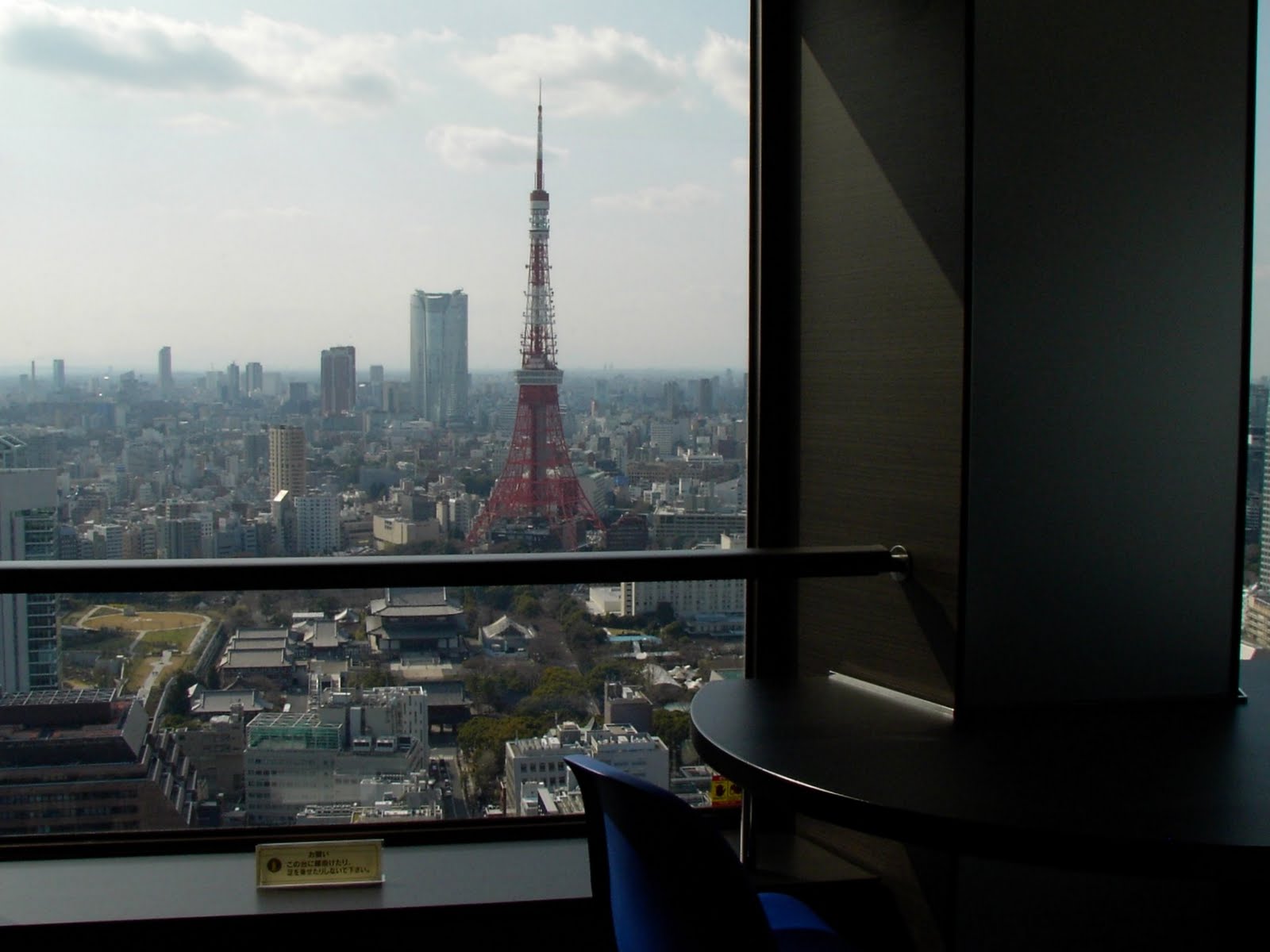
(The Tokyo Tower 333 meters high since 1958, the photo taken by EEE Reporter)


Sons & Daughters of Samurai but Not of Terrorists

Even in the samurai era in Japan, namely before the late 19th century, there were many cases of an official letter of divorce having been submitted by a samurai to his domain lord.

Especially when status of the parents' house of a wife was higher than her husband's, it is estimated, a divorce could be triggered even from the wife's side.

This must be one of the reasons that the last samurai regime under the Tokugawa family could survive for 250 years, in addition to Tokugawa's complete control of all the gold and silver mines in Japan.

Anyway, more specifically, samurais accounted for 7% of the total population in the Tokugawa era, while farmers 80% whose descendants have now really enjoyed democratic privileges as a majority.


SECTION I: Japan in Spring of 2010

In June 1960, President Dwight D. Eisenhower was about to visit Japan but decided not to, since there were so many anti-American demonstrators in Tokyo.

Eisenhower later said, "Prime Minister Kishi said those demonstrators were just a minority while most of the Japanese people supported the Japan-U.S. Security Treaty, which I believed and planned to visit Tokyo..."

(http://blog.kajika.net/?eid=996303)

Nonbusuke Kishi is the third president of the Liberal Democratic Party (LDP) (while the incumbent LDP president Mr. Sadakazu Tanigaki is the 24th).

Since 1955 till 2009, the LDP as the very pro-American party has enjoyed power in Japan except 10 months around 1993 when Mr. Ichiro Ozawa (presently No.1 DPJ politician under the Hatoyama regime) left the LDP.

Today, the Democratic Party of Japan (DPJ) led by Prime Minister Mr. Yukio Hatoyama and Secretary-General Mr. Ozawa is regarded as more pro-Chinese than pro-American by international political communities. And, some Western experts on Japan are wondering why Japan can be more pro-Chinese while Japan seems to need to leverage its alliance with America to cope with Chinese military and economic expansion, which however tells how shallow their views on Japan and China are.

Most of the Japanese people support the Japan-U.S. Security Treaty more than in 1960, but the meaning of being pro-American has vastly changed in this half a century, especially, in the wake of the 9/11 Terror and the Lehman Shock, both caused by American arrogance and foolishness.

Most of the Japanese people do not respect the Chinese Communist Party at all, but the meaning of anti-Chinese has vastly changed in this half a century, especially, since the Chinese people proved their ability to adopt modern technologies and adapt their society to modern market economy admitting necessary economic freedom and leaving ideology, both supported by efforts of Japanese businesses.

Based on cool assumption that there is no war in East Asia between China and the U.S., the Japanese people have accepted the anti-American stance of P.M. Mr. Hatoyama and DPJ leader Mr. Ozawa through 2009-30-8 general election.

But now, a trend is shifting again, not only because the people have come to be alarmed to the anti-American feature of the ruling DPJ. P.M. Mr. But also, Yukio Hatoyama is losing popularity mostly due to the lack of his sincere behaviors in terms of morals, justice, and dignity as the top of one of the greatest nations in the world, as indicated in the U.S. Marine base relocation issue around the Okinawa Island facing Taiwan and China over the East China Sea.

According to The Yomiuri Shimbun Newspaper, the politicians the Japanese voters think to be the most suitable for the Japanese prime minister at the present time are:
No.1 - Yoichi Masuzoe (LDP), No.2 - Katsuya Okada (Foreign Minister), No. 3 - Seiji Maehara (Minister of Land, Infrastructure and Transportation), No. 4 - Naoto Kan (Finance Minister), No. 5 - Yoshimi Watanabe (Min-nano-to), No. 6 - Yukio Hatoyama (Prime Minister), ...


SECTION II: "THE PACIFIC"

The more the War on Terror is prolonged, the more American people are requested to review the Pacific stage of WWII, namely a war against Japanese troops which mainly consisted of sons of farmers or ex-farmers led and guided by the samurai paradigm.

----------
By Will Lawrence
Published: 4:11PM BST 01 Apr 2010

Tom Hanks interview on The Pacific

Tom Hanks, executive producer of new TV drama series The Pacific, talks about the horrors faced by US Marines as they fought the Japanese in the Second World War.
...
"The war in the Pacific was a different beast from the conflict in Europe," says Hanks, during our recent interview in Los Angeles. "In Europe, by and large, when the bad guys knew that they were beaten, they'd put up their hands and say, 'We give up' and they were taken off and put in prisoner-of-war camps, and that was that. This did not happen on the islands of the Pacific. The war in the Pacific was a war of terror and suicide and attrition, that's all it was. There was killing and killing and killing until there was nobody left to kill."
...
"Of the 24,000 Japanese entrenched on the island of Iwo Jima," says Hanks, "only 215 survived". The invasion of the southern Japanese island of Okinawa was even more disastrous for the US forces – which suffered more than 50,000 casualties, an enormous figure in any era of warfare. The US Government decided that the only resolution to this conflict, and the intolerable loss of American lives, was atomic.

The Imperial Army's zealous, extreme behaviour, which encouraged its defeated troops to transform themselves into suicide bombers, or kamikaze pilots, invites comparisons with the current conflict in Afghanistan, where the West is once more battling an enemy whose methods of engagement do not conform to its own. Hanks concedes that the parallels are hard to ignore...


'The Pacific' starts on Sky Movies Premiere/SMPHD on Easter Monday at 9pm

http://www.telegraph.co.uk/culture/tvandradio/7527926/Tom-Hanks-interview-on-The-Pacific.html
----------

A key elite general of the Imperial Navy who devised the kamikaze attack tactics committed a suicide, and another general in command leading kamikaze fleets made himself the last kamikaze sally of the Imperial Military with some brave pilots in 11 fighter planes and bombers toward Okinawa leaving others having been so resolute on the base in the Kyusyu Island, when the generals were informed that the Imperial Government of Japan decided to unconditionally surrender to the U.S. and its allies in the summer of 1945.


http://www.geocities.co.jp/WallStreet-Stock/6210/ThelastwillTakijiroOnishi.html

(http://wgordon.web.wesleyan.edu/kamikaze/writings/books/ugaki/index.htm )

Even today, some sons of ex-kamikaze pilots who were yet ordered to sortie are found in the Japanese Parliament called the Diet.

*** *** *** ***

It is very interesting that the Devil himself tried to lead Jesus Christ to an utmost sin.

It is pride in your righteousness that can be aimed at, if you know you are righteous.

The Devil will also tell you that he knows you are righteous, so that God needs you.

It will be a fatal mistake if you show your sense of superiority in terms of righteousness to the Devil.

The God says always to be righteous but not to be proud of your righteousness against the Devil.

No matter what traps the Devil might set, you may think, you can win while showing your superiority in terms of righteousness to the Devil.

All you have to do is just to tell the teaching of the God to the Devil without finding a chance in his offer of showing your righteousness to him, namely the Devil, the most mysterious concept in its origin, while the God created man.


(http://www.scriptureandmusic.com/Music/MIDI/Amazing_Grace_AL1.mid
Source: http://www.scriptureandmusic.com/Music/Music_Index.html

Indeed, some music would make people, non-celebrated or celebrated, humble even in the front line.)


Mat 4:5 Then the devil taketh him up into the holy city, and setteth him on a pinnacle of the temple,

Mat 4:6 And saith unto him, If thou be the Son of God, cast thyself down: for it is written, He shall give his angels charge concerning thee: and in their hands they shall bear thee up, lest at any time thou dash thy foot against a stone.

Mat 4:7 Jesus said unto him, It is written again, Thou shalt not tempt the Lord thy God.

Sunday, April 04, 2010

Hello SUNDAY FRONT-LINE !?


MI - MO = IM + DM + LM + EM + TAX

MI: Money into Japan
MI: Money out of Japan
IM: Money taken by global businesses and their workers
DM: Money taken by domestic businesses and their workers
LM: Money taken by local workers
EM: Costs to maintain environment and traditions
TAX: Tax revenue for local/central governments

*** *** *** ***

Sakura (Cherry Blossoms):

One of the most popular and omnipresent breeds of cherry blossoms in Japan is "Somei-Yoshino."

But, the description about Somei-Yoshino in Wikipedia is not crucially correct, as is usual in English Wikipedia regarding Japan.

----------
Prunus × yedoensis (Yoshino Cherry; Japanese: 染井吉野 Somei-yoshino) is a hybrid cherry of unknown origin, probably between Prunus speciosa and Prunus subhirtella. It occurs as a natural hybrid in Japan, where it has also long been cultivated in Yoshino (after which it is named) and elsewhere; it is now one of the most popular and widely planted cultivated flowering cherries (sakura) in temperate climates worldwide.

http://en.wikipedia.org/wiki/Prunus_%C3%97_yedoensis
----------

This cherry blossom was created through efforts by some nurserymen and gardeners to mate a certain type of sakura with another (actually, P. pendula Maxim. f. ascendens [Makino] Ohwi. vs. P. lannesiana var. speciosa). These craftsmen lived in a village called Somei in Edo (Tokyo) around 1860's including the era of samurai. They sold this breed of sakura under the brand of "Yoshino" which is a name of the mountain area in the south of Kyoto and Nara. Yoshino has been famous for wild cherry blossoms unique to Japan, called "Yamazakura (P. jamasakura Sieb. et Zucc.)."

However, around 1900, Baron Yoshio Tanaka realized some difference between the Yamazakura from Somei Village and ordinary Yamazakura of the Yoshino origin. So, the baron ordered scientist Kimei Fujino to look into cherry blossoms in the notable Ueno Park, Tokyo, where the "Yoshino" sakura in question were also planted. Fujino discovered that the "Yoshino" was actually a unique type, so that he named the breed "Somei-Yoshino" as it had been from Somei Village.

(http://www2.odn.ne.jp/~had26900/topics_&_items2/takenaka4.htm)

The Somei-Yoshino cherry blossom can be only multiplied through grafting. This breed cannot be mated among itself. Seeds from mating of Somei-Yoshino themselves never come out to grow. Accordingly, billions of Somei-Yoshino trees ever created are all clones from one original tree having been grown by some villagers in Tokyo around 1860's. The Somei-Yoshino sakura can live only for 50 to 60 years.

Cherry blossoms are widely observed in the north hemisphere. But, the types of sakura who beautifully flower are mainly found in Asia, including Tibet. Yet, the center of flowering cherry blossoms' native habitats is Japan. Accordingly, educated people in the world associate cherry blossoms who can flower with Japan, since cherry blossoms in Japan are called sakura.

(http://www.sakuranokai.or.jp/chishiki/index.html)

And, "Somei-Yoshino" is the most popular and omnipresent breed of cherry blossoms in Japan since its start of modernization and industrialization in 1868, for "Somei-Yoshino" was created in Tokyo in 1860's.

It has still some mystery as you know, since only the last samurais could see this breed while their era was going to end...


Saturday, April 03, 2010

"Man shall not live by bread alone"


Paradigm Chnage

[Updated in February 2012]


You do not probably have $100 million as your own and at your discretion like 90% or more of American people.

But, those who have $100 million as their own and at their discretion do not want to lose $50 million at all.

If a law clearly stipulates the maxim allowable amount of money a man can earn and keep, the world would be economically improved.

But, why can't a law so stipulate? Does the God authorize an unlimited amount of money a man can earn and keep?

If freedom mostly means an unlimited amount of money a man can earn and keep is assured, slaves of money have the most freedom.

From the beginning, do you think those who have $100 million as their own and at their discretion and do not want lose $50 million at all are normal? Of course, this is a different matter from tax evasion.

In 2006, there are 116 million households in the U.S. Their average income is $66,572.

Indeed, each household must not be allowed to earn more or less than $66,572, and then each household pay a tax of $10,000 per year, since its total will be $1.16 trillion per year.


SECTION I: Separation of Taxation and Budget Preparation

Without revenue from tax, there is no budget preparation - this is the commonsense till the 20th century.

So, a government has to borrow money by issuing bonds when a fiscal balance is minus, that is, when a budget scale is larger than the amount of revenue from tax.

However, is it sane to adhere to this paradigm in a highly industrialized and advanced country, such as Japan?

Tax and budget must be two different things in my view in a new era of economy.

It is based on the idea that a scale of public work must not be influenced by the money market.

Even when a government bond loses value to zero, the government should implement public work costing, say, $1 trillion. Without tax revenue and issuing bonds, the government must prepare $1 trillion or order rich people directly to pay costs for public work mostly directed to the poor.

All the rich people might leave such a country in the worst case. But, in other case, they will obey the government. And, in this case, they will rather like the government to print bills newly to cover the public work costs.

The government, the money market, the poor, the rich, and the whole system of a nation must be addressed in new economics.

The enemy is desire for money. The enemy of a nation is the money market that does not respect a government.

The individual desire for money must be capped by the need of a government for money.


SECTION II: Could Velocity Vector Be Preserved?

They teach that a force changes the direction of the velocity of an object.

So, the gravity of the earth changes the direction of the original velocity of the moon, so that the moon circulates around the earth.

It means the moon preserves the magnitude of the original velocity but changes its direction every moment.

However, the truth might be as shown in the figure below with an assumption of a discrete time flow based on a certain small time unit.


The moon preserves the original speed in terms of direction and magnitude forever.

But, the gravity of the earth incessantly adds a new velocity to the moon toward the earth. These velocities are being added forever or as long as the moon rotates around the earth.

The original velocity still remains in addition to infinite number of added and balanced out velocities caused by the gravity of the earth.

The gravity force does not change the direction of the original velocity, but adds other velocities in different directions. They are all preserved while being added, accumulated, and cancelled out.

V = "a"
V = "a" + b
V = "a" + b + c
V = "a" + b + c + d
V = "a" + b + c + d + [the last added velocity]


If the earth should disappear before the last added velocity is added to the moon, while (b + c + d) = (0) like in the case of completion of one cycle (or all the accumulated velocities should be taken out or cancelled out), the moon should fly away to the original direction with its original magnitude.

V = "a" + (0) = "a"

Nonetheless, it might be:
V = "a" + [the latest added velocity]


(For a standard Newton-style analysis, http://en.wikipedia.org/wiki/Uniform_circular_motion )

(Force is defined as F = m x dv/dt.
If gravity works for dt, F x dt = (m x dv/dt) x dt = m x dv.
An object with a mass of m receives an additional velocity dv.
If its original speed is "a," it will have a velocity of "a" + dv.
However dt is usually an infinitesimal period of time.)


But, you had better realize that "a" is the word of the God, while (b + c + d) is what mankind has created, thought, or spoken the accumulation of which would be completely taken away or cancelled out eventually (when a man dies).

The word of the God remains forever while everything passes away.


*** *** *** ***

It will take 13 hours to fly from Tokyo to New York.

But, to meet a timing, you might have to first fly to Paris from Tokyo, taking 12 hours, and then fly to New York from Paris, taking 7 hours.

But why? Ask the Department of Foreign Affairs of Japan.

Or, is this a handicap of Japan for centuries?

Time is money, however, is not a word of Jesus Christ.


(http://www1.ocn.ne.jp/~har-snow/Zarathustra.mid
Source: http://www1.ocn.ne.jp/~har-snow/music.htm

The only direction of evolution for mankind is that Jesus Christ showed 2000 years ago. It is not to the moon and beyond, or far and far away to eventually return to the earth of a billion years ago when no dinosaurs yet emerged.)


Mat 4:3 And when the tempter came to him, he said, If thou be the Son of God, command that these stones be made bread.

Mat 4:4 But he answered and said, It is written, Man shall not live by bread alone, but by every word that proceedeth out of the mouth of God.


Friday, April 02, 2010

"some fell by the way side"


(Japan and Cherry Blossoms)


SECTION I: Japanese Central Bank Governor of Rwanda

Masaya Hattori (1918 - 1999) worked for six years from 1965 as governor of the central bank of Rwanda.

(http://ja.wikipedia.org/wiki/%E6%9C%8D%E9%83%A8%E6%AD%A3%E4%B9%9F)

His memoir is still highly praised in Japan not only because he was the first Japanese Vice President of the World Bank but because he was once Governor of the Central Bank of Rwanda. It is truly interesting that a Japanese economist contributed to Rwanda 30 years before the African country suffered the cruel civil war and genocide around 1994.

His success in Rwanda is ascribed more to his being Japanese rather than to economics.

Though he studied in America and worked in Paris while belonging to the Bank of Japan after WWII, he did not see the situation of Rwanda from the European/American side.

He observed Rwanda in comparison with Japan that have never been colonized by European/American powers. He did not despise Africans. He took them as the same human beings. In other word, Masaya Hattori truly tried to help Rwanda get rid of evil influences of Europe and America so as to be economically and financially independent. So, the Japanese governor did not concede, in his mission, to Belgians who had virtually colonized Rwanda till 1962.

The Rwanda government extended his term, originally one year, till Masaya Hattori decided to come back to Japan, since he thought the head of the central bank of Rwanda should be a Rwandan.

The central bank of Rwanda under leadership of Masaya Hattori was not a mere bank. It functioned as a government agent in charge of industry, trade, economy, and finance. The technical functionality of the central bank worked effectively only when the fundamental social conditions were secured and the overall national economy was given a chance of growth, getting rid of the remaining yoke of the past colonial rule.

In other word, a central bank should be an integral part of the administrative mechanism so as to contribute to prosperity of a nation.

As long as a central bank in an African nation serves ex-colonial rulers, it never helps a nation.

As long as a central bank in any country serves financial rulers, it never helps a nation.

Once major European nations and America were colonial rulers in the world.

Today, major players in the global financial market are colonial rulers in the global financial market, including central banks.

We have to choose a right person for a central bank governor.


SECTION II: Newton's Tradition

It happened to me, an interest in a top.

Traditionally Children used to play spinning a top even in Japan, since there are scores of different types of tops in Japan.

(http://www.fsinet.or.jp/~eohashi/k/kakuti.htm )

But, it is not easy to explain why a top does not fall so easily while spinning and tilting.

Of course, teachers of science or scientists would explain it using some scientific concepts. But, it is not easy to comprehend it.

What stops a spinning top from falling over? I checked some Web pages and Internet sites dealing with this question. The most understandable and educative explanation was finally found in a Web site related to Cambridge University.

Put simply, gravity is too small to make a spinning top fall over in comparison with the spinning power or energy.

----------
A spinning top
Dr Hugh Hunt
October 2009

What stops a spinning top from falling over? Gyroscopic effects are what it's all about. Here are two explanations, including one that doesn't rely on any knowledge of the gyroscopic effect. See which you prefer. One thing's for sure, anything to do with the gyroscopic effect is counterintuitive!

Explanation A:
...

Explanation B (less technical):
What stops a spinning top from falling over?
All we need to show is that the force of gravity is insufficient to cause the top to fall.
1. The only force acting to push the top over is gravity.

2. First think what happens when the top is not spinning. It falls over and we get a feel for how long it takes for the top to fall and how fast it is going when it falls.

3. This gives us a feel for how much angular motion that gravity alone can give to the top if it were to fall over. Let's call this angular motion "spin", but note that gravity can only create "spin" about a horizontal axis.

4. Now when we get the top going normally (spinning about a vertical axis) we can tell that we are giving the top much more "spin" about the vertical axis than gravity managed to achieve about a horizontal axis when the top fell over.

5. With the top spinning really fast, let's suppose the top were to manage somehow to fall over, with its axis horizontal. Then we would see that the top possesses a large "spin" about a horizontal axis. The "spin" we'd then have is far greater than anything gravity alone can produce. Since there are no other forces acting other than gravity, the top can't have fallen over (if not gravity, what else is there to generate the required "spin" we need about a horizontal axis?).

6. Things are different if the top is spinning quite slowly, roughly the same sort of speed as the top got to in 2. Then we see the top is verging on toppling. This is because gravity is now capable of producing the "spin" required about the horizontal axis as observed when the top falls over.

7. If the top is spinning very fast then it is ultra stable because the effect that gravity can produce is way too small.

[note: to make this read more technically correctly, replace the word "spin" when it occurs with the words "angular momentum"]

The minimum spin speed (in revs per second) for a typical top to be stable is roughly equal to √g/a where g=9.81m/s2 and a is the radius of the top. This is about 10 revs per second for a typical "pump-up" toy top, like the one shown in the picture at the top of the page.


http://www2.eng.cam.ac.uk/~hemh/gyroscopes/spinningtop.htm
----------

It is very understandable and matches my analysis on the spinning energy and the gravity.

But, who in Wall Street can explain what stops a spinning top from falling over?

Who among economists can explain what stops a spinning top from falling over?

But, Newton is so great that his influence still lives in part of England.

So, check the Newton's prophecy on the year 2060 (as I wrote yesterday)!

Also, let's check the illustration below.


The red allows indicate directions of force.

Note that the gravity does not cause a vertically downward movement to the molecules of the top at the lowest position.

The gravity causes a movement along a tangent to an imaginary (green) circle presenting the rotation of the object (the top) with the supporting point at the bottom of the axis of the top on the floor.

*** *** *** ***

Even teachers of science and scientists cannot explain well why a rotating top does not easily tilt and fall down.

It is partly because they think the gravity always causes a vertically downward movement to molecules, and partly because they think that the gravity is far larger than the power of spinning.

Even when the object further tilts down to hit the floor but the floor is immediately taken away, the top rotates and circulates without further falling down to the earth, if the direction of the synthesized forces is just horizontal at the floor level.

The spin of a top is regarded as real economic activities and the gravity as deficits in the government budget.

As long as real economic activities are strong enough, it will not fall over even if a financial state of a nation tilts within a certain limit.


(Another key is the frictional force acting at the supporting point of the axis. Without this friction, a top cannot stand. The frictional force is regarded as people's will to live.)


Mar 4:2 And he taught them many things by parables, and said unto them in his doctrine,

Mar 4:3 Hearken; Behold, there went out a sower to sow:

Mar 4:4 And it came to pass, as he sowed, some fell by the way side, and the fowls of the air came and devoured it up.


Thursday, April 01, 2010

"And he began again to teach by the sea side"


Based on Desire but Not Laws

Sometimes a very prominent economist starts to praise some successful businessman.

Then you will know that his learning is so frivolous, since it is a result of his studying economics to be a friend of some successful businessman for some material merit or vanity.

If an economist starts to praise, say, Newton, it must mean that he might be able to see and overcome truth of economics or economy being developed by mostly admitting desire of people.

Yet, it is very likely that economics and economy in this world will be totally changed around 2060.


SECTION I: How Much Bond Can Central Bank Buy?


Before the Lehman Shock, FRB decreased the amount of Treasury bonds it purchased as seen in the figure below. Was it trying to delay the occurrence of the catastrophe in Wall Street till the 2008 Presidential Election was over? Or, did China purchase too many Treasury securities so that FRB could decrease its share?

(http://d.hatena.ne.jp/nyanko-wonderful/20100304/p1 )

The Bank of Japan has a specific internal rule: the total amount of national bonds it has purchased should not exceed the total amount of yen it has provided to society through private banks.

Economists argue that there is no justification based on economics for this policy.

The amount of yen the BOJ has supplied is booked as liability.

The amount of government bonds the BOJ has purchased is booked as assets.

Yet, BOJ Governor Mr. Shirakawa said, "It is to secure sound operation by the BOJ in the money market. It is not to support the value of the government bonds."

There is a great gap between rhetoric and reality. New economics is needed which provides justification for flexible money supply and bond purchase by the BOJ.

For example, economics that authorizes existence of the central bank might be invalid any more in the 21st century.

The central bank might be an enemy of poor people, since no rich men take up current operation of the central bank.

The printing department of currency must belong to the Government but not to the central bank.

It is from the beginning very irrational to position the central bank as a bank, so that the central bank must comply with regulations and economics for banks.

Printing bills and providing them for the needy is a duty of the Government, since a bank never does it.


SECTION II: Isaac Newton (1642 - 1727)

John Maynard Keynes (1883-1946) purchased many letters and manuscripts written by Newton.

Why did Keynes have to study Newton?

Newton studied science believing that the God created the universe and the nature. Behind every natural phenomenon, there must be natural laws the God had set. So, studying the nature and finding such laws are acts of believing the God.

Keynes studied economy and economics to realize that there must be something holy behind them. Otherwise, study of economics is nothing but handing of chaos in the long term or following phenomenon of expressed desire of human being.

As Newton tried to see the God over his work, Keynes must have tried to see the God over his work. Accordingly, Keynes studied Newton to see how to seek the God, in my interpretation.

Anyway, it is not clear what Keynes thought about Newton's prophetic calculation on the end of the world or the second coming of Jesus Christ.

----------
How did Newton arrive at the date 2060?

This did not involve the use of anything as complicated as calculus, which he invented, but rather simple arithmetic that could be performed by a child. Beginning in the 1670s and continuing to the end of his life in 1727, Newton considered several commencement dates for the formal institution of the apostate, imperial Church. Earlier commencement dates include 607 and 609 A.D. As Newton grew older, he pushed the time of the end further and further into the future. In Yahuda MS 7 Newton twice gives 800 A.D. for the beginning of "the Pope's supremacy". The year 800 is a significant one in history, as it is the year Charlemagne was crowned emperor of Rome in the west by Pope Leo III at St. Peter's in Rome. Since Newton believed that the 1260 years corresponded to the duration of the corruption of the Church, he added 1260 to 800 A.D. and arrived at the date 2060 for the "fall of Babylon" or cessation of the apostate Church. It seems that Newton believed the fall could perhaps begin somewhat before the end of the 1260-year period and continue for a short time afterward. Whatever the precise chronology, Newton believed that sometime shortly after the fall of the corrupt (Trinitarian, Catholic) Church, Christ would return and set up a 1000-year Kingdom of God on earth...

Did Newton believe the world would end in 2060?

No, not in a literal sense. For Newton, 2060 A.D. would be more like a new beginning. It would be the end of an old age, and the beginning of a new era—the era Jews refer to the Messianic age and the era premillenarian Christians term the Millennium or Kingdom of God.


http://www.isaac-newton.org/update.html
----------

It should be also noted that the major factor for the 2060 prophecy is the Vatican or corruption of the Vatican. In other word, it can be the fall of Europe.

Otherwise, it could be the end of economics originated in Europe.

*** *** *** ***

Cherry blossoms are now blooming in and around Tokyo.

At a Shinto shrine I found a copy of a letter a certain kamikaze pilot had written and sent to his wife and young daughter before his final mission on April 1, 1945.

Then I saw an old lady, probably in her mid 80's, coming out of a background of cherry trees and proceeding to the front of a shrine to pray, since it is April 1 today.

If you had been 20 years old in 1945, you would be now 85 years old.

If you are now 20 years old, you will be 85 years old in 2075 over 2060.

Yet, it might be just a moment for cherry blossoms still in the middle of falling and fading away for these 2000 years.


Mar 4:1 And he began again to teach by the sea side: and there was gathered unto him a great multitude, so that he entered into a ship, and sat in the sea; and the whole multitude was by the sea on the land.


Wednesday, March 31, 2010

"He that cometh from above is above all"


What Elites Should Know


If you had known beforehand that Haiti is one the most corrupt country, the meaning of the great earthquake might have been so different to you.

If you know part of history of Japan, the miracle of Japan (the first non-European modern nation to be so industrialized) might look different to you.


SECTION I: How Much Are Nations Corrupt?

The below figure shows one example of the measure on corruption of countries recently much focused on in various contexts.

(Click to enlarge.)
http://www.nationmaster.com/graph/gov_cor-government-corruption

The most corrupt country Haiti suffered a severe earthquake.

Chile less corrupt as much as Japan also suffered a severe earthquake

Yet, even when applying European/American standards, Japan is less corrupt as much as the U.S.

Now, which is more corrupt between the American Republican Party and the American Democratic Party?

For your reference, the former is more pro-Japanese and the latter is more pro-Chinese.

Which is more corrupt between the Japanese Liberal Democratic Party (LDP) and the Democratic Party of Japan (DPJ)?

For your reference, the LDP is more pro-American and the DPJ is more pro-Chinese.


SECTION II: Samurai President Ieyasu and King James I

Tokugawa Ieyasu finally became the ruler of Japan in 1603, putting an end to the power struggle among samurai lords since 1467 since the emperor and his court had lost power for centuries.

King James I also started his reign in 1603, heralding his own theory of the divine right of kings to vie with the Vatican.

History linked samurai king of Japan Ieyasu directly with British king James I:

----------
During the time of James I rule England's' parliament was dealing with the Catholic influences in its society in much the same way as Ieyasu was dealing with the influences of Catholic Priests and missionaries in his own country. Both came to regard the priesthood of the Catholic Church as a fifth column of Spanish influence in their countries and sought to eliminate the possibility of its success by suppressing the effectiveness of catholic influences in their individual countries.

Ieyasu would begin to actively aswage the influences of the Catholic Faith in his country by direct intervention and the wholesale persecution of the Christian influences in Japan. Ieyasu would promote his own diefication and create the Tokugawa dynasty that would last another 250 years throught he end of the Edo period.

In England the the movement against the Catholic influences would take the form of the Puritians removing Charles I from rule and trying him for treason against his countrymen and substituting a parlimentary government under Oliver Cromwell. Cromwell's poliical and military campaigns would effectively unite the United Kingdom for the first time in its history.

Although James I advocated the concept of "The Divine rule of Kings" and published his own treatise on the concept by the end of James I rule in England the differences between the effects of the protestant reformation and the Catholic Church were more than apparent, entirely new concepts of an individuals personal responsibility and social rights were beginning to be formulated.

England's puritan movement, the protestant reformation and Oliver Cromwell effectively removed the concept of "The Divine Right of Kings" by putting Charles I (James I son) on trial for high treason against his own countrymen.

Japan on the other hand chose rule by a rural elite buddy system organized around Ieaysu's personal inner circle while England reorganized its government around the new ideals of free trade in commerce, humanism and scientific thinking. England through the Puritan movement deposed the concept of "The Divine Rule of Kings" and established a constitutional government ruled by a parliament. This concept was to be carried to America by these same Puritans and the concept of Constitutional Government run by elected officials of the people was to become the cornerstone of the American political system.

With the arrival of William Adams to Japan in 1600 and the assumption his advisory relationship with Ieyasu the body politic of the European Community became a topic of discussion between the two men. Adams favor with Ieyasu was in part because of his unique perspective and his willingness to reveal this information to the Japanese ruler.

When John Saris showed up to negotiate trade agreements with Japan for The English East India Company Ieyasu already knew who to send his correspondence to and the two rulers would begin their personal relationship conducted through letters sent by couriers transporting the documents and gifts between the two rulers.

Besides the written correspondence on a personal level there were items of interest still in existence today in both England and Japan that changed hands during these political processes. Suits of armor were exchanged and James I sent a clock to Ieyasu that was built in Spain in 1581 which had found its way to into his possession during his political exchanges with Spain. These items are prime examples and remain a testimony of the beginnings of the globalization of trade that has continued to create significant changes in both directions to this day.


http://artsales.com/ARTistory/Xavier/James_I.htm

(http://www.shizuoka-cvb.or.jp/oogosho400/study/05_12.htm)
----------

Far before the independence and establishment of the United States of America, Japan and England was about to enter global trading partnership around 1610's.

However, descendants of Tokugawa Ieyasu decided to close the door of Japan except for China and the Netherlands.

Yer, the Tokugawa samurai regime continued till 1867.

The Stuart dynasty ended in 1714 in the Great Britain.

It should be noted that this episode tells that Japan or at least Japanese elites were aware of situations in Europe and the world even during the period of national isolation for 250 years, since Ieyasu and King James I directly corresponded to each other.

So, it is no wonder that Japanese modernization which started in the late 19th century resulted in great success even before WWII.

*** *** *** ***

Now, March of 2010 (FY 2009 for Japan) is going to end in Japan in 10 minutes or so.

A year ago, nobody in Japan was sure about if the regime change would be realized through the coming election, even if the DPJ had been to win more seats than the LDP.

A year ago, nobody in America was sure about if President Mr. Barack Obama would be able to sign the health care reform bill in a year or so.

Today, everybody must be happy.

But, March of 2010 (FY 2009 for Japan) is going to end in Japan in 10 minutes or so.


Joh 3:31 He that cometh from above is above all: he that is of the earth is earthly, and speaketh of the earth: he that cometh from heaven is above all.


Tuesday, March 30, 2010

"in danger of eternal damnation"


(The Tokyo Tree tower has reached almost 1,000 feet or 330 meters, here.)


Royal Road


President Mr. Barack Obama once refereed to words of Mencius (C. 380 - 289 B.C.), since Mencius had learnt from a grandson of Confucius.

There is an English proverb: Manners and money make a gentleman.

Yet, Mencius taught that a nation should be established and maintained not by armed forces but by industry.

If people could live on industry, people would feel ease, steady down, observe laws, and respect public interest and good.

To achieve this way of governmental administration is truly the duty of a king. If a king follows this way, he is seen walking on a royal road.

Japan has been on a royal road for itself after WWII, in my view.


SECTION I: Ichiro Ozawa

Who has the most decisive, political decision-making power in Japan?

Everybody in Japan thinks it is Mr. Ichiro Ozawa of the ruling Democratic Party, since he is, according to some critics, the Stalin-like Director General of the party. He was first elected as the Lower House member in 1969. Since then, Mr. Ozawa belonged to the conservative LDP till 1993.

Veteran lawmaker Mr. Ozawa has specialized mainly in election or how to win election, though his past performance was not so remarkable while he seems to assume that his strategy realized the regime change in 2009, which is not true.

Now, Mr. Ozawa is under clouds of suspicion concerning political funds and tax evasion as well as too non-patriotic ties with China and Korea.

But, if Mr. Ozawa is brought down through judicial prosecution, there would rise various problems. Prime Minister Mr. Yukio Hatoyama is not expected to control them.

One of the biggest concerns is that if Mr. Ozawa is arrested and loses his seat in the national Diet, extreme liberals, ideologically biased lawmakers, terror (North Korea)-associated groups, and lawmakers allegedly associated with antisocial organizations, foreign spies, and financial criminals might throw their weight around the DPJ management and the Hatoyama Cabinet.

In this context, conservative LDP President Mr. Sadakazu Tanigaki looks very simple and clean, though almost all the former LDP presidents were also Japanese prime ministers at the same time.


SECTION II: Chinese Growth Rate 8%

Why must the growth rate of the Chinese economy be 8% or more?

Conventionally, it is explained that to absorb young workforces coming into the labor market every year, Chinese economy should grow 8% annually. Otherwise, millions of unemployed youths would run for anti-establishment or anti-Communist Party movement.

However, some critics now claim that it is because top leaders, elite executives, and high rankling officials of the Chinese Communist Party and the Chinese Government take their own share of national wealth, tax incomes, corporate profits, and industry surpluses before figures are recorded in books. The amount of these preoccupied money is equal to 8% of GDP. Then, the Chinese Government or bureaucrats manipulates financial reports allocating the deducted figures in appropriate sectors and items, so that the GDP growth rate 8% can be outwardly secured, according to a theory. But, to cover the real deficit, real GDP-based money circulation should grow 8% next year.

It is very possible, since there are no democratic Congress, universally elected Parliament, budget committees, and committee hearings to be broadcast nationwide in China, to your surprise. No way there is to verify believability of data the Chinese Government announces and presents.

But, the truth is that a real drop in GDP due to slumps in export (and too heavy military spending eventually) is covered by the real estate bubble the Government has fueled with manipulation of transaction profit recording.

The Chinese Government can order to build, say, 100 skyscrapers to businesses so as to raise GDP by 0.8 percent while supplying credit or Yuan just being printed out in proportion to acquired U.S. dollars whose exchange rate is artificially fixed higher.

Surprisingly, 45% of Chinese GDP is from fixed asset investments (according to The Sankei Shimbun newspaper), though a sale of a right to use a land cannot be recorded as part of GDP in theory.


*** *** *** ***

I once went to Hong Kong.

Then, I wondered why Japanese young women tried to look different in Hong Kong than in Tokyo or Osaka. They seemed to be trying to look better by adopting a Hong Kong style.

I found that they respected Hong Kong.

Then, how foolish Japanese young women would look when they go to London with respect for London, I later thought.

Yet, they say, "Do as the Romans do in Rome!"

Jesus Christ only said, "Do not act counter to a villain or a Roman even in Jerusalem!"

Truly, if you are in China or join the DPJ, do not act counter to a villain or a Roman!


Mar 3:29 But he that shall blaspheme against the Holy Ghost hath never forgiveness, but is in danger of eternal damnation.

Mar 3:30 Because they said, He hath an unclean spirit.


Monday, March 29, 2010

"choose none of his ways"


Power of Mirror


Everybody knows how much the nation pays the prime minister of Japan.

But, no audiences know how much a TV station has paid famous Japanese TV journalist Mr. Soichiro Tahara, though he was reportedly forced to end his 20-year program of political discussions.

Some people who support the ruling DPJ and its Director-General Mr. Ichiro Ozawa, however, praise Mr. Tahara as he triggered the fall of Prime Minister Kiichi Miyazawa and Ryutaro Hashimoto of the LDP 17 years ago and 13 years ago, respectively.

Indeed, transparency is a key to democracy.

Would President Mr. Barack Obama invite a journalist without knowing he is pro-Democratic, pro-Republican, or independent?

A Japanese journalist should be political independent. Otherwise, he might be regraded as a betrayer, if he claims that he has simply changed his ideology.


SECTION I: Confucius and Zi Lu

Zi Lu ("Shi-Ro" in Japanese) was a kind of genius among those who followed Confucius in ancient China around 2500 B.C.

However, Zi Lu was serving a kingdom as high ranking officer in 481 B.C. Yet, the kingdom was attacked; its castle was occupied and its king was captured, while Zi Lu was not there.

Zi Lu decided to go back to the castle to save his king, though people tried to stop him, since there were so many enemy soldiers in the castle.

But, Zi Lu said, "I have got a salary from the king. I have to reward him," going into the castle, fighting against enemy soldiers, and falling down on the floor under so many swords of enemies.

But, Zi Lu said, "A master never loses his crown even when he dies. Wait for me to check it," putting on his crown again, facing his enemies as a master, and then receiving so many swords of enemies.

But when Confucius heard that Zi Lu had gone back to the castle to save his king, the great philosopher said about his senior follower, "Zi Lu had gone. He must have been killed."

Then afterwards Confucius and people heard the news that Zi Lu had been killed trying to save his king, which made Confucius grieve so much, since Zi Lu was a senior and genius follower of him.

You may recall that when Caesar was assassinated in Rome in 44 B.C., he checked his clothing so that he did not look sloppily dressed while falling on the floor under several knives of betrayers in the assembly house of Roman Senators.

In my opinion, Zi Lu became the origin of the Japanese samurai.

It is so, since reading the Analects of Confucius was included in subjects for education of samurais whose political era ended in 1867 and whose spiritual era ended in 1945 in Japan.


SECTION II: Japan's Deflation and Koizumi Administration

In 1992, Mrs. Michele Schmiegelow was awarded the Masayoshi Ohira Memorial foundation prize for her work "Strategic Pragmatism : Japanese Lessons in the Use of Economic Theory" coauthored with her husband Mr. Henrik Schmiegelow.

She also wrote some on deflation in Japan in publication by the German Association for Asian Studies in 2003.

----------
ASIEN, (April 2003) 87, S. 78-86

Which "Recipe" for the Japanese Economy?
Michèle Schmiegelow

...

The Cabinet's anti-deflation policy made a significant breakthrough in March 2002. For almost the entire first year of the Koizumi government, there was dogmatic dissension among Japan's economic policy leaders on whether deflation is a monetary problem amenable only to monetary solutions, or a result of structural shortcomings
calling for structural changes. Policy-makers in charge of economic, fiscal and structural policies espoused the former view, leaving the job of coping with deflation to the Bank of Japan.
...
In fact, this bridging of dogmatic cleavages was called for both in terms of theory and the realities of the situation. For the deflation besetting Japan is a very composite phenomenon, neither exclusively monetary, nor exclusive structural, but certainly both. In fact at least four different origins of Japan's current deflation can be identified with relative ease:
1. the debt deflation left over from the bubble:
...

2. technology-induced deflation:
This pattern was present in the 1930's as well. At that time, the assembly lines brought steep price declines. Today, information technology has a similar effect, especially in a technologically leading country like Japan. This is a definitely nonmonetary phenomenon, which no government in its right mind would try to combat, yet filters into national price statistics.

3. deflation induced by 'locational competition':
Foreign locations offering lower costs of production attract domestic industries to produce abroad and sell such lower cost products at home. In Japan, this is currently summed up as 'China deflation'. Entire sectors of Japanese industry such as the once highly competitive optical industry have moved much of their assembly to China...

4. the so-called deflationary spiral:
It is caused by consumers waiting for ever further price declines before deciding to spend. The text book response, suggested to Japan by Joseph Stiglitz among others, would be not monetary but fiscal, i.e. previously announced temporary increases of consumption taxes...

The most ambitious target of the Koizumi strategy is evidently the reform of the functioning of government. As discussed above, from an economic point of view, this is not only an end in itself, but could serve as a necessary instrument for setting Japan on course for growth as a mature economy. Mancur Olsen explained Japan's post-war rise by the fact that after the defeat it was less ruled by special interests than the victorious Anglo-Saxon countries.5 In the subsequent four decades of prosperity, it may have lost that advantage. One sure way to combat the rule of special interests is to combat non-transparent relations between individual law-makers and individual decision-makers of the executive branch of government. Such non-transparent interference was highlighted case of Muneo Suzuki, former Diet Member, Parliamentary Viceminister of Foreign Affairs and influential power broker of the Hashimoto faction of the LDP, who had used his LDP power base to exert extraordinary influence on the working level of the Ministry of the Gaimusho, including the use of funds, routinely bypassing the Minister. The Prime Minister confronted him openly, triggering his resignation, expulsion from the Diet and indictment for corruption. The best cure of such intransparencies is a clearer separation of the legislative and the executive branches of government. The place for transparent interaction between them is the parliament. This recipe is a very old and tested one: the separation of powers. In his efforts at political reform, Prime Minister Koizumi has a founding father of constitutional thought at his side: Montesquieu.6


http://www.asienkunde.de/articles/Schmiegelow.pdf
----------

This is unique in that a German female economist has linked deflation of Japan with Japanese lawmaker Mr. Muneo Suzuki in terms of the Koizumi strategy to reform the functioning of government by eliminating special interests.

Anyway, a Japanese house is smaller than an American's and a European's. People cannot store more goods due to limitation of spaces.

The Japanese land size is smaller than America's and Europe's. People cannot destroy nearby nature by industry any more unlike America and Europe.

The Japanese people are forced, at least psychologically, to stop buying and wasting goods and products, partly leading to deflation.

*** ***

There is a conspiracy theory about Winter Olympics female figure skating.

A Russian female coach of Ms. Mao Asda did not join her for months before and in this winter while Vancouver Olympics were coming near.

Ms. Mao Asda of Japan ended in the Silver Medal.

Yet, in Turin, Italy, Mao won the gold medal, the second victory in the world championship for the 19-year old skater.

Yet, there is a conspiracy theory about Winter Olympics female figure skating.

Or, every conspiracy theory might be akin to this conspiracy theory, true or not.

http://www.nytimes.com/2010/03/28/sports/global/28skate.html


Pro 3:29 Devise not evil against thy neighbour, seeing he dwelleth securely by thee.

Pro 3:30 Strive not with a man without cause, if he have done thee no harm.

Pro 3:31 Envy thou not the oppressor, and choose none of his ways.


Sunday, March 28, 2010

Bye-Bye Tahara-Junichiro (?) !


The most focused-on TV discussion and interview program in Japan has finished its last round this Sunday morning. The leading program of politics in Japanese private TV channels has ended.

It is called "Sunday Project." The naming was fresh when it started in 1989 with Mr. Soichiro Tahara as moderator.

Japanese do not go to church on Sunday mornings but watch this TV program, since various politicians, economists, leaders in various fields, and persons who are much talked about are invited to this two-hour broadcast.

I have not been an intent watcher of this program, though people who are interested or involved in politics watch this program every Sunday to discuss contents later.

Yet, after the 2005-9-11 general election where P.M. Mr. Junichiro Koizumi risked his political life over postal reform and before the 2009-30-8 general election where the conservative LDP lost power, I sometimes tuned in to watch Mr. Tahara's performance in this program.

The most impressive scene was when Mr. Junichiro Koizmi was invited to this program while he was prime minister.

The next scene was when Mr. Tahara quarreled with very veteran politician Mr. Hajime Ishii of the DPJ, during a live discussion.

The attitude of Tokyo Governor Mr. Shintaro Ishihara (born in 1932) facing Mr. Tahara (1934) over a table was also impressive. It is, probably, because Mr. Ishihara is older than former P.M. Mr. Yoshiro Mori (1937) of the LDP and incumbent minister Mr. Shizuka Kamei (1936) who have been powerful guests to the program.

Today, top leaders of major parties were invited except P.M. Mr. Yukio Hatoyama to the studio of TV Asahai in Tokyo.

A female assistant of Mr. Tahara looked happy to have made TV appearances in "Sunday Project" for two years or so till this morning. It was half a year after she was employed by TV Asahi that she made the first TV appearance in this sober program of politics.

Now, "What would you do for this issue and that agenda, Mr. Tahara?"

Somebody also said, "Bye-Bye Tahara-Soichiro! Bye-Bye Tahara-Junichiro (?)!"


(Most critical political or economic incidents happened on Monday. So, "Sunday Project" planned based on information till Friday became sometimes out of date, losing influential power and connection, since the next day the situation often drastically changed to different directions leaving discussed contents of "Sunday Project" far behind.

Indeed, on most Mondays, "Sunday Project" having been broadcast one day before turned to be history...

In other word, before Mr. Tahara's performance on Sundays started to influence society, things abruptly changed in Japan on Monday mornings. Mr. Tahara cannot be responsible, ironically.

Anyway, President Mr. George W. Bush was a nice guy for Mr. Soichiro Tahara in the White House interview held in November 2008.)


(http://www.youtube.com/watch?v=xSkWli9NykQ&feature=related

You know she was not born in Paris?...)