Wednesday, November 05, 2014

"in a trance I saw a vision" - Inflation vs. Deflation


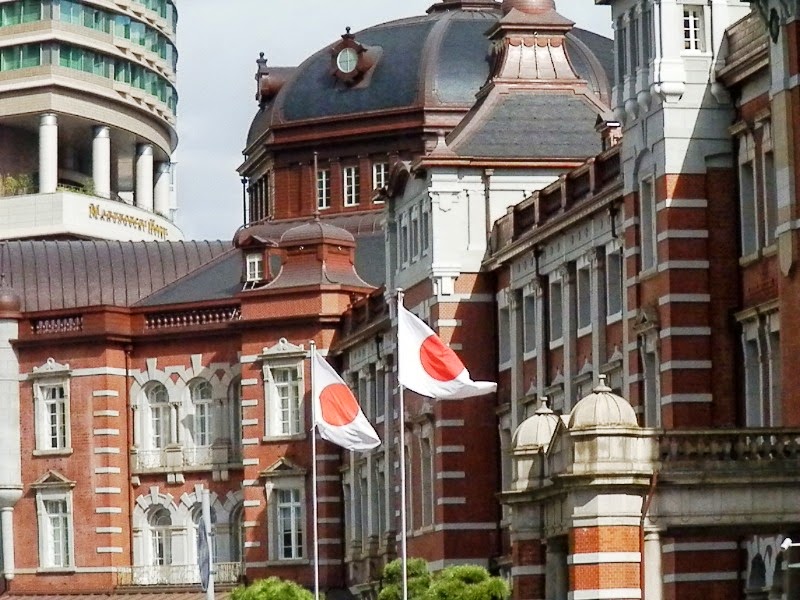
The Tokyo Station


Inflation vs. Deflation

As is often discussed in the global financial community, Japan has been in deflation in these decades. specifically since around the middle of 1990s.

After Japan became the second largest economy in the world in 1969, its economy further continued to grow, but after its economic bubble around 1989, the Japanese economy gradually into a blunting process while the US economy was boosted up riding on the IT boom and globalization of economy driven by the IT technology.  Further Japanese businesses started to move their plants and factories to China in a large scale to actively use cheap labor force in China so as to cope with the trend of globalization.

As a result, cheap products came to flood in the Japanese market and wages of Japanese workers came to stop increasing.  Though the natural environment of Japan was somewhat protected from further industrialization as many factories moved to China, this relationship with China introduced deflation in the Japanese society.

In a wider view, even the EU and North America now face deflationary pressure arising from globalization of economy that helps developing countries, like China, India, etc., carry out industrialization and export cheap products of reasonable quality to the advanced countries.  The IT technology, consisting of advanced computers and the Internet, has contributed to this new Industrial Revolution in the world.  But, it is also posing deflationary pressure to the EU, the US, and Japan.

However, it is also interesting to see a trend of monetary base, since it tells that the central banks of the advanced countries have supplied a huge amount of money for the global market to cope with deflationary pressure that was however caused by the 2008 Financial Crisis (as a direct factor).  When the financial systems in the US and the EU became unable to function normally, its influence was clearly manifested in consumers' attitudes.  The demand shrank while strong supply potential remained intact.  Businesses faced bankruptcy.  To keep a certain level of demand and operation of businesses, the central banks had to take charge of financially supporting the money market and circulating funds in society.  It was a clear tug of war between deflation power and inflation inertia.    


http://therealasset.co.uk/monetary-tectonics/


Inflation continuing forever will surely destroy the global environment as it was feared in Japan in early 1990s before many Japanese factories moved to China.  But can mankind cleverly control deflation to make all the members of the human species happy if not so materially rich?

One thing certain is the technological innovations will continue forever.  There will be always strong supply capability.  GDP of the whole world will continue to grow for centuries ahead.  But, this economic scheme is not aimed at making all the peoples in the world rich.  It is still in the hand of super-rich people who don't mind poor and unhappy people at all.  Inflation and deflation can be still a result of strategies of those super-rich people who are always trying to make themselves richer despite any crisis of the world and the earth.

We have to continue to keep watching the trend.


*** *** *** ***


Act 11:5 I was in the city of Joppa praying: and in a trance I saw a vision, A certain vessel descend, as it had been a great sheet, let down from heaven by four corners; and it came even to me:

Tuesday, November 04, 2014

"Go and shew John again those things" - Saladin


The Tokyo Station


Saladin

ISIS and AlQaeda should learn from a great Muslim leader in the 12th century: Saladin.

He was from a Kurdish family and was born in Tikrit, Mesopotamia; When he died, he was buried in Damascus.
Ṣalāḥ ad-Dīn Yūsuf ibn Ayyūb (Arabic: صلاح الدين يوسف بن أيوب‎; Kurdish: سه‌لاحه‌دین ئه‌یوبی , Selahedînê Eyûbî) (1137/1138 – 4 March 1193), better known in the Western world as Saladin, was the first Sultan of Egypt and Syria and the founder of the Ayyubid dynasty. A Muslim of Kurdish[1][2][3] origin, Saladin led the Muslim opposition to the European Crusaders in the Levant. At the height of his power, his sultanate included Egypt, Syria, Mesopotamia, Hejaz, Yemen and other parts of North Africa.
...
Saladin achieved a great reputation in Europe as a chivalrous knight due to his fierce struggle against the crusaders and his prodigality. Although Saladin faded into history after the Middle Ages, he appears in a sympathetic light in Gotthold Ephraim Lessing's play Nathan the Wise (1779) and in Sir Walter Scott's novel The Talisman (1825). The contemporary view of Saladin originates mainly from these texts. According to Jonathan Riley-Smith, Scott's portrayal of Saladin was that of a "modern [19th Century] liberal European gentlemen, beside whom medieval Westerners would always have made a poor showing."[106] Despite the Crusaders' slaughter when they originally conquered Jerusalem in 1099, Saladin granted amnesty and free passage to all common Catholics and even to the defeated Christian army, as long as they were able to pay the aforementioned ransom (the Greek Orthodox Christians were treated even better, because they often opposed the western Crusaders). An interesting view of Saladin and the world in which he lived is provided by Tariq Ali's novel The Book of Saladin.[107]

http://en.wikipedia.org/wiki/Saladin#Recognition_and_legacy
 
While Saladin’s legacy is the retaking of Jerusalem, he is also well known for his generosity and compassion. While he was a military genius and a warrior with a cause, he believed that all people were inherently good, simply misguided. The Christian crusaders who fought against him in the battle to retake Jerusalem were treated with kindness and Saladin made sure to keep every promise made to the inhabitants of the city. He agreed to a treaty allowing Europeans to hold ports on the Palestinian coast and also allowed Christians the right o make pilgrimages to Jerusalem. This taking back of Jerusalem was final in the eyes of the Muslims, and while the crusades lasted another hundred years, the Christian fervor towards the holy city waned as the renaissance and economic growth began to spread through Europe (Setton 621).

http://www.inforefuge.com/the-life-history-of-saladin
However 800 years after Saladin's death, still the areas from the Kurdistan region to Tikrit, Syria, and Palestine are in bloody wars.  Something must be wrong in the Islamic world.

Anyway, Saladin was respected even by Dante who hated the founder of Islam:
When Dante Alighieri compiled his great medieval Who's Who of heroes and villains, the Divine Comedy, the highest a non-Christian could climb was Limbo. Ancient pagans had to be virtuous indeed to warrant inclusion: the residents included Homer, Caesar, Plato and Dante's guide, Vergil. But perhaps the most surprising entry in Dante's catalog of "great-hearted souls" was a figure "solitary, set apart."

That figure was Saladin.
It is testament to his extraordinary stature in the Middle Ages that not only was Saladin the sole "modern" mentioned--he had been dead barely 100 years when Dante wrote--but also that a man who had...

http://content.time.com/time/magazine/article/0,9171,993030,00.html
Now what we can do might be just to hope that the Mausoleum of Saladin will not be damaged by any Muslim fighters and soldiers.
Saladin died of a fever on March 4, 1193, at Damascus, not long after King Richard I's departure. In Saladin’s possession at the time of his death were 1 piece of gold and 47 pieces of silver. He had given away his great wealth to his poor subjects leaving nothing to pay for his funeral.[3] The mausoleum was originally built by Saladin's son, Al-Afdal ibn Salah ad-Din. Saladin's body was interred temporarily at the Citadel of Damascus until the construction of the building was completed in 1196. The madrasah was built later by Saladin's other son, Al-Aziz Uthman.[1] The mausoleum was rebuilt in 1898 under the patronage of the German Emperor William II who financed the repairs after he visited Damascus and found the tomb in a state of disrepair.[4]

http://en.wikipedia.org/wiki/Mausoleum_of_Saladin


*** *** *** ***


Mat 11:4 Jesus answered and said unto them, Go and shew John again those things which ye do hear and see:

Monday, November 03, 2014

"Lord hath need of him"


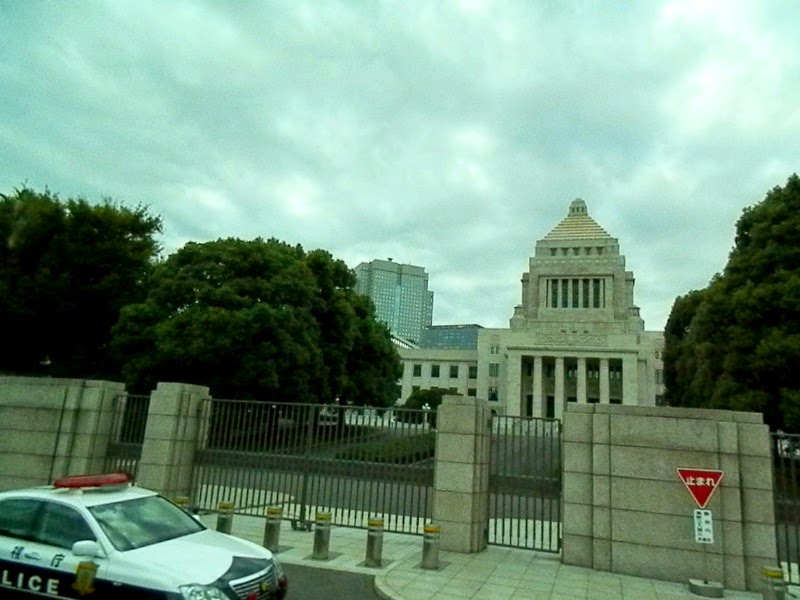
The National Diet Bldg., Tokyo


*** *** *** ***


Mar 11:3 And if any man say unto you, Why do ye this? say ye that the Lord hath need of him; and straightway he will send him hither.

Sunday, November 02, 2014

"Our Father which art in heaven" - Faith and Oil


Tokyo


Faith and Oil


One of interesting teachings by Christ Jesus is related to ten girls
Matthew 25:1-13New International Version (NIV)
The Parable of the Ten Virgins
 
25 “At that time the kingdom of heaven will be like ten virgins who took their lamps and went out to meet the bridegroom. 2 Five of them were foolish and five were wise. 3 The foolish ones took their lamps but did not take any oil with them. 4 The wise ones, however, took oil in jars along with their lamps. 5 The bridegroom was a long time in coming, and they all became drowsy and fell asleep.
6 “At midnight the cry rang out: ‘Here’s the bridegroom! Come out to meet him!’
7 “Then all the virgins woke up and trimmed their lamps. 8 The foolish ones said to the wise, ‘Give us some of your oil; our lamps are going out.’
9 “‘No,’ they replied, ‘there may not be enough for both us and you. Instead, go to those who sell oil and buy some for yourselves.’
10 “But while they were on their way to buy the oil, the bridegroom arrived. The virgins who were ready went in with him to the wedding banquet. And the door was shut.
11 “Later the others also came. ‘Lord, Lord,’ they said, ‘open the door for us!’
12 “But he replied, ‘Truly I tell you, I don’t know you.’
13 “Therefore keep watch, because you do not know the day or the hour. 
This is a very cruel parable.  Foolish girls are helpless, and nobody feels sympathy for them.  It is as if they were punished only because of their negligence.  How can the kingdom of heaven be so stern to people?  Can't it be more generous and tolerant?

But the lamp might be the human soul and oil might be faith.  And a soul without faith should be useless in the kingdom of heaven.  And, more gravely, you cannot borrow faith from others.

However, this situation of the ten young women might be related to a certain incident of the days when Christ Jesus was preaching.  He must have observed ten girls a half of whom had faith and another half had not.  Christ Jesus wanted to give a warning to them, without taking a harsh stance.  He meant that every girl was given the same lamp or the soul.  To fill it with oil is their responsibility.  They had to make an effort by themselves.  And an effort cannot be borrowed from others.  

Now I think that Christ Jesus must see three girls today: a Jewish girl, a Christian girl, and a Muslim girl.  Each has her own lamp.  But who has not oil?


*** *** *** ***


Luk 11:1 And it came to pass, that, as he was praying in a certain place, when he ceased, one of his disciples said unto him, Lord, teach us to pray, as John also taught his disciples.
Luk 11:2 And he said unto them, When ye pray, say, Our Father which art in heaven, Hallowed be thy name. Thy kingdom come. Thy will be done, as in heaven, so in earth.

Friday, October 31, 2014

"in remembrance in the sight of God" - Who is a Jew and What is the Solution?


Around Tokyo


Who is a Jew and What is the Solution?


Now the mainstream religion in the world is Christianity in terms of success of material civilization and spiritual culture realized by believers of a religion.

So, it is very dangerous for anybody to be identified as an enemy of Christianity, since Christians have great weapons of material wealth and spiritual influences.

As everybody sees, there are two major groups of people who might face this danger: Jewish people and Muslims.  But Muslims are large in the number; there are 1.5 billion Muslims.  They can well cope with pressure from Christians whose number is 2.3 billion.  But there are only 15 million Judaists in the world.  Being Jewish or being identified as a Judaist can be so dangerous sometimes as having been observed in Europe in WWII.  If you are subjectively no more a Judaist, you could be still persecuted, provided that you were identified as such by others with power.

But who would be identified as Jewish by dangerous Christians?    
Who is a Jew?

The 2013 Pew Research study of American Jews found that 62% thought that being Jewish was mainly a matter of ancestry and culture, while 15% thought that it was mainly a matter of religion. Of those who stated themselves to be Jews by religion, 55% thought that being Jewish was mainly a matter of ancestry and culture, while two-thirds thought that it was not necessary to believe in God to be Jewish.

Israeli immigration laws will accept an application for Israeli citizenship if there is proven documentation that any grandparent—not just the maternal grandmother—was Jewish. This does not mean that person is an "ethnic Jew", but Israeli immigration will accept that person because he or she has an ethnically Jewish connection, and because this same degree of connection was sufficient to be persecuted as a Jew by the Nazis. See Jewish ethnic divisions.

http://en.wikipedia.org/wiki/Who_is_a_Jew%3F#Jews_who_have_practiced_another_religion
In the past, many Jewish people living in the Iberian Peninsula were forced to convert to Christianity by Spanish and Portuguese Christians around 1490 or when the era of Columbus started.  Otherwise, they were forced to leave Spain or Portugal.  But, most of these converts were not trusted ant put into the Inquisition.

At this stage of history, it seems that conversion cannot be a solution to a question on how Jewish people could secure safety if they have to resort to any means to save themselves from evil Christians such as Hitler.

Probably, the solution is for people of any religion to study harder religions, including their own religion and others' religions.

The more you learn Christianity, for example, the more you don't like to make Judaists suffer for the only reason that they are Judaists.


*** *** *** ***


Act 10:31 And said, Cornelius, thy prayer is heard, and thine alms are had in remembrance in the sight of God.

Thursday, October 30, 2014

"the very hairs of your head" - The Most Influential Judaists of Today


Tokyo


The Most Influential Judaists of Today

Who are the most influential Judaists of today chosen by Israelis?
The Jerusalem Post's  Top 50 Most Influential Jews of 2014  list:
1. Jack Lew
2. Janet Yellen
3. Binyamin Netanyahu
4. Shimon Peres
5. Sheldon Adelson
6 Malcolm Hoenlein
7. Avigdor Liberman
8. Adina Bar-Shalom
9. Yair Lapid
10. Naftali Bennett 
http://www.jpost.com/Jewish-World/Jewish-Features/The-Jerusalem-Posts-top-50-most-influential-Jews-of-2014-355215
JACK LEW is the most powerful Jew in the US administration, the world’s top superpower. Formerly President Barack Obama’s chief of staff, his current post of secretary of the Treasury puts him in one of the key jobs in the executive cabinet: proctoring economic recovery, forecasting future debt, and managing a complex infrastructure of international sanctions. The Treasury, not the Pentagon, would be responsible for the weapon of choice used by Obama against a nuclear Iran, and Lew has been central in shaping the policy.

JANET YELLEN made history this year when she became the first woman ever appointed chair of the US Federal Reserve. This made her one of the most influential people in the world, and arguably the most influential woman.
She was voted No. 2 on Forbes’s list of The World’s 100 Most Powerful Women this year.

Binyamin Netanyahu, Prime minister of Israel
BY THE very nature of the position, the prime minister of Israel – regardless of who occupies that office at any given time – must be high atop any list of the world’s most influential Jews.


Shimon Peres , President of Israel
ANYONE WHO thinks that after July 26, when his seven- year term as president expires, Shimon Peres will fade into oblivion is greatly mistaken. Let it not be forgotten that he is the country’s only president who was also prime minister and vice president of the Socialist International.

Sheldon Adelson, CEO and owner of Sands Hotel and Casino, philanthropist
A TENDENCY towards entrepreneurship was already evident when Sheldon Adelson, chairman of the board, CEO and principal owner of the Sands Hotel and Casino in Las Vegas, was still a boy in his native Boston. He was only 12 years old when he first went into business by borrowing $200 from his uncle to buy a license to sell newspapers.

Malcolm Hoenlein, Vice chairman of the Conference of Presidents of Major American Jewish Organizations
A NUMBER of poky rooms in the back of the Jewish Agency’s New York office on Manhattan’s East Side appear to suffice for the Conference of Presidents of Major American Jewish Organizations and its longtime president.

Avigdor Liberman, Foreign minister of Israel
WHAT A year it has been for Foreign Minister Avigdor Liberman. He was acquitted on charges of corruption, ending a legal saga that stretched for nearly 17 years.

Adina Bar-Shalom. Founder of the Haredi College for Women
ADINA BAR-SHALOM is not a radical revolutionary. But since the death of her father Rabbi Ovadia Yosef – the leader of the Shas party – last October, the 69-year-old Tel Aviv mother of three has been increasingly daring, at least according to the standards of the ultra-Orthodox community into which she was born.

Yair Lapid, Finance minister of Israel
LAST YEAR, Finance Minister Yair Lapid topped this list.
He was chosen because he had rocketed his way to the top of the Israeli consciousness and redefined the country’s priorities away from security concerns and toward domestic issues, galvanizing an otherwise splintered Center bloc.

Naftali Bennett, Economy minister of Israel
WHENEVER BAYIT Yehudi leader Naftali Bennett was asked about the Palestinian conflict during the election campaign, he gave a short answer and tried to change the subject to what he really cared about.

http://www.jpost.com/Jewish-World/Jewish-Features/The-50-most-influential-Jews-of-2014-1-10-355218
It seems that Judaists or Israelis regard at least part of America, from Las Vegas to Washington DC, as an extension of Israel, though Israel must be destined to be part of the US and finally abandoned.


*** *** *** ***


Mat 10:30 But the very hairs of your head are all numbered.

Wednesday, October 29, 2014

"for my sake, and the gospel's" - Who Instead of Judaists?


The Tokyo Station


Who Instead of Judaists?


This great era that started with the emergence of Christ Jesus should end with a final solution of difficult relationships between Judaists and Christians and , probably, those between Judaists/Christians and Muslims.
Persecution of Jews has occurred on many occasions and at widely different geographical locations. Persecution has been a major part of Jewish history, and it has affected the history and social development of the countries and societies in which the persecution occurred. Europe and the Middle East have been chief areas of persecution throughout the ages.

In the Middle Ages Antisemitism in Europe was religious. Though not part of Roman Catholic dogma, many Christians, including members of the clergy, have held the Jewish people collectively responsible for killing Jesus, a practice originated by Melito of Sardis. As stated in the Boston College Guide to Passion Plays, "Over the course of time, Christians began to accept … that the Jewish people as a whole were responsible for killing Jesus. According to this interpretation, both the Jews present at Jesus Christ's death and the Jewish people collectively and for all time, have committed the sin of deicide, or "god-killing". For 1900 years of Christian-Jewish history, the charge of deicide has led to hatred, violence against and murder of Jews in Europe and America."

http://en.wikipedia.org/wiki/Persecution_of_Jews
However, along with prevalence of non-religious material civilization and modern culture, more and more Europeans, Americans, and other peoples seem to lose their adherence to religion.  Accordingly, only money counts but not religions.  If somebody is rich, nobody seems to care about what religion he believes.  But can it be a true solution to the inherently difficult relationships between Judaists and Christians.

Anyway, we have come to a point in history where such a solutions is requested by God, but we seem to forget even our religions.  Outwardly, the situation might look as if there were no such a problem of the difficult relationships, but probably we cannot enter a true new era if we cannot solve it definitely once and for all.

Today, no Jewish people are persecuted in Europe, America, or any part of the world only because they are Judaists.  But, has mankind truly and honestly conquered this most difficult problem in these 2000 years?

If not, the majority of people might start to find another scapegoat instead of Judaists.


*** *** *** ***


Mar 10:28 Then Peter began to say unto him, Lo, we have left all, and have followed thee.
Mar 10:29 And Jesus answered and said, Verily I say unto you, There is no man that hath left house, or brethren, or sisters, or father, or mother, or wife, or children, or lands, for my sake, and the gospel's,
Mar 10:30 But he shall receive an hundredfold now in this time, houses, and brethren, and sisters, and mothers, and children, and lands, with persecutions; and in the world to come eternal life.

Tuesday, October 28, 2014

"this do, and thou shalt live" - The Bible vs. Witch-Hunts


Around Tokyo


The Bible vs. Witch-Hunts


The most critical incident immediately before the era of Columbus and Martin Luther was intensification of witch-hunt movement, though witch hunts continued to the 15th, 16th, and 17th centuries even in Protestant countries.
 In 1484, in the Late Middle Ages, Pope Innocent VIII issued Summis desiderantes affectibus, a Papal bull authorizing the "correcting, imprisoning, punishing and chastising" of devil-worshippers who have "slain infants", among other crimes. He did so at the request of two inquisitors, Heinrich Kramer and Jacob Sprenger, members of the Dominican Order, who had been refused permission by the local bishops in Germany to investigate.

(In 1487 Pope Innocent VIII endorsed the Malleus Maleficarum [the 'Hammer against the Witches']. It accused women of destroying men by planting bitter herbs throughout the field.)

In 1487, Kramer and Sprenger published the notorious Malleus Maleficarum (the 'Hammer against the Witches') which, because of the newly invented printing presses, enjoyed a wide readership. The book was soon banned by the Church in 1490, and Kramer and Sprenger censured, but it was nevertheless reprinted in 14 editions by 1520 and became unduly influential in the secular courts. In 1538 the Spanish Inquisition cautioned its members not to believe what the Malleus said, even when it presented apparently firm evidence.[25]

http://en.wikipedia.org/wiki/Witch-hunt
The reason why witch hunts ceased to be exercised in Europe around the 17th century is not clear.  No Popes, no kings, or no revolutionary leaders in Europe delivered a strong request or order to stop witch hunting, but it gradually vanished from the European society.

Probably, it must have been wider circulation of the printed Bibles. With the invention of letterpress printing machine, many copies of the Bibles were made available in Europe since Gutenberg printed the New and Old Testaments in 1455.

The Bible defeated Satan who drove people to witch hunts, eventually.

Then, what did the Koran defeat?


*** *** *** ***


Luk 10:26 He said unto him, What is written in the law? how readest thou?
Luk 10:27 And he answering said, Thou shalt love the Lord thy God with all thy heart, and with all thy soul, and with all thy strength, and with all thy mind; and thy neighbour as thyself.
Luk 10:28 And he said unto him, Thou hast answered right: this do, and thou shalt live.
Luk 10:29 But he, willing to justify himself, said unto Jesus, And who is my neighbour?

Monday, October 27, 2014

"found many that were come together" - A Story at a Tomb around Jerusalem


Around Tokyo


A Story at a Tomb around Jerusalem


I can interpret the Resurrection of Christ Jesus in the following way.

Prior to his arrest by Roman soldiers in the night when Judas Iscariot betrayed Him, in a mountain Christ Jesus met one of His brothers and a Roman officer to plan and make arrangements about His Resurrection.

Then at the Crucifixion, a Roman soldier who had come to believe in Christ Jesus pretended to be a cool executor of the crucifixion prevented other soldiers from harming the body of Christ Jesus fatally, but let women who followed Christ Jesus take His body in a state of apparent death.

The women wrapped the body of Christ Jesus in a big shroud a rich old Israelite provided.  They carried His wrapped body into a tomb while armed guards were watching as Jewish priests asked the Roman authority.

And in the night of the next day when new guards took over, they rolled the rock that blocked the entrance to the tomb and let the brother of Christ Jesus come into the tomb chamber to help Him revive and get out of the tomb.  Then they set the rock again at the entrance.  And, in the second day, new guards took a turn.

In the early morning of the third day, Christ Jesus and His brother performed something astonishing to the guards who then fell in.a faint.  They together rolled the rock to the side so that some women, expected to come soon, could enter the tomb easily.  They also checked the shroud with an image of Christ Jesus mysteriously imprinted there and waited for His followers to come.  When the female followers of Christ Jesus came to the tomb, they saw Christ Jesus and His brother who looked like wearing snow white clothes like angels.

In this way, the miracle of the Resurrection was completed with love, faith, and cooperation of a brother of Christ Jesus who loved his brother so much and a certain Roman officer and soldiers who believed in Christ Jesus so enthusiastically.

Nonetheless, you may think that simply a miracle happened in the tomb and the rock rolled off its entrance by itself through the power of Christ Jesus.

But, as betrayal looked like so common in those days, one Roman office must have betrayed the Roman authority and anti-Christ Jewish priests to balance with the betrayal of Judas.


*** *** *** ***


Act 10:25 And as Peter was coming in, Cornelius met him, and fell down at his feet, and worshipped him.
Act 10:26 But Peter took him up, saying, Stand up; I myself also am a man.
Act 10:27 And as he talked with him, he went in, and found many that were come together.
Act 10:28 And he said unto them, Ye know how that it is an unlawful thing for a man that is a Jew to keep company, or come unto one of another nation; but God hath shewed me that I should not call any man common or unclean.

Sunday, October 26, 2014

" because ye are not of my sheep" - Jesus' Miracle on Lazarus


 Sagami Bay on the Pacific, Japan


Jesus' Miracle on Lazarus

Without the descriptions about miracles Christ Jesus performed, the Gospel might be very short and simple.
A List of All The Miracles of Jesus 
Control of Nature
1. Calming the storm – Matthew 8:23-27; Mark 4:37-41; Luke 8:22-25
2. Feeding 5,000 - Matthew 14:14-21; Mark 6:30-44; Luke 9:10-17; John 6:1-14
3. Walking on water - Matthew 14:22-32; Mark 6:47-52; John 6:16-21
4. Feeding 4,000 – Matthew 15:32-39; Mark 8:1-9
5. Fish with coin – Matthew 17:24-27
6. Fig tree withers – Matthew 21:18-22; Mark 11:12-14, 20-25
7. Huge catch of fish – Luke 5:4-11; John 21:1-11
8. Water into wine – John 2:1-11
 
Healing of Individuals
1. Man with leprosy – Matthew 8:1-4; Mark 1:40-44; Luke 5:12-14
2. Roman centurion’s servant – Matthew 8:5-13; Luke 7:1-10
3. Peter’s mother-in-law – Matthew 8:14-15; Mark 1:30-31; Luke 4:38-39
4. Two men possessed with devils – Matthew 8:28-34; Mark 5:1-15; Luke 8:27-39
5. Man with palsy – Matthew 9:2-7; Mark 2:3-12; Luke 5:18-26
6. Woman with bleeding – Matthew 9:20-22; Mark 5:25-34; Luke 8:43-48
7. Two blind men – Matthew 9:27-31
8. Dumb, devil-possessed man - Matthew 9:32-33
9. Canaanite woman’s daughter – Matthew 15:21-28; Mark 7:24-30
10. Boy with devil - Matthew 17:14-21; Mark 9:17-29; Luke 9:38-43
11. Two blind men – including Bartimaeus - Matthew 20:29-34; Mark 10:46-52;
 
Luke 18:35-43
12. Demon-possessed man in synagogue – Mark 1:21-28; Luke 4:31-37
13. Blind man at Bethsaida – Mark 8:22-26
14. Crippled woman – Luke 13:10-17
15. Man with dropsy – Luke 14:1-4
16. Ten men with leprosy – Luke 17:11-19
17. The high priest’s servant – Luke 22:50-51
18. Nobleman’s son at Capernaum – John 4:46-54
9. Sick man at the pool of Bethsaida – John 5:1-15
20. Man born blind – John 9:1-41
 
Raising the Dead
1. Jairus’ daughter – Matthew 9:18-26; Mark 5:21-43; Luke 8:40-56
2. Widow’s son at Nain – Luke 7:11-17
3. Lazarus – John 11:1-44

http://www.sharefaith.com/guide/christian-ministries/ministry-of-jesus/miracles-of-jesus/miracles-of-jesus---the-list.html
Except the Resurrection, the most powerful miracle is the rise of Lazarus.
Can the miracles of Jesus be explained naturally?  It is certainly possible that some might be explained with non-divine answers, but can all of them? 
Jesus raised the dead (Matt. 9:25; John 11:43-44). 
Those who were dead really only appeared to be dead--given that the people of the time were not aware of many of the medical intricacies that can lead to people looking dead when they were not really dead.  
This explanation is certainly possible, but is it really that likely?  People in ancient times were far more familiar with death than we are.  Our people die in hospitals away from the families.  Undoubtedly, we are less familiar with death then they were.  It is more probable that they knew when people were actually dead, especially since the dead were left in stasis for several days as they were washed and prepared for burial. 
The John 11 account of Lazarus' resurrection.

http://carm.org/questions/about-jesus/cant-all-jesus-miracles-be-explained-naturally

I think it was true that Lazarus had been dead already before Christ Jesus came to the tomb where Lazarus was laid down.  But how did this miracle of reviving Lazarus worked physically?  Did all the atomic elements and molecules that made Lazarus' body start to move along with the voice of Christ Jesus to the states they had been in when Lazarus was alive? Maybe.

But more simply, I think that time flew in a reversed manner inside Lazarus.  So, from the time when he was dead to the time when he was alive, the time tracked back.  After he became alive again, the time started to flow ordinarily.

Otherwise, somebody wanted to kill Lazarus.  And while Lazarus was alive, that somebody pronounced Lazarus dead.  But Christ Jesus could see the evil scheme.  He only called Lazarus making him realize that he was not dead in the darkness of death but simply in the darkness of the tomb.  Christ Jesus saved Lazarus from the fatal intrigue.


*** *** ***


Joh 10:25 Jesus answered them, I told you, and ye believed not: the works that I do in my Father's name, they bear witness of me.
Joh 10:26 But ye believe not, because ye are not of my sheep, as I said unto you.
Joh 10:27 My sheep hear my voice, and I know them, and they follow me:

Saturday, October 25, 2014

"for the disciple that he be as his master"


Pacific Coast Line Southwest of Tokyo


*** *** *** ***


Mat 10:24 The disciple is not above his master, nor the servant above his lord.
Mat 10:25 It is enough for the disciple that he be as his master, and the servant as his lord. If they have called the master of the house Beelzebub, how much more shall they call them of his household?
Mat 10:26 Fear them not therefore: for there is nothing covered, that shall not be revealed; and hid, that shall not be known.

Friday, October 24, 2014

" how hard is it for them that trust in riches" - Without Christ Jesus?


Tokyo


Without Christ Jesus?


To believe that there is only one God who created this universe might not be so difficult if we honestly observe the nature around us, especially, in a scientific manner.

Indeed the nature is so well designed with some simple basic elements though a multitude of their combinations have produced so diverse phenomena and living things.  There must be a great designer or designers of this universe, and it must be only one designer since all the physical laws are so well unified as if they were intended to achieve a sole goal, namely to generate human beings with souls eventually in this universe, which suggests that the designer is only one.

So, we can believe that there is one God that created this universe.   But, the idea that the God sent His son to the human world is hard to believe.
Most Often Quoted
One of the greatest, and most often quoted, verses in the Bible is actually a quote from Jesus.

John 3:16 For God so loved the world, that he gave his only begotten Son, that whosoever believeth in him should not perish, but have everlasting life.

http://www.whatchristianswanttoknow.com/words-of-jesus-15-amazing-bible-quotes/
Conversely, we had better think about what should have happened to mankind if the God had not sent His only son to the earth.
If Christ Had Not Come . . . we would not know the Father

It is sometimes easy to forget that without Christ, Jehovah would be, for many people, an inscrutable, faraway, mysterious Being. Even today in some countries, countless thousands and even millions of people worship images of wood or stone, hoping to appease a detached deity. For them, the idols represent gods who are harsh, condemning, and difficult to please.

The ancient Hebrews received from God a system of law that could be misunderstood by those who fail to comprehend the father love of Jehovah. Many Israelites failed to see the true intent of the Law and its purpose as a standard of righteousness. For them, it became the restrictive rules of a God who lashed out in anger at those who failed to obey the Law. They feared God for what He might do, but they failed to appreciate Him for who He truly was.

When Jesus of Nazareth began His ministry, He described God as a heavenly Father who cared for the most undeserving of His children. The Savior portrayed Jehovah as a parent awaiting the return of His prodigal child. The man from Galilee encircled children with His arms, touched repulsive lepers, and taught that God sympathized with a sparrow when it fell to the ground-anywhere in the world. When Philip said to the Lord, "Shew us the Father, and it sufficeth us," Jesus answered, "Have I been so long time with you, and yet hast thou not known me, Philip? he that hath seen me hath seen the Father; and how sayest thou then, Shew us the Father?" (see John 14:8-9). God is exactly like Jesus, but that glorious fact would have remained unknown if the Lord had not come to earth.

If Christ Had Not Come . . . prayer would be impossible

Within the ancient world, only special people had access to God. Moses went into the mountain to meet the Almighty; Elijah prayed and God responded by preventing rain from falling over a period of three and a half years; Isaiah, Daniel, and others prayed and received responses from heaven, but such experiences were unknown among ...

http://www.sermonsearch.com/sermon-outlines/22142/the-worldwithout-christ/
Put simply, it is a revolution that Christ Jesus had carried out in His lifetime around 4 BC to 30 AD.  As it was so revolutionary, it captured the minds of Paul and others including Israelites and pagans.

The core of the revolutionary notion is that the God takes greatly care about and takes deeply thought of each human being, so unconditionally.  What's more God might get angry so fiercely on people who do not obey and observe His teaching directed to love, justice, and humility.

More specifically, the God will save every individual, but everyone has a responsibility to trust and follow the God and the Son of God.

As Paul and pagans in the Roman Empire realized extravagant meanings of this revolutionary concept, they could not help but devote their lives on this revolution.  Probably the shock they felt must have been greater than that ancient people should have felt when they had been shown the structure of this solar system and its position in the galaxy.

Nonetheless, there remains still an enigma: Why did the God have to create the universe and mankind, troubling Himself so much as to send His Only Son to the earth for the purpose to save human souls from Satan.


*** *** *** ***


Mar 10:24 And the disciples were astonished at his words. But Jesus answereth again, and saith unto them, Children, how hard is it for them that trust in riches to enter into the kingdom of God!

Thursday, October 23, 2014

"Blessed are the eyes which see the things" - The Sun and The End of the World


Tokyo


The Sun and The End of the World


We may sometimes wonder how the human world will end, since eschatology is an important theme of the Bible.
End of The World: Top 5 Popular Scenarios

1: Extraterrestrial Impact
 
This scenario is where there is an impact of a large extraterrestrial object with the Earth.

2: Pandemic
 
A pandemic taken from the Greek words pan all and demos people, it is a spreading of infectious disease that propagates through populations across a large region. 
3: Climate Change 
Throughout the Earths history there has always been climate change, in this end of the world scenario we take the meaning of climate change as when the environment becomes too hostile to support current human life populations.

4: Nuclear War
 
Since the creation of the atom bomb in the 1940's, there has been a new threat to mankind, nuclear war.  
5: Gray goo (nanobots) 
Nanorobots (nanobots, nanoids, nanites or nanonites) are typically conceived to be devices ranging in size from 0.1-10 micrometers and constructed out of nanoscale or molecular components. As no artificial non-biological nanorobots have yet been created, they remain a hypothetical end of the world concept. 
Gray goo phrase is given to the concept of out-of-control self-replicating robots consume all matter on Earth while building more of themselves.

http://drwibble.hubpages.com/hub/End-of-The-World-Top-5-Scenarios
However, we have to think about our origin first when handling our survival, the matter about ourselves so grave and significant.  It is because there must be a kind of relationship between the beginning and the end of our existence.  Moreover, if we were an extraterrestrial being, we would surely check from how human beings came to exist to how it has ceased to exist all through history of human beings when we examine the fate of them.

Pu simply as we, mankind, came to exist receiving energy from the sun like any other living things, we might face the end of our history due to some special condition of the future sun.  Then, how can the sun destroy human beings?
Ice age on the way as scientists fear the Sun is 'falling asleep' 
A NEW ice age could be on its way to Europe after scientists warned of an alarming fall in the performance power of the Sun. 
By: Owen BennettPublished: Sat, January 18, 2014

The number of gas explosions on the Sun's surface should be at the peak of its 11-year cycle of activity, but there has been an unexpected drop off. 
One space physicist said he had not seen anything like it in his 30 year career, and there are fears the temperatures could drop so low the Thames might freeze over.
"If you want to go back to see when the Sun was this inactive... you've got to go back about 100 years," Richard Harrison, head of space physics at the Rutherford Appleton Laboratory in Oxfordshire told the BBC. 
One of the Sun's biggest lulls came in the 17th century, known as the Maunder Minimum, at the same time as freezing winters swept across Europe. 
That caused not only the River Thames to freeze solid,  allowing Londoners to enjoy frost fairs, but even the Baltic Sea iced over in some of the harshest conditions ever recorded in Europe. 
Dr Lucie Green, from University College London's Mullard Space Science Laboratory told the BBC: "It's completely taken me and many other solar scientists by surprise."
After this sudden calming of the Sun, scientists wonder whether its activity will continue to fall. 
"It would feel like the Sun is asleep... a very dormant ball of gas at the centre of our Solar System," said Dr Green. 
"There is a very strong hint that the Sun is acting in the same way now as it did in the run-up to the Maunder Minimum."

http://www.express.co.uk/news/uk/454657/Ice-age-on-the-way-as-scientists-fear-the-Sun-is-falling-asleep

Specifically we can refer to data and a graph showing centuries-long fluctuation of influences of the sun on the earth.


Finally, the Sun may influence the Earth's climate also in other, more convoluted ways, e.g. by modulating the flux of cosmic rays, which have been proposed to increase the coverage by low-lying clouds.

But how strong the Sun's influence is and which mechanism is playing the main role is a matter of current research. The Sun's influence on the Earth's climate can not be measured directly. However, good correlations have been found between different proxies of solar activity and climate records, for example, between the concentration of 14C in tree rings and glacier fluctuations (Fig.1).
Fig. 1. Sunspot number (green line) and the concentration of 14C in tree rings (red) as proxies of solar activity versus glacier fluctuations (white circles; after Eddy 1976, Nature 192, 1189).

Another example is the the coincidence of the so called Maunder minimum (a period in the second half of the 17th centuty when hardly any sunspots were seen during more than 50 years, see Fig. 1) with the Little Ice Age in Europe, a time of severe cold and great hardship, when the Thames froze regularly and alpine glaciers grew deep into the valleys. The latter is greatly illustrated by painters of Dutch school, showing winter scenes, ice-covered canals, figures skating and sledging (Fig. 2).
http://www2.mps.mpg.de/projects/sun-climate/se_body.html

In a longer time span through the history of the earth, it has experienced an ice age in several times.
What is an ice age? An ice age is a long interval of time (millions to tens of millions of years) when global temperatures are relatively cold and large areas of the Earth are covered by continental ice sheets and alpine glaciers. Within an ice age are multiple shorter-term periods of warmer temperatures when glaciers retreat (called interglacials or interglacial cycles) and colder temperatures when glaciers advance (called glacials or glacial cycles).

At least five major ice ages have occurred throughout Earth’s history: the earliest was over 2 billion years ago, and the most recent one began approximately 3 million years ago and continues today (yes, we live in an ice age!).

Currently, we are in a warm interglacial that began about 11,000 years ago. The last period of glaciation, which is often informally called the “Ice Age,” peaked about 20,000 years ago. At that time, the world was on average probably about 10°F (5°C) colder than today, and locally as much as 40°F (22°C) colder.


Simplified chart showing when the five major ice ages occurred in the past 2.4 billion years of Earth’s history. Modified from several sources including Dynamical Paleoclimatology: Generalized Theory of Global Climate Change, 2002, by Barry Saltzman.

http://geology.utah.gov/surveynotes/gladasked/gladice_ages.htm

If severer condition of the current ice age should come to be manifested and engulf the whole earth to continue for 100 years or more, if not one million years, the human civilization would be frozen and disintegrated.  The end of the world for human beings must surely come if the condition should continue for 1,000 years.


*** *** *** ***


Luk 10:23 And he turned him unto his disciples, and said privately, Blessed are the eyes which see the things that ye see:

Wednesday, October 22, 2014

"it was at Jerusalem the feast" - The Right Side and The Wrong Side of 1492


Asakusa, a Tokyo Downtown


The Right Side and The Wrong Side of 1492

In 1492, Columbus started to sail to a new world over the Atlantic Ocean.  But in the same year, corruption of the Vatican reached one of the worst levels.

ALEXANDER VI. (Rodrigo Borgia) (1431-1503), pope from 1492 to his death, is the most memorable of the corrupt and secular popes of the Renaissance. He was born (January 1, 1431) at Xativa, near Valencia in Spain, and his father's surname was Lanzol or Llancol; that of his mother's family, Borgia or Borja, was assumed by him on the elevation of his maternal uncle to the papacy as Calixtus III. (April 8, 1455).
...

His manners were agreeable and his appearance fascinating, but, like many other prelates of the day, his morals were far from blameless, his two dominant passions being greed of gold and love of women, and he was devotedly fond of the children whom his mistresses bore him.
...

Before his elevation to the papacy Cardinal Borgia's passion for Vannozza somewhat diminished, and she subsequently led a very retired life. Her place in his affections was filled by the beautiful Giulia Farnese (Giulia Bella), wife of an Orsini, but his love for his children by Vannozza remained as strong as ever and proved, indeed, the determining factor of his whole career. He lavished vast sums on them and loaded them with every honour. A characteristic instance of the corruption of the papal court is the fact that Borgia's daughter Lucrezia (see BORGIA, LUCREZIA) lived with his mistress Giulia, who bore him a daughter Laura in 1492.
...

On the death of Pope Innocent VIII. the three likely candidates for the Holy See were Cardinals Borgia, Ascanio Sforza and Giuliano della Rovere; at no previous or subsequent election were such immense sums of money spent on bribery, and Borgia by his great wealth succeeded in buying the largest number of votes, including that of Sforza, and to his intense joy he was elected on the 10th of August 1492, assuming the name of Alexander VI. Borgia's elevation did not at the time excite much alarm, except in some of the cardinals who knew him, and at first his reign was marked by a strict administration of justice and an orderly method of government in satisfactory contrast with the anarchy of the previous pontificate, as well as by great outward splendour. But it was not long before his unbridled passion for endowing his relatives at the expense of the church and of his neighbours became manifest. For this object he was ready to commit any crime and to plunge all Italy into war.

http://historymedren.about.com/od/aentries/a/11_pope_alex6.htm 
So, history tells us that when Europe was on the verge of irredeemable corruption symbolized by the emergence of a putrid Pope, God gave another big chance for salvation to mankind through Columbus.

The historical fact that the two incidents occurred in the same year means that the so-called discovery of America and the religious standstill of Christianity movement led by the Vatican represent the right side and the wrong side of a coin.

If there was no American Continent and the Atlantic and the Pacific formed one super-big ocean, Columbus could not have reached anywhere and Europe would have been morally degraded irremediably.

It is not simple to see how and what good influences the discovery of America had on the status of the Vatican and Christianity, but it is also a historical fact that the Vatican threw heavily itself to missions in South America.  As the incumbent Pope is from Argentina, Latin America must have given a kind of breakthrough in spirit of the Vatican.  Of course, their missions to Africa and Asia also contributed to uplift of morale of the Vatican.  But, Popes and other Vatican bishops must have felt a divine providence in the discovery of the new world, America.  They had then found a new stage to redo their stalemated religious missions despite the emergence of corrupt Popes such as Alexander VI.

It is a lesson to lean from incidents in 1492.

Today, the world has become more complicated.  But the emergence of horrible Islamic terrorists and ISIS must be balanced with something hopeful.  So then, what is the right side of a coin this time?


*** *** *** ***


Joh 10:22 And it was at Jerusalem the feast of the dedication, and it was winter.
Joh 10:23 And Jesus walked in the temple in Solomon's porch.
Joh 10:24 Then came the Jews round about him, and said unto him, How long dost thou make us to doubt? If thou be the Christ, tell us plainly.

"The lips of the righteous feed many" - Crude Oil, Desire and Tragedy


Around Tokyo


Crude Oil, Desire and Tragedy

The material civilization we are today enjoying heavily relies on crude oil and steel.

Especially without crude oil, we would have almost no electricity, since not only thermal power stations but also renewable energy generators and nuclear power systems need crude oil for building equipment and component devices in addition to grids.  Crude oil is also a main source for various chemical products.

Without crude oil, we might have to live like people 2000 years ago when Christ Jesus was alive.

Around 1980, it was said that crude oil in the world would be depleted in 30 years or so, but we have still abundant supply of crude oil, as shale oil and new forms of oil and natural gas are being put into practical use.

Crude oil has produced many super-rich people like the Rockefellars, the Rothschild, Arab royal families, etc.  Wealth has been accumulated by those who are engaged in oil business.  Accordingly, crude oil is regarded as the largest factor that rouses people to expand their desire.  Therefore crude oil must be the most anti-Christ among natural resources.

Therefore, if desire destroys human beings, as the Bible teaches, crude oil will play a major role in the future tragedy.  If we want to avoid the tragedy, we should control use and production of crude oil.  But in reality, it is in the hand of market where human desire and demands are dominant with some rationality narrowly preventing violent destruction of the human society.  

Ultimately we might have to introduce a quota system worldwide.


*** *** *** ***


Pro 10:21 The lips of the righteous feed many: but fools die for want of wisdom.
Pro 10:22 The blessing of the LORD, it maketh rich, and he addeth no sorrow with it.

Monday, October 20, 2014

"the Spirit of your Father which speaketh in you" - Tobacco, Slaves and Independence


Tokyo


Tobacco, Slaves and Independence

The economic development of America started with introduction of plantation economy.

Especially the main staple that brought wealth to early white Americans was tobacco.  It began in Virginia.  So, use of slaves started in Virginia.
Plantation owners embraced the use of slaves mainly because indentured labor became expensive. Some indentured servants were also leaving to start their own farms as land was widely available. Colonists tried to use Native Americansfor labor, but they were susceptible to European diseases and died in large numbers. The plantation owners then turned to enslaved Africans for labor. In 1665, there were less than 500 Africans in Virginia but by 1750, 85 percent of the 235,000 slaves lived in the Southern colonies, Virginia included. Africans made up 50 percent of the South’s population.
http://en.wikipedia.org/wiki/Plantation_economy#Slavery
It is so interesting that the combination of tobacco and slaves set foundation of economic growth and future great prosperity of America.
The History of slavery in Virginia can be traced back to the very founding of Virginia as an English colony by the London Virginia Company. The headright system tried to solve the labor shortage by providing colonists with land for each indentured servant they transported to Virginia.[1] African workers were first imported in 1619, and laws regarding their slavery were codified into Virginia's first slave code in 1705.

Increasingly toward the end of the 17th century, large numbers of slaves from Africa were brought by Dutch and English ships to the Virginia Colony, as well as Maryland and other southern colonies. On the large tobacco plantations, as chattel (owned property), they replaced indentured servants (who were only obligated to work for an agreed period of time) as field labor, as well as serving as household and skilled workers. As slaves, they were not working by mutual agreement, nor for a limited period of time. In time the practice of slavery became an economic factor for the labor-intensive tobacco and cotton plantations of the South.

http://en.wikipedia.org/wiki/History_of_slavery_in_Virginia
Wealth tobacco sales generated was so huge that it became a main factor of a war between Americans and Englishmen.
Tobacco cultivation and exports formed an essential component of the American colonial economy during the seventeenth and eighteenth centuries. Tobacco plantations were distinct from other cash crops in terms of agricultural demands, trade, slave labor, and plantation culture. Many influential American revolutionaries, including Thomas Jefferson and George Washington, owned tobacco plantations, and were financially devastated by debt to British tobacco merchants shortly before the American Revolution.
http://en.wikipedia.org/wiki/Tobacco_in_the_American_Colonies

So, tobacco triggered the American Revolution, leading to America's independence.  But tobacco farming needed slave labor.  In this context, the habit of smoking and existence of African Americas in the US today are two symbolic vestiges of the glorious American Revolution.

Without tobacco, originally from native Americans, and slaves from Africa, there might not have been independent America.

So, whenever you smoke a cigarette, you must be thankful to African Americans.


But, it is truly amazing that tobaccos only consumed by native Americans before the arrival of Columbus at the American Continent have so widely penetrated into the whole world over centuries.
Global Tobacco Industry

Published on December 14th, 2010 11:35

Global Tobacco Industry sells approximately 6 trillion cigarettes annually.

Last year the total value of global tobacco market was approximately $614 billion.

Excluding China, about a half of the international tobacco market is operated by the four largest public tobacco corporations, in accordance with British American Tobacco report.

The BAT’s report provides the following numbers concerning the market share for the last year:

Phillip Morris International (PMI) -16%
British American Tobacco (BAT) - 13%
Japan Tobacco International (JTI) - 11%
Imperial Tobacco - 6%

http://www.tobaccopub.net/articles/global-tobacco-industry

In addition, it is said that tobaccos were brought into Japan in the late 16th century or the early 17th century by Portuguese or Spaniards who sailed to Japan for trade or Christian missions.


*** *** *** ***


Mat 10:19 But when they deliver you up, take no thought how or what ye shall speak: for it shall be given you in that same hour what ye shall speak.
Mat 10:20 For it is not ye that speak, but the Spirit of your Father which speaketh in you.

Sunday, October 19, 2014

"a division therefore again among the Jews" - After the Resurrection


Tokyo


After the Resurrection

Where did Jesus go after the resurrection?  A common explanation is as follows:
First Jesus was in the garden where the tomb was situated. He later went to Emmaus, Galilee and back to Jerusalem. There may have been other places, but these are the ones specifically mentioned. Finally, He ascended into heaven.

http://www.answers.com/Q/Where_did_Jesus_go_after_the_resurrection
But, if Christ Jesus came back to life, why wouldn't he restart His mission again?  Of course, He had to escape from the Jewish authority and Roman troops.  If He repeated the same mission again around Jerusalem, He would have been arrested and crucified again.  In deed, they positioned guards before the tomb where the dead body of Christ Jesus was laid down.

So, what is a reasonable action Christ Jesus should take after the Resurrection?  Should He sporadically show up to His disciples like a guerrilla?  Yes, He actually did it.  But, it could not last long.  Rumors would reach His enemies, and they would send spies, like Judas Iscariot, to His followers and eventually Roman soldiers would attack them or try to capture Christ Jesus again.  Therefore, Christ Jesus should disappear.  And, He actually did it.  Then, where did He go?

There are no concrete and proven evidence about the fate of Christ Jesus after His resurrection and sporadic showing up to His followers for some time after the Resurrection.

However reliable incidents are as follows: Christ Jesus spoke to Paul in the form of pure spirit; for decades Paul and Peter were successful in preaching the Gospel in and outside Palestine; around the time when the First Jewish–Roman War (66–73 CE) was set off the Gospels of Mark, Mathew, Luke, and John were written: and despite persecution, Christianity prevailed in the Roman Empire.

So, probably we have to think that Christ Jesus must have helped Paul, Peter, and other followers spread His teaching through the First Jewish–Roman War so covertly like He worked on Paul on his way to Damascus.

In my theory, Christ Jesus went to Rome to write the Q-source, the common underlying document for the four synoptic gospels, or write a Gospel of Mark under the very name of Mark, and He must have helped Titus Flavius Josephus write The Jewish War (c. 75) and Antiquities of the Jews (c. 94).  Then where did He go finally as a human being?

One of my theories is that He traveled to Medina or Mecca to prepare for the future emergence of Islam.  Christ Jesus most probably, pretending to be the angel Gabriel, helped Muhammad (c. 570 – 632) found Islam.


*** *** *** ***


Joh 10:17 Therefore doth my Father love me, because I lay down my life, that I might take it again.
Joh 10:18 No man taketh it from me, but I lay it down of myself. I have power to lay it down, and I have power to take it again. This commandment have I received of my Father.
Joh 10:19 There was a division therefore again among the Jews for these sayings.