Friday, May 30, 2014

"we are members of his body" - Quantum Entanglement and Another Dimension


Tokyo


Quantum Entanglement and Another Dimension

What is seen is a result of what cannot be seen.

There is a phenomenon called entanglement.
 For example, if a pair of particles is generated in such a way that their total spin is known to be zero, and one particle is found to have clockwise spin on a certain axis, then the spin of the other particle, measured on the same axis, will be found to be counterclockwise. Because of the nature of quantum measurement, however, this behavior gives rise to effects that can appear paradoxical: any measurement of a property of a particle can be seen as acting on that particle (e.g. by collapsing a number of superimposed states); and in the case of entangled particles, such action must be on the entangled system as a whole. It thus appears that one particle of an entangled pair "knows" what measurement has been performed on the other, and with what outcome, even though there is no known means for such information to be communicated between the particles, which at the time of measurement may be separated by arbitrarily large distances.
http://en.wikipedia.org/wiki/Quantum_entanglement
Such a phenomenon can be explained by assuming a new axis in coordinates of an elemental particle.

 No matter how long the distance between a and b is, if the two particles P1 and P2 are entangled, they share the same value "c" indicating a quantum state.

If P1 is on the earth and P2 is on the moon, they are still entangled through the quantum-coordinate "c."

If "c" means a state of the spin, P1's having an upward spin means P2's having a downward spin.

But when the particle P2 receives observation using specific energy, its quantum state changes from "c" to "e," thus breaking an entanglement relationship.  At the same time, the particle P1 changes its quantum state from "c" to "d."  


So, no signal is sent from P2 to P1 at the speed higher than the light speed.  But, the effect on the quantum coordinate works both on P1 and P2 at the same time despite a distance between them.

Therefore, when observation leads to a finding of a downward spin in P2, the spin of P1 becomes an upward at the moment of the observation.

You may regard "e" as a downward spin and "d" as an upward spin.  Hence, you would regard the quantum state "c" as a mixed state of downward and upward.

Before observation,
P1 (a, d + e)
P2 (b, d + e)

After observation,
P1 (a, d)
P2 (b, e)

Note that the quantum coordinates d, e, and d + e must represent not only states but also force.  The state "d" means force to realize an upward spin and  "e" means force to realize a downward spin.  The sate "d + e" means force to realize "d" or "e" at any moment according to probability.


In the case of the double slit experiment, the following coordinates can be used with the position coordinate and the waveform state coordinate.

When using Slit 1 only and thus P only passes Slit 1,
P (x, p1)

When using Slit 2 only and thus P only passes Slit 2,
P (x, p2)

When using Slits 1 and 2 and thus P passes either Slit 1 or Slit 2,
P (x, p1 + p2)

As this waveform state means how force from the space works on movement of the particle, P (x, p1 + p2) means the position x of the particle P is influenced by interference force caused by  p1 and p2.  It shows the interference pattern.  And specific values of x are taken according to probability associated with wave-formed p1, p2, or p1 + p2.

But if the particle P is observed using some energy at Slit 1 or 2, its quantum state changes to P (x, p1) or P (x, p2).  In this case no interference pattern appears on the screen ahead the Slits.

The point at issue is that we have to introduce additional coordinates in handling elemental particles in addition to the position coordinates.

And this quantum coordinate or axis suggests there is another dimension in space or another layer in space of this universe where entangled elemental particles are linked no matter how long they are separated in position coordinates.

We have to admit such a dimension that cannot be seen, but rather, its existence is proved and revealed by the quantum entanglement.


*** *** *** ***


Eph 5:30 For we are members of his body, of his flesh, and of his bones.
Eph 5:31 For this cause shall a man leave his father and mother, and shall be joined unto his wife, and they two shall be one flesh.
Eph 5:32 This is a great mystery: but I speak concerning Christ and the church.

Thursday, May 29, 2014

"the resurrection of life" - 500, 1000, 1500, and 2000 Years


Tokyo


500, 1000, 1500, and 2000 Years

In AD 1, nothing happened, since Christ Jesus was born several years before it, most probably.

But, AD 500, the turmoil of Europe after the fall of the Western Roman Empire came to be settled as Frankish Kingdom was consolidated or survived toward further expansion while its king officially adopted Christianity.  The era of the Roman Empire ended in Western Europe.
Childeric is chiefly important to history for bequeathing the Franks to his son Clovis, who began an effort to extend his authority over the other Frankish tribes and to expand their territorium south and west into Gaul. Clovis converted to Christianity and put himself on good terms with the powerful Church and with his Gallo-Roman subjects.

In a thirty-year reign (481–511) Clovis defeated the Roman general Syagrius and conquered the Roman exclave of Soissons, defeated the Alemanni (Tolbiac, 504) and established Frankish hegemony over them. Clovis defeated the Visigoths (Vouillé, 507) and conquered their entire kingdom (save Septimania) with its capital at Toulouse, and conquered the Bretons (according to Gregory of Tours) and made them vassals of Francia. He conquered most or all of the neighbouring Frankish tribes along the Rhine and incorporated them into his kingdom.
http://en.wikipedia.org/wiki/Francia
Then around 1000, crusaders emerged from Western Europe under leadership of the Vatican.  Crusades did not change political and religious climates in Europe, but it gave a great impact on Muslims, making them carry an almost eternal grudge against European Christians.  Till then a level of civilization had been higher in the Islamic world, but consequently due to the Commerce of the Levant and access to various cultural heritage from ancient civilizations around the Mediterranean, including Greek Civilization, having been preserved among Muslims, Western Europeans acquired precious cultural products of the past.  It led to the advent of the Renaissance.
The Crusades were military campaigns sanctioned by the Latin Roman Catholic Church during the High Middle Ages and Late Middle Ages. In 1095 Pope Urban II proclaimed the First Crusade with the stated goal of restoring Christian access to holy places in and near Jerusalem. Many historians and some of those involved at the time, like Saint Bernard of Clairvaux, give equal precedence to other papal-sanctioned military campaigns undertaken for a variety of religious, economic, and political reasons, such as the Albigensian Crusade, the Aragonese Crusade, the Reconquista, and the Northern Crusades.[1] Following the first crusade there was an intermittent 200-year struggle for control of the Holy Land, with six more major crusades and numerous minor ones. In 1291, the conflict ended in failure with the fall of the last Christian stronghold in the Holy Land at Acre, after which Roman Catholic Europe mounted no further coherent response in the east.
http://en.wikipedia.org/wiki/Crusaders
Then in 1500, a new era started in the Christian world with Columbus who reached part of Americas.
1492: Jews expelled from Spain.
1492: Christopher Columbus landed in the Americas from Spain.
1503: Leonardo da Vinci begins painting the Mona Lisa and completes it three or four years later.
1512: Copernicus writes Commentariolus, and moves the sun to the center of the solar system.
1517: The Protestant Reformation begins when Martin Luther posts his 95 Theses in Saxony.
1521: November, Ferdinand Magellan's expedition reaches Maluku and after trade with Ternate returns to Europe with a load of cloves.
1531–32: The Church of England breaks away from the Roman Catholic Church and recognizes King Henry VIII as the head of the Church.
Finally, we reached the year 2000.
The Gulf War – Iraq was left in severe debt after the 1980s war with Iran. President Saddam Hussein accused Kuwait of flooding the market with oil and driving down prices. As a result, on 2 August 1990, Iraqi forces invaded and conquered Kuwait. The UN immediately condemned the action, and a coalition force led by the United States was sent to the Persian Gulf. Aerial bombing of Iraq began in January 1991 (see also Gulf War), and a month later, the UN forces drove the Iraqi army from Kuwait in just four days. In the aftermath of the war, the Kurds in the north of Iraq and the Shiites in the south rose up in revolt, and Saddam Hussein barely managed to hold onto power. Until the US invasion in 2003, Iraq was cut off from much of the world. 
By 1990, Soviet leader Mikhail Gorbachev's reforms were causing major inflation and economic chaos. A coup attempt by hard-liners in August 1991 failed, marking the effective end of the Soviet Union. All its constituent republics declared their independence in 1991, and on Christmas, Gorbachev resigned from office. After 73 years, the Soviet Union had ceased to exist.  
2001, September 11 attacks in New York City, Washington, D.C., and Shanksville, Pennsylvania (2,996 killed) 
As the Federal Reserve maintained low interest rates to favor economic growth, a housing bubble began to appear in the United States. In 2007, the rise in interest rates and the collapse of the housing market caused a wave of loan payment failures in the U.S. The subsequent mortgage crisis caused a global financial crisis, because the subprime mortgages had been securitized and sold to international banks and investment funds. Despite the extensive intervention of central banks, including partial and total nationalization of major European banks,[127][128] the crisis of sovereign debt became particularly acute, first in Iceland, though as events of the early 2010s would show, it was not an isolated European example. Economic activity was severely affected around the world in 2008 and 2009,[129] with disastrous consequences for carmakers.
http://en.wikipedia.org/wiki/2000s_(decade)
So, 2000 years must look like only four days for God.

You may summarize the human history of these 2000 years in various ways, but it looks like a mistake of Christians.

By leveraging power of Christianity, Western Europe and North America have come to lead the world while acquiring strong and effective means, namely modern science and technology, to produce advanced and unlimited wealth.  But as a consequence Mammon or money has come to reign the world.  So, inevitably God must be angry.  

We are responsible, since we can clearly see this history of 2000 years.  The Second Coming of Christ must be a terrible incident for human beings, while we observed many tragedies in this era, such as the Great Indian Tsunami that occurred before the death of John Paul II of 2005 and the Great Northeast Japan Tsunami that triggered the Fukushima Daiichi Nuclear Accident in 2011 when non-democratic China became the second largest economy in the world catching up with Japan.  

We live in the last phase of the history in a sense.


*** *** *** ***


Joh 5:28 Marvel not at this: for the hour is coming, in the which all that are in the graves shall hear his voice,
Joh 5:29 And shall come forth; they that have done good, unto the resurrection of life; and they that have done evil, unto the resurrection of damnation.

Wednesday, May 28, 2014

"whosoever looketh on a woman to lust after her"


Around Tokyo


*** *** *** *** 


Mat 5:28 But I say unto you, That whosoever looketh on a woman to lust after her hath committed adultery with her already in his heart.

Tuesday, May 27, 2014

"and touched his garment" - Japan and Spain in 1611


Tokyo


Japan and Spain in 1611


In 1609, a Spanish ship was wrecked in the Pacific Ocean near Tokyo, then called Edo, while it was sailing from the Philippines to Mexico.

However,  Deputy Governor of the Philippines Rodrigo de Vivero y Velasco (1564 - 1636) and 360 sailors could reach the land on Japan, specifically a village in the Boso Peninsula.  Then they received very humane hospitality from Japanese farmers and samurais in the region.

This report reached Tokugawa Ieyasu (1543 - 1616), the head of the Tokugawa clan that governed Japan at the time.  So, Ieyasu invited Rodrigo de Vivero to his castle in Shizuoka, 200  km west of Edo.  In his way to Shizuoka, Rodrigo de Vivero paid a courtesy call to shogun Hidetada, a son of Ieyasu, who acted as samurai king of Japan.

At the time, Ieysau was not strongly against Christianity.  He rather wanted to promote trade with Spain, though trade with the Netherlands was already underway.  So, their meeting was successful.  Ieyasu gave a ship to Rodrigo de Vivero.  It was William Adams (1564-1620) that built this ship.  Adams was the first Englishman who came and stayed in Japan till his death.

Then in 1611, King Philip III of Spain (1578-1621) decided to send Sebastián Vizcaíno (1548-1615) to Japan as his official diplomat to consolidate the relationship between Japan and Spain.  Vizcaíno visited Shizuoka to see Ieyasu.  It was a friendly meeting, but the situation had been drastically changed.  The Tokugawa samurai regime had already decided not to establish diplomatic relationships with Spain as well as Portugal.  Japanese samurai leaders were afraid of Catholicism, since Catholic Japanese did not fully obey shogun and the Tokugawa leadership.  As the Netherlands, a Protestant country, did not try to be engaged in missionary work, the Tokugawa regime opted to maintain a diplomatic tie only with the Netherlands.

So, Sebastián Vizcaíno left Japan, but his ship was wrecked just off Japan.  He returned to Japan, but shogun did not provide a new ship for the Spanish diplomat.  But as a feudal lord in Northeast Japan planned to send his own mission to the Vatican, Vizcaíno joined their voyage to return to Mexico in 1613.       

When Vizcaíno met Ieyasu, he presented many gifts from Philip III to Ieyasu.  One of the gifts was a famous clock that had been built in Flanders in 1581.  It was still kept in Japan.  And recently recovery work was started with help from British Museum, since only 20 or so clocks made 400 years ago in Europe remain today and this is one of them in better condition.


Philip III of Spain sent a few more diplomats after Vizcaíno to Japan in his effort to do a trade with Japan, since Japan was at the time known to Europe as a country of gold.  Vizcaíno reported that there was a plenty of silver and high quality of gold in Japan.  Nonetheless the father of shogun Ieyasu did not even see these diplomats from Spain.  The Tokugawa regime was going to close the door of the nation to Westerners, except  the Dutch, to avoid influences of Christianity.

It is hard to tell which was better, that Japan established a diplomatic tie with Spain and the Vatican 400 years ago, or that Japan rejected Christian influences coming into the nation as it did.  Samurai leader Ieyasu was not moved by the clock, which is the only sure thing we can tell today.

The first Western diplomat in Japan 
Shipwrecked in 1609, Rodrigo de Vivero negotiated with the shogun on establishing relations 
BY ALICE GORDENKER 
At the time of the shipwreck, Mexico was called New Spain and was part of the Spanish empire. Rodrigo de Vivero, a member of one of the richest families in New Spain, was 44 when he was named interim governor of the Philippines, which was also a Spanish territory. 
During his tenure in Manila, de Vivero had official contact with Japan, including negotiations concerning Japanese residents of the Philippines accused of fomenting civil unrest, but there was no plan for him to actually visit Japan. 
He was in fact returning to New Spain, on a route that hugged the coast of Japan, when his ship was wrecked against a reef at what is now the town of Onjuku in Chiba Prefecture. Fifty men were lost, but de Vivero and several hundred other passengers made it safely to shore with the assistance of local villagers. 
Although European missionaries and merchants had been arriving since the 1540s, Vivero was the first European diplomat and administrator ever to enter the country.
Once it was understood who de Vivero was, he was taken on guided tours of Edo, Kyoto and other cities, and was received in audience by Tokugawa Ieyasu, who had stepped down as shogun but was still the most powerful figure in the country, and his son and incumbent shogun, Hidetada. 
De Vivero also met with senior government officials, and had dealings with the renowned English mariner William Adams, who had been living in Japan for nine years. During such meetings, de Vivero attempted to influence Japanese foreign policy, in particular urging that the Dutch be expelled from Japan, and negotiated a proposed framework for future diplomatic and trade relations. 
The Spanish government never ratified the treaty, as Ruiz-Cabanas explained in his lecture. Authorities in Manila objected on the grounds that direct communication and trade between Japan and New Spain would result in a loss of influence and revenue for them. Spanish sailors feared the Japanese would gain knowledge of long-distance shipbuilding, increasing the danger of a Japanese invasion of Spanish territories. 
But Ruiz-Cabanas said his personal view is that religious considerations probably played a bigger role. News of official opposition to Catholicism in Japan “was a cause of anxiety in Madrid and the Vatican,” he said, and it was unlikely that Spain was ready to formally recognize a non-European and non-Catholic country.
“At the time, no European power had recognized any Asiatic nation, including Japan and China, as equal,” the ambassador observed. 
Shortly thereafter, Japan adopted a policy of seclusion, greatly limiting contact with New Spain and most other countries for more than 200 years.
http://www.japantimes.co.jp/community/2009/10/03/community/the-first-western-diplomat-in-japan/#.U4Smjvl_suc
History is God.  We cannot change it, but we have to learn any lessons and know what we are before God.

Why did God send a wrecked Spanish ship to Japan in 1609?


*** *** *** ***


Mar 5:27 When she had heard of Jesus, came in the press behind, and touched his garment.
Mar 5:28 For she said, If I may touch but his clothes, I shall be whole.
Mar 5:29 And straightway the fountain of her blood was dried up; and she felt in her body that she was healed of that plague.

Monday, May 26, 2014

"they glorified God" - Emerson's Over-Soul


Around Tokyo


Emerson's Over-Soul

What is seen is made of what cannot be seen.

This is a universal result of true religions, thus Ralph Waldo Emerson even referred to Hinduism and wrote his spiritual experiences.
ESSAY IX The Over-Soul 
There is a difference between one and another hour of life, in their authority and subsequent effect. Our faith comes in moments; our vice is habitual. Yet there is a depth in those brief moments which constrains us to ascribe more reality to them than to all other experiences.
... 
Man is a stream whose source is hidden. Our being is descending into us from we know not whence. The most exact calculator has no prescience that somewhat incalculable may not balk the very next moment. I am constrained every moment to acknowledge a higher origin for events than the will I call mine.
...

We live in succession, in division, in parts, in particles. Meantime within man is the soul of the whole; the wise silence; the universal beauty, to which every part and particle is equally related; the eternal ONE.  And this deep power in which we exist, and whose beatitude is all accessible to us, is not only self-sufficing and perfect in every hour, but the act of seeing and the thing seen, the seer and the spectacle, the subject and the object, are one.
... 
We know that all spiritual being is in man. A wise old proverb says, "God comes to see us without bell"; that is, as there is no screen or ceiling between our heads and the infinite heavens, so is there no bar or wall in the soul where man, the effect, ceases, and God, the cause, begins. The walls are taken away. We lie open on one side to the deeps of spiritual nature, to the attributes of God.
... 
Yet time and space are but inverse measures of the force of the soul. The spirit sports with time, —
"Can crowd eternity into an hour,
Or stretch an hour to eternity."
...

The soul is the perceiver and revealer of truth. We know truth when we see it, let skeptic and scoffer say what they choose. Foolish people ask you, when you have spoken what they do not wish to hear, 'How do you know it is truth, and not an error of your own?' We know truth when we see it, from opinion, as we know when we are awake that we are awake. It was a grand sentence of Emanuel Swedenborg, which would alone indicate the greatness of that man's perception, — "It is no proof of a man's understanding to be able to confirm whatever he pleases; but to be able to discern that what is true is true, and that what is false is false, this is the mark and character of intelligence."
... 
The character and duration of this enthusiasm varies with the state of the individual, from an ecstasy and trance and prophetic inspiration, — which is its rarer appearance, — to the faintest glow of virtuous emotion, in which form it warms, like our household fires, all the families and associations of men, and makes society possible. A certain tendency to insanity has always attended the opening of the religious sense in men, as if they had been "blasted with excess of light." The trances of Socrates, the "union" of Plotinus, the vision of Porphyry, the conversion of Paul, the aurora of Behmen, the convulsions of George Fox and his Quakers, the illumination of Swedenborg, are of this kind. What was in the case of these remarkable persons a ravishment has, in innumerable instances in common life, been exhibited in less striking manner. Everywhere the history of religion betrays a tendency to enthusiasm. The rapture of the Moravian and Quietist; the opening of the internal sense of the Word, in the language of the New Jerusalem Church; the revival of the Calvinistic churches; the experiences of the Methodists, are varying forms of that shudder of awe and delight with which the individual soul always mingles with the universal soul.
... 
The faith that stands on authority is not faith. The reliance on authority measures the decline of religion, the withdrawal of the soul. The position men have given to Jesus, now for many centuries of history, is a position of authority. It characterizes themselves. It cannot alter the eternal facts. Great is the soul, and plain.
http://www.emersoncentral.com/oversoul.htm
Conversely, in Buddhism they say, "Every form in reality is empty, and emptiness is the true form."

However, if our soul is linked with Heaven or at least the spiritual world, everything we see around us in this material world can be all emptiness in its essence, since we do not belong to them eternally eventually.


*** *** *** ***

Luk 5:26 And they were all amazed, and they glorified God, and were filled with fear, saying, We have seen strange things to day.

Sunday, May 25, 2014

"Agree with thine adversary quickly" - Japanese behind Casablanca


A Zoo around Tokyo


Japanese behind Casablanca

The prominent movie Casablanca has some linkage with Japan, though the work produced during WWII was a kind of anti-Axis propaganda.

In the movie Europeans were trying to flee to the US, leaving Nazi Germany-controlled Europe.  They were waiting for a chance to sail to the US at the port city Casablanca in northwest Africa or Morocco under governance of France.
Richard Nikolaus Eijiro von Coudenhove-Kalergi (1894 – 1972) was an Austrian politician, geopolitician, philosopher and count of Coudenhove-Kalergi, who was a pioneer of European integration. He was the founder and President for 49 years of the Paneuropean Union. His parents were Heinrich von Coudenhove-Kalergi, an Austro-Hungarian diplomat, and Mitsuko Aoyama, the daughter of an antiques-dealer and oil tycoon in Tokyo.
Coudenhove-Kalergi is recognized as the founder of the first popular movement for a united Europe. His intellectual influences ranged from Rudolf Kjellén and Oswald Spengler to Arthur Schopenhauer and Friedrich Nietzsche. In politics, he was an enthusiastic supporter of "fourteen points" made by Woodrow Wilson on 8 January 1918 and pacifist initiatives of Kurt Hiller. In the early 1920s he joined a Masonic lodge at Vienna, where he would reach several degrees. In 1922 he co-founded the Pan-European Union (PEU) with Archduke Otto von Habsburg, as "the only way of guarding against an eventual world hegemony by Russia".[5] In 1923, he published a manifesto entitled Pan-Europa, each copy containing a membership form which invited the reader to become a member of the Pan-Europa movement. He favored social democracy as an improvement on "the feudal aristocracy of the sword" But his ambition was to create a conservative society that superseded democracy with "the social aristocracy of the spirit".[6]
From April 1924 to March 1938, Coudenhove-Kalergi worked as an editor and principal author of the journal Paneuropa. He published his main work, the three volumes of Kampf um Paneuropa (The fight for Paneuropa) between 1925 and 1928. In 1926, the first Congress of the Pan-European Union met in Vienna funded with 60,000 marks by banker Max Warburg, and the 2,000 delegates elected Coudenhove-Kalergi president of the Central Council
After the annexation of Austria by the Third Reich in 1938, Coudenhove-Kalergi fled to Czechoslovakia, and thence to France. As France fell to Germany in 1940, he escaped to the United States by way of Switzerland and Portugal. During the war, he continued his call for the unification of Europe along the Paris-London axis. His wartime politics and peripeties served as the real life basis for fictional Resistance hero Victor Laszlo, the Paul Henreid character in Casablanca.
http://en.wikipedia.org/wiki/Count_Richard_Nikolaus_von_Coudenhove-Kalergi

So, the original movement for unification of Europe was driven by an Austrian politician whose mother was Japanese.

But how did she become the wife of Heinrich von Coudenhove-Kalergi, an Austro-Hungarian diplomat?
Mitsuko, Countess of Coudenhove-Kalergi (1874 – 1941), formerly known as Mitsu Aoyama , was one of the first Japanese people to emigrate to Europe, after becoming the wife of an Austrian diplomat, Heinrich von Coudenhove-Kalergi, in Tokyo. She was the mother of Richard Nikolaus Graf von Coudenhove-Kalergi. 
The daughter of an antiques-dealer and oil tycoon in Tokyo, aged 17 she met the Austro-Hungarian diplomat Dr. Count Heinrich von Coudenhove-Kalergi when she came to help him when his horse slipped on ice (Heinrich often visited her father's shop, not far from the Austrian legation). Heinrich gained her father's permission for her to be employed as a parlour maid in the legation and then (after they fell in love) for them to marry. The latter request was refused, but the couple defied him, marrying on 16 March 1892 in Tokyo with the consent of the Austrian and Japanese foreign ministries. This left her disinherited and banned from her father's house. In 1896 she was received at an imperial reception for foreign diplomats' wives by Empress Eishō (as a commoner Mitsuko would never have been granted such an audience, but as a countess and ambassador's wife she was) and again on the end of Heinrich's diplomatic work shortly afterwards. 
The couple then returned to Europe, where Mitsuko and their two sons Johannes and Richard took over management of the family estates in Bohemian Ronsperg.
Heinrich died in 1906 and Mitsuko took over the estates and the children's upbringing and education, while studying law and economics herself. Mitsuko never again returned to Japan and when she died in 1941 she was buried in the Hietzinger Cemetery.
http://en.wikipedia.org/wiki/Mitsuko_Aoyama
She must have experienced prejudice and discrimination in Europe on many occasions, since it was still the 19th century that she became Countess in Europe.  It might give some hint to her son Richard Nikolaus Eijiro von Coudenhove-Kalergi about evil of a divided world so that he might want to realize unified Europe where even his Japanese mother could live with less social pressure.

Mitsuko Coudenhove-Kalergi once renounced Richard when he married a famous actress while he was a student, though decades later she renounced this renunciation.

Old Mitsuko wished to be buried in her husband's grave but it was not realized.  She also wanted to have her coffin wrapped with a flag of the Rising Sun, the Japanese National Flag.

She never returned to Japan since she had left Japan for Europe with her husband in 1896, though she met mostly Japanese in Vienna in her last days.

In addition, though she died two months before the Pearl Harbor Attack, she was protected by the Japanese Embassy in Vienna from Nazis unlike her son Richard.


*** *** *** ***


Mat 5:24 Leave there thy gift before the altar, and go thy way; first be reconciled to thy brother, and then come and offer thy gift.
Mat 5:25 Agree with thine adversary quickly, whiles thou art in the way with him; lest at any time the adversary deliver thee to the judge, and the judge deliver thee to the officer, and thou be cast into prison.
Mat 5:26 Verily I say unto thee, Thou shalt by no means come out thence, till thou hast paid the uttermost farthing.

Saturday, May 24, 2014

"Thy sins be forgiven thee" - Mary H. Cornwall Legh


Tokyo


Mary H. Cornwall Legh

There was a British woman who came to Japan when she was 50 years old in 1907 after the Japanese-Russo War and before WWI as a Christian missionary.  She was, however, at the time already a successful author in England.

Then in Japan, she came to contribute to welfare and well-being of lepers while those unhappy and unlucky patients were treated in an unscientific and unreasonable manner in the Japanese society.  Eventually, her services came to be officially recognized, and she was commended by the Imperial Government of Japan in 1928 and 1939.  She died 10 days after the Pearl Harbor Attack in 1941.
Mary H. Cornwall Legh?
She worked in Japan in the early 20th century to help lepers.
Best Answer

Doethineb answered 8 years ago
She worked for the SPG (Society for the Propagation of the Gospel) She came from a wealthy and well connected family and funded herself. Mary Helena Cornwall Legh was born in Canterbury in 1857 and went to Japan about 1907 as a self-paid SPG missionary. Having obtained a piece of land in Kusatsu in 1915, she founded the Misson of St. Barnabas, Kusatsu, Japan, where she provided medical and spiritual help to lepers until 1936, when her health was failing. She died, totally unaware of the war, on 18 Dec 1941, unmarried. She wrote over a dozen books for children. She was honoured with the very distinguished Japanese 6th Order of the Sacred Treasure.
I like the fact that you ask this question on the Royalty page, as this wonderful woman will surely be wearing a crown of glory in Heaven!
https://uk.answers.yahoo.com/question/index?qid=20061106181402AAthbXJ

One Japanese researcher on Christianity was interested in Mary Helena Cornwall Legh 20 years ago, since he came to know that some Japanese who had been suffering leprosy but helped by her decades ago still extremely respected her.

He visited England to look for her home town.  Then he finally found the original house of her family.  Her father was the sixth son of a baron.  A descendant of the baron still lived in a mansion in High Legh, south of Manchester.  The Japanese researcher visited the then family head, a baron, who said that he knew that  Mary Helena Cornwall Legh had worked in Kusatsu, Japan.

Finally, the Japanese researcher found that it was priest G.H. Wilkinson that exerted a critical influence on Mary Helena Cornwall Legh. 
George Howard Wilkinson was Bishop of Truro[1] and then of St Andrews, Dunkeld and Dunblane,[2] in the last quarter of the 19th century and the early part of the 20th. 
He was born on 1 May 1833 and educated at Durham School and Oriel College, Oxford[3] and then embarked on an ecclesiastical career with a curacy at Kensington after which he held incumbencies at Seaham Harbour, Auckland, Soho and Eaton Square, a parish in a wealthy part of London,[4] before elevation to the Episcopate.
The founder of the Community of the Epiphany (1883)[5] he died on 1 December 1907.[6]
http://en.wikipedia.org/wiki/George_Wilkinson_(bishop)

So, Mary Helena Cornwall Legh came to Japan first when her mother and bishop George Howard Wilkinson died in 1907 in England.

And, in 2002, Kusatsu Town, the old base of her holy services in Japan, established Ms. Cornwall Legh Memorial Society to show eternal gratitude to her.

http://homepage2.nifty.com/jmm/leghsoci/
http://homepage2.nifty.com/jmm/legh/index2e.html
So, God sent a very special missionary to Japan from England before WWII to make Japanese lepers rise and walk or forgive others their sins.


*** *** *** ***


Luk 5:23 Whether is easier, to say, Thy sins be forgiven thee; or to say, Rise up and walk?

Thursday, May 22, 2014

"the fruit of the Spirit is love" - New Interpretation of Schrödinger's Equation (2)


Haneda International, Tokyo

New Interpretation of  Schrödinger's Equation (2)

An electron or any other elemental particle moves in space, being guided by Schrödinger's equation which shows a probability wave.

And yesterday I discussed that the equation represents force from space rather than states.

It can be illustrated as below.


When an electron is put in a quantum space, it receives force to move it from the space as sown with arrows in the figure.

However, which unit of the force it receives depends on an probability each part has.

The probability of the red piece of force to move the electron from Position A can be 0.5 at the time when the electron is at A, while the black arrow force can have a probability of 0.5.  Then, we cannot tell which direction the blue electron moves.

However, in this way, the electron can move from A to B, as if it were selecting a piece of force at every stage of the probability wave ahead.  In this figure there are three stages from A to B.

The electron can reach Position B either through the path receiving a piece of the force colored green or through the path receiving the brown piece of  force.  We can calculate each probability, but we cannot tell exactly which path the electron has taken.

One big issue is why application of the force on the electron is subject to probability.  It can be explained as below.

The force on the quantum surface changes emergence of its pieces along with time.  For example, at Position A the force changes Black to Red and then Red to Black in a cyclic manner, allowing the electron to move to either of the two directions.

Force at A: B, R, B, R, B, R, B, R...

And the probability the particle receives the Black piece of force is 50% and that it receives the Red force is 50%, too, since there are only two pieces on the wave at A.

But, when the electron takes the right route, reaching the next stage, it can receive three pieces of force: Green, Yellow, and Brown.  In this case, each piece has a probability of 1/3.

Force after Red: G, Y, B, G, Y, B, G, Y, B...

Here at a probability of 0.333..., the electron can receive the Yellow piece of force, if the moment it arrives at this wave location, the power cycle presents Yellow.

That is why we cannot expect deterministic application of force on the quantum surface of the physical or real space.  Force itself changes along with time, and we cannot tell when the particle arrives at a stage of the wave to meet which piece of the force.

This pattern of the wave, probabilities, and the force is preserved till the electron receives other types of physical force such as attractive force and electromagnetic force.  Each time the electron receives such force the whole mode changes.  And a new probability wave is formed along with a new mode of distribution of force pieces.

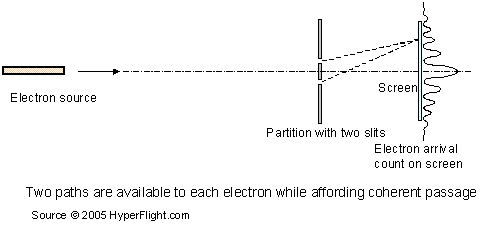
This wave can of course interfere when it is split into two or more by, say, slits on a wall.  And no matter which slit it passes, it follows the pattern of distribution of pieces of the force working from the quantum surface.  As that pattern can show an interference, the position the electron is found on the screen, the final place where it is observed after flying the space through slits, follows this interference pattern.

                
http://family.wikinut.com/img/8zlnmjhvlc1fv1f./The-Double-Slit-Experiment

A free electron, when moving toward two or more narrow slits, spreads out and becomes a wave. A single electron wave then goes through the slits simultaneously and -- landing on a screen on the other side -- makes (reduces into) a single dot on the screen. The second and other electrons that follow, however, do not always land on the same spot and after a while a pattern is discerned called interference (I prefer superposition). The electron superposition pattern emerges while each and every electron-as-wave moves individually through the slits, and it is then also appropriate to call it the electron self-superposition.
http://www.hyperflight.com/primer.htm


However, the electron has not become a sate of a wave, but the force in the space is distributed as a wave with a probability at each location on its each stage.


*** *** *** ***


Gal 5:22 But the fruit of the Spirit is love, joy, peace, longsuffering, gentleness, goodness, faith,
Gal 5:23 Meekness, temperance: against such there is no law.
Gal 5:24 And they that are Christ's have crucified the flesh with the affections and lusts.

Wednesday, May 21, 2014

"Thou shalt not kill" - New Interpretation of Schrödinger's Equation


Rice Fields, Japan


New Interpretation of  Schrödinger's Equation

In a microscopic world, things look different.  It looks like we are observing something very far.

In this world, every material body has almost no size.  But they constitute an atomic nucleus and an atom that has a diameter of about 10^-10 meters.  With so many atoms, a material object comes to have a visible size, such as a golf ball.  To move a golf ball, we have to give an impact to it with a golf club.  But in the macroscopic world, an elemental particle such as an electron has only a size of 10^-22 meters and a mass of 9.1 x 10^-31 kg.  To move an electron, we need a new kind of force in addition to attracting force and electromagnetic force.

This new force decides where an electron moves while it is subject to attracting force and electromagnetic force.  But it does not provide a deterministic course of movement of an electron.  It provides possible locations an electron can move and arrive at based on probabilities.  Or more specifically, an electron is allowed to move to and exist in any places in a space according to a probability each location has for existence of the electron.  And this probabilities follow a shape of a wave.

In the macroscopic world in the size of, say, about 10^-22 meters to 10^-10 meters, an electron receives attracting force and electromagnetic force to move to a certain direction.  But a specific course it takes and specific locations it passes are decided by this new force that moves the electron to any spot in a space according to a probability specified to each point in the space.

However, these probabilities change over the space as if they constitute a wave, the values of the probabilities change like a wave.  Accordingly it can be split into two waves and then interfere with each other.  The values of the probabilities in the space look like sometimes showing an interference of two waves.  That is why an electron which passes two slits can result in showing its position on the screen behind the slits like a wave form after many trials.


http://taste.sakura.ne.jp/static/farm/science/double_slit_experiment.html

If the electron is only influenced by attracting force and electromagnetic force, the pattern on the screen must be more converged on one or two points.  It shows new force works on the electrons being pushed out toward the slits and the screen.

If an electron passes through either of the two slits, it has the same pattern of probabilities of its existence in the space that results from work of the new force.  You cannot tell which slit an electron passes, but it arrives at a location on the screen depending on a probability that is decided by new force.  And after many trials, it shows the pattern of a wave, since the probability changes in the shape of a wave.

But if an electron receives  attracting force or electromagnetic force that is applied at the slits to see which slit it is passing, the way in which new force works on the electron changes.  Accordingly, the pattern of probabilities change. It will take a shape of a new wave.  But as the electron has already passed a slit, the new wave will not interfere.  But if another pair of two slits is placed between the original pair of slits and the screen, the new wave of probabilities come to be split into two waves and interfere with each other.  Again, a wave pattern appears on the screen.

The key is the nature of this force.  It works between the very small particle, that is an electron in this case, and the space.  And the way the force works on the electron changes each time the electron receives other known types of physical force such as attracting force and electromagnetic force.  But the electron always has interaction with the space.  It always receives this new force, resulting in movement according to probabilities of existence generated by the new force.

And in one special case where a pair of two electrons is generated simultaneously so that they have the same mode of interaction with space, if one of the pair passes one of two slits to reach a screen, the pattern it forms there after many trials depends on how another paired electron flying to a direction not toward the screen is observed or it receives attracting force and electromagnetic force for observation.

If the second electron is not observed and then the first electron is observed on the screen, the first electron shows the interference pattern on the screen when observed, since the wave form of probabilities is preserved on the screen no matter how long it takes.    

But, if the second electron is observed and then the first electron is observed on the screen, the first electron does not show the interference pattern on the screen when observed, since the wave form of probabilities for the first electron is broken on the screen when the second electron is observed somewhere in the space and thus no interference of the probability waves is possible any more.

So, it is the new force working between an elemental particle such as the electron and space but not a so-called "quantum sate" that should be recognized.  And it has a mode that is preserved till the elemental particle receives other known types of physical force such as attracting force and electromagnetic force.  One mode has its own pattern of probabilities of existence each of which is assigned to each point in space.  The elemental particle receives this new force from space and moves to any point of the space according to the value of probability.  And the values of these probabilities are distributed in the space in a shape of a wave.

This new force can also work on any physical properties of an elemental particle such as spin.  The direction of a spin of an elemental particles can be upward or downward according to probabilities taking a shape of a wave.

I this case, the spin has surely either an upward spin or a downward spin according to a value of probabilities.  Conversely, when we observe it, we can see a result of work of the new force at a certain probability to make the spin upward or downward.   Immediately before our observation, the particle might have an upward spin as a result of a certain probability coming true, but when we observe it, it might be found downward as a result of another probability coming true.

We have to admit that what the wave derived from Schrödinger's equation is not a state or a combination of states but force between an elementary particle or a center of energy and space on which energy exists.   .


*** *** *** ***


Mat 5:21 Ye have heard that it was said of them of old time, Thou shalt not kill; and whosoever shall kill shall be in danger of the judgment:
Mat 5:22 But I say unto you, That whosoever is angry with his brother without a cause shall be in danger of the judgment: and whosoever shall say to his brother, Raca, shall be in danger of the council: but whosoever shall say, Thou fool, shall be in danger of hell fire.

Tuesday, May 20, 2014

"the Father raiseth up the dead" - Russians, Ukrainians, and Judaists


Around Tokyo


Russians, Ukrainians, and Judaists


An important factor in the Ukraine issue today is apparently Judaists in Ukraine.
Before World War II, a little under one-third of Ukraine's urban population consisted of Jews[8] who were the largest national minority in Ukraine. Ukrainian Jews are comprised by a number of ethnic groups, including Ashkenazi Jews, Mountain Jews, Bukharan Jews, Karaite Jews, Krymchak Jews and Georgian Jews.
http://en.wikipedia.org/wiki/History_of_the_Jews_in_Ukraine#Ukrainian_Jews
Judaists in the Russian Empire were suppressed by the Russian imperial court.

Due to divisions of Poland in 1772, 1793, and 1795, about one million Judaists came to become subject to the Imperial Russian Government.  As a consequence, the Russian Empire had the largest Judaist population in the world at the time.

However, with an increase of attacks on Judaists,  from 1881 to 1910, almost three million Judaists left Russia.  Those who arrived at the US accounted for 70%.

On the other hand, the Judaists who remained in Russia joined the communist revolution.  They wanted to defeat the Imperial Russia that had persecuted them so severely for so long.  Even the wife of Lenin was a Judaist.  So, there were many Russian Judaists in the leadership of the new government established by Russian communists.

But as time went by, Stalin took over power, and he started to drive out Judaists from the top echelon of the political circle of the Soviet Union.  Like Hitler, Stalin also became an enemy of Judaists, though the wife of the eldest son of Stalin was a Judaist.  However, it is said that what triggered this anti Judaist movement  in the era of Stalin was a conflict between radical Judaists and conservative Judaists who well assimilated into the Russian society and culture.  And Stalin and other Russian politicians took up this rivalry to eradicate their old rivals who were mostly Russian radical Judaists to consolidate their power base.

So, after WWII, the Soviet Union Government did not promote Judaists to leading positions of the country, treating them very badly.

Then, the USSR collapsed through the Cold War against the US, Western Europe, and Japan in 1991, again paving the way for Russian/Ukraine Judaists to get freedom, wealth, and power,

A Russian oligarch is a near-synonym of the term "business oligarch" or "business magnate," borrowed by the English speaking and western media from Russian parlance to describe the huge, fast-acquired wealth of some businessmen of theformer Soviet republics (mostly Russia and Ukraine) during privatization in Russia after the dissolution of the Soviet Union in the 1990s. Businessmen with great wealth from these countries were commonly labeled (simply) "oligarchs" in Russian regardless of whether they had real political power, as the term "oligarch" would imply. Analysts have drawn comparison between the current Russian system of oligarchs, and the system of powerful Boyars that had emerged in late-MedievalMuscovy.[1]
http://en.wikipedia.org/wiki/Russian_oligarchs

There were seven powerful business oligarchs in the late 1990s in Russia, five of whom were Judaists.

There were some Judaists among Ukraine oligarchs, but they are still different from other Ukrainians.
In 1989, a Soviet census counted 487,000 Jews living in Ukraine.[74] Although discrimination by the state all but halted very soon after Ukrainian independence in 1991, Jews were still discriminated against in Ukraine during the 1990s. 
According to the European Jewish Congress, as of 2014, there are 360,000-400,000 Jews in Ukraine.[77] 
During the 1990s, some 266,300 Ukrainian Jews emigrated to Israel as part of a wave of mass emigration of Jews from the former Soviet Union to Israel in the 1990s. 
Antisemitic graffiti and violence against Jews are still a problem in Ukraine.[88]
Due to the growing 2014 Ukrainian unrest, Ukrainian Jews making aliyah from Ukraine reached 142% higher during the first four months of 2014 compared to the previous year.[91] 800 people arrived in Israel over January-April, and over 200 signed up for May 2014.[91] On the other hand chief rabbi and Chabad emissary of Dnipropetrovsk Shmuel Kaminezki claimed late April 2014 “Today, you can come to Dnipropetrovsk or Odessa and walk through the streets openly dressed as a Jew, with nothing to be afraid of”.[92]
http://en.wikipedia.org/wiki/History_of_the_Jews_in_Ukraine#Ukrainian_Jews
Russians, Ukrainians, and Judaists in Ukraine are all under strong pressure from Russia.  And till the fate of Judaists in Ukraine is settled, this turmoil in Ukraine might not end.

Referring to the case of Nazi Germany, we might have to think that the sooner Judaists leave the country, the better they can live.


*** *** *** ***


Joh 5:21 For as the Father raiseth up the dead, and quickeneth them; even so the Son quickeneth whom he will.

Monday, May 19, 2014

"called great in the kingdom of heaven" - True Modern History Covering East Asia


Around Tokyo


True Modern History Covering East Asia

True history should be honestly studied by Americans, Chinese, Koreans, and any other peoples who are interested in irresponsible and dangerous anti-Japanese behaviors of Chinese and Koreans.

From the Japanese point of view, it started with the Opium War fought by Qing Dynasty of China and the UK between 1839 and 1842.
1839 - The First Opium War
The First Opium War (1839–42), also known as the Opium War and as the Anglo-Chinese War, was fought between Great Britain and China over their conflicting viewpoints on diplomatic relations, trade, and the administration of justice for foreign nationals. 
Prior to the conflict Chinese officials wished to end the spread of opium, and confiscated around 20,000 chests of opium (approximately 1.21 million kilograms or 2.66 million lb)[4] from British traders. The British government, although not officially denying China's right to control imports of the drug, objected to this seizure and used its military power to enforce violent redress. 
In 1842, the Treaty of Nanking—the first of what the Chinese later called the unequal treaties—granted an indemnity to Britain, the opening of five treaty ports, and the cession of Hong Kong Island, thereby ending the trade monopoly of the Canton System.

1853 - Japan and the US for Diplomacy
United States Commodore Matthew C. Perry threatens the Japanese capital Edo with gunships, demanding that they agree to open trade.

1854 - Japan Opened the Country
The Convention of Kanagawa formally ends Japan's policy of isolation.

1856 - The Second Opium War
The Second Opium War, the Second Anglo-Chinese War, the Second China War, the Arrow War, or the Anglo-French expedition to China,[1] was a war pitting the British Empire and the Second French Empire against the Qing Dynasty of China, lasting from 1856 to 1860. It was fought over similar issues as the First Opium War. 
The British, French and—thanks to the schemes of Ignatiev—the Russians were all granted a permanent diplomatic presence in Beijing (something the Qing resisted to the very end as it suggested equality between China and the European powers). The Chinese had to pay 8 million taels to Britain and France. Britain acquired Kowloon (next to Hong Kong). The opium trade was legalised and Christians were granted full civil rights, including the right to own property, and the right to evangelise. 
The content of the Convention of Peking included:
China's signing of the Treaty of Tianjin
Opening Tianjin as a trade port
Cede No.1 District of Kowloon (south of present day Boundary Street) to Britain
Freedom of religion established in China
British ships were allowed to carry indentured Chinese to the Americas
Indemnity to Britain and France increasing to 8 million taels of silver apiece
Legalisation of the opium trade

1861 - American Civil War
The American Civil War, also known as the War Between the States, or simply the Civil War in the United States (see naming), was a civil war fought from 1861 to 1865, after seven Southern slave states declared their secession and formed the Confederate States of America (the "Confederacy" or the "South"). (It ultimately included a total of eleven states.) The states that remained in the Union were known as the "Union" or the "North". The war had its origin in the fractious issue of slavery, especially the extension of slavery into the western territories.[N 1] Foreign powers did not intervene. After four years of bloody combat that left over 600,000 soldiers dead and destroyed much of the South's infrastructure, the Confederacy collapsed, slavery was abolished, and the difficult Reconstruction process of restoring national unity and guaranteeing civil rights to the freed slaves began.

1868 - Start of Japan's Westernization
The Meiji Restoration, also known as the Meiji Ishin, Renovation, Revolution, Reform or Renewal, was a chain of events that restored practical imperial rule to Japan in 1868 under Emperor Meiji. Although there were emperors of Japan before the Meiji Restoration, the restoration established the practical abilities and consolidated the political system under the Emperor of Japan. The goals of the restored government were expressed by the new emperor in the Charter Oath. The Restoration led to enormous changes in Japan's political and social structure, and spanned both the late Edo period (often called Late Tokugawa shogunate) and the beginning of the Meiji period. The period spanned from 1868 to 1912 and was responsible for the emergence of Japan as a modernized nation in the early twentieth century.

1869 - Suez Canal Opened
The Suez Canal (Qanāt al-Sūwais) is an artificial sea-level waterway in Egypt, connecting the Mediterranean Sea and the Red Sea. Opened in November 1869 after 10 years of construction, it allows ships to travel between Europe and eastern Asia without navigating around Africa.

1869 - First Transcontinental Railroad in the US
Opened for through traffic on May 10, 1869, with the driving of the "Last Spike" with a silver hammer at Promontory Summit,[4] the road established a mechanized transcontinental transportation network that revolutionized the settlement and economy of the American West by bringing these western states and territories firmly and profitably into the "Union" and making goods and transportation much quicker, cheaper and much more flexible from coast to coast.

1887- French Clonization of Indochina
French Indochina (French: Indochine française) officially known as the Indochinese Federation (French: Fédération indochinoise) since 1947, was part of the French colonial empire in southeast Asia. A federation of the three Vietnamese regions, Tonkin (North), Annam (Central), and Cochinchina (South), as well as Cambodia, was formed in 1887. 
1894 - First Sino-Japanese War
The First Sino-Japanese War (1 August 1894 – 17 April 1895) was fought between Qing Dynasty China and Meiji Japan, primarily over control of Korea. After more than six months of continuous successes by the Japanese army and naval forces, as well as the loss of the Chinese port of Weihai, the Qing leadership sued for peace in February 1895.

1898 - Spanish–American War
The Spanish–American War was a conflict in 1898 between Spain and the United States, the result of American intervention in the Cuban War of Independence. American attacks on Spain's Pacific possessions led to involvement in the Philippine Revolution and ultimately to the Philippine–American War. 
The U.S. had sent a force of some 11,000 ground troops to the Philippines. Armed conflict broke out between U.S. forces and the Filipinos when U.S. troops began to take the place of the Spanish in control of the country after the end of the war, resulting in the Philippine–American War. On August 14, 1899, the Schurman Commission recommended that the U.S. retain control of the Philippines, possibly granting independence in the future.

1898 - Boxer Rebellion in China
The Boxer Rebellion, Boxer Uprising or Yihetuan Movement was a violent anti-foreign and anti-Christian movement which took place in China towards the end of the Qing dynasty between 1898 and 1900. It was initiated by the Militia United in Righteousness (Yihetuan), known in English as the "Boxers", and was motivated by proto-nationalist sentiments and opposition to foreign imperialism and Christianity. The Great Powers intervened and defeated Chinese forces. 
Beijing, Tianjin, and other cities in northern China were occupied for more than one year by the international expeditionary force under the command of German General Alfred Graf von Waldersee.  
French troops ravaged the countryside around Beijing to collect indemnities—and on one occasion arresting American missionary William Scott Ament who beat them to the punch in gathering wealth from some villages.[93] Nor were the soldiers of other nationalities any better behaved. "The Russian soldiers are ravishing the women and committing horrible atrocities" in the sector of Beijing they occupied.

1902 - Anglo-Japanese Alliance
The first Anglo-Japanese Alliance was signed in London at what is now the Lansdowne Club,[1] on January 30, 1902, by Lord Lansdowne (British foreign secretary) and Hayashi Tadasu (Japanese minister in London). A diplomatic milestone that saw an end to Britain's splendid isolation, the alliance was renewed and expanded in scope twice, in 1905 and 1911, before its demise in 1921. It was officially terminated in 1923.

1904 - Russo-Japanese War
The Russo-Japanese War (8 February 1904 – 5 September 1905) was "the first great war of the 20th century."[3] It grew out of rival imperial ambitions of the Russian Empire and the Empire of Japan over Manchuria and Korea. The major theatres of operations were Southern Manchuria, specifically the area around the Liaodong Peninsula and Mukden; and the seas around Korea, Japan, and the Yellow Sea.

1910 - Japan–Korea Annexation Treaty
The Japan–Korea Treaty of 1910, also known as the Japan–Korea Annexation Treaty, was made by representatives of the Empire of Japan and the Korean Empire on August 22, 1910. In this treaty, Japan formally annexed Korea following the Japan–Korea Treaty of 1905 by which Korea became the protectorate of Japan and Japan–Korea Treaty of 1907 by which Korea was deprived of the administration of internal affairs.
(Source: Wikipedia) 
It is not so simple as Chinese and Koreans claim.  When they blame Japan for any past incidents in and before WWII, they don't usually take into consideration Western influences on, invasions into, and colonization of Asia.  Accordingly, their judgment on the past history in blaming Japan is very biased and often wrong.  

Understanding the history of East Asia and related global incidents will lead to deep understanding of China and Korea in addition to Japan.


*** *** *** ***

Mat 5:18 For verily I say unto you, Till heaven and earth pass, one jot or one tittle shall in no wise pass from the law, till all be fulfilled.
Mat 5:19 Whosoever therefore shall break one of these least commandments, and shall teach men so, he shall be called the least in the kingdom of heaven: but whosoever shall do and teach them, the same shall be called great in the kingdom of heaven.
Mat 5:20 For I say unto you, That except your righteousness shall exceed the righteousness of the scribes and Pharisees, ye shall in no case enter into the kingdom of heaven.

Saturday, May 17, 2014

"the power of the Lord was present to heal them" - Mahayana Buddhism


Government Office District, Tokyo


Mahayana Buddhism

A big change occurred in Buddhism in the first century.

A school called Mahayana came to grow, develop, and deploy to more vast regions.
Mahāyāna (literally the "Great Vehicle") is one of the three main existing branches of Buddhism and a term for classification of Buddhist philosophies and practice. Mahāyāna Buddhism originated in India, and some scholars believe that it was initially associated with one of the oldest historical branches of Buddhism, the Mahāsāṃghika. 
The Mahāyāna tradition is the largest major tradition of Buddhism existing today, with 56% of practitioners, compared to 38% for Theravāda and 6% for Vajrayāna. 
The origins of Mahāyāna are still not completely understood.[11] The earliest Western views of Mahāyāna assumed that it existed as a separate school in competition with the so-called "Hīnayāna" schools. 
Scholars have suggested that the Prajñāpāramitā sūtras, which are among the earliest Mahāyāna sūtras,[19][20] developed among the Mahāsāṃghika along the Kṛṣṇa River in the Āndhra region.[21] The earliest Mahāyāna sūtras to include the very first versions of the Prajñāpāramitā series, along with texts concerning Akṣobhya Buddha, which were probably written down in the 1st century BCE in the south of India. 
Few things can be said with certainty about Mahāyāna Buddhism,[note 11] especially its early Indian form, other than that the Buddhism practiced in China, Indonesia, Vietnam, Korea, Tibet, and Japan is Mahāyāna Buddhism.[note 12] Mahāyāna can be described as a loosely bound collection of many teachings with large and expansive doctrines that are able to exist simultaneously.
http://en.wikipedia.org/wiki/Mahayana

The Buddha lived and taught in the eastern part of India between the 6th and 4th centuries BCE.
His teaching was about the way in which an individual achieved enlightenment to conquer pains of living and existence and enter eternal peace and repose.  It was intended to be practiced by an individual for his own salvation of soul.

But around the first century a new movement emerged among Buddhists.  The background was that around the first century Buddhism became a religion for special people who could renounce the world and leave their families to devote themselves to practicing spiritual training.  Conversely, ordinary or poor people forced to work for their masters and families could not be saved.  Accordingly, people wanted another form of enjoying merit of Buddhism.

So, people came to revere followers of Buddhism who carried out hard spiritual training for salvation not only of their own souls but also of others' souls.  Those followers were respected as bodhisattvas.  And this school of Buddhism adopted a theory that people who continued to be engaged in worldly lives could also grasp the wisdom of Buddhism and reach enlightenment through their efforts.  The core of this teaching is wider salvation of souls.  

However, the largest difference between this school, called Mahayana, and other sects of Buddhism lies in that the former uses Mahayana sutras but the latter doesn't.

Yet, how this difference came to exist has been a mystery.  There is a huge gap between the direction Mahayana faces and that other sects do.  What made it possible for Buddhism to realize this quantum leap? 

One theory to solve this enigma is that around the first century Buddhists changed their method of handing down the teaching.  It was a change from an oral method to a writing and copying method.        
     
Wider introduction of religious texts as a means of keeping and communicating teachings paved the way for more detailed and structured study of Buddhism.  Different from a traditional practice of learning the teaching through individual ascetic practices where contents of the religion were stored in the brain of an ascetic monk, written teachings allowed for cooperation and discussion on the religion by many people, including laymen.  Further, documents opened a new space for human thinking.  It created a new world.  Religious practices were no longer restricted to individual's narrow space of his existence.  Study of Buddhism could now expand human and natural boundaries.    

For this reason,  Mahayana or Great Vehicle of Buddhism came to spread among peoples in different culture and traditions, such as Tibetans, Mongolians, Vietnamese, Chinese, Koreans, and Japanese.   
    
From a different perspective, the history of Mahayana is comparable with that of Christianity that began in the first century.  And Theravada (Hinayana or Small Vehicle) or other sects that keep more original form of the teaching of Buddhism might be comparable to Judaism in the analogy of the relationship of these religions.

Even Christianity probably could not spread without the Gospels or the New Testaments.  And the Old Testament could be accepted by Christians as it is written material.  There is no need to be Judaists to learn the teaching of Judaism.  

Therefore these 2000 years can be regarded as the era of sacred writings, though it was between 475 BC and 221 BC that Analects of Confucius were written and edited.


*** *** *** ***


Luk 5:16 And he withdrew himself into the wilderness, and prayed.
Luk 5:17 And it came to pass on a certain day, as he was teaching, that there were Pharisees and doctors of the law sitting by, which were come out of every town of Galilee, and Judaea, and Jerusalem: and the power of the Lord was present to heal them.
Luk 5:18 And, behold, men brought in a bed a man which was taken with a palsy: and they sought means to bring him in, and to lay him before him.
Luk 5:19 And when they could not find by what way they might bring him in because of the multitude, they went upon the housetop, and let him down through the tiling with his couch into the midst before Jesus.
Luk 5:20 And when he saw their faith, he said unto him, Man, thy sins are forgiven thee.