Tuesday, March 29, 2011

"but is in danger of eternal damnation" - (Fukushima Daiichi Nuclear Plant)

Tokyo Bay
Tokyo(Click to enlarge.)


Fukushima Daiichi (No.1) Nuclear Power Plant

The Magnitude 9.0 earthquake happened in the seabed of the North Pacific Ocean 150 kilometers off northeast Honshu Island, Japan, or 400 kilometers northeast of Tokyo on March 11, 2011.

Then 10 to 14 meter-high tsunami rushed to coastal areas stretching 600 kilometers from north to south or Aomori Prefecture to Chiba Prefecture, immediately north of Tokyo, over two to three hours after the earthquake.

It took almost 40,000 lives living on north Honsyu Island or the north of Tokyo.

It further destroyed four reactor units of Fukushima Daiichi (No.1) Nuclear Power Plant in Fukushima Prefecture, which situated 250 km northeast of Tokyo.

Yet, 18 days after the incident, the grave situation of the four reactor units is not yet to be improved or fixed.

However, life is going on in and around Tokyo as usual.


PART 29-4:

The Fukushima Daiichi (No.1) Nuclear Power Plant was started to be constructed in 1967 and completed in 1971, based on technology provided by U.S. GE.

Fukushima in 1967: (Click to enlarge.)

Fukushima in 1969: (Click to enlarge.)

Fukushima in 1971:

Fukushima in 1976: (Click to enlarge.)

http://www.tepco.co.jp/nu/f1-np/intro/outline/history-j.html

Fukushima in March 2011: (Click to enlarge.)
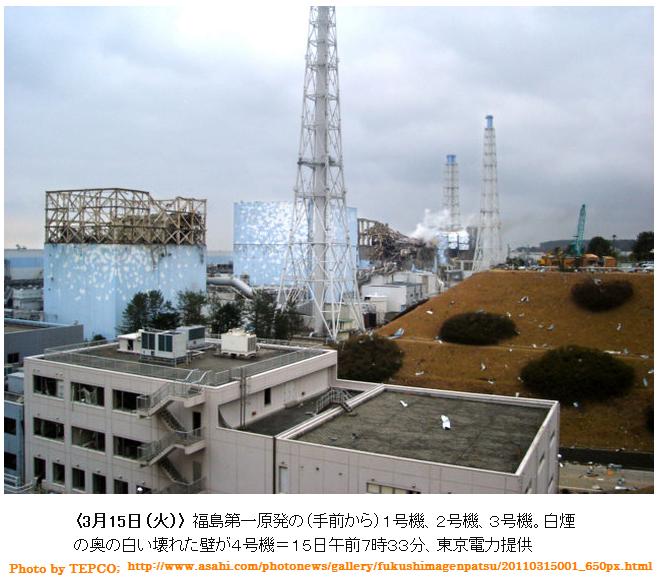
http://www.asahi.com/photonews/gallery/fukushimagenpatsu/20110315001_650px.html


PART 29-3:

If the worst thing happens one after another, it is time to change a way of living completely in any war-torn nation or around a nuclear power plant.

Plutonium Detected in Soil Around Fukushima Daiichi
Mar 28, 2011, 11:00 by David Hope

Plutonium, a highly toxic, heavy, radioactive metallic element, has been detected in soil at several locations at the earthquake-crippled Fukushima Daiichi nuclear plant in Japan, the plant's operators said Monday.

Tokyo Electric Power Company said the plutonium detected in five locations is believed to have been discharged from nuclear fuel at the plant, which was severely damaged by the March 11th 9-magnitude earthquake in northeastern Japan.

Levels of radiation exceeding 1,000 millisieverts per hour have also were been detected in water in a trench outside the No. 2 reactor's building, officials said Monday. The contaminated water, detected Sunday, is suspected to have come from the reactor's core, where fuel rods partially melted...


In South Korea, the Nuclear Safety Information Center said a small amount of radioactive xenon, believed to have come from the Fukushima plant, was detected by a monitoring station, Kyodo reported.

http://onlinejournal.com/artman/publish/article_7461.shtml


PART 29-2:

Once in a decade or two or three, automakers will surely have to face a crisis like everybody in the world.
Tuesday, March 29, 2011
Tohoku disaster may bring automakers to their knees

By SHARON SILKE CARTY and ELAINE KURTENBACH
The Associated Press

Because parts and supplies are shipped by sea, the real drop-off has yet to be felt by factories in the U.S., Europe and Asia. That will come by the middle of April.

Much of Japan's auto industry — the second-largest supplier of cars in the world — remains idle. Few plants were seriously damaged by the quake, but with supplies of water and electricity fleeting, no one can say when factories will crank up. Some auto analysts said it could be as late as this summer.

Goldman Sachs estimates the shutdowns are costing the Japan automakers $200 million a day, which adds up to $2.8 billion for just the past two weeks. Each week of continued shutdowns costs $1.4 billion. By comparison, Toyota made $2.3 billion in all of 2010, and its sudden acceleration recalls cost $2 billion. The cost of damage from Japan's natural disaster could dwarf that recall, which was considered Toyota's biggest crisis ever.

http://search.japantimes.co.jp/cgi-bin/nb20110329a1.html


PART 29-1:


http://www.japantimes.co.jp/news/tohoku-kanto-earthquake-news.html

The unit of the numbers in the figure is micro-sievert per hour. But, a chest x-ray uses 0.2 milli-sievert radiation.

A chest X-ray is measured at about 0.2 mSv, and a brain scan at about 50 mSv, both thought to be negligible...

http://www.khaleejtimes.com/Displayarticle09.asp?section=health&xfile=data/health/2011/March/health_March52.xml

But, a man is exposed to a chest x-ray only a second or less.

As a man in Tokyo receives 0.1 microsievert per hour, if he stays in the environment for 0.2 x 10^-3 divided by 0.1 x 10^-6, he receives an amount of radiation equal to one chest x-ray check. It is 2000 hours or 83 days.

So, if the present radioactive condition continues for 83 days in Tokyo and you stay in Tokyo for these 83 days, you receive the same amount of radiation as one chest x-ray.

*** *** *** ***


There are 47 prefectures in Japan including Tokyo Prefecture that has 13 million population.

The 3/11 Disaster hit hard the Pacific Coast areas mainly of three prefectures: Iwate, Miyagi, and Fukushima.

The number of those who lost lives or houses and assets seem to be 400,000.

Yet, Japan has the 125 million population, excluding 1.7 million foreigners in Japan, as of 2010.

Yet, the Fukushima No.1 Nuclear Power Plant provided power for the Tokyo area. Accordingly scheduled outage has been applied to the Tokyo area, excluding the main districts of Tokyo. In this context, psychological pressure on people living around Tokyo is not small, since the Plant is situated at 250 kilometers or 150 miles northeast of Tokyo.

It will take further a few weeks to fix the Fukushima Daiichi (No.1) problem.


Mar 3:29 But he that shall blaspheme against the Holy Ghost hath never forgiveness, but is in danger of eternal damnation.


Monday, March 28, 2011

"I said, I am not the Christ" - (Nuclear Reporting)

Tokyo Bay


Nuclear Reporting


In a reactor unit of the Fukushima No.1 Nuclear Power Plant, nuclear fuel in the pressure vessel was exposed out of water filled in the vessel due to the big earthquake/tsunami and lost electricity.

Then fuel got heated and started to partially melt. Radioactive material got into the water and then leaked from piping connecting the pressure vessel with a turbine system in a different building. So, the water including radioactive material dropped on the floor of the turbine building. The problem is that the amount of leaked water radioactively contaminated was tons and could be tens of tons or probably hundreds of tons eventually.

In one million kilo-watt nuclear power generator, it is said 400 tons of water is used for taking heat from fuel, turning a turbine, and cooling fuel again.

In other word, 100 tons of contaminated water could leak from the piping between the pressure reactor and the turbine building.

Now, it is suspected that tons of such water leaked onto the turbine building floor and further to a trench running down into the ground from the turbine building to its outside and peripheral 50 to 60 meters from the shore facing the North Pacific Ocean.

The trench is said to be big enough for a man to walk through, since it was installed for laying pipes and cables connecting each reactor unit while one unit building has a width of almost 100 meters.


PART 28-6:

NewScientist:
Yomiuri Daily Online reports that "many types of radioactive substances" have also been detected in seawater near the plant, including iodine-131, barium-140, lanthanum-140 and tellurium-132.

According to Yomiuri, based on the type of radioactive substances found in the seawater, the culprit is most likely to be damaged pipes connected to nuclear reactors that are discharging into the sea.

This would indicate the plant is leaking radiation from at least two sources: pipes and its core. Kyodo reports that radiation exceeding 1000 millisieverts per hour was detected in water in a trench outside the no. 2 reactor's turbine building yesterday afternoon.

As for possible leaks of plutonium from the mixed-oxide fuel reactor at no. 2, NHK reports that TEPCO say it is checking soil samples from around the plant for plutonium and will announce the results in a few days.

http://www.newscientist.com/blogs/shortsharpscience/2011/03/fukushima-may-have-experienced.html?DCMP=OTC-rss&nsref=online-news


PART 28-5:

Tokyo Electric Power Company:
Press Release (Mar 28,2011)
Plant Status of Fukushima Daiichi Nuclear Power Station (as of 12:00 AM Mar 28th)

[No update from the last release issued at 8:30 pm, March 27th]

All 6 units of Fukushima Daiichi Nuclear Power Station have been shut down.

Unit 1 (Shut down)
- Explosive sound and white smoke were confirmed after the big quake occurred at 3:36 pm Mar 12th. It was assumed to be hydrogen explosion.
- At approximately 2:30 am on March 23rd, seawater was started to be injected to the nuclear reactor through the feed water system.
- At approximately 10:50 am on March 24th, white fog-like steam arising from the roof part of the reactor building was observed.
- At approximately 11:30 am on March 24th, lights in the main control room was restored.
- We had been injecting sea water into the reactor, but from 3:37 pm on March 25th, we started injecting fresh water into it.

Unit 2 (Shut down)
- At approximately 6:00 am on March 15th, an abnormal noise began emanating from nearby Pressure Suppression Chamber and the pressure within this chamber decreased.
- At 6:20 pm on March 21st, white smoke was confirmed arising from the top of the reactor building. As of 7:11 am on March 22nd, smoke decreased to the level to nearly non-existent.
- We have been injecting sea water into the reactor, but from 10:10 am on March 26th, we started injecting fresh water (with boric acid) into it.
- At approximately 4:46 pm on March 26nd, the light in the main control room was turned on.
- Previously, we have been injecting fresh water in to the reactor utilizing fire pump, however, we have switched over to utilizing temporary electrical pump from 6:31 pm on March 27th.

Unit 3 (Shut down)
- Explosive sound and white smoke were confirmed at 11:01am March 4th. It was assumed to be hydrogen explosion.
- At 8:30am on March 16th, fog like steam was confirmed arising from the reactor building.
- At approximately 6:15 am on March 17th the pressure of the Suppression Chamber has temporarily increased. We were preparing to implement measures to reduce the pressure of the reactor containment vessel (partial discharge of air containing radioactive material to outside) in order to fully secure safety. However, at present, it is not a situation to immediately implement measures and discharge air containing radioactive material to outside. We will continue to monitor the status of the pressure of the reactor containment vessel.
- At approximately 4:00 pm, March 21st, light gray smoke was confirmed arising from the floor roof of the Unit 3 building. On March 22nd, the color of smoke changed to somewhat white and it is slowly dissipating.
- At approximately 10:45 pm on March 22nd, the light in the main control room was turned on.
- At around 4:20 pm on March 23rd, our staff confirmed light black smoke belching from the Unit 3 building. At approximately 11:30 pm on March 23rd and 4:50 am on March 24th, our employee found no signs of smoke.
- We had been injecting sea water into the reactor pressure vessel, but from 6:02 pm on March 25th, we started injecting fresh water into it.

...
Today's work for cooling the spent fuel pools
- We are considering further spraying subject to the conditions of spent fuel pools.

Casualty
- 2 workers of cooperative firm were injured at the occurrence of the earthquake, and were transported to the hospital on March 11th.
...
- On March 24th, it was confirmed that 3 workers from cooperative companies who were in charge of cable laying work in the 1st floor and the underground floor of turbine building were exposed to the radiation dose of more than 170 mSv. 2 of them were confirmed that their skins on legs were contaminated. Although they were decontaminated, since there was a possibility of beta ray burn injury, they were transferred to Fukushima Medical University Hospital. The third worker was also transferred to Fukushima Medical University Hospital on March 25th. After that, the 3 workers were transferred to National Institute of Radiological Sciences in Chiba Prefecture.

Regarding this event, TEPCO has reported to the related government ministries and agencies on measures to be taken to assure appropriate radiation dose control and radiation exposure related operations.Before today's restoration work, we will make notification to the concerned parties and continue to take all possible measures to future management.

http://www.tepco.co.jp/en/press/corp-com/release/11032802-e.html?amp&


PART 28-4:
China News:
Radiation from Japan n-plant detected in China
China News.Net
Sunday 27th March, 2011 (IANS)

Low levels of radiation from the quake-hit Fukushima nuclear plant in Japan has been detected in northeast China, authorities said.

The National Nuclear Emergency Coordination Committee confirmed Saturday that an 'infinitesimal' amount of radioactive iodine-131 was detected in the atmosphere in Heilongjiang province, according to China Daily.

The radiation was detected in monitoring stations in Dongning, Hulin, Raohe and Wusu townships, said Xu Lijuan, a senior radiation monitoring official.

However, the amount was only one-hundred-thousandth the normal level, and hence no protective measures were needed.

http://www.chinanews.net/story/761147/ht/Radiation-from-Japan-n-plant-detected-in-China


PART 28-3:

BBC:
28 March 2011 Last updated at 06:55 GMT
Japan nuclear plant data error was 'unacceptable'

The Japanese government has attacked the operator of a crippled nuclear plant for "unacceptable" mistakes.

The Tokyo Electric Power Company (Tepco) had said radiation levels were 10m times higher than normal before correcting the figure to 100,000 times...

Japan's nuclear watchdog said the level of radiation in water near reactor 2 was confirmed at 1,000 millisieverts an hour.

"It is an extremely high figure," said spokesman Hidehiko Nishiyama.

The radiation levels are so high, that emergency workers near the contaminated water would have received four times their maximum annual dose of radiation in just one hour.

http://www.bbc.co.uk/news/world-asia-pacific-12877198


PART 28-2:

TIME:
Officials: Spike at Japan Nuke Plant an Error
By AP / YURI KAGEYAMA AND MARI YAMAGUCHI Sunday, Mar. 27, 2011

On Sunday night, though, plant operators said that while the water was contaminated with radiation, the extremely high reading was a mistake. "The number is not credible," said Tokyo Electric Power Co. spokesman Takashi Kurita. "We are very sorry"...

Officials say they still don't know where the radioactive water is coming from, though government spokesman Yukio Edano has said some is "almost certainly" seeping from a cracked reactor core in one of the units...

Just outside the coastal Fukushima nuclear plant, radioactivity in seawater tested about 1,250 times higher than normal last week — but that number had climbed to 1,850 times normal by the weekend. Hidehiko Nishiyama, a nuclear safety official, said the increase was a concern, but also said the area is not a source of seafood and that the contamination posed no immediate threat to human health.

http://www.time.com/time/world/article/0,8599,2061653,00.html


PART 28-1:

Bloomberg:
Food Contamination May Climb as Japan Fights Radiation Crisis
By Jae Hur - Mar 28, 2011 12:50 PM GMT+0900


Radioactive contamination in food is likely to increase as Japan enters a third straight week of battling the biggest nuclear-energy crisis since Chernobyl...

Among products found to be contaminated, red-leaf lettuce in Ibaraki prefecture had 2,300 Becquerels per kilogram of iodine-131, exceeding the ministry’s limit of 2,000 Becquerels. Parsley in Chiba on March 22 had a reading as high as 3,100 Becquerels and spinach as high as 3,500 Becquerels on March 24, according to data on the health ministry’s website.

http://www.bloomberg.com/news/2011-03-27/food-contamination-set-to-rise-as-japan-fights-radiation-crisis-at-reactor.html


*** *** *** ***


Joh 3:27 John answered and said, A man can receive nothing, except it be given him from heaven.

Joh 3:28 Ye yourselves bear me witness, that I said, I am not the Christ, but that I am sent before him.


Sunday, March 27, 2011

From 9/11 2001 To 3/11 2011

Tokyo Bay


From 9/11 2001 To 3/11 2011


The European-led civilization is now questioned in Japan and the Islamic nations.

In Japan, people have come to realize that modern science, technology, and business are all useless to prevent the great disaster from occurring at the most unlikely time.

In the Islamic nations, dictators and dictatorship having been bolstered by Western powers face collapse.

In the U.S., Hispanics population is growing at the highest pace among various ethnic groups.

At the start of 2010's, the world has come to start a great change of the old paradigm which has been built around the European technology, politics, and traditions.

If Europeans shout CO2 reduction for prevention of global warming, it will not work, since they do not sincerely try to abolish their way of material life: living based on modern technology, vastly imported energy, and globally deployed economy. Europeans want to keep a high standard of living while trying to avoid global warming. It is impossible. A high level of European living standard can be sustained by a huge energy use, aggressive applications of technology, and insatiable pursue of wealth through global business. It is not CO2 but desires of Europeans to keep a high living standard that is making the earth heated. (A nuclear power plant accident in Japan, triggered by the great tsunami on March 11, is therefore significant in this context related to CO2 reduction technology.)

Japan is the nation that has absorbed, applied, and advanced European science and technology the most in the world outside Europe and North America.

The Islamic nations have been offering oil and gas to Europe, North America, and Japan for so long. But, to be stable energy sources, they have to be controlled by European and American Christians politically. To control one dictator is easier than control tens of millions of people in a nation. So, Western powers accept dictatorship in the Middle East and North Africa.

The U.S. has been under the spirit of anti-Vatican Christians whose ancestors left Europe for various reasons, including religion and politics. But the era of dominance by Anglo-Saxon or North European Americans come to be ending. The President is always an African American. Hispanics are increasing in a number. Chinese will be also moving to America. The U.S. will inevitably lose its traditional roots. Accordingly, a paradigm in pursuing technological and political success might change. They will not pursue material American Dream like pure descendants of North Europeans as before any more.


The 2000's virtually started with the 9/11, 2001, Terror on the East Coast of America.

The 2010's seems to have virtually started with the 3/11, 2011 Tsunami on the Northeast Coast of Japan.

Indeed, it is 10 and a half years, since September 11, 2001.


*** *** *** ***


On January 17, 1991, the U.S. started all-out air-raid attacks in the Persian Gulf, bombing Iraqi troops.

It opened a new era of 1990's when the Soviet Union collapsed, Japan and the U.S. competed fiercely on technology and money, and China was getting ready for rapid economic growth.


(To be continued...)


*** *** *** ***


Former Defense Minister of Japan Ms. Yuriko Koike met with Mr. Gaddafi in November 2009.

http://www.youtube.com/watch?v=OzG9ztnBOZo&feature=related

Just for curiosity, though in case.


Saturday, March 26, 2011

"the same baptizeth, and all men come to him" - (Mysterious Radiation)

Tokyo-Yokohama
Shibuya, Tokyo(Click to enlarge.)


Mysterious Radiation


Nuclear power generation is based on a very primitive method to turn a turbine and generate electricity by supplying a flow of heated vapor to a turbine system. To produce heated vapor nuclear fuel is used.

However, nuclear fuel also releases radiation and produce radioactive material which is included in water circulating between a fuel vessel and the turbine system.

If this water leaks, it can contaminate the environment. But, in any such plant, leakage is common since facilities use many pipes and valves in addition to control electric devices and power cables.

The weak point is at this complexity around the nuclear fuel vessel or the pressure vessel.

So, the design concept should be changed to make safe the use of uranium or plutonium as fuel for electricity generation, so that it can be burnt without a fear of leakage.


PART 26-15:

American Ambassador to Japan Mr. John Roos kindly visited shelters in the affected area of northeast Japan.

@AmbassadorRoos
John V. Roos
I am still moved & draw great motivation from my visit with the people in Miyagi. Their strength & resilience will guide Japan’s recovery.


PART 26-14:

Some media in the world expressed candidly what they feel about Japan's tragedy.

Japan desperation calls for global measures

World owes tsunami relief to country known for its 'generous' assistance to many others during times of need.

Vaclav Havel,Desmond Tutu, Richard von Weizsacker Last Modified: 24 Mar 2011 15:30

Because Japan is a rich country, some people may be tempted to view it as being in a position to undertake most of the effort to rebuild on its own.

For decades, the Japanese have been generous in supporting people around the world in times of need, providing extensive financial assistance to developing countries and spearheading rescue and relief activities when disasters have struck. Now it is time for the international community to step up and show the same concern for Japan.

http://english.aljazeera.net/indepth/opinion/2011/03/201132211274579842.html


PART 26-13:

There is a website that shows pictures of the #3 reactor unit of the Fukushima No.1 Nuclear Power Plant which were taken in 2000.

Fukushima Daiichi (No.1) Plant
Inside the #3 Reactor Unit
MOX Fuel in a Pool
http://www.newcs.futaba.fukushima.jp/05-20000519/index41.html


PART 26-12:

The source of 10,000 times stronger radiation than usual cooling water was still unknown as found in water in a #3 reactor unit bldg. though it hurt two workers.


PART 26-11:

The International Atomic Energy Agency has released today's report on the Japanese nuclear plant in trouble for two weeks.


IAEA

Fukushima Daiichi Nuclear Accident Update (26 March, 05:15 UTC)
Brief Update on State of Fukushima Daiichi Reactors

Japanese authorities today confirmed a number of developments at the nuclear reactors at Fukushima Daiichi.

Unit 1

Workers have restored lighting in the control room and have recovered some instrumentation. As of 25 March, fresh water is now being pumped into the reactor pressure vessel (RPV) instead of seawater.

Unit 2

Seawater injection into the reactor pressure vessel continues, and RPV pressures remain stable.

Unit 3

Workers are now pumping fresh water into the RPV, while seawater is pumped into the spent fuel pool. In addition, firefighters sprayed water into the reactor building yesterday from the outside.

Unit 4

With no fuel in the RPV, concerns remain focused on the condition of the spent fuel pool, and workers continued to use a concrete pump truck to pour water into the pool from above while pumping seawater into the pool through the fuel pool cooling line.

Units 5 and 6

Both reactors have achieved safe, cold shutdown, and their fuel pool temperatures have stabilised at acceptable levels.

http://www.iaea.org/newscenter/news/tsunamiupdate01.html


PART 26-10:

The confirmed deaths from the 3/11 Disaster exceeded 10,000 yesterday.

After two weeks, the number of the missing is over 17,000, with some yet to be officially reported.

The 3/11 Great Earthquake and Tsunami takes probably 40,000 lives eventually.

The number of evacuees is now over 240,000 staying in 2000 or so refuges and shelters, meaning 100,000 houses and buildings are lost as well as 100,000 cars.

And, 35 million people living around Tokyo is under a possible threat from the crippled Fukushima No.1 Nuclear Power Plant.

This is the situation of part of Japan 15 days after the March 11 Disaster of northeast Honshu Island.


PART 26-9:

It is found that a big tremor continued for more than 100 seconds in the Tohoku Area, including Sendai and Fukushima, on March 11.

A significant tremor continued for almost three minutes in some areas near the epicenter.

Then the first-wave tsunami came. The second-wave came scores of minutes after it in coastal areas facing the epicenter over a 50 to 150 kilometer sea area. Finally the third-wave tsunami came even 2 hours after the quake in an area 200 kilometers south of the epicenter off Miyagi Prefecture.


PART 26-8:

China, Hong Kong, Taiwan, and South Korea have started to stop import of vegetables from some part of Japan due to the radiation issue.


PART 26-7:

Emperor allowed some evacuees to use hot-spring bathrooms for imperial villa staff in the Nasu Imperial Villa.

PART 26-6:

Japan Tabacco is going to reduce or stop production of some brands due to shortage of material caused by the 3/11 Disaster, for a month.


PART 26-5:

An NHK TV satellite channel reported last night the state of providing aid for Tohoku evacuees, from USS Ronald Reagan.

Helicopters with fookds and other goods are flying to isolated people in the Miyagi/Iwate Prefectures from the U.S. aircraft carrier.


PART 26-4:

The North Korean leader sent some money to Japanese Red Cross Society. 250 or more N. Koreans living in Japan are still missing since the 3/11 Great Earthquake/Tsunami.


PART 26-3:

At least 25 people have been killed and more than 250 injured in an earthquake that struck southwest China near the border with Myanmar.

http://english.aljazeera.net/news/asia-pacific/2011/03/201131071347825487.html


PART 26-2:

The Japanese Government set a liaison/control office on the 2nd floor of the main office building of Tokyo Electric Power Corporation.

A politician of the ruling DPJ is stationed there.


PART 26-1:

Around a water discharging point to the Pacific Ocean from Fuksuhima No.1 Plant, 1000 times stronger radioactive material than a statutory value was detected.


*** *** *** ***


It is known that almost 1000 years ago, a very big earthquake hit the same area that suffered the one on March 11, 2011.

At the time, also a big tsunami happened to invade inland.

So, the same thing has happened as an event that happens once in 1000 years.

If it had happened 100 years earlier or later, the Fukushima No.1 Nuclear Plant could pose no threat to Tokyo. If the tsunami had not been 14-meters high, the Fukushima No.1 Nuclear Plant could pose no threat to Tokyo now.

So, nobody sincerely tackled the nuclear plant to realize ultimate safety, because such damage could happen once in 1000 years. But, precisely the time came on March 11, 2011.

It is a fate, Fate of Japan. But, why on March 11, 2011? What is wrong with Japan or the world?

Maybe there are too many people who do not believe in God in Tokyo.

Yet, the U.S. suffered a terror on September 11, 2001, the space-shuttle Columbia accident in February 2003, Hurricane Katrina in August 2005, and the Lehman Shock in September 2008 in addition to the War on Terror since 2001.

The last time Japan experienced a major tragedy was the Kobe Great Earthquake in 1995, losing 6500 people.

So, in these 16 years, Japan has been comparatively in peace and prosperity with the only major problem of economic deflation.

Yet, since 1998, 30,000 people commit suicide every year in Japan.

And, some Japanese have started to take this tragedy as the anger of Heaven. But at what?


Joh 3:26 And they came unto John, and said unto him, Rabbi, he that was with thee beyond Jordan, to whom thou barest witness, behold, the same baptizeth, and all men come to him.

Joh 3:27 John answered and said, A man can receive nothing, except it be given him from heaven.

Joh 3:28 Ye yourselves bear me witness, that I said, I am not the Christ, but that I am sent before him.


Friday, March 25, 2011

"if a house be divided against itself" - (Continental Plate)

Tokyo


Continental Plate & Earthquakes


2004: Sumatra: M9.1 earthquake and tsunami took 200,000 lives around the Indian Ocean.

2008: Sichuan: An earthquake south of the Himaraya Mountains hit the Chinese nuclear center.

2010: Haiti: 300,000 died of the epicentral earthquake at the capital of Haiti.

2011, February: The Christchurch earthquake in NZ killed scores of Japanese.

2011, March: M9.0 earthquake and tsunami took possible 40,000 lives and damaged a nuclear plant in northeast Japan.

It approached through a 4-year interval to a 2-year interval and a 1-year interval to zero!

Heaven clearly gave a warning that a great earthquake/tsunami could happen between Tokyo and a nuclear power plant-situated area. The Japanese Government and people should have prepared for the coming tragedy, say, by reinforcing strength of the Fkushima No.1 Nuclear Power Plant.

As they were busy eating, drinking, chatting and making a fuss around over minor political, economical, and social issues, they could not foresee the coming disaster of a scale that could happen once in a thousand years.


PART 25-13:

A map of earthquakes that occurred around Japan clearly indicates that they occurred precisely along borders of the continental plates, such as the North American Plate, the Pacific Plate, the Eurasia Plate, and the Philippine Plate.


So, Sumatra, Sichuan, Haiti, New Zealand, Northeast Japan, and most recently Myanmar are all near or on borders of the continental plates.


PART 25-12:

Lawmaker Mr. Masahisa Sato, an ex-Self Defense Force officer, took a picture of troops in cold chill searching for dead bodies of victims in a place suffering ground subsidence due to the M 9.0 earthquake and holding water due to tsunami.

http://twitpic.com/4d3anx

He also took a picture of a town washed away by tsunami.


PART 25-11:

Harmful rumors are spreading on Japanese vegetables. No dangerous vegetables are exported from Japan. It is only a limited local issue.


PART 25-10:

Water filter plants in and around Tokyo have found a radiation level to become further lowered today, being at a safe level for infants.


PART 25-9:

The Magnitude 9.0 earthquake was triggered by part of a massive continental plate moving from Hawaii to Japan.


PART 25-8:

Fresh water is going to replace seawater for cooling the reactor vessels and spent fuel pools of Fukushima No.1 Plant.


PART 25-7:

The Japanese Government suspects leakage of radioactive material from the #3 reactor vessel to water on the turbine building floor, Fukushima Plant.


PART 25-6:

The Japanese land size accounts for 0.25% of the world land.

The number of Magnitude 6.0 or larger earthquakes that happen in Japan accounts for 20.5% in all the earthquakes of this class that happen in the world per year.


PART 25-5:

In 2005 and 2006, a Japan's Diet session discussed a possibility of losing electricity for cooling water circulation in a nuclear power plant due to an earthquake.

When so pointed at in a press conference today, a TEPCO vice president claimed that it was tsunami that destroyed the power generators for a cooling water circulation system on March 11, 2011.


PART 25-4:

An expert: It is unlikely that strong radioactive materials came out of the reactor vessel into water on the #3 unit turbine building floor of the Fukushima No.1 Nuclear Power Plant.


PART 25-3:

Two contaminated workers of the Fukushima No.1 #3 reactor unit were carried to a special hospital in Chiba Prefecture with the third worker.

PART 25-2:

The #3 reactor unit of Fukuhsima Plant seems to lose capability of containing nuclear material; Breakage is suspected. Investigation under way.


PART 25-1:

The number of casualties of Japan's disasters is expected to climb up to more than 30,000, according to NHK; Still 20,000 or so missing.


*** *** *** ***


Mar 3:25 And if a house be divided against itself, that house cannot stand.

Mar 3:26 And if Satan rise up against himself, and be divided, he cannot stand, but hath an end.

Mar 3:27 No man can enter into a strong man's house, and spoil his goods, except he will first bind the strong man; and then he will spoil his house.


Thursday, March 24, 2011

"Which was the son of Matthat" - (2004, 2008, 2010, 2011 & 2011)

Tokyo


Year after Years: 2004, 2008, 2010, 2011 & 2011

In December 2004, the Great Sumatra Earthquake (M 9.1) and tsunami swept coastal areas of the Indian Ocean, taking 200,000 and more lives.

In May 2008, the Great Sichuan Earthquake hit a nuclear-facility converged area of China.

In January 2010, the Great Haiti Earthquake destroyed the capital, taking 300,000 lives eventually.

In February 2011, the Christchurch Earthquake killed scores of Japanese students who were learning in New Zealand.

Then, Tokyo Electric Power Corporation continued to use the Fukushima No.1 Nuclear Plant without implementing reinforcement work. The basic design of the Plant is based on 1960's US GE's engineering paradigm. It was just prepared for 4.5-meter high tsunami. It was not prepared for a scale of earthquake with magnitude 9.0 or of such one as observed once in thousand years in Japan.

They did not implement any reinforcement work onto the Fukushima Daiichi (No.1) Nuclear Power Plant, while M7.0-class earthquakes started to occur in the Pacific Ocean off the Plant or off the northeast part of Honshu Island, Japan as it entered 2011.

So, finally, March 11 of 2011 came with the magnitude 9.0 earthquake and 14-meter high tsunami.

Accordingly, the Fukuhsima No.1 Plant was drenched, damaged, and deprived of electricity, halting the circulation of water to cool nuclear fuel inside pressure vessels of the first, second, and third reactor units. The, heated metal cases of nuclear fuel emitted hydrogen gas to be ignited and exploded when it leaked outside the vessel and touched oxygen. Finally, ceilings and walls of the building housing the reactor vessels were blow off, leaking some radioactive materials to the air.

Indeed, in December 2004, the Great Sumatra Earthquake (M 9.3) and tsunami swept coastal areas of the Indian Ocean, taking 200,000 and more lives.

In May 2008, the Great Sichuan Earthquake hit a nuclear-facility converged area of China.

In January 2010, the Great Haiti Earthquake destroyed the capital, taking 300,000 lives eventually.

In February 2011, the Christchurch Earthquake killed scores of Japanese students who were learning in New Zealand.

So, finally, March 11 of 2011 came with the magnitude 9.0 earthquake and 14-meter high tsunami.

Yes, it rushed to the nuclear power plant designed based on 1960's US GE's engineering paradigm.

Consequently, some Tokyo citizens are today buying up mineral-water bottles, while 20,000 people lost their lives in the Tohoku Region.


PART 24-8:

Video by JIJI showing cooling work inside the Fukushima Daiichi (No.1) Plant:


http://www.jiji.com/jc/movie?p=top235-movie02&s=254&rel=y


PART 24-7:

Beta ray hit the legs of two workers in the 3rd reactor unit of the Fukushima No.1 Nuclear Plant who were carried to a special hospital.

The Beta-ray hit workers were in the turbine building of the 3rd reactor unit, Fukushima; there 30 cm-high water was collected on the floor.


PART 24-6:

Tokyo tap water was found to include radioactive material less than specified values as water was measured again today at the Kanamchi filter plant.


PART 24-5:

Tokyo Prefecture Government starts to deliver bottles of mineral water for families with infants due to radiation found in tap water, though at a small level.


PART 24-4:

Simulation (called SPEEDI) by the Japanese Government on radiation affecting the thyroid of a human body was made public yesterday after a long dispute:
(Click to enlarge.)
http://www.nikkei.com/news/headline/article/g=96958A9C93819595E0E1E2E0E18DE0E1E2E1E0E2E3E39793E3E2E2E2

It showed the "possible" accumulated radiation at the thyroid, if a one-year old infant had spent outside a house all-day long between March 12 and 23.

On this assumption, dangerous 100 milli sievert per hour radiation could be estimated beyond the 30-km boundary.


PART 24-3:

Railroad services around Tokyo are provided at a rate of 70 to 80% of normal schedules; still under power-shortage condition.


PART 24-2:

The cause of yesterday's black smoke from the 3rd unit of the Fukuhsima No. 1 Nuclear Plant is still unknown; but recovery work is going on.


PART 24-1:

Japan is the fourth largest consumer of electric power in the world, following the U.S., China, and Russia.

The breakdown of energy sources for electricity in each country:


http://www.iae.or.jp/energyinfo/energydata/data1017.html

The U.S. and China depend on coal as the main energy source for electricity.

But, the U.S. and Japan as well as France depend on nuclear energy for power generation in a larger ratio.

The U.S. and Russia as well as Japan remarkably depend on natural gas in a high ratio.


*** *** *** ***

There are many Japanese websites and blogs, posted by victims of the earthquake/tsunami disaster, appealing to people and the public for any possible aid. From one of them is the following picture of a scene after the tsunami:

http://www.tanteifile.com/diary/2011/03/24_01/index.html


Luk 3:23 And Jesus himself began to be about thirty years of age, being (as was supposed) the son of Joseph, which was the son of Heli,

Luk 3:24 Which was the son of Matthat, which was the son of Levi, which was the son of Melchi, which was the son of Janna, which was the son of Joseph,


Wednesday, March 23, 2011

"How can Satan cast out Satan?" - (Fukushima Radioactive Influence)

Tokyo toward the Northwest
Tokyo Haneda Airport on Tokyo Bay


Fukushima Radioactive Influence


It is estimated that the damage from the 3/11 Great Disaster could lower Japan's growth by 0.5 per cent.

Among 127 million population, evacuees are about 300,000 mostly in three prefectures of the Tohoku rehion: Iwate, Miyagi, and Fukushima.

However, the tragedy in the Fukushima No.1 Nuclear Power Plant located 250 kilometers northeast of Tokyo has a grave psychological influence on 30 million people living in the Kanto Plain around Tokyo Prefecture.

Yet, it is just 12 days after the tragic day of March 11, 2011.


(In addition, IRSN, a French agency, presented a radioactive diffusion simulation:
http://www.youtube.com/watch?v=qHbQZQygrag&feature=share

It is truly alarming for Tokyo citizens; yet, reality can be a little different in terms of wind flowing and intensity of radioactive materials.)


PART 23-15:

Toyota is to continue the stop of plant operation till March 26; Honda till March 27.


PART 23-14:

163,000 Bq/Kg of radioactive Cesium 137 was found at a point 40 km north of Fukushima No.1 Plant; 1600 times larger than a normal value.

However, radioactive cesium is believed to be less menacing than radioactive iodine.


PART 23-13:


The 3/11 Tohoku-Kanto earthquake and tsunami disaster of Japan is estimated to cost up to $309 billion.

http://www.theaustralian.com.au/business/news/japan-quake-to-cost-up-to-309bn-govt/story-e6frg90f-1226026913493


PART 23-12:

Fukushima 50 video, showing Tokyo Fire Department crews being engaged in discharging water in the Fukushima Plant. They laied hoses from the sea to nuclear reactor unit buildings on May 18 and 19.

http://video.jp.msn.com/watch/video/%E5%8E%9F%E7%99%BA%E3%81%A7%E3%81%AE%E6%B4%BB%E5%8B%95%E6%98%A0%E5%83%8F%E3%82%92%E5%88%9D%E5%85%AC%E9%96%8B-%E6%9D%B1%E4%BA%AC%E6%B6%88%E9%98%B2%E5%BA%81/afl5f3cc


PART 23-11:

Around 5 p.m. of today, the 3rd reactor unit of the Fukuhsima Daiichi Plant discharged dark smoke, while some staff were working in its Central Control Room being powered up through the power grid.


PART 23-10:

The Kanamchi filtration plant gathered rainwater yesterday as it rained well around Tokyo; So contamination was concentrated, into water supply.

However, the radioactive level is not so alarming to Tokyo citizens except infants.


PART 23-9:

Only having 3 tons of milk and eating 84 kilograms of spinach at one time will result in a trouble, if they are from Fukushima Prefecture.

PART 23-8:

There is no Japanese law that specifis the duration limit of service for a nuclear power plant; it is 40 years (+ 20 years extensible) in the US.


PART 23-7:

Tokyo tap water is found to include radioactive materials at a level harmful to infants.

WHO sets the drinking contamination level at 10 becquerel/kg; Japan sets it at 300 Bq/kg for grownups and 100 Bq/kg for infants.


PART 23-6:

Japanese banks have decided to provide 1 trillion yen to Tokyo Electric Power Corporation as support for recovery from the disaster.

"1 trillion yen" is almost $12.5 billion now.


PART 23-5:

Fukushima Daiichi nuclear reactors were designed by U.S. GE in 1960's. No anti-earthquake functions were incorporated into original design; the Japanese electric company did not correct it much.

At best it was designed to withstand a 4.5-meter high tsunami, though the Fukushima No.1 Plant was attacked by 14 meter-high tsunami.

As it was supposed to be used for 10 years or so, the precaution against a disaster of a scale observed once a thousand years was not applied.


PART 23-4:

Some tremor occurred several times in Fukushima Prefecture early this morning of Wednesday.


PART 23-3:

In a village partly within a 30km range from the Fukushima Daiichi (No.1) Nuclear Power Plant, 3000 villagers remain but other 3000 have left; 350 Army troops are now stationed.


PART 23-2:

In Miyagi Prefecture, the number of property crimes in the wake of the disaster is about 80; Sendai City, the capital of the prefecture, alone has one million population.


PART 23-1:

The number of locations on roads broken or damaged is 1700 in the disaster-affected area of northeast Japan.


*** *** *** ***


Geo-thermal generation is one of the most promising alternatives to the nuclear power generation.

Country...Geo-thermal generation (MW)...Ratio in total electricity
1. USA...2,534.1...0.2%
2. Philippines...1,930.8...14.4%
3. Mexico...953.0...2.2%
4. Indonesia...797.0...3.2%
5. Italy...790.5...1.0%
6. JAPAN...535.0...0.2%

(As of 2007)

However, Japan has the world third largest potential for geo-thermal generation.

Country....Potential Geo-thermal power
1. Indonesia...27,790 MW
2. USA...23,000 MW
3. JAPAN...22,070 MW

Probably, we have to stop construct more nuclear power plants but install geo-thermal electricity generation facilities.

Then, it will cover as much as 30% of total needs for electricity in Japan.


Mar 3:22 And the scribes which came down from Jerusalem said, He hath Beelzebub, and by the prince of the devils casteth he out devils.

Mar 3:23 And he called them unto him, and said unto them in parables, How can Satan cast out Satan?

Mar 3:24 And if a kingdom be divided against itself, that kingdom cannot stand.


Tuesday, March 22, 2011

"And the Holy Ghost descended" - (Atomic Energy Doubted)

Tokyo


Atomic Energy Doubted


Globally intensive discussions are going on about the Fukushima nuclear power plant tragedy.

Even safety of Tokyo is focused on as some reports on vegetable contamination and seawater radioactive-influence are flowing widely in and outside Japan.

Yet, the core of the issue is about how much the pressure vessels where nuclear fuel is set can endure and how much the spent-fuel cooling pools can sustain its function.

When electricity from an external power source is provided each of four reactor units of the Fukushima No.1 Nuclear Power Plant, a clear answer will be obtained. So, we need still a little more time.


PART 22-16:

Electricity from an outside power source is now provided for Central Control Room of the 3rd reactor unit of the Fukushima No.1 Nuclear Power Plant.

Other units will have it to operate pumps for cooling fuel in the pressure vessels and the storage pools.


PART 22-15:

The 1st reactor unit of the Fukushima No.1 Plant was completed in 1971 with an expected scope of operation for 10 years.

It was originally intended to be closed down in 1981 but continued to operate till 2011.

Discussion Thread – Japanese nuclear reactors and the 11 March 2011 earthquake
Posted on 12 March 2011 by Barry Brook

At one plant, the 40-year old Fukushima Daiichi (unit #1 opened in 1971), the backup diesel generators supply power to the core cooling system failed (apparently due to damage from the tsunami). This allowed pressure to build up in at least one of the reactors cores to about 50% higher than normal (unit 1), and requires venting of very mildly radioactive steam (contains trace levels of tritium).


http://bravenewclimate.com/2011/03/12/japan-nuclear-earthquake/


PART 22-14:

Nuclear energy should not be used for electricity generation as a major mean in the electric utility industry.

N-Tech, No Way
Mickey / 15 March 2011 / Commentary, Events, News

And three, because of N-tech’s potential to be hazardous, despite safety measures. All it needs is a tsunami to blow the reactor off the charts.
Japan is reliving pains of historical proportions. Only that this time, it is due to their civilian nuclear energy plants not being able to withstand the recent Sendai earthquake and tsunami.


http://www.whatswiththeclimate.org/2011/03/15/n-tech-no-way/


PART 22-13:

The Magnitude 9.0 earthquake, the hundreds kilometer long tsunami, and the Fukushima Daiichi (No.1) Nuclear Plant malfunction have inflicted a big blow on Japan. Yet, there is no assurance that the U.S. can be exempted from similar triple calamities.

Map of U.S. Nuke Reactors Reveals What Happened in Japan Could Happen in America


Maps of the United States nuclear power plants show many lie along dangerous earthquake zones. There are four nuclear power plants in Southern California, at least one (the Diablo Canyon power plant) rests right next to the ocean like the Fukushima plant in Japan.

http://www.lambslain.com/2011/03/nuclear-power-plants-in-u.html


PART 22-12:

The Nuclear Energy Agency, part of the international Organisation for Economic Co-operation and Development, said radiation from the plant was likely to reach everywhere in the northern hemisphere but in extremely small quantities.


http://www.mirror.co.uk/news/top-stories/2011/03/18/japan-earthquake-and-tsunami-nuke-cloud-drifts-over-us-to-europe-115875-22999770/

PART 22-11:

Harmful rumors of radioactive contamination alienate farmers in Fukushima and Ibaraki Prefectures from accessing consumers. Their vegetables without contamination are rejected in market around Tokyo.


PART 22-10:

The number of locations on roads broken or damaged is 1300 in the disaster-affected area of northeast Japan.


PART 22-9:

TEPCO said: Central Control Room of the 3rd reactor unit and the pump of the 2nd unit of Fukushima No.1 Plant to have electricity tonight.


PART 22-8:

Iodine 131 was found in the ground 40 km north of the Fukushima Plant to be 400 times larger than a normal concentration value.


PART 22-7:

The number of evacuees from the disaster-affected area of northeast Japan is now 310,000.


PART 22-6:

Many volunteers contribute radiation measurement to a collective reporting site:
http://www.rdtn.org/en


PART 22-5:


The number of houses and buildings totally or partially damaged and destroyed is about 130,000 in this 3/11 Great Disaster of Japan.


PART 22-4:


A Thai Air force plane has carried Thai people out of Sendai, Miyagi Prefecture, to Thailand.


PART 22-3:


US C-17 air carriers conveyed 93 tons of supplies while a Japan's Air Force C-130s 20 tons of goods to Sendai Airport on Sunday.


PART 22-2:

Fukushima City (80 Km from the power plant) shows 156 times larger; Tokyo (250 Km) shows 3 times larger radiation than normal, most recently, according a TV news report at 0:35 p.m.


PART 22-1:

A little high radiation level was measured on the sea surface around the Fukushina Nuclear Power Plant.


*** *** *** ***


Luk 3:22 And the Holy Ghost descended in a bodily shape like a dove upon him, and a voice came from heaven, which said, Thou art my beloved Son; in thee I am well pleased.


Monday, March 21, 2011

"he that doeth truth cometh to the light" - (Fukushima Radiation)

Tokyo


Fukushima Radiation


In January 2010, a big earthquake hit Haiti.

No Japanese are victimized.

In February of 2011, a big earthquake hit New Zealand, sacrificing 30 or so Japanese at Christchurch.

Then, big earthquakes and tsunami hit the northeast part of Honshu Island, Japan, taking lives of 20,000 people.

This series of warning must not be missed. A divine intension must be searched for. Why does Japan have to be hit so hard at this time, though in a series of the global natural disasters?

And, one answer may be nuclear power generation.


PART 21-9:

Japanese Prime Minister Mr. Naoto Kan officially ordered stop of delivery of spinach and other vegetables harvested in Fukushima Prefecture, Ibaraki Prefecture, etc. Milk from Fukushima Pref. is included.

The order was issued by law based on results of measuring radiation from vegetables and milk.


PART 21-8:

The Ministry of Education, Culture, Sports, Science and Technology of Japan makes public everyday the monitoring results of a radiation level in Tokyo.


(Click to enlarge.)
http://mextrad.blob.core.windows.net/page/13_Tokyo.html

The unit of the graph is micro sievert.


PART 21-7:

The Ministry of Education, Culture, Sports, Science and Technology of Japan makes public everyday the monitoring results of radiation and radioactive materials around the Fukushima Nuclear Power Plant.

(Click to enlarge.)
http://eq.yahoo.co.jp/

The unit of figures in the map is micro sievert per hour.


PART 21-6:

An American scientist calculated the effect of the Fukushima nuclear power plant trouble to find that North America is safe from this radioactive crisis.
North America Safe From Radioactive Particles
By Brandon Keim March 14, 2011

Radioactive particles from the failing Fukushima Daiichi nuclear power station pose little immediate risk to North America, and should fall into the Pacific before reaching western shores.


http://www.wired.com/wiredscience/2011/03/nuke-fallout-risk/


PART 21-5:

US Nuclear Regulatory Commission's Fukushima Radiation Map:

(Click to enlarge.)


PART 21-4:

In Rio de Janeiro, Brazil, visiting President Mr. Barack Obama reportedly called for a prayer for victims of the 3/11 Great Disaster of Northeast Japan, since there are many Japanese Brazilians in the city.


PART 21-3:

Yesterday, the radiation at Tokyo-Narita Airport is 0.95 milli sievert per year; Tokyo-Haneda Airport 0.39 milli sievert per year, though Narita is 30-km northeast of Tokyo (Haneda).

However, it is at 100 milli sievert per year that the human body is affected by radioactive rays, especially at an airport.


PART 21-2:

Among 400 square kilometers of land, northeast Japan, covered by tsunami, more than 30% has still remaining pools of seawater 10 days after the disaster.

Note that New York City has an area size of 780 square kilometers and London 1579 square kilometers; Paris 105 square kilometers.


PART 21-1:

A U.S. Navy helicopter delivered foods and good to evacuees of the 3/11 Great Disaster at a shelter in O-funato, Iwate Prefecture, northeast Japan.

They came without a prior-notice. They flew in without coordination with the Japanese Government. But they were welcomed so much.

http://www.youtube.com/user/yunnsaboaro


*** *** *** ***


Joh 3:21 But he that doeth truth cometh to the light, that his deeds may be made manifest, that they are wrought in God.


Sunday, March 20, 2011

Fukushima Nuclear Power Plant at Crisis

Tokyo Bay


Fukushima Nuclear Power Plant at Crisis


A week has already passed since the occurrence of the great earthquake/tsunami disaster on March 11, 2011.

The main concern is now about the state of the Fukushima No.1 (Daiichi) Nuclear Power Plant where four nuclear reactors are installed.

The 1st and 3rd units had suffered a major hydrogen blast, blowing off ceilings and walls of their housing buildings.

The 4th unit was empty in its pressure vessel as all the fuel rods were placed in the cooling water pool, but now temperature of the pool has been increasing.

The second unit has its suppression pool under the reactor vessel partially blown as I reported on March 15.

http://eereporter.blogspot.com/2011/03/it-shall-bruise-thy-head-and-thou-shalt.html#links

Some vegetables taken in the Fukushina Prefecture, 200 km northeast of Tokyo, and the Ibaraki Prefecture, south of Fukushima, show a higher level of radiation than usual, though it is not threatening to the human body.

Tokyo and its adjacent areas are not threatened by the radioactive influences from the Fukushima No.1 Plant which is situated 250 km or 150 miles northeast of the metropolitan center of Tokyo.


PART 20-10:

Air pollution kills 656,000 people per year in China (as of 2007).

http://news.nationalgeographic.com/news/2007/07/070709-china-pollution.html

Western Japan is a little affected by air and dust flowing from China, namely from the Asian continent to the Pacific Ocean.

Yet, some Japanese residents around Tokyo are reportedly heading for Western Japan, or the Osaka area, due to a possible radioactive influence.

Again, Western Japan is a little more affected than the Tokyo area by air and dust flowing from China, namely from the Asian continent to the Pacific Ocean.


PART 20-9:

Japan is the country that uses the least amount of primary energy per GDP, leveraging advanced technology.

Total Primary Energy Use per GDP

1. JAPAN...1.0
2. EU 27...1.8
3. USA...2.1
4. Australia...2.5
5. Canada...3.1
6. Korea...3.2
7. Thailand...6.1
8. Middle East...6.3
9. India...7.8
10. Indonesia...8.3
11. China...8.3
12. Russia...16.8
-. World Average...3.1

(http://www.enecho.meti.go.jp/topics/hakusho/2010energyhtml/2-1-1.html)


PART 20-8:

Now 210 helicopters and 325 fixed wings of the Japanese Self Defense Forces are operating in rescue/aid work for evacuees of the disaster.


PART 20-7:

A NASA scientist has found that the 3/11 Great Earthquake of Japan has some influence on the earth itself.

Japan Quake May Have Shortened Earth Days, Moved Axis

His calculations indicate that by changing the distribution of Earth's mass, the Japanese earthquake should have caused Earth to rotate a bit faster, shortening the length of the day by about 1.8 microseconds (a microsecond is one millionth of a second).

The calculations also show the Japan quake should have shifted the position of Earth's figure axis (the axis about which Earth's mass is balanced) by about 17 centimeters (6.5 inches), towards 133 degrees east longitude.

http://www.jpl.nasa.gov/news/news.cfm?release=2011-080


PART 20-6:

Ibaraki Prefecture Government "asked" Agricultural Co-Operative not to deliver their products till the radiation issue is settled down.

PART 20-5:

IAEA announced that their staff did not detect radioactive materials in Tokyo.


PART 20-4:

The combined number of confirmed deaths and those missing has reached 19,000 for the 3/11 Great Northeast Japan Disaster.


PART 20-3:

External power cables were connected to pumps of the 1st and 2nd units of Fukushima No.1 Plant, waiting for operation to cool the reactors.


PART 20-2:

Yesterday's heroic work by 50 crews of Tokyo Fire Department is highly praised this morning on each TV station as they set a water-cannon car before the 3rd reactor unit site which can automatically spray water.


PART 20-1:

Discharging of water to the 4th reactor unit of Fukushima No.1 Plant started this morning, around 8:20 a.m., with Self-Defense-Force vehicles, reducing radiation.


*** *** *** ***


Hydrogen-Gas Explosion of the 3rd Reactor Unit on March 14

Hydrogen-Gas Explosion of the 1st Reactor Unit on March 12

http://cnic.jp/files/earthquake20110311/CNICpresentation_20110319.pdf

The explosion has not remarkably damaged the containment vessel and the pressure vessel of the reactor in each unit.

The explosion was triggered by the power outage in the Plant due to the great earthquake and tsunami that occurred on March 11. Accordingly, the cooling pump of water circulating between the reactor pressure vessel and the turbine for electricity generation stopped in each unit. It then depleted water inside the vessel to have nuclear fuel exposed to the space in the vessel. Subsequently metal covers of nuclear fuel melted, generating hydrogen gas which sparked when leaking outside the vessel and touching oxygen. Then, the ceiling and walls of the unit building housing the vessels were blown off as the above pictures indicate.

Now, power restoration work is going on to operate the pumps on site, using an external power source.