Monday, April 18, 2011

"And Jesus, walking by the sea of Galilee" - (Tokyo the Most Dangerous City)

Tokyo


Tokyo the Most Dangerous City in the World

Since the state of the Fukushima Daiichi Nuclear Power Plant started to be widely reported a month ago, many foreigners have left Japan and less and less foreign tourists have came to Japan.

Even Secretary Mrs. Clinton stayed only for five or six hours in Tokyo yesterday.

As northeast Honshu Island of Japan turned to be another Sumatra, Tokyo could be rather another Port-au-Prince of Haiti.

Yet, no Japanese think about relocation of the capital of Japan, since no one knows when and how a big earthquake will hit Tokyo.


CHAPTER I: State of Surface of Subsoil of Japan

Fukushima Prefecture where the Fukushima Daiichi Nuclear Plant is situated comparatively based on the stable surface of the subsoil. However, east Japan including Tokyo has not so solid basement as west Japan, since the continental plate each region of Japan resides on is different.
(Click to enlarge.)
http://www.bousai.go.jp/oshirase/h17/yureyasusa/zenkoku.pdf

The above map shows an alarmingly weak state of the ground on which Tokyo lies. The resisting strength to an earthquake and temblor caused by it is surprisingly small around Tokyo.


CHAPTER II: Earthquake Forecast around Tokyo

What will cause a devastating impact on Tokyo is not only possible (no matter how unrealistic) radioactive contamination by the Fukushima Daiichi Plant but also an M7 class earthquake to happen in the vicinity of Tokyo Central.
http://www.bousai.go.jp/syuto_higaisoutei/pdf/higai_gaiyou.pdf

There are many scenarios about possible occurrence of an earthquake directly around Tokyo. In either case, the number of possible deaths of Tokyo citizens are estimated to be thousands.


CHAPTER III: Tokyo The Most Dangerous City

Nobody living in New York or London thinks that there is a possibility that his or her life ends under a collapsed or crushed home or building.

But, those living in Tokyo sometimes do.

Under the natural hazard risk index, the Tokyo-Yokohama conurbation is tops with a score of 710, followed by San Francisco at 167, Los Angeles at 100, and the Osaka, Kobe and Kyoto area at 92.

Given that such megalopolises as Tokyo-Yokohama are "vulnerable to natural perils, technological risks, terrorism and environmental hazards," there is a need for more risk awareness on the part of all parties concerned, Munich Re Group said.

City...Risk Score
Tokyo/Yokohama...710.0
San Francisco...167.0
Los Angeles...100.0
Osaka/Kobe/Kyoto...92.0
New York...42.0
Hong Kong...41.0
London 30.0
Paris...25.0
Chicago...20.0
Mexico City...19.0
Beijing...15.0
Seoul...15.0
Moscow...11.0


http://search.japantimes.co.jp/cgi-bin/nn20050113a8.html


So, the Tokyo-Yokohama conurbation was 17 times more dangerous than New York even before the occurrence of the Fukushima Daiichi nuclear accident.

*** *** ***


In one typical town affected by the 3/11 Tsunami, Minami-sanriku-cho, 467 died, 640 were still missing, and 6630 were evacuated from their homes, among 18,000 residents.

As they were prepared for a big tsunami since the last one that had hit the town decades ago with public drills and education, it could be said that the ratio of casualties was comparatively small. Yet, 6% of the local population was lost, while almost half of houses and buildings of the city were demolished by the greatest tsunami that has ever been generated in the North Pacific Ocean off Honshu Island.

Around Tokyo Bay, 1000 times more people are living than Minami-sanriku-cho. It is time for the Japanese Government to think about ultimate safety of Tokyo from any sort of disasters.


Mat 4:18 And Jesus, walking by the sea of Galilee, saw two brethren, Simon called Peter, and Andrew his brother, casting a net into the sea: for they were fishers.

Mat 4:19 And he saith unto them, Follow me, and I will make you fishers of men.


Sunday, April 17, 2011

Such Statements on the 3/11 Disaster

Tokyo Bay
As Large as the Dead Sea of Israel
(But, not bad at all to live on it.)


Such Statements on the 3/11 Disaster of Northeast Japan


Some Japanese TV stations are still reporting, in a non-nonsense manner, the states of the northeast region of Honsyu Island and the Fukushima No.1 (Daiichi) Plant in prime time.

No joking and no laughing, but sharing the feeling of being hit by Heaven.

Indeed, it is a historic experience for any Japanese to have lived and survived March 11.

Traditionally, in East Asia, a big natural disaster was taken as a sign of anger or discomfort of Heaven at some king or political and tribal leader.

Yet, I do not think that Heaven is going to destroy Japan, since I respect Heaven more than anybody on this earth. It is so, since Heaven has M9.0 and more power.


1) Prime Minister Mr. Naoto Kan expressed his gratitude for the global support for the Japanese people.
Kizuna
- The Bonds of Friendship -

April 11, 2011
[Provisional Translation]
JAPANESE

One month has passed since the Great East Japan Earthquake, which caused over 13,000 people to lose their lives in the enormous earthquake and tsunamis that struck. Even now, over 14,000 people remain unaccounted for, and about 150,000 people remain forced to take shelter as evacuees. I extend my heartfelt sympathy to all the people who have suffered as a result of this disaster, both Japanese nationals and non-Japanese, and to their families.

We are currently mobilizing all resources to bring the situation at Fukushima Daiichi Nuclear Power Station under stable control and working to stabilize the situation there at the earliest possible time.

This one month since the great earthquake has been an extremely arduous time for Japan. Yet at the same time, it has been a period during which Japan has once again realized, and once again given thanks, that we stand together with the world.

Thus far, over 130 nations and regions, nearly 40 international organizations, a number of nongovernmental organizations and people from all around the globe have extended their best wishes to us, and moreover they have expressed their support and solidarity through donations and other means. Various countries and regions rushed in rescue workers to swiftly conduct rescue operations in the affected areas swiftly and delivered supplies such as food, medical supplies, and blankets. This assistance also brought wholehearted encouragement to the disaster victims. In addition, we have received thousands of origami paper cranes intently folded by children in distant nations wishing for the reconstruction of the disaster-stricken areas.

On behalf of the people of Japan, I extend my heartfelt thanks for such assistance from all around the world.

There is no doubt that Japan will recover, become vibrant again, and become an even more marvelous country. In living up to the cordial encouragement and solidarity extended to us by the international community, I consider walking down the road to such a rebirth to be incumbent upon us, and the best way for Japan to reciprocate your kind concern. It is my firm conviction that through the fundamental strengths inherent to the Japanese people and the cordial cooperation of the international community, we can achieve this without fail.

I am also determined that Japan will certainly repay, through our contributions to the international community, the cordial assistance we have received from around the world.

To that end, I will work to the best of my ability to realize reconstruction of Japan.

Naoto Kan
Prime Minister of Japan

A friend in need is a friend indeed


http://www.kantei.go.jp/foreign/kan/statement/201104/11kizuna_e.html


=== === ===

2) American Embassy in Tokyo keeps strong friendship with Japan.
PRESS RELEASE
U.S. Embassy Marks One-Month Anniversary of Great East Japan Earthquake

April 11, 2011

Ambassador Roos and the entire staff of the U.S. Embassy in Tokyo offer their condolences to the people of Japan on the one-month anniversary of the March 11 Great East Japan Earthquake.

Despite the horrific devastation of the earthquake and tsunami, the resilience of the Japanese people has served as an inspiration to citizens around the world. The United States will continue to support Japan as it rebuilds from this unprecedented disaster.

Today, the U.S. Embassy will fly the U.S. flag at half-staff and observe a moment of silence at 2:46 p.m. to honor all the victims of the earthquake and tsunami.

http://japan.usembassy.gov/e/p/tp-20110411-02.html


(This emblem was created by a Japanese managing and editing an aviation magazine. He and his wife ordered production of this emblem to a Taiwan maker. He then provided American troops stationed around Tokyo with 1000 emblems for free. American soldiers liked them and asked more for any prices.)

=== === ===

3) Japanese female politician is expressing her vision toward the future over the 3/11 Tragedy.
The Sun Will Rise Again
Yuriko Koike

2011-04-15

TOKYO – In Japan, memorial services for the dead are normally held 49 days after their passing. The bereaved mourn throughout this period. The number of victims of the earthquake and tsunami that assaulted the Tohoku region of northeast Japan has now reached around 30,000, if those who are still missing are included. This was the largest natural disaster to strike Japan in its history, and the entire nation has been in mourning...

Indeed, the only way truly to honor those who lost their lives is to create a new-model Japan from the tsunami’s wreckage, rather than simply restoring towns and their economies to their previous decadent conditions.

Yuriko Koike, Japan’s former defense minister and national security adviser, is Chairman of the Executive Council of the Liberal Democratic Party.

Copyright: Project Syndicate, 2011.


http://www.project-syndicate.org/commentary/koike17/English#comments


=== === ===

4) WHO does not encourage people in the world to casually visit and enjoy Japan, especially in the affected area, though radiation contamination is very restricted and limited in the coastal area of Fukushima Prefecture, Japan, or specifically within a 20 kilometer zone from the Fukushima Daiichi Plant on the North Pacific Ocean.
WHO SITREP NO 13

Japan earthquake and tsunami
Situation Report No. 13
22 March 2011
As of 14:30 hrs Manila Time
All times stated below are in Tokyo time.


SITUATION SUMMARY
- A 9.0 magnitude earthquake occurred on 11 March 2011 in Japan at 5:46:23 GMT, hitting the northeast coast of Honshu, Japan....

- 73 food samples exceed the provisional regulation value for Iodine-131 and 30 food samples exceed the provisional regulation value for Caesium (200 Bq/kg for milk and 500 Bq/kg for vegetables). Samples which exceeded the provisional regulation values originated from Gunma, Fukushima, Chiba, Ibaraki, Nagano and Tochigi prefectures....

Hong Kong, China has reported that it has tested 214 consignments of imported food from Japan between 12 and 18 March 2011. All results are satisfactory.

Taiwan, China reported imported fava beans from Kagoshima Prefecture (in southern Japan) have low level radiation levels (11 Bq/kg Iodine and 1 Bq/kg Caesium) (media report only; official information has been requested).

Outside of the Western Pacific Region, several countries have also put in additional monitoring procedures, of particular note is the European Commission.

The US FDA is enhancing monitoring of food for radiation (e.g. increasing the number of samplings) and working with the Japanese government. FDA has stated that since produce import from Japan is low and there is already no transport of food products from the earthquake-affected areas, there is no immediate risk (media)....


TRAVEL ADVISORIES

WHO websites (HQ and WPRO) advise travelers who do not have essential reasons to travel to Japan should give careful consideration to deferring travel to any areas where there has been considerable disruption to the normal infrastructure and where authorities are responding to urgent humanitarian needs.

Travelers to Japan are also advised to monitor local media, follow the advice and instructions issued by local authorities and register their travel and location details with their respective embassy or consulate...


http://www.u-tokyo-rad.jp/data/whositrep.pdf


=== === ===

5) It might be Prime Minister himself that took the Fukushima situation to this crisis.
Prime Minister Kan Caused Nuclear Plant Explosion? Visit to Fukushima Delayed Controlled Release of Vapor

The Yomiuri Shimbun reports that Prime Minister Kan’s visit to the Fukushima Dai-ichi nuclear plant on March 12th caused workers to delay critical tasks, worsening an already bad situation:

Temperatures and pressures inside the pressure vessels of the Nos. 1 to 3 reactors began rising sharply, complicating the injection of cooling water into the reactors. When the level of water in the reactors drops, nuclear fuel rods become exposed, overheat and may start melting, risking damage to the reactor as well as the emission of radioactive substances.

On the night of March 11, TEPCO planned a controlled release of vapor mixed with radioactive substances from the No. 1 reactor, in an operation to decrease pressure in the pressure vessel.

However, the operation was not carried out until 10:17 a.m. the following day, four hours after Prime Minister Naoto Kan left the Prime Minister’s Office to travel to the Fukushima Prefecture plant for an inspection. Also, evacuation of residents in areas within 10 kilometers of the power plant had not been completed at that time.

Then, on the afternoon of March 12, a hydrogen explosion occurred at the No. 1 reactor, destroying the reactor building roof.

Kenzo Miya, professor emeritus at the University of Tokyo, an expert on nuclear engineering, said the prime minister’s inspection delayed TEPCO’s original plans to vent the pressure vessel.

“Because of the prime minister’s [impending] inspection, the start of the ‘vent’ was delayed. The possibility that the subsequent actions all fell behind can’t be denied,” Miya said.

Haruki Madarame, chairman of the Cabinet Office’s Nuclear Safety Commission, also noted the time-loss disadvantage.

“Work [to conduct the 'vent'] took time to get under way. As a result, several hours were lost before starting to inject seawater [to cool the reactor]. It was a painful incident,” Madarame said, when recalling the situation on the night of March 23.

It would be unfair to blame Kan for what happened, since we do not know if he was told about the importance of venting the gas as soon as possible...

http://www.japanprobe.com/2011/04/03/prime-minister-kan-caused-nuclear-plant-explosion-visit-to-fukushima-delayed-controlled-release-of-vapor/


=== === ===


On January 1 of this year, I was puzzled that I could not well observe Mt. Fuji from a certain spot.

Last year I could see it well and the year was not so bad, roughly speaking.

But, on January 1 of this year, I was puzzled that I could not well observe Mt. Fuji from a certain spot.

Then, an earthquake occurred in Christchurch, New Zealand, killing 20 or 30 Japanese students. It reminded me well of the 2010 Great Haiti Earthquake.

Till March 11, this year, the Japanese media focused on the fate of Prime Minister Mr. Naoto Kan. It was exposed that PM Mr. Kan received political funds from a Korean resident in Japan, while then Foreign Minister Mr. Seiji Maehara was forced to resign for the same reason. It is illegal in Japan for a politician receives money for political activities from a foreigner. So, it was highly expected that PM Mr. Kan would be compelled to step down without dissolving the parliament.

During a session in the parliament, called Diet in Japan, being televised nationwide, very drastically the M9.0 Earthquake hit the undersea ground 400 kilometers northeast of Tokyo. The TV broadcast on the spot in the Diet was immediately cancelled, and the live coverage of the 3/11 Disaster started so fatefully on March 11, 2011.

So, the story of PM Mr. Kan has been suspended. Either to be shamefully forced to step down from the Japanese premiership or to save the nation acting as a hero in the middle of the 3/11 Disaster looked like his option. And, maybe, time has come that a focus is on Mr. Kan himself. It is so, since all the conservative, nationalistic, and pro-American Japanese want Mr. Kan to step down.


Saturday, April 16, 2011

"sown on stony ground" - (Global/Local State of Dangerous Accidents)

Tokyo Imperial Palace Plaza
Tokyo Bay


Global/Local State of Dangerous Accidents

Prime Minister Mr. Naoto Kan got on a helicopter to observe the Fukushima Daiichi Nuclear Power Plant in the early morning of March 12, 2011.

In the evening of the day after he returned to Tokyo, the building housing the first reactor unit exploded due to hydrogen explosion.

Since then, in several days, the third reactor unit exploded in the same way as the 1st unit; the second reactor unit partially exploded; and the fourth unit fired.

PM Mr. Kan did not very often appear before reporters and TV cameras. But, his approval rating rose up from 20% to 30% (Former President Mr. George W. Bush marked 80% or so after the 9/11 Terror). Yet, he and his party DPJ lost the local elections widely conducted in a unified manner all over Japan a week ago. His scheme to establish grand coalition with the major opposition party LDP was rejected by President of the LDP Mr. Sadakazu Tanigaki.

Now, PM Mr. Kan shows his will to raise the rate of the consumption tax as a means to obtain funds for recovery of the affected area, including 800,000 victims of any sort, from the 3/11 Disaster.

Some politicians and people concerned seem to get prepared for an extraordinary political situation, though it is the LDP that is responsible for the government policy on nuclear energy in Japan in these 50 years, since the DPJ took power for the first time in 2009.


PART I: Past Nuclear Accidents

The New York Times' list of the past nuclear plant accidents:

1. Sodium Reactor Experiment (SER)
Location: Santa Susana Field Laboratory, California, United States
Reactor type: sodium-cooled graphite-moderated thermal power reactor
Power: 20 MWt; 6.5 MWe
History: initial criticality: April 25, 1957; first produced electricity in July 1957; operated two years, partial core meltdown accident from July 12 to 26, 1959, resulting in melting of as much as one-third of the fuel; shutdown July 26, 1959 (appears to have been operated for several days with its core partially melted); converted to HEU-Th fuel; second core operations began September 1960; permanently shutdown in February 1964.

2. Stationary Low-Power Reactor No. 1 (SL-1)
Location: National Reactor Testing Station (now Idaho National Laboratory), United States
Reactor type: experimental, gas-cooled, water-moderated
Power: 3.3 MWt; 300 kWe
History: initial criticality March 1961; prompt criticality accident Jan. 3, 1961; shut down May 1964

3. Enrico Fermi Unit 1 Reactor
Location: Newport, Lagoona Beach, Frenchtown Township, Monroe County, Mich., United States
Reactor Type: Liquid Metal Fast Breeder Reactor ( LMFBR)
Power: 200 MWt; 65 MWe (gross); 61 MWe (net)
History: initial criticality Aug. 23, 1963; commercial operations began August 1966; partial fuel melt accident Oct. 5, 1966, two of the 105 fuel assemblies melted, but no contamination was recorded outside the containment vessel; closed November 1972

4. Chapelcross Unit 2 Nuclear Power Plant
Location: Annan, Dumfreshire, Scotland, United Kingdom
Reactor Type: gas-cooled, graphite moderated; Magnox
Power: originally 180 MWt, up-rated progressively to 265 MWt, originally 23 MWe (gross) progressively up-rated to 60 MWe (gross); 50 MWe (net)
History: start-up May 1959; while under evaluation for the commercial reactor program, experienced a partial blockage in a single fuel channel May 1967, contamination was limited to one region of the core; shut down June 29, 2004

5. Saint-Laurent A-1 Nuclear Power Plant
Location: St. Laurent-Nouan, Loir-et-Cher, Centre, France
Reactor Type: gas-cooled, graphite moderated
Power: 1570 MWt; 405 MWe (gross), 390 MWe (net)
History: grid connection March 14, 1969; commercial operation June 1969; 50 kg of uranium began to melt Oct. 17, 1969; permanently shut down May 27, 1992

6. Saint-Laurent A-2 Nuclear Power Plant
Location: St. Laurent-Nouan, Loir-et-Cher, France
Reactor Type: gas-cooled, graphite moderated
Power: 1690 MWt; 465 MWe (gross) [uprated to 530 MWe (gross)], 450 MWe (net)
History: started November 1970; grid connection Aug. 9, 1971; commercial operation November 1971; heat excursion causing some fuel melting March 13, 1980; permanently shut down May 27, 1992

7. Three Mile Island Unit 2 Nuclear Power Plant
Location: Londonderry Township; Dauphine County, Pa., United States
Reactor Type: Pressurized Water Reactor (PWR)
Power: 2,568 MWt, 808 MWe (gross); 776 MWe (net)
History: initial criticality December 1978; partial core melt accident March 1979; decommissioned 1979

8. Chernobyl Unit 4 Nuclear Power Plant
Location: Pripyat, Ukraine, Soviet Union (now Ukraine)
Reactor Type: RBMK-1000 (graphite-moderated water-cooled)
Power: 3,200 MWt; 1,000 MWe (gross); 925 MWe (net)
History: destroyed in full-core melt accident April 26, 1986

9. Greifswald Unit 5 (KGR-5) Nuclear Power Plant
Location: Lubmin, East Germany (now Germany)
Reactor Type: VVER-440, Model V-230, Pressurized Water Reactor (PWR)
Power: 1,375 MWt; 440 MWe (gross); 408 MWe (net)
History: grid connection April 24, 1989; commercial operation Nov. 1, 1989; near core melt with 10 fuel elements damaged Dec. 7, 1975; permanent shutdown Nov. 24, 1989


http://green.blogs.nytimes.com/2011/04/12/keeping-score-on-nuclear-accidents/


PART II: The world's worst nuclear accidents

Soon after the 3/11 Disaster, some media focused on the Fukushima Nuclear Plant.

- March 28, 1979: 140,000 people are evacuated after an accident at Three Mile Island in Pennsylvania, United States. The reactor's core suffers partial meltdown, causing contamination within the plant but none outside. There are no casualties. The accident registers five on the International Atomic Energy Agency's seven-point scale of nuclear accidents.

- August 1979: A leak of uranium at a secret nuclear site near Erwin in Tennessee, United States, contaminates some 1,000 people.

- January-March 1981: Four radioactive leaks occur in succession at the Tsuruga nuclear plant in Japan. According to official figures, 278 people are contaminated.

- April 26, 1986: The world's worst nuclear incident occurs when Reactor Number Four at Ukraine's Chernobyl plant blows up after an experiment goes wrong and the top of the reactor blows off. Some 200 people are seriously contaminated, of whom 32 die within three months. The accident is only revealed after a giant radioactive cloud is registered moving across northern Europe.

The fall-out is recorded as being equivalent to that from more than 200 atomic bombs of the type dropped by the US on Hiroshima in 1945. Hundreds of thousands of residents are evacuated from the area and a similar number are estimated to have been contaminated by radiation. The incident registers the maximum seven on the international scale.

- April 1993: An explosion at a secret reprocessing plant in Tomsk-7 in western Siberia releases a cloud of radioactive gas, including Uranium-235, Plutonium-237 and various other fissile materials. The number of casualties is unclear.

- November 1995: Serious contamination is reported at Chernobyl during the removal of fuel from one of the plant's reactors. The incident is reported only after an apparent attempt to cover it up.

- March 11, 1997: Work at the experimental treatment plant in Tokaimura, northeast of Tokyo, is partially halted after a fire and an explosion expose 37 people to radiation.

- September 30, 1999: Two workers die in an accident at the uranium processing plant in Tokaimura, Japan -- the world's worst since Chernobyl, rating four on the seven-point scale. Workers at the plant pour too much uranium into a precipitation tank as they cut corners to save time and can only watch helplessly as a blue flash signals the start of Japan's most serious nuclear accident.

It exposes more than 600 people to radiation and forces around 320,000 to shelter indoors for more than a day. Two of the workers who triggered the disaster die from their injuries in hospital, three and six months after the incident. The first had been exposed to 17,000 times the average annual dose of radiation.

- August 9, 2004: Four workers are killed and seven others severely burned by a leak of non-radioactive steam at a nuclear plant in Mihama, 350 kilometres (220 miles) west of Tokyo.


http://www.hindustantimes.com/News-Feed/restofasia/The-world-s-worst-nuclear-accidents/Article1-672581.aspx


PART III: Nuclear and Chemical Accidents

Not only nuclear plants but some chemical plants are also counted.

1952
Dec. 12, Chalk River, nr. Ottawa, Canada: a partial meltdown of the reactor's uranium fuel core resulted after the accidental removal of four control rods. Although millions of gallons of radioactive water accumulated inside the reactor, there were no injuries.

1953
Love Canal, nr. Niagara Falls, N.Y.: was destroyed by waste from chemical plants. By the 1990s, the town had been cleaned up enough for families to begin moving back to the area.

1957
Oct. 7, Windscale Pile No. 1, north of Liverpool, England: fire in a graphite-cooled reactor spewed radiation over the countryside, contaminating a 200-square-mile area.

South Ural Mountains: explosion of radioactive wastes at Soviet nuclear weapons factory 12 mi from city of Kyshtym forced the evacuation of over 10,000 people from a contaminated area. No casualties were reported by Soviet officials.

1976
nr. Greifswald, East Germany: radioactive core of reactor in the Lubmin nuclear power plant nearly melted down due to the failure of safety systems during a fire.

1979
March 28, Three Mile Island, nr. Harrisburg, Pa.: one of two reactors lost its coolant, which caused overheating and partial meltdown of its uranium core. Some radioactive water and gases were released. This was the worst accident in U.S. nuclear-reactor history.

1984
Dec. 3, Bhopal, India: toxic gas, methyl isocyanate, seeped from Union Carbide insecticide plant, killing more than 2,000 and injuring about 150,000.

1986
April 26, Chernobyl, nr. Kiev, Ukraine: explosion and fire in the graphite core of one of four reactors released radioactive material that spread over part of the Soviet Union, eastern Europe, Scandinavia, and later western Europe. 31 claimed dead. Total casualties are unknown. Worst such accident to date.

1987
Sept. 18, Goiânia, Brazil: 244 people contaminated with cesium-137 from a cancer-therapy machine that had been sold as scrap. Four people died in worst radiation disaster in Western Hemisphere.

1999
Sept. 30, Tokaimura, Japan: uncontrolled chain reaction in a uranium-processing nuclear fuel plant spewed high levels of radioactive gas into the air, killing two workers and seriously injuring one other.

2004
Aug. 9, Mihama, Japan: nonradioactive steam leaked from a nuclear power plant, killing four workers and severely burning seven others.

2007
July 17, Kashiwazaki, Japan: radiation leaks, burst pipes, and fires at a major nuclear power plant followed a 6.8 magnitude earthquake near Niigata. Japanese officials, frustrated at the plant operators' delay in reporting the damage, closed the plant a week later until its safety could be confirmed. Further investigation revealed that the plant had unknowingly been built directly on top of an active seismic fault.

2008
February 7, Port Wentworth, Georgia: an explosion fueled by combustible sugar dust killed 13 people and injured several others at the Imperial Sugar plant near Savannah.

2011
March 12, Fukushima Daiichi Nuclear Power Station, Japan: an explosion in reactor No. 1 caused one of the buildings to crumble to the ground. The cooling system at the reactor failed shortly after the earthquake and tsunami hit Japan. By Tuesday, March 15, two more explosions and a fire had officials and workers at the plant struggling to regain control of four reactors. The fire, which happened at reactor No. 4, was contained by noon on Tuesday, but not before the incident released radioactivity directly into the atmosphere.

http://www.infoplease.com/ipa/A0001457.html


Frankly speaking, Japan has failed in management of its nuclear power plants. There must be a kind of arrogance in behaviors of power utility companies, government authorities and regulators, politicians, and academic people especially of the University of Tokyo. Though in 1990's and 2000's the Japanese nuclear industry enjoyed a leading position in the world on equal terms with the U.S. and France, something has been apparently insufficient since Japan is totally on the very active earthquake/volcanic belt surrounding the Pacific Ocean unlike the U.S. and France.


PART IV: US Department of Energy

The state of radiation around the Fukushima Nuclear Daiichi Plant has been monitored also by the U.S. Department of Energy.

(Click to enlarge.)
http://blog.energy.gov/content/situation-japan/

As Japan has US Treasury securities and bods worth $900 billion, the radioactive state of Tokyo must be a big concern for the United States.

The capital of the largest ally of the U.S. is still safe from the threat of radiation. But, Japan might need more support from the nuclear giant America to fix the matter as quick as possible.


**** **** **** ****


The point at issue is whether any of the three pressure vessels of the 1st to the 3rd reactor units of Fukuhsima Daiichi can sustain itself, containing and cooling nuclear fuel, and whether more than 1000 spent fuel rods of the 4th reactor unit can be also cooled down.

If it is carried out, Tokyo is safe.

If we fail in it, Tokyo might face a big trouble. Both the Three Mile and the Chernobyl accidents were all about one reactor vessel, respectively. But, there are four reactor units in trouble in Fukushima No.1 Plant.

The distance between Tokyo and the Plant, 250 km, and the general direction of air flow from Tokyo Prefecture to Fukuhsima Prefecture might be of a little help. But, as on September 11, 2001 another hijacked jet plane might have been flying over Washington DC, ultimate safety is yet to be confirmed on Tokyo since March 11, 2011.

Yet, 35 million people are peacefully and diligently living around Tokyo or on the Kanto Plain as usual as if they were under protection of something deeply spiritual (the Tokyo radiation level today is 0.076 micro-sieverts per hour, which is very safe like in any other cities in the world).
http://atmc.jp/?n=13


(It will be gone with wind...
http://vodpod.com/watch/876467-youtube-gone-with-the-wind1939-maintitletaras-theme)


Mar 4:16 And these are they likewise which are sown on stony ground; who, when they have heard the word, immediately receive it with gladness;

Mar 4:17 And have no root in themselves, and so endure but for a time: afterward, when affliction or persecution ariseth for the word's sake, immediately they are offended.


Friday, April 15, 2011

"he taught in their synagogues" - (Fukushima Water)

In Tokyo Bay


Fukushuima Water


Tokyo Electric Power Corporation has announced that the company would provide one million yen for each affected household (750,000 yen for a single-person household).

This $12,000 temporary damages payment scheme is however not welcomed by evacuees from the 30-km zone. They say that if it is all TEPCO can offer, they cannot accept it. The number of households who were evacuated from the zone and are qualified as recipients is about 50,000.  

But, it is not a simple matter of money. It is a matter of trust.

TEPCO should have said that their nuclear plant is safe because it can withstand a disaster that could happen only once in a thousand years.

They should not have said that they were not a fool who worried about a possibility of occurrence of a disaster that could only happen once in a thousand years.


CHAPTER I: Significance of Fukushima Accident

It should not have happened, an M9.0 earthquake and a 14-meter high tsunami, but it did.

They should not have been paralyzed, the Fukushima Daiichi reactors, but they were.

The fact that the 2004 Sumatra-class earthquake and tsunami happened in Japan was shocking.

The fact that the 1986 Chernobyl-class nuclear accident happened in Japan was also shocking.

Especially hydrogen blasts were so shocking as they blew off the buildings housing nuclear reactor vessels.


http://www.dailymail.co.uk/news/article-1369216/Japan-nuclear-crisis-Fukushima-Fifty-pictures-inside-nuclear-power-plant.html

It is understood that the Japanese society will undergo a significant change as the American society did after the 9/11 Terror of 2001.

As I wrote, the sub-era of 2000s was highly influenced by the way of Americans handling the aftermath of the 9/11 Terror of 2001. This sub-era of 2010s will be highly characterized by the way of the Japanese handling the aftermath of the 3/11 Disaster of 2011, though the Fukushima nuclear problem is now still going on.


CHAPTER II: Dig Pools at Fukushima Plant

Now, 90% of efforts in the Fukushima Daiichi Plant are consumed for water handling.

Thousands of tons of water have been input into the pressure vessels and the spent-fuel pools of the four reactor units of the Plant, in order to cool nuclear fuel.

The problem is that the facilities are partly broken and water is leaking. No circulation systems function well due to pumps submerged in the buildings. But, water must be sent to the vessels to cool the fuel. So, how to dispose the radiologically contaminated water is a big problem, now that 60,000 tons of contaminated water, probably including the seawater the tsunami brought in, is in the Daiichi Plant.

From the beginning, they should have started to dig a big water pool beside a reactor building immediately after the accident happened a month ago. A pool with a size of 50 m x 20 m x 10 m (10,000 tons) could be built in a week. Then they must have had 4 of big water pools by now without a need of discharging 10,000 tons of a low-level contaminated water to the North Pacific Ocean.


Juts dig a big water pool is a right temporary solution, since they are now charging water at a pace of 5 to 20 tons per hour per unit. The water volume each unit can take in its pressure vessel is 200 tons for #1 and 330 tons for #2 and #3, respectively.

As an international design rule, every nuclear power plant must have a big underground pool for emergency water reposition.


CHAPTER III: Fukushima vs. Chernobyl

First of all, the tragedy in Chernobyl occurred during operation of the reactor. The accident did not even stop the power-generation operation with a critical state of nuclear fuel inside the power plant.

But, at Fukushima, one second after the M9.0 Earthquake, all the three reactors of #1, #2, and #3 under operation stopped their electricity generation with control rods inserted between fuel rods. The fourth unit had no fuel inside the pressure vessel but had all spent fuel rods in the pool inside the containment vessel.


Prof Richard Wakeford, Visiting Professor in Epidemiology at the University of Manchester, said:

“The Japanese authorities have temporarily assessed the Fukushima events as Level 7 on the International Nuclear Event Scale (INES) on the basis of the estimated quantities of radioactive iodine and caesium released since the earthquake on 11 March – around 10% of the releases from the Chernobyl accident, the only other INES Level 7 event. However, the Chernobyl accident had a much greater radiological impact, and the Japanese authorities have acted to limit the radiation doses received by both emergency workers and members of the public. Indeed, the only INES Level 6 event – the "Kyshtym" accident in the USSR in 1957*, when a radioactive waste tank exploded – had a much greater radiological impact than is predicted from the events at Fukushima.


Dr. J.T. Smith, Reader in Environmental Physics at the University of Portsmouth, said:

“The preliminary grading of the Fukushima accident as Level 7 on the International Nuclear Events Scale reflects the severity of radionuclide releases to land and sea. But there are key differences between Fukushima and Chernobyl, the only previous Level 7 accident. From the data so far, it seems that about ten times more radioactivity was released at Chernobyl. Crucially, key health protection countermeasures have been put in place at Fukushima. At Chernobyl, local people were not evacuated until about 48 hours after the accident: children were still playing outside as the reactor burned, and potassium iodide tablets were not distributed. In the weeks after Chernobyl, people continued to eat milk and leafy vegetables highly contaminated with radioactive iodine.


Prof Laurence Williams FREng, Professor of Nuclear Safety at the John Tyndall Institute, University of Central Lancashire

“I am a little surprised by the uprating to level 7. On the basis of the publically available information there has been no significant change in the state of the 3 affected reactors or the 4 spent fuel ponds and there has been no sudden increase in radioactivity released into the atmosphere.
“I can only assume that the Japanese authorities are taking a very conservative line given that the 3 reactors are not yet under control and the conditions in the fuel storage ponds in reactors 1 to 4 where there are significant quantities of spent nuclear fuel is also not fully under control.”


Dr Pradip Deb is a Senior Lecturer in Medical Radiations at the School of Medicals Sciences, RMIT University

“The increase of the level of Fukushima incident to level 7 is combined re-classification of the earlier individual assessments of the different level of incidents of different reactors. This does not mean that it will do any extra harm to the public life. Although this level 7 is the same level as Chernobyl incident, the Japanese Nuclear and Industrial Safety Agency estimated that the amount of radioactive material released in Fukushima is ninety percent less than Chernobyl.


http://smc-japan.org/?p=1738


**** **** ****


The nuclear energy is not suitable for generating electricity.

But, there is a big reason that this technology has been widely applied.

It is related to the merit of nuclear weapons. If a nation is armed with nuclear weapons, it cannot be defeated in warfare. So, development of the nuclear technology has big justification. So, politicians would like to be trusted by the people, presenting their policies to defend their nation with the mightiest weapons. Nobody would make a protest, since having the best weapons is an act of nationalism. But, industry would not stop at mere production of nuclear weapons. They would try to make profits by applying the nuclear energy to electricity generation. Accordingly, it would lead to formation of a big powerful community of politicians, the industry, the media, and others.

If there is no problem of radiation contamination, it is accepted. But, radiation is so dangerous to human beings. The nuclear energy is not suitable for generating electricity for mankind.

Yet, to stop the nuclear power generation, we have to first stop politicians who would like to be trusted by the people, presenting their policies to defend their nation with the nuclear weapons.

I think this is what the God has indicated through the 3/11 Disaster of Japan, since an M9.0 earthquake should not have happened on March 11, 2011 150 kilometers northeast of the Fukushima Daiichi Nuclear Power Plant.


Luk 4:14 And Jesus returned in the power of the Spirit into Galilee: and there went out a fame of him through all the region round about.

Luk 4:15 And he taught in their synagogues, being glorified of all.


Thursday, April 14, 2011

"which was spoken by Esaias the prophet" (Natural & Man-Made Disasters)

Around the Tokyo Station


Natural & Man-Made Disasters

Search for dead bodies of tsunami/earthquake victims in a range within 10 kilometers from the Fukushima Daiichi Nuclear Power Plant was for the first time conducted today.

The police plans to continue this search operation for 10 days.

As this range is under strong radiation from the Plant, no such work was conducted for a month from March 11.

In a village on the Pacific Ocean where 190 or so are missing, the police found 10 bodies today.

Though business is now as usual in most of regions in Japan, including Tokyo, the three prefectures, Iwate, Miyagi, and Fukushima, hit the most hard by the earthquakes/tsunamis and the nuclear accident are still in a heavy aftermath.


PART I: Natural Disaster Victims after 1940

Since 1940's to date, 40 major natural disasters happened in the world.

Year...Country...Disaster...Death Toll

1948...Turkmenistan...Earthquake...100,000
**********

1949...China...Floods...57,000
******

1949...Tadzhikistan...Earthquake...20,000
**

1954...China...Floods...40,000
****

1959...Japan...Typhoon...5,098
*

1960...Morocco...Earthquake...12,000
*

1962...Iran..Earthquake...12,000
*

1965...Bangladesh...Cyclone...57,000
******

1968...Iran...Earthquake...12,000
*

1970...Peru...Earthquake...70,000
*******

1970...Bangladesh...Cyclone...500,000
**************************************************

1971...India..Cyclone...10,000
*

1976...China...Earthquake...250,000
*************************

1976...Guatemala...24,000
**

1977...India..Cyclone...20,000
**

1978...Iran...Earthquake...25,000
***

1982...Mexico...Volcano...17,000
**

1985...Bangladesh...Cyclone...10,000
*

1985...Mexico...Earthquake...10,000
*

1985...Columbia...Volcano...22,000
**

1988...Armenia...Earthquake...25,000
***

1990...Iran...Earthquake...41,000
****

1991...Bangladesh...Cyclone...140,000
**************

1991...Philippines...Typhoon...6,000
*

1993...India...Earthquake...9,800
*

1995...Japan...Earthquake...6,400
*

1998...Honduras...Hurricane...13,700
*

1999...Turkey......Earthquake...15,500
**

1999...India..Cyclone...9,500
*

2000...Venezuela...Floods...30,000
***

2001...India...Earthquake...13,800
*

2003...Iran...Earthquake...30,000
***

2004...Indian Ocean...Earthquake/Tsunami...229,700
***********************

2005...USA...Hurricane...5,300
*

2005...Pakistan, etc....Earthquake...74,700
*******

2006...Indonesia...Earthquake/Volcano...5,800
*

2008...Myanmar...Cyclone...138,400
**************

2008...China...Earthquake...87,500
*********

2010...Haiti…Earthquake...222,500
**********************

2011…Japan…Earthquake/Tsunami...30,000?
***

http://www2.ttcn.ne.jp/honkawa/4367.html


In Eras:

In 1940's, the death count is 177,000.

In 1950's, the death count is 45,098

In 1960's, the death count is 93,000

In 1970's, the death count is 899,000

In 1980's, the death count is 84,000.

In 1990's, the death count is 241,900.

In 2000's, the death count is 837,700.


In regions:

South Asia (13): One in 5 Years
1965...Bangladesh...Cyclone...57,000
1970...Bangladesh...Cyclone...500,000
1971...India..Cyclone...10,000
1977...India..Cyclone...20,000
1985...Bangladesh...Cyclone...10,000
1991...Bangladesh...Cyclone...140,000
1991...Philippines...Typhoon...6,000
1993...India...Earthquake...9,800
1999...India..Cyclone...9,500
2001...India...Earthquake...13,800
2004...Indian Ocean...Earthquake/Tsunami...229,700
2006...Indonesia...Earthquake/Volcano...5,800
2008...Myanmar...Cyclon...138,400

West Asia (8): One in 8 Years
1962...Iran..Earthquake...12,000
1968...Iran...Earthquake...12,000
1978...Iran...Earthquake...25,000
1988...Armenia...Earthquake...25,000
1990...Iran...Earthquake...41,000
1999...Turkey......Earthquake...15,500
2003...Iran...Earthquake...30,000
2005...Pakistan, etc....Earthquake...74,700

Central America (5): One in 14 Years
1976...Guatemala...24,000
1982...Mexico...Volcano...17,000
1985...Mexico...Earthquake...10,000
1998...Honduras...Hurricane...13,700
2010...Haiti..Eathquake...222,500

China (4): One in 17 Years
1949...China...Floods...57,000
1954...China...Floods...40,000
1976...China...Earthquake...250,000
2008...China...Eathquake...87,500


JAPAN (3): One in 23 Years
1959...Japan...Typhoon...5,098
1995...Japan...Earthquake...6,400
2011...Japan...Earthquake/Tsunami...30,000?

South America (3): One in 23 Years
1970...Peru...Earthquake...70,000
1985...Columbia...Volcano...22,000
2000...Venezuela...Floods...30,000

Central Asia (2): One in 35 Years
1948...Turkmenistan...Earthquake...100,000
1949...Tadzhikistan...Earthquake...20,000

N.Africa/Middle East (1): One in 70 Years
1960...Morocco...Earthquake...12,000

USA (1): One in 70 Years
2005...USA...Hurricane...5,300


PART II: Components of a Nuclear Power Plant

For a 1.1 Mega kW boiling-water type reactor, they typically use about 140 heat exchangers, 360 pumps, 30,000 valves, 1,300 motors, and 10,000 various types of instruments.

The total extended length of piping in the reactor can be 80 kilometers and cables is 1440 kilometers.

An aging reactor has so many locations where radioactive water can be leaked to the outside of the pressure vessel and the containment vessel or in the turbine building.

And for the four reactor units, though each less than 1.1 Mega kW, have total 2.7 Mega kW, of the Fukushima Daiichi Nuclear Plant, it would be more difficult to fix the problem.

(Fukushima nuclear plant - Two Flyovers shot in high definition

http://www.youtube.com/watch?v=M22Gt4sswEA&feature=player_embedded#at=265)


*** *** *** ***


In Japan, a school year begins on April 1.

So, children in the 3/11 Disaster affected areas graduated from their primary school on Match and entered junior high-school this April.

As the 3/11 Disaster happened on March 11, it is getting warmer day after day. But, if it had been in November or December that the M9.0 Earthquake happened, it should have been colder day after day.

In this context, it was probably not the worst.

But, everything depends on how the Fukushima Daiichi Nuclear Power Plant is fixed.

Has it stopped emission of a dangerous amount of radioactive material? Has it been truly stable as its fuel is well cooled by water forcibly input into the reactor vessels from the outside.

A clear answer is yet to be given.


Mat 4:13 And leaving Nazareth, he came and dwelt in Capernaum, which is upon the sea coast, in the borders of Zabulon and Nephthalim:

Mat 4:14 That it might be fulfilled which was spoken by Esaias the prophet, saying,

Mat 4:15 The land of Zabulon, and the land of Nephthalim, by the way of the sea, beyond Jordan, Galilee of the Gentiles;


Wednesday, April 13, 2011

"Know ye not this parable?" - (Nuclear Plants on Crashing Border)

In Tokyo...


Nuclear Plants on the Crashing Border


After the 9/11 Terror of 2001, every American lived for a year or so with a nightmare of another Terror attack coming.

Now, after the 3/11 Disaster of 2011, every Japanese is living with a nightmare of possible nuclear contamination. But, it should not continue for a year.

To make sure, no radiologically contaminated foods harvested within a 30-km range and adjacent prefectures of Fukushima and Ibaraki are delivered. Authorities check everyday vegetables, milk, and so on. Only safe foods are provided from those areas to Tokyo. No abnormal radiation levels are recorded in Tokyo and neighboring prefectures except some part of Fukushima Prefecture, though a higher radiation level of tap water was detected in Tokyo only for several days toward the end of March.
http://www.waterworks.metro.tokyo.jp/tp_first.pdf


PART I: Japanese Nuclear Reactors

A Japanese blogger posted a video clip showing the inside of a nuclear reactor of a similar type to the Fukushima Daiichi Plant. He wrote that he took the video for himself. The reactor is run by the Japan Atomic Power Company in Fukui Prefecture, 150 km north of Kyoto.


http://www.youtube.com/watch?v=eJeEka0qcng&feature=player_embedded#at=67
(http://anjin.cocolog-nifty.com/nuclear/2011/04/post-6a4d.html)

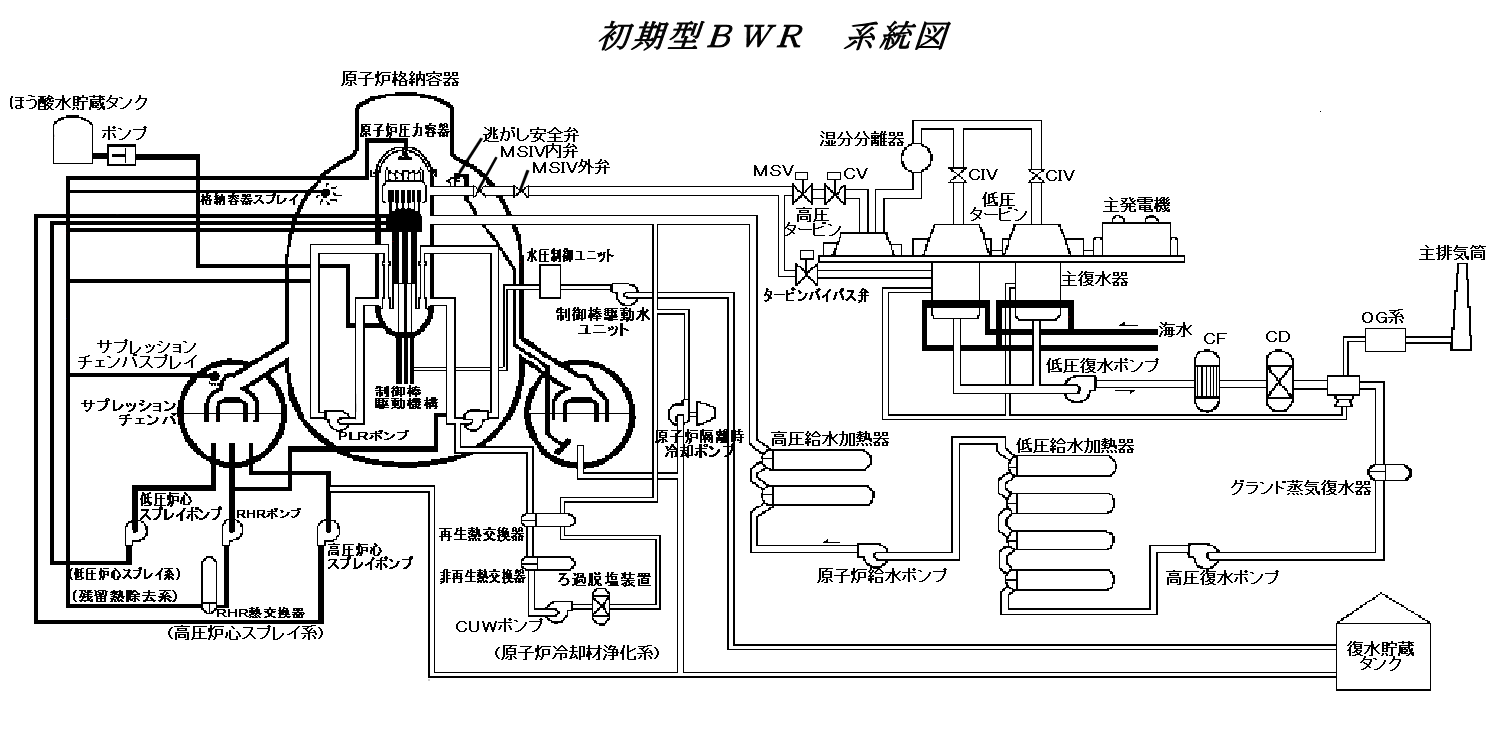
The schematic diagram of a boiling-water reactor is also presented:

(Click to enlarge)
http://anjin.cocolog-nifty.com/nuclear/2011/03/post-4e19.html

What it lacks is the emergency water supply to be set above the pressure reactor for automatic provision and circulation of cooling water in case that emergency operation of pumps using an emergency power supply should fail.


By applying a special mechanism, water/vapor can be circulated between the pressure vessel and the auxiliary water tank without using electricity, even in the worst case.


PART II: North East Japan M8 Earthquakes

The history of big earthquakes (M8.0 or larger) that occurred in north east Honshu Island, Hokkaido Island, and the South Kuril Islands of Japan on the North Pacific Ocean are as follows:

1) 869, July 9, Jyogan-Saniriku-oki, M 8.6

2) 1611, December 2, Keicho-Sanriku-oki, M 8.1

3) 1793, February 17, Sanriku-oki, M 8.4

4) 1843, April 25, Tokachi-oki, M 8.0

5) 1896, June 15, Meiji-Sanriku, M 8.5

6) 1918, September 8, Kuril Ostrov Urup, M 8

7) 1933, March 3, Showa-Sanriku, M 8.1

8) 1952, March 4, Tokachi-oki, M 8.2

9) 1958, November 7, Kuril Etorofu (Iturup) Island, M 8.1

10) 1963, October 13, Kuril Etorofu (Iturup) Island, M 8.1

11) 1994, October 4, Hokkaido-Toho-oki, M 8.2

12) 2003, September 26, Tokachi-oki, M 8.0

13) 2011, March 11, Tohokuchiho-Taiheiyo-oki, M 9.0

These earthquakes can be put into a group, since their epicenters are along the border between the Pacific plate and the North American plate.

(Click to enlarge.)
http://www.jma.go.jp/jma/kishou/know/whitep/2-1.html

Especially, 210 years between 1793 and 2003, 10 earthquakes each with a magnitude M 8.0 or larger occurred in this region.

It is one in 20 years since around 1800. In this region, one Magnitude 8.0-class earthquake has occurred in every 20 years in these 200 years.

So, if a nuclear power plant is built in this region, it must be prepared for twice occurrences of an M 8.0 class earthquake, assuming the plant operates for 40 years.

The Fukushima Nuclear Power Plants of TEPCO do not look like having been designed and built on this rational assumption.

Eventually, on March 11, 2011, the M 9.0 earthquake occurred, accompanied by 14-meter high tsunami.

It must be also noted that the Jyogan-Saniriku-oki earthquake of 869 was accompanied by big tsunamis of a 10-meter class. Some scientists and scholars who recently found the evidence of the past tsunamis actually gave a warning to TEPCO and the government about a possible 10-meter-high tsunami to hit the nuclear power plants in the sanriku region (Pacific shores of Iwate Prefectures in northeast Honshu) and the south Tohoku region (including Fukushima Prefecture).
The 869 Sanriku earthquake and tsunami (869-nen Sanriku jishin) struck the area around Sendai in the northern part of Honshu on 9 July 869 (May 26, Jogan 11).[2] The earthquake had an estimated magnitude of 8.6 on the surface wave magnitude scale.[citation needed] The tsunami caused widespread flooding of the Sendai plain, with sand deposits being found up to 4 kilometres (2.5 mi) from the coast...

As for the other two large tsunamis recognized before the 869 tsunami, one was estimated to have occurred between about 1000 BC and 500 BC and the other about 500 BC and 1 AD.[6] In 2007 the probability of an earthquake with a magnitude of Mw 8.1–8.3 was estimated as 99% within the following 30 years.


http://en.wikipedia.org/wiki/869_Sanriku_earthquake_and_tsunami


If the American East Coast from Rhode Island to Charleston is to have an M 8.0 earthquake once in 20 years, who would construct a nuclear power plant in New York and Washington D.C. on a just 15 feet-high plot above the sea.


PART III: A Suggestion from England

As this is an accident related to a core of human civilization of today, the Japanese authorities should refer to wisdom in the world.

TUESDAY, APRIL 12, 2011
Filtering gaseous emissions from Fukushima

I have been speaking to a UK company producing ion-exchange resins, to see how the filtration process would be assembled.

Once a duct has been fixed to the window(s) of Reactor 2 (the one with intact secondary containment) the gases will first need to be cleansed of H2 because of the explosion risk.

An oxidant solution such as chlorine should meet this need.

Second, a simple particle filter would be needed. The gases should then be passed through water to dissolve the radionuclides. this would also cool them as they need to be close to 40*C for ion exchange filters to work.

Next, chemical preciptiation could bring most radionuclides out of solution.

Finally, ion-exchange resins would be used for entrapment of anything left. The exact form of resin would depend on the mix of ions left in solution.

All filters and precipitates would have to be stored as radioactive waste.

Once experience has been gained with Reactor 2 gases, 1,3 and 4 will need to be clad in fabric and have ducts inserted in order to do the same, but at larger scale, with them.

The ducts can lead to manifolds, so that more filter processes can be added on as necessary.

It is therefore pretty simple technology. At the end of the treatment, the cleaned water can be cooled further, and passed back into the cooling circuit.

The technology is simple. Persuading the decision makers to do it is the difficult aspect.


http://greenerblog.blogspot.com/2011/04/filtering-gaseous-emissions-from.html


**** **** ****


Japan provided $100 million for recovery of Haiti from the earthquake of January 2010.

It is estimated that the amount of damage from the 3/11 Disaster of Japan reaches $235 billion, probably without counting future nuclear damage.

Yet, in Haiti, the number of casualties, including victims of the unrest after the earthquake, is 316,000. It is ten times larger than the deaths in the 3/11 Disaster of Japan.

Somebody must provide $2350 billion for Haiti to make the matter even.

Anyway, as the 9/11 Terror on America set the course of 2000's in the world, the 3/11 Disaster in Japan might set the course of 2010's in the world.

In this context, the 2010 earthquake in Haiti might symbolize the 2000's as the aftermath of the 2001 Terror on America. I hope that something better would happen in 2020 in the world.


(Sumatra, Sichuan, Haiti, Christchurch, and finally Northeast Honshu of Japan...or Three Mile, Chernobyl, and finally Fukushima? Oh I really wanna take ya...down to Kokomo...

http://www.youtube.com/watch?v=AHtQ4-WBkis&feature=related)


Mar 4:12 That seeing they may see, and not perceive; and hearing they may hear, and not understand; lest at any time they should be converted, and their sins should be forgiven them.

Mar 4:13 And he said unto them, Know ye not this parable? and how then will ye know all parables?

Mar 4:14 The sower soweth the word.


Tuesday, April 12, 2011

"Now when Jesus had heard" - (Atomic Calculation)

In Tokyo...


Atomic Calculation


They say the number of radioactive intensity, using a unit of becquerel.

But, how much and how many are there in terms of the number and the weight of radioactive atoms?

Where there is radiation of some becquerels, there must be some grams and some number of radioactive atoms.

The number of atoms and the weight of atoms can be more easily understood for some people, though strength of radiation becquerel is convenient.


PART I: Nitrogen Input into Fukushima Plant

Now what are they doing in the Fukushima Daiichi Plant?

Essentially they are cooling nuclear fuel in the pressure vessel of each reactor unit of the Daiichi Plant.

But, at the same time, they have to prevent another hydrogen explosion as hydrogen is generated from damaged metal frames of heated fuel rods and oxygen is generated from radiated water. For this purpose, they are sending nitrogen gas into the containment vessel.


The work started on April 7, accompanied by an increase of the pressure inside the containment vessel of the 1st reactor unit. But, on April 11, the internal gas pressure stopped rising. So, it is suspected that gas is leaking from the vessel, meaning uncontrolled leakage of radioactive material from the containment vessel.


PART II: Fukushima Reevaluated as Level 7 the Worst

It has been judged that the Fukushima Daiichi Plant output 630,000 of trillion (6.3 x 10^17 ) becquerels of radioactive material from March 11 to April 5, though the amount being output is now less than 1 trillion becquerels per hour (2.8 x 10^8 Bq per second).

So, the crisis level of the Fukushima accident has been raised from 5 to 7, equivalent to the level of the 1986 Chernobyl accident in the former Soviet Union.

One radioactive decay per second in an atom means 1 becquerel.

However, the total amount of radioactive material accidentally sprayed from the Fukushima Daiichi Plant is 10% of that in the Chernobyl case, according to the Nuclear and Industrial Safety Agency of Japan.


PART III: How Much Nuclear Vessel Is Damaged

In a 1 cm x 1 cm x 1 cm space of the air, there are 2.5 x 10^19 molecules of N2, O2, H2O, CO2, etc.

In a million kW nuclear reactor unit, there is more than 13.6 x 10^19 becquerels of radioactive material, of course, in fuel rods within a pressure vessel in safety.

So, in one second, total 13.6 x 10^19 radioactive decays happen in such a reactor.

But, now from the Fukushima Daiichi Plant, total less than 2.8 x 10^8 radio active decays have an influence on the outside. But as there are four reactor units in question, one unit can be thought to emit 0.7 x 10^8 becquerels.

As (0.7 x 10^8)/(13.6 x 10^19) = 0.05/10^11 = 0.00000000005/10^2, there is a possibility that 0.00000000005% of the pressure vessel and the containment vessel of each unit is broken.

As for 6.3 x 10^17 becquerels output from March 11 to April 5, in this period the maximum output per hour was 1 x 10^16 becquerels, which was 2.8 x 10^12 becquerels per second.

In this case, 0.0000005% of the pressure vessel and the containment vessel of each unit is broken.

So, when the hydrogen explosion occurred in a reactor unit, 0.0000005% of the vessel of the unit was broken, but now it is around 0.00000000005% probably because of a lack of explosive pressure.

The point at issue is whether or not this breakage caused fractions of nuclear fuel to leak out of the pressure vessel into the containment vessel and out to the building housing the vessels.

In addition, WHO sets a guideline level for drinking water at 10 Bq per liter.


PART IV: Pressure Vessel

A pressure vessel of one mega-kilo watt reactor (a standard of today) has 100 tons of fuel.

Among them, the real fuel Uranium-235 accounts for 4 to 5 tons.

Among this 4 to 5 tons, 1 ton is burnt in a year and converted to other elements which are still situated in the fuel rods held by metal frames.

This 1 ton of radioactive atoms have higher radioactive strength than original 1 ton of Uranium-235.


PART V: 1 Gram of Fuel

In one gram of Uranium-235, there are more than 10^21 Uranium-235 atoms, namely 1,000,000,000,000,000,000,000 atoms.

If this one gram of Uranium-235 underwent fission to become radioactive atoms and escaped a crippled reactor vessel in Fukushima through explosion or vaporization, how many radioactive atoms will fall on the ground with an area of 100 km x 100 kilometers.

The area: 100 km x 100 km = 10000 square kilometers = 10^10 square meters.

Accordingly, one square meter will have 10^21/10^10 = 10^11 = 0.1 trillion radioactive atoms.

For 400 km x 400 km = 160000 square kilometers = 1.6 x 10^11

Accordingly, one square meter will have 10^21/(1.6 x 10^11) = 6 x 10^9 = 6 billion radioactive atoms.

However, as above mentioned, one gram of nuclear fuel has only 5% of pure Uranium-235 and its radioactive derivatives. Among 6 billion atoms, there are 300 million radioactive atoms actually.

So, in this case, a plot around Tokyo with a size of 1 meter x 1 meter might have 300 million (3 x 10^8) radioactive atoms.

However, on the ground of 1 meter x 1 meter x 1 meter (depth), there are more than 10^6 x 10 ^21 = 10^27 of ordinary atoms of various elements. Then the radioactive element accounts for:
10^8/10^27 = 1/10^19 = 0.0000000000000000001 = 0.00000000000000001%.

As for the amount of radiation of a given type of atom in becquerel, the following equation should be used:
N becquerels = [4 x 10^23 x (grams of atoms)] / [(atomic mass number) x (half-life period in seconds)]

In the case of 1 gram of Uranium-238, N = 12400 Bq as its half-life is 4.468 billion years.

Again, WHO sets a guideline level for drinking water at 10 Bq per liter.

For one kilo-gram of spinach, the allowable limit for radioactive cesium-137 is 500 Bq since cesium-137 has 137 of the atomic number and 30 years of the half-period. From these numbers, we can confirm how many atoms of the radioactive cesium could be allowed to attach to the spinach of 1 kg.


**** **** ****


The conclusion is that a nuclear power plant must be segregated, sealed, and covered completely.

It must be a complete closed system.

Every wall and ceiling should be made of reinforced concrete with 3 meter thickness. No air flow should be allowed between the inside of the vessel-housing building and the outside of it.

And, as I wrote yesterday, we have to start to use magnesium but not uranium for electricity generation.


Mat 4:11 Then the devil leaveth him, and, behold, angels came and ministered unto him.

Mat 4:12 Now when Jesus had heard that John was cast into prison, he departed into Galilee;

Mat 4:13 And leaving Nazareth, he came and dwelt in Capernaum, which is upon the sea coast, in the borders of Zabulon and Nephthalim:


Monday, April 11, 2011

"Thou art worthy, O Lord" - (Uranium to Magnesium)

Spring around Tokyo in 2011


From Uranium to Magnesium

When mankind found coal to be useful as an energy source, civilization drastically expanded.

When mankind found crude oil to be useful as an energy source, civilization drastically expanded.

When mankind found uranium to be useful as an energy source, civilization however did not drastically expand.

But, now as some scientists have found magnesium to be useful as an energy source, civilized society might be drastically improved.


SECTION I: State of Tokyo

Everything is as usual in and around Tokyo nowadays, since planned outage by TEPCO is all cancelled.

Electricity is now fully supplied for houses, offices, shops, and factories. Radiation levels are all within a safety range. No suspected types of agricultural foods are delivered from a very restricted radiologically affected area around the Fukushima Daiichi (No.1) Nuclear Plant.

The only difference is found in the state of foreigners. The number of foreigners visiting Japan has fallen.

And, in a TV program, they say that some foreign media are reporting to the world that Tokyo is in a sea of fire; many Japanese were killed by the nuclear accident of Fukuhshima. But, Tokyo is as it was last year; no people were killed in Japan by radiation leaked from the Fukushima plant.

However, some Japanese makers, including Toyota, are in trouble collecting parts and providing them for overseas plants. Yet, 70 million corporate workers in Japan go to work every morning as they did last year except in the areas hit hard by the M9.0 Earthquake and the more-than-10-meter high tsunami on March 11.


SECTION II: General State of Fukushima Plant

Nonetheless, it must be admitted that it is not so normal that the Japanese Government issues a report on radiation levels in the air and of foods produced around Fukushima Prefecture everyday, and officials and staff of the Nuclear and Industrial Safety Agency and TEPCO hold press conferences everyday.

And, some Japanese think that the Government should tel the world that the Fukushima nuclear reactors all stopped power generation operation in safety one second after the occurrence of the big earthquake while the Chernobyl reactor continued its operation while having entered an emergency state till it was blown off.

The problem in Fukushima is failure in cooling nuclear fuel in the pressure vessels and the spent-fuel pools in containment vessels, since the cooling systems were damaged by the M9.0 earthquake and a 14-meter-high tsunami. And, there is a possibility that hydrogen bursts damaged some vessels. They are grave accidents. But, nuclear fuel are all inside the reactor vessels. The task remaining is to cool fuel and seal the building for housing the vessels. And this work is being carried out in full cooperation with the U.S. and France.

It might take still several days to see how long it will take to fix the case definitely.


SECTION III: Alternative Power Source: Magnesium

Magnesium can be used as a source to generate electricity as crude oil, natural gas, and coal can be.

This seems to be an original idea of a Japanese scientist.
(PhysOrg.com) -- There is enough magnesium to meet the world's energy needs for the next 300,000 years, says Dr. Takashi Yabe of the Tokyo Institute of Technology.
...
Magnesium is highly reactive and stores a lot of energy. Researchers are now devising ways to extract energy from magnesium in a more controlled method.


http://www.physorg.com/news191259549.html


Calorific power of oil is 44 mega joules/kilo-gram; coal 30 Mjoules/kg; timber 15 Mjoules/kg; and magnesium 25 Mjoules/kg.

Fossil fuels, namely oil, coal, and natural gas, are used in an amount of 100 billion tons per year as energy sources for mankind today. But, 1800 trillion tons of magnesium is included in the seawater surrounding the continents of the world. Accordingly, if we use magnesium at the same pace as that of fossil fuels, we can use magnesium for 300,000 years without depletion.

Mr. Yabe has an idea to use a "solar-pumped laser" system to extract magnesium from the sea economically.

After burning magnesium to generate electricity, magnesium turns to magnesium oxide. Again, the "solar-pumped laser" system can be used to extract metal magnesium from magnesium oxide. This cycle is perfect for realizing recycling of the energy source magnesium.

However, at present, without the "solar-pumped laser" system, costs for the refinery process to extract metal magnesium are huge. In order to get one ton of magnesium, 10 tons of coal is needed, which inhibits the use of magnesium as an alternative energy source.


(Click to enlarge.)
http://www.mech.titech.ac.jp/~ryuutai/

Burning of Magnesium is tried in a science class of Japanese junior high-school.

http://www.ons.ne.jp/~taka1997/education/2003/chemistry/05/index.html

Production of Magnesium:
Rank...Country...Production...estimate for 2007 (metric tons)
1... China... 627,000
2... Russian Federation... 37,000
3... Israel... 25,000
4... Kazakhstan... 21,000
5... Brazil... 18,000
6... Canada... 16,300
7... Ukraine... 2,500
8... Serbia... 1,500
Source: USGS[16]

http://en.wikipedia.org/wiki/Magnesium#Production


When magnesium has come to be obtained from the sea, the world does not have to depend on China.

**** **** ****

A crude oil-based thermal power station has an index of potential danger evaluated as 1.

A crude oil-based thermal power station has an index of facility protection capability evaluated as 1.

A nuclear power plant has an index of potential danger evaluated as 100,000.

A nuclear power plant has an index of facility protection capability evaluated as 100.

Accordingly, the nuclear power plant is potentially 100,000 times dangerous than the crude oil-based thermal power station; the nuclear power plant is actually 100 times more protected than the crude oil-based thermal power station.

So, it is protected 100/100,000 = 1/1000 times what is required for protection of the nuclear power plant at the same level as the crude oil-based thermal power station.

The nuclear power plant must be strengthened 1000 times more than it is, in terms of safety.

If Tokyo Electric Power Company has spent $1 million for safety improvement conventionally, they have to increase the budget to $1 billion.

Yet, as I once wrote, the Fukushima No.1 Nuclear Power Plant could be protected with $30,000 fortification work with external emergency power generators for emergency fuel-cooling water circulation pumps against a possible 14-meter high tsunami.

Honestly, check the potential danger of the Fukushima Daiichi Nuclear Power Plant (potentially 100,000 times dangerous than the crude oil-based thermal power station):
http://www.jma.go.jp/jma/kokusai/EER/eer_latest.pdf


Rev 4:11 Thou art worthy, O Lord, to receive glory and honour and power: for thou hast created all things, and for thy pleasure they are and were created.