Saturday, July 07, 2012

"in vain do they worship me" - Foreign Debts of the US


The Tokyo Station under Repair, Tokyo

Foreign Debts of the US

The US is the largest owner of external assets and external debts.

But Japan is not.

List of sovereign states by external assets
RankCountryFinancial assets
1 United States35,543
2 Japan14,172
3 United Kingdom5,067
4 Germany4,934
5 China4,459
6 France3,995
7 Italy3,655
8 Canada2,711
9 Australia1,953
10 Spain1,777
11 Netherlands1,746
12 Taiwan1,623
13 Switzerland1,575
14 South Korea1,435
15 Brazil1,224
16 India989
17 Belgium918
18 Mexico819
19 Sweden739
20 Denmark587
21 Austria498
22 Singapore431
23 Portugal395
24 Malaysia348
25 Norway345
26 Ireland294
27 Russia282
28 Poland281
29 Greece276
30 Chile261
31 Finland240
32 Thailand211
33 South Africa205
34 Turkey191
35 Indonesia169
36 Czech Republic136
37 New Zealand124
38 Colombia115
39 Romania112
40 Hungary104
41 Argentina47
42 Croatia45
43 Slovenia42
44 Slovakia41
45 Ukraine41
46 Bulgaria38
47 Lithuania22
48 Estonia19
49 Kazakhstan17
50 Latvia14
http://en.wikipedia.org/wiki/List_of_sovereign_states_by_external_assets


List of countries by external debt
RankCountryExternal Debt[2]
US dollars
DatePer capita[3][4][5][6]
US dollars
% of GDP[7][8][9]
1 United States15,813,740,000,00026 June 201250,266103
— European Union13,720,000,000,00030 June 201027,86485
2 United Kingdom8,981,000,000,00030 June 2010143,009360
3 Germany4,713,000,000,00030 June 201057,755142
4 France4,698,000,000,00030 June 201074,619182
5 Japan2,441,000,000,00030 September 201019,14845
6 Ireland[10][11]123,058,047,00010 November 201126,820108.2
7 Netherlands1,884,489,600,0003rd quarter of 2010[12]226,503344
8 Italy2,223,000,000,00030 June 2010 est.36,841108
9 Spain2,166,000,000,00030 June 201018,26084
10 Luxembourg[note 1]1,892,000,000,00030 June 20103,696,4673,443
11 Belgium1,241,000,000,00030 June 2010113,603266
12 Switzerland1,200,000,000,00030 September 2010154,063229
13 Australia1,169,000,000,00031 December 2010est.52,59695
14 Canada1,181,000,000,00030 June 2011 est.29,62564
15 Sweden853,300,000,00030 June 201091,487187
16 Austria755,000,000,00030 June 201090,128200
— Hong Kong750,800,000,00031 December 2010est.105,420334
17 Norway643,000,000,00012 August 2011131,220141
18 China635,500,000,00031 December 2011 est.3965
19 Denmark031 March 201200
20 Greece532,900,000,00030 June 201047,636174
21 Portugal497,800,000,00030 June 201046,795217
22 Russia480,200,000,00030 November 2010est.3,23533
23 Finland370,800,000,00030 June 201068,960155
24 Korea, South370,100,000,00031 December 2010est.7,56737
25 Brazil310,800,000,00031 December 2010est.1,60815
http://en.wikipedia.org/wiki/List_of_countries_by_external_debt 

Yes, to your surprise, Japan has less foreign debts than the US, the EU, the UK, Germany and France.  But Japan has the largest foreign assets only next to the US.
A disturbing aspect of the U.S. external position has been the United States’ move from being the world’s largest creditor nation in the mid-1980s to the world’s largest debtor nation at present. Currently, the U.S. gross external debt position is around 120 percent of GDP while its net external debt position is more than 20 percent of GDP and rising.
It is also of concern that most of the U.S. external current account deficit is now being financed by central banks, particularly in the OPEC countries and China, rather than by private investors. Foreign central bank dollar holdings now exceed US$6 trillion, of which more than one-quarter is held by the Chinese central bank. Earlier this month, the Chinese premier expressed his unease about China’s very large exposure to changes in the value of the U.S. dollar that was posed by China’s holdings of U.S. government bonds.
http://www.american.com/archive/2009/march-2009/q-a-how-to-think-about-the-u-s-dollar

The world of today has one big problem as the US relies on China in maintaining its financial balance.  China is financing the US.

But truth is this.  China imports, legally or illegally, Japanese technology and funds to have industrial capability.  China produces goods and products for Wal-Mart, Apple, and other US companies.  China receives a huge amount of dollars from the US.  And then China invests those dollars into the US financial market.    

The point at issue is whether it is possible that the US and China make war against each other for any interest.  It is not.  But, if a revolution and a civil war should occur in China, the US might be involved with its superior military capability.  Till the start of the 22nd century, this situation can happen in and around China.  The Chinese Communist Part will lose power.

Another possibility is that more and more Chinese will move to the US to live there as permanent residents.  Till the start of the 22nd century, about 30 million more Chinese might be living in the US whether or not on the permanent basis or the temporary basis.  

But, the peace would be maintained due to the presence of Japan.


*** *** *** ***


Mar 7:7 Howbeit in vain do they worship me, teaching for doctrines the commandments of men.
Mar 7:8 For laying aside the commandment of God, ye hold the tradition of men, as the washing of pots and cups: and many other such like things ye do.

Friday, July 06, 2012

"their heart is far from me" - Present State of Nuclear Japan


The Tokyo Railway Station


Present State of Nuclear Japan

Every Friday in Tokyo, anti-nuclear citizens gather on the streets running in front of the Prime Minister Office.

The police are protecting the PM Office, but more than 10,000 people are expressing their opinions against restart of nuclear power generation though all the nuclear power plants in Japan were halted till this July.

As the summer has started and people are expected to use more electricity for air-conditioning, the Noda Cabinet decided to resume operation of a nuclear power plant in Fukui Prefecture situated north of Osaka and Kyoto.  This power plant is to provide additional electricity for the second largest metropolitan area in Japan that includes Osaka and Kyoto.  So, now one nuclear reactor of one nuclear power plant is under operation.  Another reactor of the plant, called Oi Nuclear Power Plant, is also planned to start full operation by August.  

However, TEPCO, the utility company providing electricity for Tokyo and the Kanto area, has yet no plan to resume nuclear power generation, since its Fukushima Daiichi plant got crippled by the M9.0 earthquake and the big tsunami that occurred on March 11, 2011.

If Tokyo Electric Power Company (TEPCO) should decide resumption of its nuclear power generation in its nuclear plants, such as Fukushima Daini and Kashiwazaki/Kariha, and the Japanese Government should authorize it, more protesters would gather in front of the PM Office in Tokyo.

Generally speaking, the Japanese nuclear power community, consisting of utility companies, nuclear facility makers, related bureaucrats, etc., does not change their policy to promote nuclear power generation in Japan, though the 3/11 Disaster and the Fukushima Daiichi accident gave a great shock to parties concerned.  Especially, Prime Minister Mr. Noda has recently taken a clear step toward restart of nuclear power generation in Japan.

Anyway, the Japanese people experienced living without nuclear power since this May till this July.  About 50 nuclear power reactors in Japan were all halted as the public requested more critical testing and assessment for restart of nuclear power plants that were halted for periodic overhauls after March 2011. 

One key issue is that PM Mr. Noda had decided to resume nuclear power operation before the investigative committees set up by the government and the parliament did not yet release their final reports.  The parliament investigative committee made its report public yesterday.  But its recommendations are yet to be implemented by the Japanese Government.

Parties, business leaders, bureaucrats, and politicians promoting the nuclear power operation in Japan claim that Japanese industry and economy would be badly influenced by restriction on supply of electricity.   So, for prosperity of Japan, they claim, nuclear power generation is necessary.  Otherwise, they assert, Japan will have to purchase crude oil and natural gas at higher prices and the unemployment rate in Japan will increase.

But, from the beginning, it is crazy to build nuclear power plants in Japan that suffers 20% of earthquakes with Magnitude 6.0 or more that occur in the world per year.

Japan should start to forget about nuclear power generation or invent a new technology to make it completely safe.


http://earth.o-oi.net/Category/16/


*** *** *** ***


Mar 7:6 He answered and said unto them, Well hath Esaias prophesied of you hypocrites, as it is written, This people honoureth me with their lips, but their heart is far from me.

Thursday, July 05, 2012

"For he loveth our nation" - A Factor of Sino-Japanese War


A Tokyo Station Platform


A Factor of Sino-Japanese War

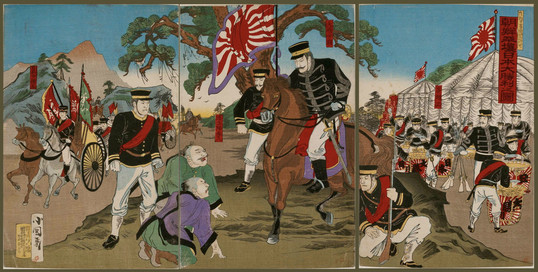
Before the end of WWII, contempt of Chinese was widely observed in the Empire of Japan.


Japanese people came to disdain Chinese after the Japanese-Russo War (1904 - 1905).  


It is even suspected that leaders and authorities of the Imperial Government promoted this superior feeling to Chinese among the Japanese people.


This general atmosphere that the Japanese public held Chinese in contempt was a key to understanding the Sino-Japanese War (1937 - 1945).

Before Japan started its modernization and Westernization, there was no such disdain of Chinese people.  Before the Meiji Restoration of the Imperial Authority in 1868, Japan was ruled by the samurai class who honestly learnt Confucianism and other Chinese classics.  So, Japanese people in the samurai era respected China as a culturally advanced country.

But, when the last samurai regime of Japan fell to be replaced by the modern and Westernized Meiji government, the tide came to gradually change.  Japanese people, in addition to the Japanese elites, realized that China could not compete with Western powers.  The Qing Dynasty lost the Opium War against the UK in 1842 and 1856.  This defeat of China gave a great shock to the Japanese elite samurais and other Japanese.  They admitted superiority of Western science, technology, and systems.  Japanese people in the late 19th century found that China was no more a leader in Asia.  Confucianism and other Chinese classics could not give merit to East Asians facing a threat from invading Western powers.  Japanese people started to import Western science, technology, and systems so as to enhance national power.


This effort of Japanese people was paid off as the Empire of Japan  won the first Sino-Japanese War in 1895 and defeated the Russian Empire in 1905.

The Japanese people came to realize at the time that only the Empire of Japan could cope with Western powers that had been busy colonizing Africa and Asia.  And, China was in a great social turmoil after the collapse of Qing Dynasty.  Korea was worse than China without any effective movement toward modernization and Westernization.


In the samurai era, Japanese people respected China and Korea, but it was only based on reading and learning of the Analects of Confucius and other Chinese classics.  Japanese people had not seen real life of ordinary Chinese people.  Indeed the samurai Japan closed its door to the world except trade with China and the Netherlands.  Japanese people only imagined an ideal country and society when they thought about China.  But, after the Meiji Restoration, reality and poverty of ordinary Chinese people and their living came to be well known in Japan.  In one word, Chinese were at the brink of colonization by the UK, Russia, and other Western powers.  As the Empire of Japan succeeded in modernization and Westernization of its industry and society, the Japanese elites came to despise China and Chinese.  This disposition to make little of China and Chinese diffused widely among ordinary Japanese.  The Japanese elites wanted to be a member of Western colonizing powers.  They came to despise China and Chinese as Europeans did. 
  
This biased psychological advantage of Japanese people made it easier for the Imperial military to launch military campaigns in the Chinese continent if those battles were first triggered by Chinese troops.

And, the war with China that started in full swing in 1937 could not be stopped.  It developed to the Japanese-US war that started in Pearl Harbor, Hawaii, in 1941, since China became a virtual ally of the US.

http://nissinsensonishikie.jimdo.com/%E4%BD%9C%E5%93%81-%EF%BC%91-%EF%BC%91%EF%BC%92%EF%BC%93/%E4%BD%9C%E5%93%8162-70/066%E6%9C%9D%E9%AE%AE%E5%B9%B3%E5%A3%8C%E6%97%A5%E6%9C%AC%E5%A4%A7%E5%8B%9D%E5%88%A9%E4%B9%8B%E5%9B%B3/


*** *** *** ***


Luk 7:5 For he loveth our nation, and he hath built us a synagogue.
Luk 7:6 Then Jesus went with them. And when he was now not far from the house, the centurion sent friends to him, saying unto him, Lord, trouble not thyself: for I am not worthy that thou shouldest enter under my roof:
Luk 7:7 Wherefore neither thought I myself worthy to come unto thee: but say in a word, and my servant shall be healed.
Luk 7:8 For I also am a man set under authority, having under me soldiers, and I say unto one, Go, and he goeth; and to another, Come, and he cometh; and to my servant, Do this, and he doeth it.