Saturday, July 07, 2012

"in vain do they worship me" - Foreign Debts of the US


The Tokyo Station under Repair, Tokyo

Foreign Debts of the US

The US is the largest owner of external assets and external debts.

But Japan is not.

List of sovereign states by external assets
RankCountryFinancial assets
1 United States35,543
2 Japan14,172
3 United Kingdom5,067
4 Germany4,934
5 China4,459
6 France3,995
7 Italy3,655
8 Canada2,711
9 Australia1,953
10 Spain1,777
11 Netherlands1,746
12 Taiwan1,623
13 Switzerland1,575
14 South Korea1,435
15 Brazil1,224
16 India989
17 Belgium918
18 Mexico819
19 Sweden739
20 Denmark587
21 Austria498
22 Singapore431
23 Portugal395
24 Malaysia348
25 Norway345
26 Ireland294
27 Russia282
28 Poland281
29 Greece276
30 Chile261
31 Finland240
32 Thailand211
33 South Africa205
34 Turkey191
35 Indonesia169
36 Czech Republic136
37 New Zealand124
38 Colombia115
39 Romania112
40 Hungary104
41 Argentina47
42 Croatia45
43 Slovenia42
44 Slovakia41
45 Ukraine41
46 Bulgaria38
47 Lithuania22
48 Estonia19
49 Kazakhstan17
50 Latvia14
http://en.wikipedia.org/wiki/List_of_sovereign_states_by_external_assets


List of countries by external debt
RankCountryExternal Debt[2]
US dollars
DatePer capita[3][4][5][6]
US dollars
% of GDP[7][8][9]
1 United States15,813,740,000,00026 June 201250,266103
— European Union13,720,000,000,00030 June 201027,86485
2 United Kingdom8,981,000,000,00030 June 2010143,009360
3 Germany4,713,000,000,00030 June 201057,755142
4 France4,698,000,000,00030 June 201074,619182
5 Japan2,441,000,000,00030 September 201019,14845
6 Ireland[10][11]123,058,047,00010 November 201126,820108.2
7 Netherlands1,884,489,600,0003rd quarter of 2010[12]226,503344
8 Italy2,223,000,000,00030 June 2010 est.36,841108
9 Spain2,166,000,000,00030 June 201018,26084
10 Luxembourg[note 1]1,892,000,000,00030 June 20103,696,4673,443
11 Belgium1,241,000,000,00030 June 2010113,603266
12 Switzerland1,200,000,000,00030 September 2010154,063229
13 Australia1,169,000,000,00031 December 2010est.52,59695
14 Canada1,181,000,000,00030 June 2011 est.29,62564
15 Sweden853,300,000,00030 June 201091,487187
16 Austria755,000,000,00030 June 201090,128200
— Hong Kong750,800,000,00031 December 2010est.105,420334
17 Norway643,000,000,00012 August 2011131,220141
18 China635,500,000,00031 December 2011 est.3965
19 Denmark031 March 201200
20 Greece532,900,000,00030 June 201047,636174
21 Portugal497,800,000,00030 June 201046,795217
22 Russia480,200,000,00030 November 2010est.3,23533
23 Finland370,800,000,00030 June 201068,960155
24 Korea, South370,100,000,00031 December 2010est.7,56737
25 Brazil310,800,000,00031 December 2010est.1,60815
http://en.wikipedia.org/wiki/List_of_countries_by_external_debt 

Yes, to your surprise, Japan has less foreign debts than the US, the EU, the UK, Germany and France.  But Japan has the largest foreign assets only next to the US.
A disturbing aspect of the U.S. external position has been the United States’ move from being the world’s largest creditor nation in the mid-1980s to the world’s largest debtor nation at present. Currently, the U.S. gross external debt position is around 120 percent of GDP while its net external debt position is more than 20 percent of GDP and rising.
It is also of concern that most of the U.S. external current account deficit is now being financed by central banks, particularly in the OPEC countries and China, rather than by private investors. Foreign central bank dollar holdings now exceed US$6 trillion, of which more than one-quarter is held by the Chinese central bank. Earlier this month, the Chinese premier expressed his unease about China’s very large exposure to changes in the value of the U.S. dollar that was posed by China’s holdings of U.S. government bonds.
http://www.american.com/archive/2009/march-2009/q-a-how-to-think-about-the-u-s-dollar

The world of today has one big problem as the US relies on China in maintaining its financial balance.  China is financing the US.

But truth is this.  China imports, legally or illegally, Japanese technology and funds to have industrial capability.  China produces goods and products for Wal-Mart, Apple, and other US companies.  China receives a huge amount of dollars from the US.  And then China invests those dollars into the US financial market.    

The point at issue is whether it is possible that the US and China make war against each other for any interest.  It is not.  But, if a revolution and a civil war should occur in China, the US might be involved with its superior military capability.  Till the start of the 22nd century, this situation can happen in and around China.  The Chinese Communist Part will lose power.

Another possibility is that more and more Chinese will move to the US to live there as permanent residents.  Till the start of the 22nd century, about 30 million more Chinese might be living in the US whether or not on the permanent basis or the temporary basis.  

But, the peace would be maintained due to the presence of Japan.


*** *** *** ***


Mar 7:7 Howbeit in vain do they worship me, teaching for doctrines the commandments of men.
Mar 7:8 For laying aside the commandment of God, ye hold the tradition of men, as the washing of pots and cups: and many other such like things ye do.

Friday, July 06, 2012

"their heart is far from me" - Present State of Nuclear Japan


The Tokyo Railway Station


Present State of Nuclear Japan

Every Friday in Tokyo, anti-nuclear citizens gather on the streets running in front of the Prime Minister Office.

The police are protecting the PM Office, but more than 10,000 people are expressing their opinions against restart of nuclear power generation though all the nuclear power plants in Japan were halted till this July.

As the summer has started and people are expected to use more electricity for air-conditioning, the Noda Cabinet decided to resume operation of a nuclear power plant in Fukui Prefecture situated north of Osaka and Kyoto.  This power plant is to provide additional electricity for the second largest metropolitan area in Japan that includes Osaka and Kyoto.  So, now one nuclear reactor of one nuclear power plant is under operation.  Another reactor of the plant, called Oi Nuclear Power Plant, is also planned to start full operation by August.  

However, TEPCO, the utility company providing electricity for Tokyo and the Kanto area, has yet no plan to resume nuclear power generation, since its Fukushima Daiichi plant got crippled by the M9.0 earthquake and the big tsunami that occurred on March 11, 2011.

If Tokyo Electric Power Company (TEPCO) should decide resumption of its nuclear power generation in its nuclear plants, such as Fukushima Daini and Kashiwazaki/Kariha, and the Japanese Government should authorize it, more protesters would gather in front of the PM Office in Tokyo.

Generally speaking, the Japanese nuclear power community, consisting of utility companies, nuclear facility makers, related bureaucrats, etc., does not change their policy to promote nuclear power generation in Japan, though the 3/11 Disaster and the Fukushima Daiichi accident gave a great shock to parties concerned.  Especially, Prime Minister Mr. Noda has recently taken a clear step toward restart of nuclear power generation in Japan.

Anyway, the Japanese people experienced living without nuclear power since this May till this July.  About 50 nuclear power reactors in Japan were all halted as the public requested more critical testing and assessment for restart of nuclear power plants that were halted for periodic overhauls after March 2011. 

One key issue is that PM Mr. Noda had decided to resume nuclear power operation before the investigative committees set up by the government and the parliament did not yet release their final reports.  The parliament investigative committee made its report public yesterday.  But its recommendations are yet to be implemented by the Japanese Government.

Parties, business leaders, bureaucrats, and politicians promoting the nuclear power operation in Japan claim that Japanese industry and economy would be badly influenced by restriction on supply of electricity.   So, for prosperity of Japan, they claim, nuclear power generation is necessary.  Otherwise, they assert, Japan will have to purchase crude oil and natural gas at higher prices and the unemployment rate in Japan will increase.

But, from the beginning, it is crazy to build nuclear power plants in Japan that suffers 20% of earthquakes with Magnitude 6.0 or more that occur in the world per year.

Japan should start to forget about nuclear power generation or invent a new technology to make it completely safe.


http://earth.o-oi.net/Category/16/


*** *** *** ***


Mar 7:6 He answered and said unto them, Well hath Esaias prophesied of you hypocrites, as it is written, This people honoureth me with their lips, but their heart is far from me.

Thursday, July 05, 2012

"For he loveth our nation" - A Factor of Sino-Japanese War


A Tokyo Station Platform


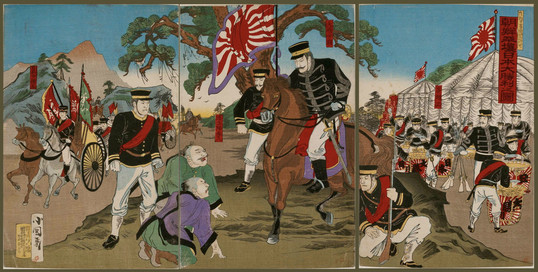
A Factor of Sino-Japanese War

Before the end of WWII, contempt of Chinese was widely observed in the Empire of Japan.


Japanese people came to disdain Chinese after the Japanese-Russo War (1904 - 1905).  


It is even suspected that leaders and authorities of the Imperial Government promoted this superior feeling to Chinese among the Japanese people.


This general atmosphere that the Japanese public held Chinese in contempt was a key to understanding the Sino-Japanese War (1937 - 1945).

Before Japan started its modernization and Westernization, there was no such disdain of Chinese people.  Before the Meiji Restoration of the Imperial Authority in 1868, Japan was ruled by the samurai class who honestly learnt Confucianism and other Chinese classics.  So, Japanese people in the samurai era respected China as a culturally advanced country.

But, when the last samurai regime of Japan fell to be replaced by the modern and Westernized Meiji government, the tide came to gradually change.  Japanese people, in addition to the Japanese elites, realized that China could not compete with Western powers.  The Qing Dynasty lost the Opium War against the UK in 1842 and 1856.  This defeat of China gave a great shock to the Japanese elite samurais and other Japanese.  They admitted superiority of Western science, technology, and systems.  Japanese people in the late 19th century found that China was no more a leader in Asia.  Confucianism and other Chinese classics could not give merit to East Asians facing a threat from invading Western powers.  Japanese people started to import Western science, technology, and systems so as to enhance national power.


This effort of Japanese people was paid off as the Empire of Japan  won the first Sino-Japanese War in 1895 and defeated the Russian Empire in 1905.

The Japanese people came to realize at the time that only the Empire of Japan could cope with Western powers that had been busy colonizing Africa and Asia.  And, China was in a great social turmoil after the collapse of Qing Dynasty.  Korea was worse than China without any effective movement toward modernization and Westernization.


In the samurai era, Japanese people respected China and Korea, but it was only based on reading and learning of the Analects of Confucius and other Chinese classics.  Japanese people had not seen real life of ordinary Chinese people.  Indeed the samurai Japan closed its door to the world except trade with China and the Netherlands.  Japanese people only imagined an ideal country and society when they thought about China.  But, after the Meiji Restoration, reality and poverty of ordinary Chinese people and their living came to be well known in Japan.  In one word, Chinese were at the brink of colonization by the UK, Russia, and other Western powers.  As the Empire of Japan succeeded in modernization and Westernization of its industry and society, the Japanese elites came to despise China and Chinese.  This disposition to make little of China and Chinese diffused widely among ordinary Japanese.  The Japanese elites wanted to be a member of Western colonizing powers.  They came to despise China and Chinese as Europeans did. 
  
This biased psychological advantage of Japanese people made it easier for the Imperial military to launch military campaigns in the Chinese continent if those battles were first triggered by Chinese troops.

And, the war with China that started in full swing in 1937 could not be stopped.  It developed to the Japanese-US war that started in Pearl Harbor, Hawaii, in 1941, since China became a virtual ally of the US.

http://nissinsensonishikie.jimdo.com/%E4%BD%9C%E5%93%81-%EF%BC%91-%EF%BC%91%EF%BC%92%EF%BC%93/%E4%BD%9C%E5%93%8162-70/066%E6%9C%9D%E9%AE%AE%E5%B9%B3%E5%A3%8C%E6%97%A5%E6%9C%AC%E5%A4%A7%E5%8B%9D%E5%88%A9%E4%B9%8B%E5%9B%B3/


*** *** *** ***


Luk 7:5 For he loveth our nation, and he hath built us a synagogue.
Luk 7:6 Then Jesus went with them. And when he was now not far from the house, the centurion sent friends to him, saying unto him, Lord, trouble not thyself: for I am not worthy that thou shouldest enter under my roof:
Luk 7:7 Wherefore neither thought I myself worthy to come unto thee: but say in a word, and my servant shall be healed.
Luk 7:8 For I also am a man set under authority, having under me soldiers, and I say unto one, Go, and he goeth; and to another, Come, and he cometh; and to my servant, Do this, and he doeth it.

Wednesday, July 04, 2012

"when they came to Jesus" - Debts and Forgiveness

The Tokyo Station

Debts and Forgiveness

Christ Jesus must have well understood pain of falling in debt.
Matthew 18:23-35
New International Version (NIV) 
23 “Therefore, the kingdom of heaven is like a king who wanted to settle accounts with his servants. 24 As he began the settlement, a man who owed him ten thousand bags of gold[a] was brought to him.  
25 Since he was not able to pay, the master ordered that he and his wife and his children and all that he had be sold to repay the debt. 
26 “At this the servant fell on his knees before him. ‘Be patient with me,’ he begged, ‘and I will pay back everything.’ 27 The servant’s master took pity on him, canceled the debt and let him go. 
28 “But when that servant went out, he found one of his fellow servants who owed him a hundred silver coins.[b] He grabbed him and began to choke him. ‘Pay back what you owe me!’ he demanded. 
29 “His fellow servant fell to his knees and begged him, ‘Be patient with me, and I will pay it back.’ 
30 “But he refused. Instead, he went off and had the man thrown into prison until he could pay the debt.31 When the other servants saw what had happened, they were outraged and went and told their master everything that had happened. 
32 “Then the master called the servant in. ‘You wicked servant,’ he said, ‘I canceled all that debt of yours because you begged me to. 33 Shouldn’t you have had mercy on your fellow servant just as I had on you?’ 34 In anger his master handed him over to the jailers to be tortured, until he should pay back all he owed. 
35 “This is how my heavenly Father will treat each of you unless you forgive your brother or sister from your heart.”
Indeed debts account for 90% of pain people are feeling.  Debts are a source of 90% of problems the Government has to address.

And Christ Jesus indicated how to handle debts: Release debtors from their debts.
Household Debt
The average American's household debt is nearly $118,000, according to VisualEconomics. This is figured by adding the amount of money they have in the bank to their home's value along with any other property they own and subtracting the amount they owe to the bank for their mortgage or other outstanding loans. 
Credit Card Debt
The average household credit card debt was reported to be $7,394 in February 2010. Since the recession which began in 2007, this amount has gone down, which indicates that most Americans are paying down credit card debt rather than adding to it.
http://www.ehow.com/facts_7158345_average-debt-american-family_.html

So, the solution is simple.  The US Government or FRB should assume debts American families have amassed.  The American authority should pay off debts that making American citizens suffer, since debts have become the biggest factor of business depression and thus low employment.

For reference, the amount of debts one Japanese household has incurred is about $60,000 (http://www.nanchatte.com/money/debts/).

The Bank of Japan should purchase all these debts from all the Japanese households to pay them back by printing and delivering yen bills.

But what will happen if all the debts are forgiven?

Probably, people have to live like they did before 2000.  And creditors should also do business like they did before 2000 or 1995.  And nobody should be forced to commit a suicide as they surely lived in these years.

 http://www.puyan.net/boyaki/00amekou.htm


*** *** *** ***


Luk 7:4 And when they came to Jesus, they besought him instantly, saying, That he was worthy for whom he should do this:
Luk 7:5 For he loveth our nation, and he hath built us a synagogue.
Luk 7:6 Then Jesus went with them. And when he was now not far from the house, the centurion sent friends to him, saying unto him, Lord, trouble not thyself: for I am not worthy that thou shouldest enter under my roof:

Tuesday, July 03, 2012

"come and heal his servant" - God and Mammon


Shinkansen Railway in Tokyo


God and Mammon

Today everybody knows that mankind has technology and energy to produce agricultural foods and industrial goods enough to feed and take care of all the people in the world.

With this level of technology and energy, poverty must have already been a dead word for mankind for a long time.  But, the fact is opposite.  There are so many poor people and potential poor people in the world, though there are also a lot of rich men.


The point at issue to be focused on is human desire and a lack of love to their neighbors.  One of common patterns is that a poor man, one day, gets determined to be rich.  He will neglect and then abuse poor people so as to leave the poor environment.  He will never help or support other poor people at the sacrifice of his success.  But he will make the best effort to be employed by a rich man or a business.  To be promoted, he will accept and follow the way of thinking and living of the rich man and the management of the company.  


And he will soon know that rich people in society can be rich and continue to be rich as they do neglect and abuse poor people.  So, he will stick to this policy of neglecting and abusing the poor.

Of course there are so many levels and steps for a poor man to go through to be rich.  Accordingly, he will not directly face this ugly reality in his career.  He will not feel the prick of conscience.


But, he can wonder why mankind cannot yet
 feed and take care of all the people in the world with such high technology and big energy they have developed and obtained.  And he must know the answer: it is because a poor man can be rich only by neglecting and abusing the poor.

No matter how humane a rich man looks, at the bottom of his mind there is adherence to the philosophy that 
 a poor man can be rich only by neglecting and abusing the poor.
Indeed what makes poor people suffer is a gap and  the disparity between the rich and the poor.

Truly what 
 makes poor Americans suffer is a gap and the disparity between the rich and the poor.   Indeed what  makes poor Africans suffer is a gap and the disparity between the rich and the poor.  

If all the Americans are equally poor, there will be little pain among the poor.  
If all the Africans are equally poor, there will be little pain among the poor.
So, Christ Jesus teaches that a man cannot serve both God and Mammon.  God tells a man not to be greedy.  But Mammon persuades a man to be greedy as much as possible.

Income inequality has been on the rise in most countries since the early 1980s, including in advanced, emerging, and transition economies, Milanovic finds. Explanations for this increase include technological progress, government policies on the use of taxes and social transfers to redistribute income, changing social norms, and globalization. Today, the poorest 20 percent of the world's population receive only 1.27 percent of global income, while the richest 1 percent alone receive 13.08 percent.

http://www.imf.org/external/pubs/ft/survey/so/2011/NEW091211A.htm

So, if this top 1% is not so rich, the poorest 20% will not suffer so much as they can obtain financial resources to solve their problems.

The point at issue here is a lack of faith among these top 1% rich people in the world.  They might look outwardly Judaists, Christians, Muslims, Hindus, or Buddhists, but they belong to a religion that reveres Mammon.

And, it is only faith and a correct religion that can force this top 1% rich people to repent and change their philosophy.

In other word, all the non-religious discussions about the gap between the poor and the rich that are not based on religion and faith will turn to be useless eventually.


The answer and the solution to the Wall Street evil are in religion and faith but not in politics and economics.
In Britain, the gap in earnings between the richest and poorest in the working-age population has risen from eight to one in 1985 to 12 to one in 2008.
http://www.telegraph.co.uk/finance/economics/8935943/Gap-between-rich-and-poor-growing-fastest-in-Britain.html


*** *** *** ***


Luk 7:3 And when he heard of Jesus, he sent unto him the elders of the Jews, beseeching him that he would come and heal his servant.

Monday, July 02, 2012

"the Jew's feast of tabernacles" - Imperial Troops in China


Tokyo Subway

Imperial Troops in China

When the Empire of Japan got engaged in war in China in 1937, the Imperial Government had no plan and policy about how to govern whole China after its victory over the Chinese military.

The Imperial Government could recruit hundreds of thousands of soldiers from the Japanese society and send them to the Chinese continent.  But it could not fully prepare logistics and especially foods for them.  Accordingly, divisions and troops of the Imperial Army had to obtain foods in China as foods coming from Japan were not enough for them.

The Imperial military could well equip troops with arms and ammunition, but its provision of foods for soldiers was not sufficient.  So, it became inevitable that Japanese troops forced Chinese farmers in occupied areas to offer foods to them for free or in exchange of military currency.

As they had put their own efforts into obtaining foods, Japanese troops could not feed Chinese prisoners of war while so many Chinese soldiers surrendered in the front.  And the terrible solution many Japanese generals adopted was simply executing them.

The acquisition of foods from local Chinese by requisition and the execution of prisoners of war were the two big reasons for failure of the Imperial military in saving its reputation.  And these elements led to other misconduct by Imperial troops.


Anyway, leaders of the Empire of Japan thought that they could send 900,000 soldiers to the Chinese continent only for fight but not for management and supervision of Chinese farmers and Chinese prisoners of war.  They thought that Japanese soldiers could be respected by Chinese farmers while taking on all the Chinese soldiers without a need to take them captive and feed them.


Today, few Japanese people respect those leaders of the Empire of Japan that fell in the summer of 1945 after the US nuclear attacks on Hiroshima and Nagasaki.   


http://www.inaco.co.jp/isaac/back/023-4/023-4.htm
The Imperial Troops in China in 1937


*** *** *** ***


Joh 7:1 After these things Jesus walked in Galilee: for he would not walk in Jewry, because the Jews sought to kill him.
Joh 7:2 Now the Jew's feast of tabernacles was at hand.
Joh 7:3 His brethren therefore said unto him, Depart hence, and go into Judaea, that thy disciples also may see the works that thou doest.
Joh 7:4 For there is no man that doeth any thing in secret, and he himself seeketh to be known openly. If thou do these things, shew thyself to the world.
Joh 7:5 For neither did his brethren believe in him.
Joh 7:6 Then Jesus said unto them, My time is not yet come: but your time is alway ready.

Saturday, June 30, 2012

"What sign shewest thou then" - The Inevitable 4th Religion

Lawmakers' Office Building around the National Diet (Parliament) Bldg. of Japan, Tokyo

The Inevitable 4th Religion

The three steps in Hegel's dialectic are thesis, antithesis, and synthesis.

On the other hand, the quadripartite structure of certain Chinese poetry is introduction, development, turn and conclusion.

Any event in the human world can be observed and analyzed by applying these two sequences of matter.

But, for example, a recent part of the sequence of US presidents is Clinton, W. Bush, and Obama.  Can it be analyzed by applying the conceptual movement of thesis, antithesis, and synthesis?  Yes, it can be if it is viewed as a sequence of intellectual and social elitism. 


Or, other recent part of the sequence of US presidents is Reagan, W.H. Bush, Clinton, and W. Bush.  Can it be analyzed by applying the basic pattern of introduction, development, turn and conclusion?  Yes, it can be if it is viewed as a sequence of political and popular elitism.

In a long sequence of events and phenomena, some part can be identified as one following the structure of thesis, antithesis, and synthesis, while other part can be regraded as being subject to the rule of introduction, development, turn and conclusion.

However, other instance of religion, that is, Judaism, Christianity, and Muslim, might not fit Hegel's dialectic.  It looks like thesis, antithesis, turn, and synthesis, though the fourth religion is yet to be manifested to mankind. 

And, the US can be one possible place where the fourth religion is formed.
January 11, 2012 
Opinion: The changing face of Judaism in the U.S., Israel 
BY SHMUEL ROSNER
...
SR: Is there a growing gap between Jewish Americans and Jewish Israelis? If so, why? 
HG: The basic historical fact is that Judaism in America and in Israel have evolved along differing trajectories. Given the constitutional separation of church and state in the United States, Jews were free to formulate different religious paths and to organize synagogues, schools and other forms of communal life accordingly. This led to the growth of liberal forms of Judaism, but even Orthodoxy in America benefited from this freedom. Diversity among the various streams grew with time, and no group can force its beliefs and practices on another.

In Mandate Palestine, and then the State of Israel, Jews who were committed to exact religious practice sought to protect their way of life and turned to politics to ensure that formal institutions were in place enabling them to follow their religious conscious. This resulted in the established place of Orthodoxy, and the separate streams of education seeking to ensure the continuity of various Orthodox ideologies and groups.

Thus, while the majority of Jews in America affiliated with Reform or Conservative congregations, these were stifled in the Israeli setting and only slowly attained some recognition. The recent strengthening of strong nationalist rhetoric in Israel, anchored in the conflict with Palestinians, is another factor now driving many Jews in America along religious and cultural roads that separate them from Israel. Liberal ideologies and laws enabled Jews to make their way in America, and many find it difficult to understand why Israel seems to ignore or even run against these principles. There thus have emerged articulate Jewish voices in America that distance themselves from contemporary Israeli life. Simultaneously, other American Jews feel deep connection to Israel no matter what policies its leaders advocate, and some remain attached even as they try to contribute to projects of social change.
http://www.jewishjournal.com/opinion/article/the_changing_face_of_judaism_in_the_us_israel_20120111/

And the fourth religion must have some linkage to American Christianity, as a matter of course, as well as to American Judaism.
Christianity is the most popular religion in the United States, with around 77% of polled Americans identifying themselves as Christian in 2009. This is down from 86% in 1990, and slightly lower than 78.6% in 2001. About 62% of those polled claim to be members of a church congregation. In the mid-1990s the United States had the largest Christian population on earth, with 224 million Christians. 
Protestant denominations accounted for 51.3%, while Roman Catholicism, at 23.9%, was the largest individual denomination.
http://en.wikipedia.org/wiki/Christianity_in_the_United_States

I think when Americans, either Christianity-associated or Judaism-associated, come not to call themselves Christians or Judaists, the era of the new religion must be closer.


*** *** *** ***


Joh 6:30 They said therefore unto him, What sign shewest thou then, that we may see, and believe thee? what dost thou work?
Joh 6:31 Our fathers did eat manna in the desert; as it is written, He gave them bread from heaven to eat.
Joh 6:32 Then Jesus said unto them, Verily, verily, I say unto you, Moses gave you not that bread from heaven; but my Father giveth you the true bread from heaven.

Friday, June 29, 2012

"on the one cheek offer also the other" - Introduction of Cavalry in China


Another Tokyo Street...

Introduction of Cavalry in China

The concept of a horse soldier was not so old as a chariot in the human history.

Horse soldiers appeared first among the Scythians in the 8th century BC, who occupied regions south of the west Siberia or west of Central Asia. This type of war capability was first introduced in China in 307 BC by King Wuling of Zhao.  Then state Zhao became a strong state in the Period of Warring States between 403 BC and 221 BC.

However, many subjects of the King were first against adopting the new method of war to have a soldier equipped with a bow and arrows mount a horse.  They claimed that it was a habit of barbarians in the western regions or in Central Asia.  Besides, riding on a horse needs to wear clothing those western barbarians put on.  Great Chinese so civilized should not behave like those barbarians living in wilderness west of China.  But King Wuling patiently persuaded his subjects to  set up a cavalry consisting with pairs of one soldier and one horse instead of pairs of three soldiers and one chariot.

However, state Zhao could not conquer all the other states, unify China and establish an empire.  Zhao was defeated by Qin in 260 BC in a great war called the Battle of Changping, since Qin also followed suit to set up its own cavalry.  And, as Qin was closer to the western wilderness where horses were traditionally bred than Zhao, formerly a backward state Qin became one of the strongest states in ancient China.

But why was Zhao so doomed due to one defeat in the Battle of Changping?  It was because Zhao lost 400,000 soldiers in this great Battle against rising Qin.
Zhao Kuo (of state Zhao) assumed command in July 260 BC of an army reinforced to approximately 400,000 men. Zhao Kuo took part of his army and attacked the Qin camp. Bai Qi responded with a Cannae manoeuvre. The first group of the Qin army withdrew toward the Qin fortress and drew Zhao Kuo after them. The second group of 25,000 cavalry, and 5,000 light cavalry with bows and crossbows, remained behind to spring the trap.

When the Zhao attack reached the Qin fortress, the Qin cavalry ambushed the Zhao Kuo's rear while the Qin light cavalry surrounded the Zhao fortress. With the enemy trapped Bai Qi ordered the Qin to counter-attack. The Zhao army was split in two and its supply lines cut. Zhao Kuo was unable to continue his attack or return to the Zhao fortress; his army dug in on a hill and awaited relief.

Since 295 BC, Zhao foreign policy had been dominated by opportunism and had frequently shifted between hezong (anti-Qin alliances) and lianheng (pro-Qin alliances). Thus, as the battle in Changping unfolded, Zhao was unable to secure support from either the State of Chu or the State of Qi. King Zhaoxiang of Qin used this opportunity to mobilize additional forces against Zhao from Henei, in modern-day Henan province; he bestowed one grade of noble rank to the population and ordered all men over the age of 15 to Changping to bolster the encirclement.

Zhao Kuo hill fortification was besieged for 46 days. In September, having run out of food and water, his desperate army made several unsuccessful attempts to breakout. The general was killed by Qin archers while leading his best troops. The Zhao army finally surrendered.

Bai Qi ordered the captured soldiers to be executed, presumably by being buried alive; the local population was hostile to Qin rule and he was afraid the captured soldiers would revolt. 240 of the youngest soldiers were released to spread terror in Zhao. Sima Qian claimed over 450,000 Zhao soldiers were killed during and after the battle. Emperor Xuanzong of Tang later built a temple over a collection of some of the human remains, and bones continue to be discovered on the site.
http://en.wikipedia.org/wiki/Battle_of_Changping

So, the introduction of cavalry into China set the course of its history into the era of classic centralized empires but not of warring states.

But it was not the state which introduced the new war method first but the one which followed it with some crucial advantage that could make the best use of the new war technology cavalry before the era of the First Qin Emperor.

http://tupian.hudong.com/a0_32_00_01300000020798126620005170364_jpg.html


*** *** *** ***


Luk 6:29 And unto him that smiteth thee on the one cheek offer also the other; and him that taketh away thy cloak forbid not to take thy coat also.