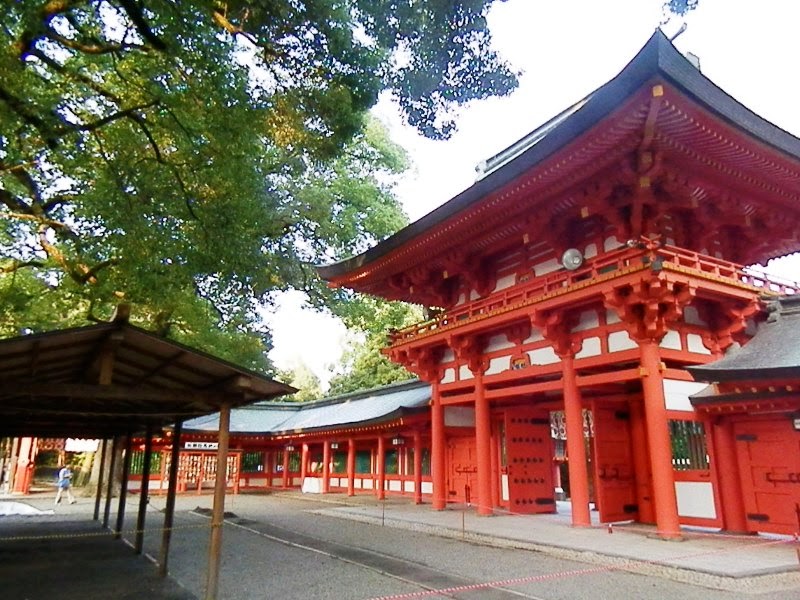
Tuesday, July 29, 2014

"for I am from him" - The Views on the Apocalypse in Columbus' Era


Around Tokyo


The Views on the Apocalypse in Columbus' Era


How was the Apocalypse painted by notable artists in the era of Columbus?
Hans Memling (also spelled Memlinc; 1430 – 1494) was a German-born painter who moved to Flanders and worked in the tradition of Early Netherlandish painting. He spent some time in the Brussels workshop of Rogier van der Weyden, and after Rogier's death in 1464, Memling was made a citizen of Bruges, where he became one of the leading artists, painting both portraits and diptychs for personal devotion and several large religious works, seamlessly continuing the style he learned in his youth.
http://en.wikipedia.org/wiki/Hans_Memling
http://ipaintingsforsale.com/painting/st_john_altarpiece_%5bdetail_8_right_wing%5d-26612.html

Above Memling's picture of the Apocalypse is rather peaceful.  Probably it is because he died before 1500.  Indeed opposite feeling is expressed by another artist who succeeded in his profession after 1500.  Truly situations seems to have drastically changed after 1500, though Columbus reached the New World in 1492.
Albrecht Dürer (1471 – 1528)[2] was a German painter, engraver, printmaker, mathematician, and theorist from Nuremberg. His high-quality woodcuts (nowadays often called Meisterstiche or "master prints") established his reputation and influence across Europe when he was still in his twenties, and he has been conventionally regarded as the greatest artist of the Northern Renaissance ever since. His vast body of work includes altarpieces, religious works, numerous portraits and self-portraits, and copper engravings. The woodcuts, such as the Apocalypse series (1498), retain a more Gothic flavour than the rest of his work. His well-known prints include the Knight, Death, and the Devil (1513), Saint Jerome in his Study (1514) and Melencolia I (1514), which has been the subject of extensive analysis and interpretation.
http://en.wikipedia.org/wiki/Albrecht_D%C3%BCrer


The era of Columbus is directly linked to the era of Martin Luther (1483-1546).  Let's see Luther's view on the Apocalypse.
Archives / 1951 / December

RESEARCH: Martin Luther and the End of the World
 Daniel Walther
Luther was so impressed by the precarious- ness of the times in 1528 that he expected the end to come before he had time to finish the translation of the Old Testament...

The imminence of the end was indeed uppermost in his mind: "Things are going toward their end." And he added, "I hope the last day will not be long delayed, not over a hundred years..."

He shared the usual very old view that the world would stand six thousand years. Since it took seven days for the creation of the world, and since a day is like a thousand years, the world would stand six thousand years before the seven-thousandth year, which .was to be the millennium, a period of rest. But then, Luther was so impressed by the impending doom that he opined that the end might come in the midst of the sixth millennium. According to Luther's computation, the world was 5,500 years old in the year 1540, which was to be about the right time for the end of all things to occur...

Many of his sermons dealt directly with the end of the world and the coming of the Lord, such as the one on "the bridegroom cometh; go ye out to meet him." In 1544, shortly before his death, he wrote to a friend that he had nothing else to say than that he was hoping for Christ's return that same year...
Lastly, let us mention Luther's particular idea of Antichrist, whose "raging was a definite Sign of the end." Who was that Antichrist in Luther's mind? Interestingly, the Antichrist is applied to both the Pope and the Turk! "The person of the Antichrist is at the same time the Pope and the Turk. Every person consists of a body and a soul. So the spirit of the Antichrist is the Pope, his flesh is the Turk. The one has infested the Church spiritually, the other bod ily. However, both come from the same Lord, even the devil."
https://www.ministrymagazine.org/archive/1951/12/martin-luther-and-the-end-of-the-world

According to Luther's calculation, the world is now 6,000 years old.  It seems reasonable to think that the Second Coming of Christ is in the early 21st century or before 2100 or Newton's 2060.

*** ***

As I wrote before, the Second Advent of Christ Jesus has started around 2010.  Let's review how it was calculated so.
Newton focused on  the year 800 when he calculated the year of the Second Advent, finally obtaining 2060 (= 800 + 1260).

Yet, from a global point of view, it is not 800 but 750 that should be the starting year of Newton's calculation. So, the Second Advent of Christ Jesus already started around 2010 (= 1260 + 750). 
Under the Abbasids, Islamic civilization flourished in the "Islamic Golden Age" (c. 750 CE - c. 1258 CE), with its capital at the cosmopolitan city of Baghdad.  
Although the city (Pella in Palestine where early Christians fled) was still inhabited as late as the tenth Century CE, it was the deadly earthquake of CE 747 that ended its long history as a city of major influence in the region. 
http://eereporter.blogspot.com/2011/08/blog-post_21.html 
 720 - The second oldest exisiting imperial chronicle and myth of Japan called Nihon Shoki (Record of Japan) was compiled following an imperial order. This book has become one of major documentary resources for shintoism. 
752 - The world's largest bronze statue of the Buddha, called "Daibutsu" in Japanese, was built in Heijyo-kyo (Nara City), following an imperial order.  
http://eereporter.blogspot.com/2011/08/having-eyes-see-ye-not.html
"(Islamic) Golden Age" (750–1258)
http://eereporter.blogspot.com/2011/08/have-ye-your-heart-yet-hardened.html
The Battle of Talas (or Battle of Artlakh in 751 AD between the Arab Abbasid Caliphate and the Chinese Tang Dynasty, resulting in transfer of paper production technology from China to Europe.    
http://eereporter.blogspot.com/2011/10/greater-than-all.html


*** *** *** ***


Joh 7:29 But I know him: for I am from him, and he hath sent me.
Joh 7:30 Then they sought to take him: but no man laid hands on him, because his hour was not yet come.
Joh 7:31 And many of the people believed on him, and said, When Christ cometh, will he do more miracles than these which this man hath done?

Monday, July 28, 2014

"the people were astonished at his doctrine" - Early Christians and Judaists in the Roman Empire


Around Tokyo


Early Christians and Judaists in the Roman Empire


It is a big mystery how Christianity spread in the Roman Empire.

This map from ‘A History of Christianity’ (Lion Handbook) shows the growth of the Church over the first 300 years. This is stark evidence that the early Church had indeed captured Christ's vision of a 'movement,' which Luke had so powerfully articulated in his writings!
http://simplymobilizing.blogspot.jp/2011/06/amazing-growth-of-early-church-in-first.html


We have to also refer to a map showing where Judaists lived in the Roman Empire.

The Jewish Diaspora
By the end of the first century BCE, Rome had taken over the eastern Mediterranean and the Jewish population was spread through many cities of the east. In the third and fourth centuries CE there were substantial Jewish settlements in most major eastern cities and many western provinces as well.
http://www.pbs.org/wgbh/pages/frontline/shows/religion/maps/jewish.html

So, comparing the two maps with each other, we can find that where Judaists were Christians also emerged in the Roman Empire till the Third Century.

But what was the Jewish population at the time?
Jews in Roman Empire:
25% of Roman population in Eastern Mediterranean
10% of entire Roman Empire 
 
48 C.E. Roman census: 7 million Jews (mostly in Judea, Egypt, Syria, Asia Minor, Babylon, Iran, Yemen and Ethiopia) for an estimated total of 8 million world wide.
http://www.sephardicgen.com/popul.htm
So then, what was the Christian population in the Roman Empire?
The Growth of Christianity in the Roman Empire 
The Christian population grew by 40 percent a decade, from about 1,000 Christians in the year 40 to 7,530 in 100 to a little over six million in 300 and 33 million in 350
— growing, in the hundred years between 250 and 350, from about two percent of the population to slightly over half. 
By the time Constantine legalized the practice of Christianity in 313, the empire was already heavily Christianized. By the year 300 perhaps 10 percent of the people were Christians, and by the middle of the century, Christians may well have been a majority of the citizens, 33 million Christians in an empire of 60 millionpeople. So Constantine did not so much ensure Christianity’s success as acknowledge it.
http://huron2.aaps.k12.mi.us/smitha/HUM/PDF/Growth-of-Chr.pdf

In summary, it seems that presence of Judaists around helped many Roman citizens and dwellers in the Empire accept the teaching of Christianity, even though only a small number of Judaists converted to Christianity.

Probably, in a typical case, a Roman citizen saw Judaists in his community to be interested in the world depicted in the Gospels.  Then he found that the teaching of Jesus transcended time and space or history and environment.  Christianity appealed to the Roman citizen regardless of a difference in the race, tradition, and other backgrounds, since Jesus' teaching was universal.

So long as Judaists played such an important role in the early stage of acceptance of Christianity by Roman citizens, those Roman-citizens-turned Christians would not hate, attack, or try to kill those Judaists.  But as time went by, when the Vatican consolidated its authority and people came to believe in Christianity without communications with Judaists, Judaists must have been isolated from Christians.  It must have become a cause of later friction and clashes between Christians and Judaists.  


*** *** *** ***


Mat 7:28 And it came to pass, when Jesus had ended these sayings, the people were astonished at his doctrine:
Mat 7:29 For he taught them as one having authority, and not as the scribes.

Saturday, July 26, 2014

"the devil out of her daughter" - Christian Judaists Peter, James and Paul


A Shinto Shrine around Tokyo


Christian Judaists Peter, James and Paul


Christianity was not established immediately after the resurrection of Christ Jesus from the crucifixion.

The Apostles and other believers of Christ Jesus did not think that they were now no more Judaists but Christians.  They had no doubt that they would continue to be Judaists.  They never dreamed that Christ Jesus launched a new religion being separated from Judaism.
The history of the Jerusalem Church begins from the day of Pentecost.  On this day of circa A. D. 30, the tongues of fire came down on Apostles and filled them with the Holy Spirit, enabling them to speak in different languages (Acts 2:4-5).  After this, the Jews who gathered in Jerusalem to celebrate Pentecost (Lev. 23:15-16) from all over the world heard the celebrated sermon of Peter about Christ.  Around three thousand people joined the Church on that day (Acts 2:41).  All this happened on the southwestern hill of Jerusalem, known today as Mount Zion.   After the next sermon which Peter and John delivered in the Temple, the number of converted men grew to five thousand (Acts 4:4).   The life of the first Christians was concentrated around the Temple, where they were going to pray and to preach Christ every day (Acts 2:46; 3:1; and 5:21,42).  They held everything in common (Acts 2:44) and those who were rich supported the poor (Acts 2:45 and 4:34-37).  The breaking of bread in homes (Acts 2:46) is an allusion to celebrating of the Holy Eucharist.

 The proselytizing activities of the Apostles immediately brought about oppression from the Jewish Sanhedrin (Acts 4:1-23 and 5:17-20, 26-40).  After the martyrdom of Stephen (Acts 7), a persecution of Christians began in Jerusalem, and everybody except the Apostles left the city for Judea and Samaria (Acts 8:1).  Saul, a Pharisee and a student of Rabbi Gamaliel (Acts 22:3), was one of the fiercest persecutors.  Since the Apostles had to comfort those who were in prison and serve as a coordinating center for scattered Christians, they stayed in Jerusalem.  The dispersed Christians began their preaching of the good news throughout the whole country.  The eighth, ninth, and tenth chapters of Acts describe the missionary journeys of Philip, one of the seven deacons of the Jerusalem Church, and of Peter and John.   Sometime after 32, the event which changed the whole history of the Church took place:  the bloodthirsty persecutor Saul was converted and became the holy Apostle Paul who by his missionary activities turned the Church into the universal means of humankind’s salvation.

 Around 35, St. Paul made his first visit to Jerusalem to see Peter (Gal. 1:18).  He writes that of all the Apostles only Peter and James were there (Gal. 1:19).  While other Apostles must have gone from Jerusalem to spread the good news throughout the Roman Empire and visited the city only from time to time, James became the head of the local Christian community (Acts 12:17; 15:13-21; 21:18; Gal. 1:19; and 2:9,12).  Clement of Alexandria in his sixth book of Hypotyposes writes that “Peter and James and John, after the Ascension of the Savior, did not struggle for glory, because they had previously been given honor by the Savior, but they chose James the Just as Bishop of Jerusalem.”   In the spring of 49, the first Church council was convened at Jerusalem (Acts 15).  Whether Gentile Christians should obey the law of Moses and be circumcised were the main matters of concern at this council.
http://morewhoiswho.tripod.com/history.html 
In the situations depicted in the Gospels and the Acts of the Apostles, followers of Christ Jesus all lived as Judaists but not as Christians.  They must have talked about teaching of Christ Jesus but must not have denied Judaism and their faith in Judaism and Torah and other Judaist books.  Probably they came to mention Christ Jesus less and less to avoid friction and troubles with other Judaists.

Consequently, Christian Judaists came to be gradually absorbed in the Israelite public while leaders and priests of the Temple of Jerusalem attacked Christian Judaists and killed James. And then he First Jewish–Roman War (66–73 CE) started to wipe out Christian Judaists with other Israelites.

On the other hand, Christianity was established outside Jerusalem and Judea or specifically around Rome.  Christianity separated from Judaism when the Gospels of Mark, Mathew, Luke, and John were written and issued to be read widely.

It is very impressive that the Acts of the Apostles is finished abruptly as Paul was living in Rome.  Till the moment, there was no Christianity, but only Christian Judaism existed.  So, they were not stories of early Christians but of the last Christian Judaists that are depicted in the Gospels and the Acts.

Christianity started when Paul quit being a Christian Judaist after the last scene of the Acts.  But strangely, there are no documents, written and preserved till today, that report how Christian Paul or Peter lived and died.  It is so since the Gospels and the Acts are books that still belong to the domain of Christina Judaism.


*** *** *** ***


Mar 7:26 The woman was a Greek, a Syrophenician by nation; and she besought him that he would cast forth the devil out of her daughter.
Mar 7:27 But Jesus said unto her, Let the children first be filled: for it is not meet to take the children's bread, and to cast it unto the dogs.

Friday, July 25, 2014

"whom they seek to kill" - The First Pope, Not Paul?


Tokyo


The First Pope, Not Paul?


St. Peter is a mysterious man, though he is positioned as the first Pope while St. Paul was not.
About halfway through, the Acts of the Apostles turns its attention away from Peter and to the activities of Paul, and the Bible is mostly silent on what occurred to Peter afterwards. 
The church in Rome was already flourishing when Paul wrote his Epistle to the Romans about AD 57,[34] he greets some fifty people in Rome by name,[35] but not Peter whom he knew. There is also no mention of Peter in Rome later during Paul's two-year stay there in Acts 28, about AD 60-62. Church historians consistently consider Peter and Paul to have been martyred under the reign of Nero, around AD 65 such as after the Great Fire of Rome.
http://en.wikipedia.org/wiki/Saint_Peter#Role_in_the_early_church 
However, as the Vatican puts the highest priority on the church but not on the Bible, the linkage between St. Peter and Christ Jesus is a key to its claim for the supreme power in the Christian world.

According to the Vatican, Christ Jesus is God and He chose Peter as His successor in leadership of the church.  So, everything crucially important was handed over to Peter.  Every secret in Christianity was provided for Peter in a spiritual manner.  And every Pope after St. Peter has also received this tradition.  Therefore, a Pope at any era has been a holy deputy of Christ Jesus.

But if the holy authority of St. Peter should be denied, the Vatican would lose its ground for leading Christians in the world.

And as everybody knows, the Acts of the Apostles depicts Paul as the true leader of early Christians.  On the other hand, Peter's acts are not clear.  Even where Peter had been and how Peter reached Rome were unclear.  Suddenly, they claims, Peter died in Rome around the same time when Paul was executed.  It is mysterious.  It is as if the author of the Acts of the Apostles Luke had had no expectation that Peter would become the first Pope.

In Jerusalem, the church of early Christians or more correctly Christian Judaists was led by James, a younger brother of Christ Jesus.
In the non-canonical Gospel of Thomas, Jesus names James his successor: "The disciples said to Jesus, 'We know that you will depart from us. Who will be our leader?' Jesus said to them, "Where you are, you are to go to James the Just, for whose sake heaven and earth came into existence.'"
http://en.wikipedia.org/wiki/James_the_Just
So, all the Christian Judaists, who were left by Christ Jesus and lived around Jerusalem, respected and followed James.  But this church in Jerusalem was terminated by violence in internal conflicts among Israelites when James the Just was killed.
According to a passage found in existing manuscripts of Josephus' Antiquities of the Jews, (xx.9) "the brother of Jesus, who was called Christ, whose name was James" met his death after the death of the procurator Porcius Festus but before Lucceius Albinus had assumed office (Antiquities 20,9) — which has been dated to 62. The High Priest Hanan ben Hanan (Anani Ananus in Latin) took advantage of this lack of imperial oversight to assemble a Sanhedrin (although the correct translation of the Greek synhedrion kriton is "a council of judges"), who condemned James "on the charge of breaking the law", then had him executed by stoning.
http://en.wikipedia.org/wiki/James_the_Just
So, it looks reasonable that Peter ran away from Jerusalem and Judea as the High Priest and his followers must have intended to kill Peter, too.  Peter fled to Rome as Paul and other believers caught already some followers who accepted the teaching by Paul.

The Vatican could not recognize James as the first Pope since he was the leader of Christian Judaists in Jerusalem.  But the Vatican neither recognized Paul as the first Pope since he had never seen Christ Jesus living and preaching.  The only choice was Peter, though Peter was very mysterious and his acts having been conducted between Jerusalem and Rome were mostly unknown even if he had power to work miracles.    

The point at issue is how much more the Vatican did inherit information about Christ Jesus directly from St. Peter than the Gospels of Mark, Mathew, Luke and John.


In addition, there are many people today who doubt justification for the Vatican introduces Peter as the first Pope.
Was Peter Bishop in Rome?

A side note. There is no scriptural proof that Peter was the founding bishop in Rome. When Paul writes to Rome, he never greets Peter in the letter, which proves conclusively that Peter was not in Rome so he could not be the founding Bishop. It is true, he probably was crucified in Rome, but dieing there does not make you a bishop there.

At one time Peter was probably in Rome, for he mentions it in 1 Peter 5:13: She who is in Babylon, chosen together with you, sends you her greetings, and so does my son Mark. It can be argued that Babylon was the code name for Rome; however, some believe Babylon was an actual location that Peter was in, and not Rome. Regardless of one’s view of Babylon, it does not mean Peter was the founding bishop there. He may have been there at one time, but there is no reason to assume that Peter was setting up headquarters in Rome and thus setting up the pontificate. So if Peter was not the founding Bishop in Rome, how could the Roman Catholic Church argue that Peter was the first Pope?

I think the burden of proof is on the Catholic Church to prove otherwise, and there is no scriptural proof that Peter was the first Pope. On the contrary, there is plenty of scriptural proof that Peter was not the first Pope.

http://www.tbm.org/was_peter_the_first_pope.htm
Of course, only Christ Jesus who secretly helped Paul and Peter, in addition to James, preach and teach gentiles as well as Hebrews after resurrection could authorize Peter to assume the title of the First Pope.  But we have no record on this holy authorization even when we refer to ancient documents discovered around the Dead Sea and the Nile River in the 20th century or so.


*** *** *** ***


Joh 7:25 Then said some of them of Jerusalem, Is not this he, whom they seek to kill?
Joh 7:26 But, lo, he speaketh boldly, and they say nothing unto him. Do the rulers know indeed that this is the very Christ?
Joh 7:27 Howbeit we know this man whence he is: but when Christ cometh, no man knoweth whence he is.
Joh 7:28 Then cried Jesus in the temple as he taught, saying, Ye both know me, and ye know whence I am: and I am not come of myself, but he that sent me is true, whom ye know not.

Wednesday, July 23, 2014

"ye that work iniquity" - Q Source and Judas Iscariot


Tokyo


Q Source and Judas Iscariot

Recent studies on the Gospels have revealed that the Gospels of Mathew and Luke rely on two sources: the Gospel of Mark and Q Source.

The Gospels of Matthew and Luke were written independently, each using Mark and a second hypothetical document called "Q" as a source. Q was conceived as the most likely explanation behind the common material (mostly sayings) found in the Gospel of Matthew and the Gospel of Luke but not in Mark.
http://en.wikipedia.org/wiki/Q_source


What I think is that this Q Source was written by the controversial Apostle Judas Iscariot.

It is thought by scholars today that Q Source was written in Greek by somebody who heard Jesus preaching.
The Q document must have been composed prior to the Gospels of both Matthew and Luke. Some scholars even suggest Q may have predated Mark. A date for the final Q document is often placed in the 40s or 50s of the first century, with some arguing its so-called sapiential layer (1Q, containing six wisdom speeches) being written as early as the 30s.[22]

If Q did exist, it has since been lost. Some scholars believe it can be partially reconstructed by examining elements common to Matthew and Luke (but absent from Mark). This reconstructed Q is notable in that it generally does not describe the events of the life of Jesus: Q does not mention Jesus' birth, his selection of the 12 disciples, his crucifixion, or the resurrection. Instead, it appears to be a collection of Jesus' sayings and quotations.
http://en.wikipedia.org/wiki/Q_source#Notable_contents
My theory is that Judas Iscariot was a spy sent by Roman authority that actually governed Palestine and Jerusalem.  Judas was probably directly controlled by Governor Pilate or under a Roman general stationed in Damascus.  Anyway, Judas Iscariot must have been making a report on Christ Jesus.  No Apostles and followers of Christ Jesus kept a note of preaching and sayings of Christ Jesus because they had no such a need.  But as a spy Judas had to write down what Christ Jesus said secretly.

Q Source was originally the report Judas Iscariot wrote and submitted to Roman authority and maybe to the Roman Governor in charge of keeping order in Judea.   So, Q does not contain any information Roman authority was not interested in or knew already, including background of Christ Jesus; it focuses on what Christ Jesus said and preached to people.  As Q was such a report written by Judas in order to find matters and reasons for which to justify arrest of Christ Jesus, events after the arrest of Christ Jesus by Roman soldiers are not included in Q Source.

However as time went by, Q Source or Judas' secret report must have come to be in the hand of some Roman citizens who became a believer of Christ Jesus.  And, when early Christians heard that Mark wrote and issued his version of Gospel, some of them wanted to write their versions of Gospel as they happened to know the existence of Q Source or Judas' secret report.  Eventually the Gospels of Mathew and Luke were written with reference to the Gospel of Mark and Q Source, though Mathew and Luke thought it was desirable to hide Q Source since it was originally a secret report Judas, as a spy for Romans, made betraying trust of Christ Jesus.

In another possibility, Christ Jesus secretly allowed Judas to keep a note on His sayings for some purpose.  But Judas betrayed Christ Jesus and handed the record to Roman authority.  In this case, as the Gospel of Judas tells, Judas Iscariot was a special Apostle, but eventually he looked like betraying Christ Jesus by abusing the record of Jesus' sayings.

Anyway, Q Source was written by Judas Iscariot with a kind of approval of Christ Jesus, though it was handed to Romans to be used as evidence of insurgence on which they arrested Christ Jesus, according to my theory.

So, it is very ironical that the Synoptic Gospels we read today are based on writings by Christ Jesus and Judas Iscariot, since Christ Jesus must have been the very author of the Gospel of Mark and Judas Iscariot of Q Source.


*** *** *** ***


Mat 7:22 Many will say to me in that day, Lord, Lord, have we not prophesied in thy name? and in thy name have cast out devils? and in thy name done many wonderful works?
Mat 7:23 And then will I profess unto them, I never knew you: depart from me, ye that work iniquity.

Tuesday, July 22, 2014

"to the poor the gospel is preached" - The Gospel of Mark for Separation from Judaism


Tokyo


The Gospel of Mark for Separation from Judaism

The Gospel of Mark is the earliest one among the three synoptic gospels of Mark, Luke and Mathew.

Till the Gospel of Mark was issued, there had been no documents written by followers of Christ Jesus.  It was, most probably, because writing books unique to Christ Jesus meant an expression of intention to separate from Judaism.  Indeed, if followers of Christ Jesus had wanted to stay within the scope of Judaism, they should not have needed new documents.

But, the Gospel of Mark was written in Greek.  This Gospel was not intended to be solely read by Hebrews or Israelites.

The Apostles and other early followers of Christ Jesus who lived in Jerusalem before the First Jewish–Roman War (66–73 CE) must have had no intention to quit being Judaists.  They never thought that they had become something different from Judaists only because they believed in Christ Jesus.  They didn't need any other books but conventional books such as the Torah or the Old Testament.  What the Apostles read was not the New Testament but only the Torah and old Hebrew books.

So, while the Apostles lived, no new books concerning Christ Jesus were written and issued due to respect for them.  Conversely, writing and issuing new books concerning Christ Jesus meant clear separation from Judaism.  So, the Gospel of Mark was written in Greek, targeting Roman citizens and other gentiles who spoke Greek.

Especially, if the Gospel of Mark had not been written and issued, the Gospels of Luke and Mathew should not have been able to be written.  Then, a new religion, Christianity, should not have been possible.  In fact, 93% of contents of the Gospel of Mark were adopted in the two succeeding Gospels.  And roughly speaking, a half of contents of each of  Luke and Mathew is unique to itself.   So, it is apparent that Luke and Mathew read the Gospel of Mark and decided to write their versions of Gospel, collecting information about the preaching of Christ Jesus that had been delivered decades ago.

Establishment of Christianity and its separation from Judaism started with the appearance of the Gospel of Mark.  And "Mark" intended, from the beginning, to spread Christianity to Roman citizens and other gentiles by writing the book in Greek.  It was "Mark" that decided to make Christianity separate from Judaism.  So, "Mark" was the true founder of Christianity.  But, it must be Christ Jesus that founded Christianity.  It means that "Mark" was Christ Jesus.  Christ Jesus must have continued to live after resurrection under the name of Mark.

Of cause, Paul played a key role in establishing early Christianity.  But without the Gospel of Mark, documents written by Paul had less significance.  Those documents would lose meaning.  Readers of Paul's letters would not be able to understand what St. Paul was arguing and mentioning without the Gospels.

Therefore, Christianity was launched with the Gospel of Mark that was written and issued after all the Apostles and other early followers of Christ Jesus who had directly seen Christ Jesus preaching died and disappeared without their successors, namely Hebrew Christians.

So logically, it is quite reasonable to regard Mark who wrote the Gospel of Mark as Christ Jesus.


Traditionally Mark is thought to have been founder and bishop of the church of Alexandria, Egypt, where he was martyred.
http://www.scs.sk.ca/mak/Html/saint.html


*** *** *** ***


Luk 7:22 Then Jesus answering said unto them, Go your way, and tell John what things ye have seen and heard; how that the blind see, the lame walk, the lepers are cleansed, the deaf hear, the dead are raised, to the poor the gospel is preached.

Monday, July 21, 2014

"and ye all marvel" - The Gospel of Judas or Judas the Spy?


Tokyo


The Gospel of Judas or Judas the Spy?


The Gospel of Judas was so identified and translated around 2005 when John Paul II died.

Maybe it suggested that somebody betrayed the Vatican.
The Gospel of Judas is a Gnostic gospel whose content consists of conversations between the Apostle Judas Iscariot and Jesus Christ. 
It is believed to have been written by Gnostic followers of Jesus, certainly not by Judas himself, and, since it contains late 2nd century theology, probably dates from no earlier than the 2nd century. In 180 AD, Irenaeus, the Bishop of Lyons, wrote a document in which he railed against this gospel, indicating the book was already in circulation. 
A leather-bound Coptic language papyrus document that surfaced during the 1970s, near Beni Masar, Egypt,[2] was named the Codex Tchacos after an antiquities dealer, Frieda Nussberger-Tchacos, who became concerned about the deteriorating condition of the manuscript. First translated in the early 2000s, the codex contains text that appears to be from the late 2nd century AD,[3] and includes the self-titled "Gospel of Judas" (Euangelion Ioudas)[4] which claims to be the story of Jesus's death from the viewpoint of Judas. 
The initial translation of the Gospel of Judas was widely publicized but simply confirmed the account that was written in Irenaeus and known Gnostic beliefs, leading some scholars to simply summarize the discovery as nothing new.
However, it is argued that a closer reading of the existent text, as presented in October 2006, shows that the writer suggests that Judas was set up to actually betray Jesus out of wrath and anger:
http://en.wikipedia.org/wiki/Gospel_of_Judas
It is very interesting that in the second century some people tried hard to interpret what Judas did from a viewpoint of Judas.  But what did they gain by justifying the Judas' act?
THE GOSPEL OF JUDAS
Translated by
Rodolphe Kasser, Marvin Meyer, and Gregor Wurst,
in collaboration with François Gaudard
 
... 
When Jesus appeared on earth, he performed miracles and great wonders for the salvation of humanity. And since some [walked] in the way of righteousness while others walked in their transgressions, the twelve disciples were called. 
He began to speak with them about the mysteries beyond the world and what would
take place at the end. Often he did not appear to his disciples as himself, but he was found among them as a child.
...
 
One day he was with his disciples in Judea, and he found them gathered together and seated in pious observance. When he [approached] his disciples, [34] gathered together and seated and offering a prayer of thanksgiving over the bread, [he] laughed. 
The disciples said to [him], “Master, why are you laughing at [our] prayer of
thanksgiving? We have done what is right.”
 
He answered and said to them, “I am not laughing at you. are not doing this
because of your own will but because it is through this that your god [will be] praised.”
 
They said, “Master, you are […] the son of our god.”
Jesus said to them, “How do you know me? Truly [I]
...
 
Knowing that Judas was reflecting upon something that was exalted, Jesus said to him,“Step away from the others and I shall tell you the mysteries of the kingdom. It is possible for you to reach it, but you will grieve a great deal. [36] For someone else will replace you, in order that the twelve [disciples] may again come to completion with their god.”
...
 
Judas said, “Master, could it be that my seed is under the control of the rulers?”
Jesus answered and said to him, “Come, that I [—two lines missing—], but that you
will grieve much when you see the kingdom and all its generation.”
When he heard this, Judas said to him, “What good is it that I have received it? For
you have set me apart for that generation.”
 
Jesus answered and said, “You will become the thirteenth, and you will be cursed by the other generations—and you will come to rule over them. In the last days they will curse your ascent [47] to the holy [generation].”
...
 
“Truly […] your last […] become [—about two and a half lines missing—], grieve
[—about two lines missing—] the ruler, since he will be destroyed. And then the image of the great generation of Adam will be exalted, for prior to heaven, earth, and the angels, that generation, which is from the eternal realms, exists. Look, you have been told everything. Lift up your eyes and look at the cloud and the light within it and the stars surrounding it. The star that leads the way is your star.”
Judas lifted up his eyes and saw the luminous cloud, and he entered it.
...
 
[…] Their high priests murmured because [he] had gone into the guest room for his
prayer. But some scribes were there watching carefully in order to arrest him during the prayer, for they were afraid of the people, since he was regarded by all as a prophet.
 
They approached Judas and said to him, “What are you doing here? You are Jesus’
disciple.”
 
Judas answered them as they wished. And he received some money and handed him over to them. 
THE GOSPEL OF JUDAS
http://www.nationalgeographic.com/lostgospel/_pdf/GospelofJudas.pdf
One possible theory about creation of this Gospel is that as Christianity came to be widely accepted by people in the Roman Empire and citizens of Rome, some scholars at the time checked the background of this religion.  And they found that there was a controversial figure, though so negative, in the story of Christ Jesus: Judas Iscariot.

Such Roman scholars concerned must have further referred to documents that were related to Christ Jesus and Judas Iscariot and kept secretly somewhere in Rome or Palestine.  And, in my theory, when they discovered that Judas Iscariot had been a spy sent by the then Roman authority in Palestine to Christ Jesus, they must have been very much embarrassed.

"What if the increasing number of believers in Christ Jesus found that Judas had been a spy of Romans?"  The Roman elite had to do something to avoid such possible indictment from Christians who were then gaining influences in Rome.  The fact that Judas Iscariot had been a spy under control of a Roman general or governor in Syria or Jerusalem must be kept secret for ever.   So, they decided to write the Gospel of Judas.

This is one possible scenario, though the Gospel of Mark must be reexamined in this context, since it is very likely that Christ Jesus Himself wrote this Gospel using the name Mark.


we’re all betrayers of Christ
http://www.aumethodists.org/worship/sermons/2012-spring/what-judas-did-wrong/


*** *** *** ***


Joh 7:21 Jesus answered and said unto them, I have done one work, and ye all marvel.

Sunday, July 20, 2014

"by their fruits" - Respect History and Stop Wars


Around Tokyo


Respect History and Stop Wars

We, as members of mankind, have to show our full respect for history, since history is God.

However, the Iraqi War was conducted with an alarming degree of brutality, resulting in a more brutal civil war after retreat of US troops.

Iraq stands on Mesopotamia, the birth place of urban civilization of mankind.  If we, as members of mankind, show full respect for history, which is God, we should have stopped the US from sending troops to Iraq to dismantle so-called weapons of mass destruction that did not exist after all.  We all failed in showing full respect to the ancient Mesopotamian Civilization.  

The Afghan War was also launched and is still going on with not only US troops but also NATO soldiers being engaged in battles in the country where no modern urban civilization can be found.

Afghanistan was a limit where Alexander the Great could reach in his advancement to the east.  The glory of the Roman Empire and the growth of Christianity came after the era of Alexander the Great.  We all failed to show full respect to the great historic achievement of Alexander the Great.

Syria has also longer history than any European/American cities.  Not only Abraham and his clan but also the armies of ancient Greece, ancient Iran, the Roman Empire, Crusade, etc. passed or were stationed there.  Damascus has been a family place for readers of the Old Testament even before the era of Christ.  Nonetheless, the international community cannot stop the brutal civil war going on for three years.  We all fail in exercising justice onto Syria and also showing respect to history.

Gaza is also an old area.  It appeared in records of ancient world covering ancient Egypt and ancient Hebrew kingdoms.  But this series of conflicts around Gaza between Palestinians and Israelis symbolizes our lack in respect for history.      

It is very bad.

We have to preserve those historic places with full respect, since history is God.  But as if we were having history lose its face, we have shed too much blood there.  Consequently, something terrible must happen.

Indeed, we have seen the second tragedy of Malaysian airliners in troubled and dangerous Ukraine after the mysterious prelude of missing MH370, while we assume that Malaysia has nothing to do with these tragic wars and battles in the world.  It is a warning delivered to us by God.

Respect history and stop wars!

The Third World War might be set off in the worst case in extension of this dangerous trend.


http://www.gameinformer.com/blogs/members/b/johnwrek_blog/archive/2013/06/05/building-the-perfect-gaming-apocalypse.aspx


*** *** *** ***


Mat 7:20 Wherefore by their fruits ye shall know them.

Saturday, July 19, 2014

"Did not Moses give you the law" - "The Bible of Jesus"


Inside the Tokyo Station


"The Bible of Jesus"

There must be miracles, more miracles, and much more though they might not been realized yet.

One of them is that Christ Jesus Himself wrote one of the Gospels.  He must be the true author of the Gospel of Luke, Mathew, Mark or John.

However nobody realized it for 2000 years.  It is because Christ Jesus called Himself Mark after the resurrection, in my theory.

To write a New Testament against the Old Testament meant to declare a war against Judaists 2000 years ago.  So, no early Christians dared to make their version of the Bible, since such an act was tantamount to declaring complete separation from Judaism.  It is a very difficult act only Christ Jesus Himself could do.

So, all the believers today must try to prove that the Gospel of Mark was actually written by Christ Jesus, which is one of the the largest miracles still being covered.

And if it should be proved, people would think how foolish they have been to doubt Christ Jesus and God!

The "Bible of Jesus" is what we want in any way.

To make sure, you cannot perfectly deny that Christ Jesus wrote the Gospel of Mark, since Mark who followed Peter or Paul in the first century could not be the author of this earliest Gospel according to recent studies on the Bible.


*** *** *** ***


Joh 7:19 Did not Moses give you the law, and yet none of you keepeth the law? Why go ye about to kill me?

Friday, July 18, 2014

"the disciples of John" - Martin Luther, America & St. Peter's Basilica


Inside the Tokyo Station 


Martin Luther, America & St. Peter's Basilica 


In 1492 Columbus sailed west over the Atlantic Ocean to the New World later called America.

In 1506, the Vatican started to replace the Old St. Peter's Basilica of the 4th century AD and build new St. Peter's Basilica which was completed in 1626.

In 1517, Martin Luther, a German priest, issued the 95 Theses to open the new domain in the Christian world.  In this Theses Luther referred to St. Peter's Basilica in some articles.
50. Christians are to be taught that if the pope knew the exactions of the indulgence preachers, he would rather that the basilica of St. Peter were burned to ashes than built up with the skin, flesh, and bones of his sheep. 
51. Christians are to be taught that the pope would and should wish to give of his own money, even though he had to sell the basilica of St. Peter, to many of those from whom certain hawkers of indulgences cajole money. 
86. Again, ``Why does not the pope, whose wealth is today greater than the wealth of the richest Crassus, build this one basilica of St. Peter with his own money rather than with the money of poor believers?''

I think these three incidents that were recorded around 1500 in history really symbolize the fates of Judaists, the Vatican, and Protestants.

Judaists were given the New World, America; the Vatican was given the new great basilica; and poor believers were given their version of Christianity.

There are many anecdotes about Martin Luther.  A few interesting ones are:

Martin Luther married one of nuns who fled together from a nunnery.  Those nuns married one after another after they came to live in towns.  But Luther married the one who were left behind while all the others found their husbands.

Martin Luther taught how to read the Bible in three ways.  But the most revolutionary way he presented was to read the Bible along with difficulties in one's real life.  Luther told that a believer should read the Bible while suffering pains and experiencing a crisis in one's life.  

So, when you see America or American Judaists, St. Peter's Basilica, and Protestants, you have to wonder how they look different while they have almost the same length of years in their deployment since around 1500.
On 15 June 1520, the Pope warned Luther with the papal bull (edict) Exsurge Domine that he risked excommunication unless he recanted 41 sentences drawn from his writings, including the 95 Theses, within 60 days. That autumn, Johann Eck proclaimed the bull in Meissen and other towns. Karl von Miltitz, a papal nuncio, attempted to broker a solution, but Luther, who had sent the Pope a copy of On the Freedom of a Christian in October, publicly set fire to the bull and decretals at Wittenberg on 10 December 1520,[61] an act he defended in Why the Pope and his Recent Book are Burned and Assertions Concerning All Articles. As a consequence, Luther was excommunicated by Pope Leo X on 3 January 1521, in the bull Decet Romanum Pontificem.
http://en.wikipedia.org/wiki/Martin_Luther

Incidentally, in 1520 the Spanish conquered Yucatán and started conquest of the Maya civilization.  European influences in America were being accelerated with bloods and violence like in ancient Palestine in the era of the Old Testament.


Dr. Martin Luther - The Protestant Reformationhttp://www.uecf.net/articles/a25.htm


*** *** *** ***


Luk 7:18 And the disciples of John shewed him of all these things.
Luk 7:19 And John calling unto him two of his disciples sent them to Jesus, saying, Art thou he that should come? or look we for another?
Luk 7:20 When the men were come unto him, they said, John Baptist hath sent us unto thee, saying, Art thou he that should come? or look we for another?
Luk 7:21 And in that same hour he cured many of their infirmities and plagues, and of evil spirits; and unto many that were blind he gave sight.
Luk 7:22 Then Jesus answering said unto them, Go your way, and tell John what things ye have seen and heard; how that the blind see, the lame walk, the lepers are cleansed, the deaf hear, the dead are raised, to the poor the gospel is preached.

Thursday, July 17, 2014

"concerning the parable" - Jesus Said, I Am the Son of God


Around Tokyo


Jesus Said, I Am the Son of God


There is a very decisive scene depicted in the Gospel of Mark.
Mar 14:60 And the high priest stood up in the midst, and asked Jesus, saying, Answerest thou nothing? what is it which these witness against thee?
Mar 14:61 But he held his peace, and answered nothing. Again the high priest asked him, and said unto him, Art thou the Christ, the Son of the Blessed?
Mar 14:62 And Jesus said, I am: and ye shall see the Son of man sitting on the right hand of power, and coming in the clouds of heaven.
This is one of decisive pieces of evidence that this Gospel was written by Christ Jesus Himself.

First of all, this is the most important information about Christ Jesus and hence the most important paragraphs in all the entire Gospels.  This is the very core of Christianity either of 2000 years ago or of today.  And who was allowed to write these sentences without direct permission of Christ Jesus while nobody was in such a position or a situation when Christ Jesus was persecuted, crucified, and resurrected.  Therefore, the passage must have been written by Christ Jesus Himself.

This is a very, very extraordinary witness that Christ Jesus thought He himself was the Son of God.  And He confessed it not to his followers but to his enemy.  Conversely, Christ Jesus was preaching the gospel in ancient Palestine to be summoned and declare that He was the Son of God.  This situation must have been one of his goals through his mission.

In other word, if you were just a follower of Christ Jesus,  how could you write such sentences without concrete proof and direct approval from Christ Jesus since He forbade His followers and even the devils to discuss His status?
Mar 1:34 And he healed many that were sick of divers diseases, and cast out many devils; and suffered not the devils to speak, because they knew him.
Mar 3:11 And unclean spirits, when they saw him, fell down before him, and cried, saying, Thou art the Son of God.
Mar 3:12 And he straitly charged them that they should not make him known.
After resurrection, Christ Jesus worked secretly behind the scene to make Paul succeed in his preaching the gospel.  But eventually one day, Christ Jesus must have thought that it was necessary to leave a correct record of his mission.

Till the issuance of this Gospel, it was a tradition and tacit consent for early Christians not to write any books and reports on Christ Jesus.  Probably they thought that if they had delivered such a book on Christ Jesus, it would have become a grave challenge to other Judaists at the time.  Early Christians could not make unnecessary enemies from surrounding Judaists who did not yet come to believe Christ Jesus.  To compile and issue another Bible or Testament meant a clear separation of followers of Christ Jesus from other conventional Judaists.

So, the one who could write and issue the first Gospel, presenting Christ Jesus as the Son of God, which meant a decisive separation from Judaism, was Christ Jesus Himself.

The Gospel of Mark must have been written by Christ Jesus Himself, taking into account the grave meaning of declaration of Christ Jesus's being the Son of God against the whole Judaist community.


*** *** *** ***


Mar 7:17 And when he was entered into the house from the people, his disciples asked him concerning the parable.
Mar 7:18 And he saith unto them, Are ye so without understanding also? Do ye not perceive, that whatsoever thing from without entereth into the man, it cannot defile him;

Wednesday, July 16, 2014

"let him hear" - Dubious History of Hebrews


Around Tokyo


Dubious History of Hebrews

Judaists or Hebrews did not enjoy uninterrupted independence for a very long and continuous period in the ancient world.

Roughly speaking, they built a real independent kingdom around 1200 BC but they were conquered by Babylonians around 600 BC and taken to Babylon as captives.   Though they could return to Palestine in 538 BC, Hebrews were put under rule of Persians and then successors of Alexander the Great till 160 BC.  In 63 BC, Roman general Pompey and his troops invaded Judea.  Hebrews lost independence.  Since then Judaists were virtually subject to Rome though they had nominal king till 6 CE when Judea was made a Roman province.

So, put simply, in 2000 years before the emergence of Christ Jesus, Judaists were an independent nation only for  700 years.  Especially, in 1000 years since the era of King David, they enjoyed independence only for 500 years.

Israelites never conquered Egypt, Mesopotamia, Greece, and other regions around the Mediterranean Sea except part of Palestine in the pre-Christian world.  And for 2000 years in the Christian Era, they had almost nothing to do with Palestine till 1948.

Judaists belong to their holy books more than to Palestine of today.

In addition, Christ Jesus did not tell, 2000 years ago, Isaelites to fight and defeat Romans in order to secure complete independence.

It is very dubious that Judaists have inherent right to occupy Palestine today.

1.1 Prehistory
Between 2.6 and 0.9 million years ago, at least four episodes of hominine dispersal from Africa to the Levant are known, each culturally distinct. The flint tool artifacts of these early humans have been discovered on the territory of the current state of Israel, including, at Yiron, the oldest stone tools found anywhere outside Africa.

1.2 Egyptian rule
During the 2nd millennium BC, Canaan, part of which later became known as Israel, was dominated by Egypt.

1.3 Early Israelites
The first record of the name Israel (as ysrỉꜣr) occurs in the Merneptah stele, erected for Egyptian Pharaoh Merneptah c. 1209 BCE, "Israel is laid waste and his seed is not."[7] William Dever sees this "Israel" in the central highlands as a cultural and probably political entity, more an ethnic group rather than an organized state.

1.4 Israel and Judah
The Hebrew Bible describes constant warfare between the Jews and other tribes, including the Philistines, whose capital was Gaza. The Bible states that King David founded a dynasty of kings and that his son Solomon built a Temple. No material evidence indisputably of Solomon's reign has been found.

Around 930 BCE, the kingdom split into a southern Kingdom of Judah and a northern Kingdom of Israel.

1.5 Babylonian rule 586–538 BCE
In 586 BCE King Nebuchadnezzar II of Babylon conquered Judah. According to the Hebrew Bible, he destroyed Solomon's Temple and exiled the Jews to Babylon.

2 Classical era (538 BCE–636 CE)
2.1 Persian and Hellenistic rule 538–160 BCE
In 538 BCE, Cyrus the Great of Persia conquered Babylon and took over its empire. Cyrus issued a proclamation granting subjugated nations (including the people of Judah) religious freedom (for the original text see the Cyrus Cylinder). According to the Hebrew Bible 50,000 Judeans, led by Zerubabel, returned to Judah and rebuilt the temple. A second group of 5,000, led by Ezra and Nehemiah, returned to Judah in 456 BCE although non-Jews wrote to Cyrus to try to prevent their return.

2.2 Hasmonean dynasty 160–37 BCE
The Hasmonean dynasty of (Jewish) priest-kings ruled Judea with the Pharisees, Saducees and Essenes as the principal Jewish social movements.

In 125 BCE the Hasmonean King John Hyrcanus subjugated Edom and forcibly converted the population to Judaism.[28] In 64 BCE the Roman general Pompey conquered Syria and intervened in the Hasmonean civil war in Jerusalem. In 47 BCE the lives of Julius Caesar and his protege Cleopatra were saved by 3,000 crack Jewish troops sent by King Hyrcanus II and commanded by Antipater, whose descendants Caesar made kings of Judea.[

2.3 Herodian kingdom 37 BCE–6 CE
From 37 BCE to 6 CE, the Herodian dynasty, Jewish-Roman client kings, descended from Antipater, ruled Judea. Herod the Great considerably enlarged the temple (see Herod's Temple), making it one of the largest religious structures in the world.

2.4 Roman rule 6–390
Judea was made a Roman province in 6 CE, following the transition of Judean tetrarchy into a Roman realm. Following the next decades, though prosperous, the society suffered increasing tensions between Greco-Roman and Judean populations.
http://en.wikipedia.org/wiki/History_of_Israel#Prehistory

http://www.davka.org/2010/06/08/leaflet/


*** *** *** ***


Mar 7:16 If any man have ears to hear, let him hear.

Tuesday, July 15, 2014

"he that was dead sat up" - The Gospel of Mark against Twelve Apostles


Around Tokyo Bay


The Gospel of Mark against Twelve Apostles


There is a very interesting but terrible paragraph in the Gospel of Mark.
Mar 8:33 But when he had turned about and looked on his disciples, he rebuked Peter, saying, Get thee behind me, Satan: for thou savourest not the things that be of God, but the things that be of men.
The context of this scene where Peter was rebuked by Christ Jesus is that He told His disciples how he would be betrayed and left by His disciples and killed eventually by "the elders, the chief priests, and scribes" but He would rise from His death in three days.  But Peter, having heard Christ Jesus speaking so openly, started to rebuke Him.  Then immediately, Christ Jesus called out, "Peter, you Satan!"  

The fact that such a terrible scenes was not erased but left in the Gospel is very meaningful.  According to a Japanese professor, it means that the Gospel of Mark was written to challenge authority of St. Peter and other 11 members of Twelve Apostles.
In Mark the disciples, and especially the Twelve, move from lack of perception of Jesus to rejection of the "way of suffering" to flight and denial – even the women who received the first proclamation of his resurrection can be seen as failures for not reporting the good news. There is much discussion of this theme among scholars. Some argue that the author of Mark was using the disciples to correct "erroneous" views in his own community concerning the reality of the suffering messiah, others that it is an attack on the Jerusalem branch of the church for resisting the extension of the gospel to the gentiles, or a mirror of the convert's usual experience of the initial enthusiasm followed by growing awareness of the necessity for suffering. It certainly reflects the strong theme in Mark of Jesus as the "suffering just one" portrayed in so many of the books of the Jewish scriptures, from Jeremiah to Job and the Psalms, but especially in the "Suffering Servant" passages Isaiah. It also reflects the Jewish scripture theme of God's love being met by infidelity and failure, only to be renewed by God. And in the real-world context in which the gospel was written, the persecutions of the Christians of Rome under Nero, the failure of the disciples and Jesus' denial by Peter himself would have been powerful symbols of faith, hope and reconciliation.
http://en.wikipedia.org/wiki/Gospel_of_Mark#Mark.27s_gospel_theology
So it looks natural that Protestants since Martin Luther (1483-1546) have claimed that believers should only refer to the Bible but should not trust blindly the Vatican.  Indeed in the Gospel of Mark, Christ Jesus called Peter Satan.
All four gospels tell a story in which Jesus' death and resurrection are the crucial redemptive events.[55] There are, however, important differences between the four:

- Unlike Matthew and Luke, Mark does not trace Jesus' ancestry back to King David, and there is no mention that he is the offspring of a virgin mother and a divine father

- Unlike John, Mark never calls Jesus "God", nor does he claim that Jesus existed as a divine being prior to his earthly life
http://en.wikipedia.org/wiki/Gospel_of_Mark#Mark.27s_gospel_theology
Today most of scholars don't think that this Gospel was written by Mark who followed St. Peter.  If Mark had written this Gospel, it would have been an unforgivable act to depict Peter in such a manner.

In my theory, the Gospel of the Mark was written by Christ Jesus Himself who resurrected and continued to live secretly, helping Paul secretly and promoting diffusion of His teaching secretly.  As His Apostles and followers who survived the tragedy of His crucifixion to continue to live around Jerusalem did not preach and teach His teaching in a manner that satisfied Christ Jesus, He must have decided to present His version of the Bible.

If this theory should be proved, the Gospel of Mark will be renamed the Gospel of Jesus Himself.

In this case, the Vatican will be totally demoted if its religious merit is not totally forfeited.


...most scholars agree that Mark is the earliest gospel, most likely written in mid 60's A.D. Unlike Matthew and Luke, Mark does not contain many of the teachings of Jesus, such as the Sermon on the Mount; nor does Mark include the birth narrative of Jesus and post-resurrection appearances
http://rectorscorner.blogspot.jp/2011/02/introducing-marks-gospel.html 


*** *** *** ***


Luk 7:13 And when the Lord saw her, he had compassion on her, and said unto her, Weep not.
Luk 7:14 And he came and touched the bier: and they that bare him stood still. And he said, Young man, I say unto thee, Arise.
Luk 7:15 And he that was dead sat up, and began to speak. And he delivered him to his mother.
Luk 7:16 And there came a fear on all: and they glorified God, saying, That a great prophet is risen up among us; and, That God hath visited his people.