Thursday, April 07, 2011

"Jesus, thou Son of the most high God" - (The 27th Day after 3/11)

Tokyo
NHK


The 27th Day after 3/11


Tonight it is the quarter moon like in the night of March 10, 2011.

There is a theory that the moon came closer to the earth in both the occasions of 2004 Indonesia Tsunami and 2011 Northeast-Japan Tsunami.

Or it is said the moon was the closest to the earth on these occasions in 100 years.

It is the shift of the center of combined gravity of the earth and the moon that can affect the state of continental plates. This center of the combined gravity is, as I once calculated, beneath the surface of the ground of the earth. A subtle change might cause a trigger to losing balance between continental plates above the center.

And, now, at 11:32 p.m. of tonight, a big aftershock occurred in eastern Japan at a location near the epicenter of the 3/11 Earthquake.

The moon is now almost at the same position in the orbit around the earth as on March 11, since the moon rotates around the earth taking 29.5 days.


This is a Magnitude 7.4 earthquake according to a Japanese authority. Japanese TV stations are now busy reporting the state of damage around Sendai City and nuclear power plants in the region.

The Onagawa Nuclear Power Plant, Miyagi, has lost two of three external power supply systems, but it works in safety with the one power line to cool reactors.

Prime Minister Mr. Naoto Kan has arrived at the PM office to examine the situation with other ministers in charge.


PART 4-7-15:

Japan will continue to invest into infrastructures in ASEAN. Deputy Finance Ministers' meeting was held in Bali, Indonesia, to confirm Japan's commitment.


PART 4-7-14:

The Bank of Japan reportedly purchased exhaustively corporation bonds of Tokyo Electric Power Company in market.

The total amount of money BOJ spent is said to be $1.2 billion.


PART 4-7-13:

There is a fact most of people in the world do not know:
Japan is the largest owner of net external assets or net overseas assets as of the end of 2009.

1....JAPAN...266.2 trillion yen ($3 trillion)
2....China...167.7 trillion yen ($1.9 trillion)
3....Germany...118.8 trillion yen ($1.3 trillion)


That is why the Japanese Government can issue bonds to finance recovery work, though it has the biggest ratio of country's debt over GDP among major nations.


PART 4-7-12:

There is a rumor a major newspaper even reported that a subcontractor of TEPCO is recruiting workers to be sent to the Fukushima Daiichi Nuclear Power Plant, promising a big remuneration.

The wage promised is $5000 per day.


PART 4-7-11:

Inside the sea near the shore of the affected area of northeast Japan, visibility is still poor.

The seawater is still muddy after almost a month since the tragic incident, hiding about 15,000 dead bodies yet to be discovered.


PART 4-7-10:

Moskovskij Komsomolets of Russia reportedly launched a surprising idea to return South Kuril Islands to Japan as aid for the 3//11 Disaster of Japan.

The USSR invaded the South Kuril Islands or the Northern Territory of Japan after WWII.


PART 4-7-9:

The U.S. has sent 39 experts of nuclear power plants and 450 specialists in radioactive hazard to Japan.

The U.S. and France have strongly advised the Japanese Government to enhance the cooperative work with the each of two atomic giants.

But, the Kan cabinet does not look like fully understanding the need. The politicians of the ruling DPJ must at lease respect pride of the U.S. and France in this field.


PART 4-7-8:

The Tohoku shinkansen express train system was not put into a crisis by the 3/11 Earthquake.

All the trains running at 200 km/h to 300 km/h in the affected area responded to early warning from seismic instruments East Japan Railway Company sets along the railroads and the shore of northeast Honshu Island.

After slowing down on early warnings, the bullet trains all stopped in safety when they received a full-scale warning from the instruments.


http://railf.jp/news/2010/11/11/165500.html

However, on its 740-km line from Tokyo to Aomori, 1,100 locations and spots of facilities received damage from the M9.0 earthquake.

Full recovery of the shinkansen service in the Tohoku Line is expected to be completed by the end of April.


PART 4-7-7:

Stupid design and management of a nuclear power plant can be easily found and discussed, since this technology has half a century history.

On 4 April 2011, the 72 countries that are "Contracting Parties" to the Convention on Nuclear Safety (CNS), which meet every three years to consider the CNS' implementation, gathered at the IAEA's headquarters in Vienna for their fifth Review Meeting.

The ten-day Conference, convening from 4 to 14 April 2011, discusses the country reports on nuclear safety that every Contracting Party is obliged to submit. All countries with operating nuclear power plants are among the CNS' Contracting Parties.

http://www.iaea.org/newscenter/news/2011/safety_convention.html

The issue is to understand the difference between a plant in Japan and the one in Russia, America, and France.

The design and control of a plant in a place full of earthquakes and tsunamis are totally different from those of a plant in a place without a possibility of earthquakes and tsunamis.

Building a nuclear plant in the middle of the Sahara desert is very different from building one on the shore of Sumatra Island or in the capital of Haiti.


PART 4-7-6:

In Fukushima Prefecture, 4,280 people were still missing since the 3/11 Great Tsunami.

The southernmost prefecture among the three most severely damaged, Iwate, Miyagai, and Fukushima, is suffering the nuclear power plant problem and harmful rumors about their agricultural and fishery products.

The Government has, however, actually imposed a ban on delivery of some types of agricultural and fishery products from the prefecture as a higher-level of contamination was measured on them.


PART 4-7-5:

The American Forces have mobilized 19 ships and 18,000 soldiers to rescue work and humanitarian aid in Japan.

This the third largest expedition and engagement next to those to Iraq and Afghanistan.

Great work by American soldiers has been well reported in Japan as they even helped clean-up work of the gymnasium of a high school in the affected area.


http://banmakoto.air-nifty.com/blues/2011/04/post-ffb9.html

USS Essex has been also dispatched to the sea off northeast Honshu Island with helicopters of the Marines stationed in Okinawa. It is still a big operation to support recovery work in Miyagi and Iwate Prefectures.


PART 4-7-4:

In a port of the affected area, only a few ships were left intact among 200 fishing vessels.

In another port of the tsunami-hit area, only a few ships were left intact among 700 fishing boats on March 11.

Some captains of fishing vessels dared to sail out of the port when they heard a warning about the big tsunamis coming. Some succeeded in saving their ships through hard efforts to have their ships get out of the port and ride on waves.


PART 4-7-3:

Special unmanned helicopters will be delivered to the Fukushima Nuclear Power Plant for checking the inside of the reactor buildings by a US company and a French company. The three of them are expected to help recovery work in Fukushima.


PART 4-7-2:

According to Japan Coast Guard, the location on the seabed, 1700 meters deep, just above the epicenter has risen 3 meters and shifted east-south-east for 24 meters or 80 feet compared with the state before the 3/11 Earthquake.

This is the largest change of the ground after an earthquake, at least in Japan, that has been ever reported.

The locations is 120 km off Ojika Peninsula which also moved several meters.


PART 4-7-1:

The damage ratio of fuel in Fukushima No.1 Nuclear Power Plant:

#1 reactor fuel rods: 70%
#2 reactor fuel rods: 30%
#3 reactor fuel rods: 25%
#4 reactor fuel rods: 0%
#5, #6 ...: 0%

The most dangerous state is found in the first reactor pressure vessel. So, TEPCO is now charging the containment vessel with nitrogen gas so as to prevent another hydrogen explosion.

**** **** ****


Goods and products exported from Japan are checked by some foreign authorities, when they enter those nations, as to whether Japanese industrial products have been contaminated by radioactive material.

It is unthinkable that any goods from Japan is radioactively dangerous. The 30-km range from the Fukushima Nuclear Power Plant has an area of 1400 square kilometers as half the area is on the sea. On the other hand, the land size of Japan is 378,000 square kilometers. The ratio of the possible contaminated area is 0.75%. Even in the Fukushima Prefecture the warning zone occupies just 20% of the prefecture area.

So, there is no possibility that radioactively contaminated products are exported from Japan to the world.

Yet, it is understood that the world market is on alert. It is reality that some radiation is being emitted from some nuclear reactors in the Fkushima Daiichi Plant 250 km northeast of Tokyo Area where 35 million people live.


http://www.japantimes.co.jp/radiation-levels.html

The ordinary value of background radiation from the environment is 0.05 to 0.14 micro-sieverts per hour in Japan, of course, without a nuclear accident.


Mar 5:6 But when he saw Jesus afar off, he ran and worshipped him,

Mar 5:7 And cried with a loud voice, and said, What have I to do with thee, Jesus, thou Son of the most high God? I adjure thee by God, that thou torment me not.

Mar 5:8 For he said unto him, Come out of the man, thou unclean spirit.


Wednesday, April 06, 2011

"All this power will I give thee" - (War on Earthquakes)

Tokyo Haneda Airport
On Tokyo Bay(Click to enlarge.)


War on Earthquakes

Foreigners living around Tokyo must be anxious about whether Tokyo will be hit hard by a big earthquake soon.

No large-scale or M8 class earthquake is expected to happen for decades.

But, an inland-earthquake of an M6.0 class can happen at any time to locally destroy streets and towns in and around Tokyo.

So, they have to decide to stay or leave Tokyo. It is up to their trust in Japan.


CHAPTER I: How Japan is Pulled

The Japanese Archipelago receives mostly pushing work toward the Asian Continent.

But, a region from the north of Tokyo to Hokkaido Island is being pulled toward the Pacific Ocean. The 3/11 Great Earthquake occurred off the coast of this northeast area of Honshu Island, pulling the mass of land toward the east.

(Click to enlarge.)
http://mekira.gsi.go.jp/project/f3/ja/index.html

The reason is that the Pacific Continental Plate is sinking there. The Plate is going under the North American Plate at the northeast region of Honshu Island or around and north of Tokyo.

(Click to enlarge.)
http://www.jma.go.jp/jma/kishou/know/whitep/2-1.html

The earthquakes that happened from March 6 to April 6 are plotted on the following map indicating Central and East Honshu Island, Japan.

(Click to enlarge.)
http://ktjisinmap.appspot.com/

There is a boundary that prevents progress of big earthquakes into the region around Tokyo. It is apparently due to the difference in directions of of the force pulling or pushing the Japanese Archipelago.

In summary, the Kanto Plain with Tokyo at its southernmost area is exempted from the turmoil caused by the recent continental plate movement that triggered the 3/11 Earthquake on March 11, 2011.


CHAPTER II: 1500-Year Long Study

In these 1500 years, many big earthquakes have happened in Japan.

However, not all of them inflicted severe damage to people and the society. Only those that made Japan suffer great casualties are plotted by the Seismological Society of Japan in the map below, covering past 1500 years. Note that it presents earthquakes that happened before 1994. But, especially as for M8.0 or more larger earthquakes, it is still useful.


http://www.zisin.jp/modules/pico/index.php?content_id=1266

It tells that Tokyo and the Kanto Plain can be hit at any time by an M7.0 or M8.0 earthquake.

There is no such a capital of a nation in the world as Tokyo which is surely to be half destroyed in 1500 years.

It can come today or tomorrow, or otherwise 100 years later, depending on the power balance between the Philippine Sea Plate or the Pacific Plate and the North American Plate in the region stretching from the Kii Peninsula to the Bousou Peninsula.


CHAPTER III: Tokyo Earthquake History

Major earthquakes with a magnitude 7.1 or larger that happened in these 1500 years around Tokyo are as follows:

Year....Magnitude...Area around Tokyo

818...M7.9...North Kanto

878...M7.4...Sagami/Musashi

1257...M7.5...South Kanto

1293...M7.1...Kamakura

1498...M8.4...Suruga/(Westward)

1605...M8...Suruga/(Westward)

1633...M7.1...Sagami/Izu

1649...M7.1...Musashi

1677...M7.4...Bousou

1703...M8.1...Kanto

1707...M8.7...Kanto/Sagami/(Westward)

1707...Mt. Fuji Erupted

1854...M8.4...Bousou/Izu/(Westward)

1895...M7.2...Ibaraki

1909...M7.5...Bousou

1923...M7.9...Sagami/South Kanto (Great Kanto Earthquake)

1924...M7.3...Tanzawa

1930...M7.3...North Izu

1953...M7.4...Bousou

The noteworthy incidents are:
1498...M8.4...Suruga/(Westward)
1703...M8.1...Kanto
1707...M8.7...Kanto/Sagami/(Westward)
1854...M8.4...Bousou/Izu/(Westward)
1923...M7.9...Sagami/South Kanto

It can be roughly illustrated as follows:
1500...M8+
1700...M8+
1850...M8+
1925...M8-

The time interval is shortened from 200 years to 150 years and to 75 years. But, around 1950, 1975, or 2000, no M8 class earthquakes occurred around Tokyo.

The sequence can be further simplified:
1500...M8+
1700...M8+
1900+/-50...M8+/-

Then, next will be 2100+/-50...M8+/-

In this case, Tokyo will be safe for 40 years or so, or till 2050, from an M8 class earthquake.


CHAPTER IV: Tokyo Inland Earthquake

It is said an epicentral-earthquake or an inland earthquake with a magnitude of 5.0 to 7.0 can happen at any time in Tokyo.

Some scientists claims that there is a special mass of land under the Kanto Plain, on which Tokyo is situated, called the Kanto Fragment.


http://www.aist.go.jp/aist_j/new_research/nr20081010/nr20081010.html

It can be a local tremor, but might damage Tokyo hard.

So, the Government must take preventive measures as soon as possible against a possible inland earthquake to be triggered by the friction between the Kanto Fragment and the Philippine plate or the Pacific plate.


**** **** *****


In a wider scope, there is a 400-year time cycle for activated state of earthquakes around Tokyo:

1) 800's, 2) 1200's, 3) 1600's, and 4) 1900's

The 4th period must be 2000's, strictly speaking; but a 100 year margin seems to accelerate the last cycle.

So, during 2000's, not so many earthquakes might happen as they were already put into work in 1900's.

Anyway, as Mt. Fuji is situated at the converging point of the Eurasia plate, the Philippine Sea plate, the North American Plate, and the Pacific plate, Japan is so unique in terms of its position on the earth. And now you know why Mt. Fuji is so special and holy in the world.

So, if you are given Mt. Fuji, you might be able to reject any temptation by Devil in terms of pride in the world.


(Born in the USA is not so critical as living in California nowadays...
http://www.youtube.com/watch?v=lZD4ezDbbu4)


Luk 4:6 And the devil said unto him, All this power will I give thee, and the glory of them: for that is delivered unto me; and to whomsoever I will I give it.

Luk 4:7 If thou therefore wilt worship me, all shall be thine.

Luk 4:8 And Jesus answered and said unto him, Get thee behind me, Satan: for it is written, Thou shalt worship the Lord thy God, and him only shalt thou serve.


Tuesday, April 05, 2011

"setteth him on a pinnacle of the temple" - (War on Radiation 3)

Tokyo - NHK
Tokyo - Yoyogi Park(Photos by EEE Reporter as usual)


War on Radiation 3


There are some worries in Japan now.

Though the world has shown strong compassion to Japanese victims and evacuees of the 3/11 Disaster, they are turning inquisitive or alarming eyes to the Japanese Government. It is the delayed progress in handling the Fukushima nuclear reactor problem.

South Korea has already claimed that they should have been formally informed of the discharge of contaminated water from a tank in the Fukushima No.1 Plant to the North Pacific Ocean.

Prime Minister Mr. Naoto Kan asked opposition leader Mr. Sadakazu Tanigaki to join the Kan Cabinet and assume the post of the minister in charge of disaster recovery. Lower House member of the LDP Mr. Tanigaki has reportedly turned down the offer.

As Mr. Kan's election district is in Tokyo and local voters do not much support the ruling liberal DPJ, he might not have many instruments and tools to mobilize in the recovery work in northeast prefectures of Honshu Island.

Without the 3/11 Great Earthquake/Tsunami, PM Mr. Kan would have to be by now forced to decide to step down or dissolve the Lower House of the Diet.

It is a very sensible situation, though no political fight now flames up in the Japanese politics. Majority of voters are determined to support the Kan Cabinet till the matter allows the people to take breath.


CHAPTER I: How He Died in the Nuclear Plant

A young worker in his early 20's was found dead almost 20 days after the 3/11 Earthquake/Tsunami of Northeast Japan.

The worker of Tokyo Electric Power Corporation, with one of his co-workers, had been missing since the occurrence of the 3/11 Disaster. The two were unfortunately found dead in the turbine building of the 4th reactor unit in the Fukushima Daiichi (No.1) Nuclear Power Plant.

Immediately after the great earthquake on March 11, he called his family in his hometown in Aomori Prefecture 400 km north of the Fukushima Plant. He said that he was all right. It seems that he was making a phone call from the Central Control Room of the 4th reactor unit. He also suggested that some electric power supply worked in the plant (as a 14-mete-high deadly tsunami was yet to come). Then with another worker, he went out to check the turbine building only to encounter the great tsunami. The dead bodies of the two could not be confirmed for 20 days as electricity was stopped and all the plant workers were evacuated till an emergency recovery team returned 10 days later.

On the occasion, though in another turbine building, it was found that the floor of the turbine building was covered with contaminated water a feet high so as to damage the foot of recovery team members. And the radiation density in the water was, and is still, 1000 times or so stronger than ordinary water used in the reactor unit. And then it needed another 10 days to confirm and retrieve the dead bodies of the two young engineers of TEPCO in the different turbine building.

At the time the young worker called his home, the family could not use the telephone due to power failure caused by the great earthquake, but they could receive the call from their son. His mother said that she thanked Tokyo Electric Power Company since they gave him a good chance to work as an engineer for three years after his graduation from high school.

(Picture by Aljazeera; Fukushima No.1 Plant too close to the sea)
http://english.aljazeera.net/news/asia-pacific/2011/04/20114454422691143.html


CHAPTER II: The Greatest Earthquakes since 1900

No....Region....Date...Magnitude

1...Chile...5/23, 1960...9.5

2...Gulf of Alaska...3/28, 1964...9.2

3...Sumatra...12/26, 2004...9.1

4...Northeast Japan...3/11, 2011...9.0

4...Polustrov Kamchatka...11/5, 1962...9.0


They all happened on the rim of the Pacific Ocean, remarkably.

The only spot left blank is off California.


CHAPTER III: Foreign Victims

At least 19 foreigners from eight nations/regions died in the 3/11 Disaster of Japan.

But, it is estimated that there are more victims of 32 nations yet to be found.


CHAPTER IV: Broken Houses

Fully or severely destroyed houses and buildings have reached 55,000 in the number.

The number of partially destroyed houses and buildings has reached 140,000.

The 3/11 Disaster of Japan is estimated to inflict damages costing $300 billion.


**** **** ****


The Japanese people very much thank President Mr. Barack Obama and USS Ronald Reagan's crew for their great help in relief efforts for Japanese evacuees and in search for bodies of the victims.

So, Mr. Barack Obama has decided to run for the 2012 Presidential Election.

After the drastic decade beginning with the 2001 9/11 Terror and intensified by the 2008 Financial Crisis, the 2012 Election will probably be sailing over calm waters domestically for the U.S. The unemployment is gradually reducing; American consumption is recovering; and new energy can be a timely agenda. So, the incumbent candidate looks advantageous.

But, globally the wind of the Islamic movement for democracy might change its direction, influencing psychology of American voters in their choice of the new American president.


Mat 4:5 Then the devil taketh him up into the holy city, and setteth him on a pinnacle of the temple,

Mat 4:6 And saith unto him, If thou be the Son of God, cast thyself down: for it is written, He shall give his angels charge concerning thee: and in their hands they shall bear thee up, lest at any time thou dash thy foot against a stone.

Mat 4:7 Jesus said unto him, It is written again, Thou shalt not tempt the Lord thy God.


Monday, April 04, 2011

"the fowls of the air came and devoured it up" - (War on Radiation - 2)

Tokyo Imperial Palace Plaza
(Photos taken by EEE Reporter)


War on Radiation - 2


Since March 11, citizens living around Tokyo, or outside central 23 wards of Tokyo Prefecture, have suffered planned outages for 3 hours per day, shortage of gasoline, a lack of batteries and instant noodles in supermarkets, and so on.

The situation has been improved nowadays; the planned outage has been often canceled by TEPCO.

But, many foreigners left Tokyo, partly due to fear of radiation leaked from the crippled Fukushima nuclear power plant.

The Japanese Government announced that it would take months to settle the radioactive problem in the Fukushima Daiichi (No.1) Nuclear Plant to any satisfactory degree, though Tokyo is completely safe from the potential nuclear hazard as it is situated 250 kilometers or 150 miles southwest of the Fukushima Plant.

Everyday, TEPCO staff and Nuclear and Industrial Safety Agency officials hold press conferences being televised live through a cable TV channel in Japan. Elite corporate workers and elite bureaucrats of Japan are trying to explain the state of the Fukushima crisis as much as plainly, though almost in vain.

Yet, this is a good lesson for Japan and the Japanese people, like in Indian Ocean nations since 2004 and in Haiti since 2010, or in Afghanistan since 2001 and in Iraq since 2003, otherwise together with Libya, Bahrain, and Syria since 2011.

Japan is with those nations and people, including the case of the U.S. since 2001.


PART 4-4-7

Remember M9.0 of 3/11, 2011.

An Magnitude 9.0 earthquake occurred 400 kilometers northeast of Tokyo on March 11, 2011 at 05:46:23 UTC or 14:46 Japan Time. This is the fourth largest earthquake among those that have happened in the world since 1900.


Then a moment later, many, many middle-sized and small earthquakes followed.

(Click to enlarge.)
http://neic.usgs.gov/neis/eq_depot/2011/eq_110311_c0001xgp/neic_c0001xgp_h.html


PART 4-4-6

TEPCO has decided to discharge 10,000 tons of contaminated water to the sea as reserve tanks cannot be obtained timely.

The water includes a lower level of radioactive material, according to Tokyo Electric Power Company. It is unlikely that the discharged water contaminates sea foods so that they pose a threat to human health.


PART 4-4-5

USS Ronald Reagan has been off Honshu Island, Japan, to deliver aid to evacuees from villages, towns, and cities damaged or destroyed by the 3/11 earthquake and tsunami.

Yet, the spot on the Pacific Ocean it sails around is not so far away from Fukushima Prefecture.


Eugene Hoshiko / AP

The island on the deck is sprayed for radioactive decontamination aboard USS Ronald Reagan (CVN76) in the Pacific Ocean off the Japanese coast Wednesday, March 23. The carrier is off the Pacific coast of Japan to supply relief supplies to the people suffered from the March 11 earthquake and tsunami.

http://photoblog.msnbc.msn.com/_news/2011/03/23/6328076-the-uss-ronald-reagan-aircraft-carrier-gets-washed-to-remove-radioactive-contamination


PART 4-4-4

Many countries in the world have kindly and generously supplied aid for Japan in the emergency situation caused by 3/11 Earthquake/Tsunami/Radiation crises as recorded by the Ministry of Foreign Affairs of Japan, as follows:

List of Relief Goods from Overseas
As of March 31, 2011. MOFA


Country / Region
Details of Supplies
Date of Receipt , Dispatched to

---

USA

Relief goods (sleeping bags, makeshift beds, oilstove, kerosene, etc.) and 10,000 radioactive-proof suits from USAID; distribution of approx. 250 tons of relief supplies from the US Forces (as well as transportation of more than 2,000 tons of cargo), 2 fire trucks, 5 pumps, 99 protective suits against nuclear, biological, and chemical weapons, and approx. 9 tons of boron from the U.S. forces in Japan. Radiation dosemeter (31,000)
As needed, All regions
----

United Nations Children's Fund (UNICEF)

Water (approx. 40,000 tons), children's underwear (200,000 pairs), toys, stuffed animals, educational kits, recreation kits
As needed, Miyagi Pref., Iwate Pref., Fukushima Pref.
----

China

500 12-person tents, 400 6-person tents, 2,000 blankets, 200 hand-held emergency lights
14th, Miyagi Pref.

Water (60,000 bottles), Rubber gloves (3,250,000 pairs)
28th, Miyagi Pref., Ibaraki Pref. and other Prefectures
---

Taiwan

Electricity generators (590), blankets (725 boxes), sleeping bags (1,589 boxes), sleeping mats (236 boxes), clothing (including warm clothing, etc.)(3,421boxes), food (16.5 tons), kerosene heaters (900), masks ( 54 boxes), pocket body warmers (150 boxes)
14th - 21st, Miyagi Pref., Fukushima Pref., Iwate Pref.
----

Mongolia

Blankets (approx. 2,500), warm clothing such as sweaters and socks (total of approx. 800 items)
14th - 15th, Miyagi Pref.
---

India

Blankets (26,740)
16th - 30th, Tochigi Pref. and other Prefectures

Water (approx. 13,000 750ml bottles [about 10 tons])
23rd Miyagi Pref.

Biscuits (approx. 10 tons)
28th Miyagi Pref.
---

Canada

Blankets (approx. 25,000)
17th Miyagi Pref., Chiba Pref., etc.
---

Thailand

Blankets (approx. 20,000)
17th, Tochigi Pref., Yamagata Pref., etc.

Survival kits (500), sleeping bags (1,000), canned food (approx. 28,000), noodles (28,000 packs)
18th -21st, Iwate Pref., Miyagi Pref. (to the Prefecture and to Ishinomaki City), Fukushima Pref.

Flashlights (approx. 200)
18th -21st, Saitama Pref.

Water (1.5L x approx. 9,000 bottles)
18th -21st, Ibaraki Pref.
----

Ukraine

Blankets (2,000)
17th, Tochigi Pref.
----

International Telecommunication Union (ITU)

Lending out of satellite mobile communication terminals (152)
17th - 22nd, Iwate Pref., Miyagi Pref., etc.
---

Indonesia

Blankets (approx. 10,000)
18th - 20th, Iwate Pref., Yamagata Pref., Saitama Pref.
---

Kyrgyz

Water (approx. 2.5 tons of mineral water)
18th, Miyagi Pref.
----

France

Blankets (8,000)
19th, Yamagata Pref.

Blankets (6,870), masks (972,000) protective suits and masks, radiation measurement equipment
(approx. 20,000 sets), 10 pumps, 5 power generators, 5 compressors, 3 environmental survey vehicles, an environmental survey towed vihicle, 5 tons of medical supplies, 12 tons of sterilization alcohol, and 10 tons of food supplies
25th, Iwate Pref., Miyagi Pref., Fukushima Pref., and other Prefectures

Masks (20,000)
26th, Iwate Pref.

Water (0.5L bottles x 100,800)
25th, Ibaraki Pref.
---

Singapore

Blankets (4,350), water (0.5l x 10,000 and 1.5l x 10,000), mattresses (200), polyurethane tanks (20l x 3,000), emergency food (4,400 servings)
19th, Miyagi Pref.
---

Republic of Korea

Blankets (6,000), water (100 tons)
19th, Fukushima Pref.

Retort fried rice (30,000 packs), chocolate pies (12,000 packages), noodles (129,024 packages), boots (4,000 pairs), rubber gloves (12,000 ), tea (14,000 bottles)

27th, Miyagi Pref.
---

Russia

Blankets (17,200), water (3.6 tons)
19th, Miyagi Pref.
---

Uzbekistan

Tents (200), blankets (2,000), insulating boots (2,000 pairs)
23rd, Fukushima Pref., Miyagi Pref.
---

Iran

35,000 cans of food (10 tons, with an additional 15,000 scheduled to be delivered over the next few days)
24th, Miyagi Pref.
---

EU

Blankets (25,000), mattresses (2,000), and sleeping bags (300)
24th, Ibaraki Pref.
---

Venezuela

Blankets (5 tons), canned food (1,190 boxes), and water (approx. 2.8 tons)
24th, (To be determined)
---

Malaysia

Food packs (2,000)
24th, Miyagi Pref.
---

United Nations World Food Programme (WFP)

High energy biscuits (50 tons, 500,000 biscuits) movable warehouses (10), prefabricated buildings
(10) Transportation of relief supplies (blankets, food etc.) from each country, within Japan
24th, 25th, Miyagi Pref. (to the Prefecture and to Ishinomaki City)
---

Philippines

Food packs (1,500), cup noodles (12,000), bath towels (1,000), mats (1,000), and dust masks (5,000)
25th, Miyagi Pref., Iwate Pref.
---

Pakistan

Water (1.5L x 500 bottles)
26th, Iwate Pref.

Shelf-life milk packs (9 tons), high energy biscuits (13.5 tons)
26th, Miyagi Pref.
---

Nepal

Blankets (5,000)
26th, 27th, Saitama Pref.
---

Israel

Portable toilets (150), gloves (8,920 pairs), acrylic fleece blankets (6,000), coats (10,000)
27th, Fukushima Prefecture
---

Mexico

Preserved food (approx. 8.4 tons), sets of sanitary items (approx. 3.4 tons), water (approx. 6.8 tons)
27th, Miyagi Pref., Ibaraki Pref.
---

UK

Water (approx. 100 tons)
28th, Ibaraki Pref.
---

United Nations High Commissioner for Refugees (UNHCR)

Solar lamps (1,794 sets)
29th, Ishinomaki City, Miyagi Pref.
http://www.mofa.go.jp/j_info/visit/incidents/pdfs/r_goods.pdf


PART 4-4-3

TEPCO and the Nuclear and Industrial Safety Agency of the Japanese Government confessed that they did not foresee a possibility that all the electricity is lost in the Fukushima Nuclear Power Plant and outer power sources for the reactors are lost.

If it should happen, they thought the situation would continue only for a limited period of hours.

However, an American organization concerned pointed to such a possibility of losing all the external power sources due to floods and other causes.

Without electricity, no pumps could work to circulate water from the pressure vessel where nuclear fuels is set to the turbine building where heated water is cooled down to be sent back to the vessel. Accordingly, forced infusion of water into the vessel is now conducted at the Fukushima Daiichi Plant, keeping the fuel somewhat at 200 to 300 degrees Centigrade or so.


PART 4-4-2

The approval rating for Prime Minister Mr. Naoto Kan has increased to more than 30% from about 20%.

Yet, those who think that PM Mr. Kan has contributed little to solving the Fukushima Daiichi nuclear power plant problem account for 70%.

A majority of voters do not want to immediately replace PM Mr. Kan.

The ruling DPJ and the major opposition LDP have almost the same approval rating around 19%.


PART 4-4-1

The number of the dead and missing confirmed has reached 27,000 for the 3/11 Disaster

The tsunami reached a 50 km point along the Kitakami River, Iwate Pref., from the Pacific Ocean.

It reached a 38 meter point at the highest.


**** **** ****


The Japanese people are greatly encouraged by heartful messages from all over the world.

Japanese TV stations presented many people delivering encouraging words from Taiwan, China, Russia, the Philippines, Thailand, Indonesia, Bangladesh, the U.S., and even from the Balkan Peninsula and Italian soccer teams in addition the U.S. Major League Baseball teams.

And, India has sent its first international aid mission to Japan on this occasion of the 3/11 Disaster case.

I hope that the Japanese Government will establish a new international body to cope with natural disasters on mankind. It can be a kind of United Nations.

Yet, before launching this plan, Japan has to win the War on Radiation.

So, check the radiation level in Tokyo of today:
http://mextrad.blob.core.windows.net/page/13_Tokyo.html


It looks like 0.1 micro-sievert/hour or 876 micro-sieverts per year, doesn't it?

An ordinary person on the earth receives radiation of 2400 micro-sieverts per year.


Mar 4:3 Hearken; Behold, there went out a sower to sow:

Mar 4:4 And it came to pass, as he sowed, some fell by the way side, and the fowls of the air came and devoured it up.

Mar 4:5 And some fell on stony ground, where it had not much earth; and immediately it sprang up, because it had no depth of earth:


Sunday, April 03, 2011

War On Radiation

Tokyo Bay - Yokosuka
Japanese Navy - Maritime Self-Defense Forces
Yokosuka - US Navy(Photos taken by EEE Reporter; Click to enlarge.)


War On Radiation


Evey nuclear power plant compound in the world should be surrounded by 50-meter-high and 4 meter-thick concrete and iron walls completely; not huge budgets.


Or every nuclear power plant must be installed in the underground site 60 meters below the surface.


Otherwise, every nuclear power plant must be covered by a 100-meter high dome made of special material to contain every radioactive material.


Yet, the best way to build a nuclear power plant in Japan is to install it on Tokyo Bay. It would be free from a 15-meter high tsunami and an M9.0 earthquake. As it is so close to the political and economic center of Tokyo, every precaution and protective measures would be taken no matter how much they should cost.

The safest nuclear power plant in Japan can be only built on Tokyo Bay, maybe near Disneyland in Urayasu or US Naval base in Yokosukua.

Finally, funds for recovery from the 3/11 Disaster can be easily covered. As Japan has $885.9 billion (100 trillion yen) US Treasury securities and bonds, 50 trillion yen can be easily retrieved from America.

Yet, more importantly, the Japanese people might come to have fear of God as the 3/11 Northeast Japan Disaster happened on March 11, 2011 when everybody was thinking about their own matters but not of God.

One more thing, it has been confirmed and proven that the Japan-US Security Treaty can be really activated when Japan faces a crisis of the nation. It is one of the best things we have encountered in this national tragedy of Japan.


Saturday, April 02, 2011

"fasted forty days and forty nights" - (New Reactor Design)

Tokyo Bay
Tokyo Central
(Photos taken by EEE Reporter)


New Reactor Design

A citizens' group requested several years ago TEPCO to take enough preventive steps so as to protect emergency power generators from a possible tsunami estimated to be as large as the one caused by the 1960 Great Chilean earthquake.
The 1960 Valdivia earthquake or Great Chilean earthquake (Spanish: Gran terremoto de Chile/Valdivia) of 22 May 1960 is to date the most powerful earthquake ever recorded on Earth, rating 9.5 on the moment magnitude scale...

Earthquake-induced tsunamis affected southern Chile, Hawaii, Japan, the Philippines, eastern New Zealand, south east Australia and the Aleutian Islands. Some localised tsunamis severely battered the Chilean coast, with waves up to 25 metres (82 ft)...

In Japan, the tsunami arrived about 22 hours after the earthquake and 142 people were killed. Tsunami waves as high as 10.7 metres (35 ft) were recorded 10,000 kilometres (6,000 miles) from the epicentre, several as far away as Japan and the Philippines.


http://en.wikipedia.org/wiki/1960_Valdivia_earthquake#Tsunami

This tsunami was measured to be about 5 meters high around the site where Fukushima Daiichi Plant was built later. TEPCO set the emergency power generators for nuclear reactors at the height of 5.5 meters or so above the sea level, rejecting every request from such citizens' groups.

It has been reported that 14 meter-high tsunami attacked the Fukushima No.1 Nuclear Power Plant on March 11, 2011, thus disabling emergency circulation of cooling water around nuclear fuel in the pressure vessel, as the main power supply to the reactor was halted due to the M9.0 earthquake.


CHAPTER I: Design Review of Nuclear Reactor

Arrogance can be easily seen in the conventional design of a nuclear reactor:


If the turbine system fails or the piping between the pressure reactor and the turbine building has a trouble, nuclear fuel cannot be cooled in the pressure reactor, since water/vapor circulation is stopped.

Economy for power generation has however neglected this possibility, since its probability is very small when the plant is constructed and operated very properly in a place without a past history of earthquakes, tsunamis, or terror.

Yet, humbly taking into consideration earthquakes, tsunamis, or terror of any scale, an auxiliary cooling system should be installed in connection with the pressure vessel as below designed.


By applying a special mechanism, water/vapor can be circulated between the pressure vessel and the auxiliary water tank without using electricity, even in the worst case.


CHAPTER II: How to Finance Disaster Recovery

The GDP of Japan is about $7 trillion.

Based on this capacity, the Japanese Government can issue a 50-year maturation bond to get $240 billion. This bond can be purchased by the central bank of Japan BOJ.

If the Japanese economy grows at 2% for 50 years, its GDP will be $19 trillion in 50 years. (1.02 x 1.02 x... x 1.02 = 2.69 with 50 items on the left-hand side) The net increase is $12 trillion (19-7). If it is evenly distributed over 50 years, each year's increase is $240 billion. Accordingly, money or yen bills can increase $240 billion each year if applied linearly. So, BOJ can supply yen bills worth $240 billion for the Government in exchange of the 50-year bond without harming credibility of yen.

This bond will be bought back by the Government 50 years later at $240 billion or so.

This $240 billion is almost equal to the estimated damages of the afflicted area by the 3/11 Earthquake and Tsunami.


**** **** ****


The tsunami-hit area of northeast Japan or northeast of Tokyo is indicated with a red line segment in the following map indicating the U.S. and Japan in the same scale size.

(Click to enlarge.)

So, it is tantamount to hitting the coastal area from Long Island and New York to Washington DC.


(From Libya to Syria, Gaza to Bahrain, and Afghanistan to Pakistan, poor people are running and shouting on the street not like in Las Vegas.

http://www.youtube.com/watch?v=PgrTJqfUBm0&feature=related)


Mat 4:2 And when he had fasted forty days and forty nights, he was afterward an hungred.

Mat 4:3 And when the tempter came to him, he said, If thou be the Son of God, command that these stones be made bread.

Mat 4:4 But he answered and said, It is written, Man shall not live by bread alone, but by every word that proceedeth out of the mouth of God.


Friday, April 01, 2011

"again to teach by the sea side" - (History of Crises)

Tokyo Bay
Haneda Airport on Tokyo Bay
(Photos taken by EEE Reporter)


Such History of Crises


The regime change was realized in September 2009 in Japan.

Whatever mistakes and negligence before it can be ascribed to the LDP, a major ruling party before the general election conducted in August 2009.

However, during the reign of the incumbent major ruling party DPJ, many warning tragedies have happened in the world. If the DPJ cabinet had taken enough notice on those natural and man-made disastrous incidents, they must have ordered TEPCO to reinforce anti-earthquake/tsunami facilities in the Fukushima NO.1 (Daiichi) Nuclear Power Plant.

Responsibility is more on the DPJ led by Prime Minister Mr. Naoto Kan than on the LDP which had been in power for half a century after WWII.


PART 4-1-5:

Northeast Japan Earthquake/Tsunami: 3/11, 2011

Christchurch of NZ Earthquake: 2/22, 2011

Big Floods in East Australia: December 2010 to January 2011

Chile Copper Mine Accident: 8/5, 2010

BP's Accident in the Gulf of Mexico: 4/20, 2010

Haiti Earthquake: 1/12, 2010

Sichuan China Earthquake: 5/12, 2008

Pakistan Earthquake: 10/8, 2005

Hurricane Katrina: 8/29, 2005

Sumatra Earthquake/Tsunami: 12/26, 2004

US East Coast Attack by Terror: 9/11, 2001

Kobe Earthquake: 1/17, 1995

Tokyo Electric Power Corporation and the Japanese Government are wrong in neglecting a great threat coming to the Fukushima Nuclear Power Plants situated on the North Pacific Ocean and in the earthquake-prone zone.

All they had to do is spend $30,000 to reinforce facilities housing emergency power generators to activate pumps for circulating water and cooling nuclear fuel in the case that the normal water-circulation system was broken by an earthquake, a tsunami, or a typhoon of a magnitude beyond imagination or by an act of terror.

(Note: As the direct cause of the Fukushima Daiichi acident was 15-meter high tsunamis triggered by the M9.0 earthquake that occurred on March 11, 2011; all they needed was 15-meter-high walls surrounding the Fukushima Diichi nuclear power plant, which would cost just tens of millions of dollars.  With such high-walls, no tsunamis would destroy emergency power supplies.)


PART 4-1-4:

My idea on a new cooling system of a nuclear reactor is as follows:


The "New Cooling System" will not be accessed in normal condition. Its piping to the pressure vessel is usually closed.

But, when the circulation of water between the pressure vessel and the turbine building is halted for any emergency, the valves or the doors between the pipes to the New Cooling System and the pressure vessel will be opened.

Vapor in the pressure vessel is guided and taken to the upper part of the New Cooling System and water will be supplied from the System to the pressure vessel through the lower piping.


PART 4-1-3:

Paris, Berlin, London, and Washington DC and Beijing as well as Moscow are free from fear of a great earthquake. But, Tokyo can be hit at any time by a great natural disaster like the capital of Haiti Port-au-Prince or as Tokyo itself of 1923.

The 1923 Great Kanto earthquake struck the Kanto plain on the Japanese main island of Honshu at 11:58:44 am JST on September 1, 1923. Varied accounts hold that the duration of the earthquake was between 4 and 10 minutes. The Kantō quake killed between 100,000 and 140,000 people, making it the deadliest earthquake ever to strike Japan.

http://en.wikipedia.org/wiki/1923_Great_Kant%C5%8D_earthquake


http://www.kajima.co.jp/news/digest/sep_2003/tokushu/toku02.htm

The Japanese history in the first half of the 20th century changed greatly after this Great Kanto Earthquake Disaster.

At the time, as today, the U.S. sent great aid to the Empire of Japan. But, after this tragedy, the diplomatic courses of the two countries started to conflict over the Chinese market. Indeed, several years after the 1923 Great Disaster, the Great Depression started in America, leading to difficult 1930's worldwide.

So, Japan and the U.S. of today must not repeat the tragic scenario of 1930's following the 1923 Great Kanto Earthquake and the 1929 Great Debacle of Wall Street.


PART 4-1-2:

The Japanese Self-Defense Army sent eight divisions and seven brigades to the earthquake/tsunami hit areas and the nuclear-threated areas; the total number of service men and women engaged is about 100,000.

So, some critics are afraid of the defense of Japan from aggressive Russia, North Korea, and China getting weak.

Yet, what the Self-Defense Forces have lost in this 3/11 tragedy is just 18 or so training planes as a tsunami attacked its airfield a few miles into the interior from the North Pacific Ocean.


PART 4-1-1:

The U.S. Major League Baseball players on their season-opening game expressed their sympathy to Japan and the Japanese people who suffered the 3/11 Great Earthquake and Tsunami.

Some Japanese journalists and reporters working in Washington DC were surprised to receive so many compassionate words and friendly greetings from American elites and ordinary people as well as their old friends in New York and so on.

It has really revealed hidden pro-Japanese sentiments in the American society which some anti-Japanese factions in the American political and economic domains cannot defeat.

Some US military platoon has helped a Japanese high school in the affected area clean up its schoolhouse and gymnasium.

Some US Navy ships are helping the Japanese Self-Defense Navy search for victims of the tsunami in every port of the affected area.

Especially, helpful was US military's activities to recover the Sendai Airport that was covered by tsunami waves on March 11, 2011. It is rather a mystery why the Japanese Government did not give priority to restoration of the Sendai Airport immediately after the disaster.

More than 13,000 U.S. military personnels have been mobilized for this aid operation on northeast Japan, including one aircraft-carrier fleet.

Their activities have been well reported and televised in Japan.


*** *** *** ***


The tsunami of March 11 reached as far as 16 kilometers inland at some place.

At average, it reached 4 to 5 kilometers; seawater still remains today in a paddy field in which some sea fish are swimming.

As most of the affected area had past experiences of big tsunamis since the late 19th century, they built the world largest breakwater before their port, long and tall walls around their village, and escape facilities here and there, conducting evacuation drills occasionally and teaching children the power of tsunami, all in vain.

So far it is estimated that 1,100 or so children, school boys and girls, and high school students lost their lives on March 11, 2011, among the 30,000 deaths and missing.


(No wonder that the sun was shining, the sea was shining, and the sky was shining as usual somewhere in the universe on March 11, 2011.

http://www.youtube.com/watch?v=pyzMy9pZmwc&feature=related)


Mar 4:1 And he began again to teach by the sea side: and there was gathered unto him a great multitude, so that he entered into a ship, and sat in the sea; and the whole multitude was by the sea on the land.

Mar 4:2 And he taught them many things by parables, and said unto them in his doctrine,

Mar 4:3 Hearken; Behold, there went out a sower to sow:


Thursday, March 31, 2011

"He that cometh from above is above all" - (Quake, Tsunami, & Nuke))

Tokyo - Chiyoda Ward
Tokyo - Shibuya Ward(Photos by EEE Reporter)


Earthquake, Tsunami, & Nuclear Problems


Before March 11, 2011, Japanese Prime Minister Mr. Naoto Kan's approval rating was falling down below 20%.

With the 3/11 Great Disaster of Northeast Japan the trend changed a little, pushing up the rating to 30%.

Yet, the ruling party DPJ for the first time took power in September 2009. They are called amateur administration. They have specialized in criticism but not in administration.

On the other hand, the old conservative party LDP looks like offering just moderate cooperation to the Kan Cabinet, though there are some voices calling for grand coalition.

Without this tragedy, P.M. Mr. Kan would be forced to leave the premiership in April when local elections are conducted in most parts of Japan. With this tragedy, he looks like going to survive some more months.


PART 31-10

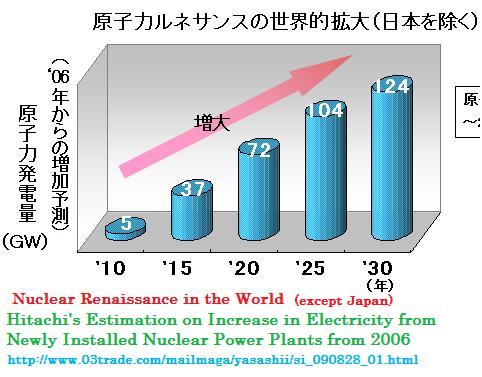
Japanese atomic power-related makers, Hitachi, Toshiba, and Japan Steel Works, have been aggressive in its estimation of further introduction of nuclear power plants in the global market.


Hitachi estimates that world nuclear power plants (except in Japan) will add electricity of 37 Giga-Watts in 2015 to the level in 2006.

One new nuclear power plant is expected to produce 1 GW. Therefore, they expect nations in the world to build 4 to 6 nuclear power plants per year till 2030.


PART 31-9

Now at 6 p.m of Thursday Japan Time, French President Mr. Sarkozy and Japanese PM Mr. Kan are holding a joint press conference in the prime minister office in Tokyo; Mr. Sarkozy said it is a matter of tsunami but not a plant.

French President Mr. Sarkozy stressed that it is not whether to choose a nuclear power plant or not but how to enhance safety of nuclear plants that is essential.


PART 31-8

There is a report that once a Japanese nuclear power plant designer found a fault in his engineering design. There was a possibility that some piping might cause a trouble. So, he tried to correct it, though his original design had been already authorized by a competent authority of the Japanese Government and put into construction. So, he submitted a request for change in design, which was however rejected by an official in charge.

"If it was admitted, it would harm reputation of inerrancy of my office. What my office approved must be perfect. Therefore no change or correction is allowed," replied the elite bureaucrat.

And, there have been many anti-nuclear power plant activists in Japan. If any design change is done, they would jump at it to take it as evidence of incompleteness of nuclear power plants.

Accordingly, the design fault was left as it was.

(Of course, without a big earthquake or tsunami, this defect does not cause any problem in operation of the nuclear power plant.)


PART 31-7

The nearest city to Tokyo significantly damaged by the 3/11 Earthquake is Urayasu City, Chiba Prefecture.

Liquefaction phenomenon emerged largely in the city where Tokyo Disney Land is situated as it is 10 km east of the Tokyo Station.


http://d.hatena.ne.jp/ikusayohei/20110312/1299929367

In Tokyo, one old big hall had part of its roof fallen to the audience, killing two people, due to the 3/11 M9.0 Earthquake of which epicenter was 550 km northeast.


PART 31-6

The nearest city to Tokyo significantly damaged by the 3/11 Tsunami is Asahi City, Chiba Prefecture.

The city is 80 kilometers east of Tokyo, facing the Pacific Ocean. The tsunami killed 11 citizens and damaged 300 or so houses and buildings. Even its city hall was battered by three waves of the tsunami that came in 3 house after the occurrence of the M9.0 earthquake off Miyagi Prefecture, 500 km north of Asahi.
(Click to enlarge.)
http://www.youtube.com/watch?v=zqwnAXArtNs&feature=related

Tokyo does not face the Pacific Ocean directly, though connected to it through Tokyo Bay.


PART 31-5

PetroChina Company is to provide 20,000 tons of oil fuel to Japan as emergency aid.


PART 31-4

The president of Tokyo Power Electric Company has been reportedly hospitalized.

Mr. Masataka Shimizu, president of TEPCO, was called to the Prime Minister Office at 4:17 a.m. by Prime Minister Mr. Naoto Kan on April 15 for some emergency talk, though PM Mr. Kan did not take any effective measures on the day except setting up the unified headquarters of the government and TEPCO in the TEPCO's main office building.


PART 31-3

IAEA has reported that twice larger radioactivity than its specified allowable limit was detected by its stuff in a village 40 kilometers from the Fukushima Daiichi Plant.


PART 31-2

Today in three consecutive days, planned outage is cancelled by Tokyo Power Electric Corporation.

So, electricity will be provided all day long for every household and business today around Tokyo where 35 million people live and work.


PART 31-1

The Thai Government has decided to provide two sets of gas turbine generators for Japan as rental for five years.

The electricity-generator facilities could reportedly cover 244,000 households with their utility service if set in Tokyo Bay.


*** *** *** ***


President Mr. Barack Obama has expressed his will to continue to introduce nuclear power plants.

In America, except California, no big earthquakes and tsunamis are expected to happen like in France. But, there is an essential problem of nuclear waste. Though the U.S. might find many suitable places to deposit various types of nuclear waste in its vast land, there is still a big possibility that those who are in charge of handling the waste are contaminated.

So, we had better stop pursuing the nuclear power generation policy for a while worldwide.

Incidentally, the U.S. and some other nations still rely on nuclear weapons. It is time to pursue abolition of this type of weapons worldwide. If an era has come when a mediocre-size of nuclear warfare becomes a common thing, it will surely lead to decline of human civilization.

When mankind has come to use nuclear power in the 20th century, I really think the God must get His angels prepared for some critical action: salvation or punishment depending on what nuclear energy represents or suggests in terms of modern humanity.

One more thing, Israel is reportedly armed with nuclear weapons, too. In this context, nuclear power is biblical or historically crucial for people who live today at the summit of these 2000 years of development of civilization.

Anyway, we had better check the Apocalypse to find passages related to the 3/11 Disaster of Northeast Japan including an M9.0 earthquake, a 14-meter high tsunami, and a nuclear power plant morass.


Joh 3:31 He that cometh from above is above all: he that is of the earth is earthly, and speaketh of the earth: he that cometh from heaven is above all.

Wednesday, March 30, 2011

"Strive not with a man without cause" - ($30,000 Care for $300 bn Damage)

Tokyo Bay


$30,000 Preventive Care before $300 billion Damage


A preventive measure costing $1 can sometimes prevent occurrence of a tragedy that costs $30 million.

In other word, a probability that a M9.0 earthquake happens and a 14-meter high tsunami is generated within a hazardous range of a nuclear plant is 1/100,000,000 at any time.

But, TEPCO did not spend $1 or $30,000 for reinforcement work to put into readiness its Fukushima No.1 Nuclear Power Plant. Accordingly, $300 billion damage on Japan is at stake, especially around Tokyo.

If a normal cooling-water circulation system is halted due to power outage after a big earthquake, an emergency pump can be used to circulate water through a pressure vessel in a nuclear reactor system. But, to activate the pump, a separate power generator is needed. In the Fukushima Daiichi Plant, those emergency power generators were installed outside the containment building and the turbine building, just on the ground facing the sea 4 to 5 meters below. And, they were not housed in concrete structure.

Then, a M9.0 earthquake and a 14-meter high tsunami attacked the Fukushima No.1 Plant on March 11, 2011, destroying the emergency power generators without protective walls and ceilings. The housing work is estimated to cost just $30,000 or so.


SECTION I: 55 Operating Nuclear Reactors in Japan

Each year since 1966, more than one nuclear reactor was built and put into operation in Japan.


Among them, a score of nuclear reactors were attacked by an M9.0 earthquake and more than 10-meter high tsunami on March 11, 2011.

And, only four reactor units in the Fukushima Daiichi (No.1) Nuclear Power Plant were damaged.


http://en.wikipedia.org/wiki/Nuclear_power_in_Japan

FUKUSHIMA No.1 (Daiichi) PLANT:
Fukushima I – 1 - 460 MW General Electric...hydrogen explosion
Fukushima I – 2 - 784 MW General Electric...vessel damaged?
Fukushima I – 3 - 784 MW Toshiba...hydrogen explosion
Fukushima I – 4 - 784 MW Hitachi...spent fuel pool damaged?

Fukushima I – 5 - 784 MW Toshiba
Fukushima I – 6 - 1,100 MW General Electric

FUKUSHIMA No.2 (Daini) PLANT:
Fukushima II – 1 - 1,100 MW Toshiba
Fukushima II – 2 - 1,100 MW Hitachi
Fukushima II – 3 - 1,100 MW Toshiba
Fukushima II – 4 - 1,100 MW Hitachi

ONAGAWA PLANT:
Onagawa - 1 - 524 MW General Electric?
Onagawa - 2 - 825 MW General Electric?
Onagawa - 3 - 825 MW General Electric?

TOKAI PLANT:
Tokai-1 166 MW Magnox
Tokai-2 1100 MW General Electric?

So, among 15 nuclear reactors, only four in Fukushima No.1 Plant failed on March 11, 2011.

But why?

It is because their emergency power generators for pumps to cool water inside the reactor were not protected sufficiently from tsunami waves unlike others.

If those emergency power generators in Fukushima No.1 Plant had been surrounded by 3-meter high walls and ceilings, there would not have been the Fukushima Daiichi radiation problem now. Simple construction work costing $30,000 could have saved the nuclear reactors from this tragedy.


SECTION II: Fukushima Daini on March 11

There is a report on the state of the Fukushima No.2 (Daini) Nuclear Power Plant on March 11, 2011.
All Fukushima Daini units in cold shutdown
15 March 2011

All four units at the Fukushima Daini nuclear power plant have now achieved cold shutdown - where coolant water is at less than 100ºC - with full operation of cooling systems, Tepco reported. All the reactors shut down automatically during last week's earthquake and have remained safe. While unit 3's shutdown went as expected, damage to the emergency core cooling systems of units 1, 2 and 4 led to the announcement of emergency status. These three reactors were prepared for potential pressure release, but this was never required. Unit 1 announced cold shutdown at 1.24 am on 14 March and unit 2 followed at 3.52 am. Tepco has now announced that unit 4 achieved cold shutdown at 7.15 pm on 15 March. Water levels are now stable in all four reactors and offsite power is available, the company said.


http://www.world-nuclear-news.org/IT-All_Fukushima_Daini_units_in_cold_shutdown-1503114.html

As the emergency power generators in Fukushima No.2 Plant are surrounded by 3-meter high walls and ceilings, there are no Fukushima Daini radiation problem now.


SECTION III: If Chernobyl is at Fukushima

If a map of Ukraine is overlapped on a map of Japan to compare the affected areas in both the cases of Fukushima and Chernobyl, the difference in the scale can be understood. Specially, if the non-inhabitable area set around Chernobyl was applied around Fukushima, Tokyo must be evacuated.

(Click to enlarge.)
http://genpatumap.seesaa.net/article/126065171.html


*** *** *** ***


Club Atletico Osasuna, a Spanish football club, sent a message of support for Japan.

http://ow.ly/i/9IYR

The U.S. is especially extending its friendship to Japan in these days:
"The American Red Cross today announced that the public has generously donated $120.5 million to help the people of Japan following the March 11 earthquake and tsunami."

http://www.redcross.org/portal/site/en/menuitem.94aae335470e233f6cf911df43181aa0/?vgnextoid=6f120bf1bf10f210VgnVCM10000089f0870aRCRD


The Japanese Red Cross Society has received total $500 million of donation from all over the world.

Japan donated $539 million to victims of the 2004 Sumatra earthquake and Indian Ocean tsunami.

http://eereporter.blogspot.com/2011/03/preaching-in-wilderness-of-judaea.html

Money cannot solve the underlying problem of this era which has been manifested in Japan through the 3/11 Disaster. It is related to civilization mankind has built to date. A nuclear power generator is the very symbol of this civilization. An earthquake and a tsunami could happen as long as continental plates move in a larger scale of space and time. But, what they expose through their violent power is damage on humanity having been always done by material civilization. No matter how sophisticated Japan and the Japanese are, they cannot be exempted from this problem. A great sin must be felt at least in the nuclear threat. A sin that we think of money more than the God, since a nuclear power plant is apparently for money but not for praising the God. The Japanese economy should be corrected in this context as the first among major countries.

Money is for a man, but a man is not for money.


Pro 3:29 Devise not evil against thy neighbour, seeing he dwelleth securely by thee.

Pro 3:30 Strive not with a man without cause, if he have done thee no harm.

Pro 3:31 Envy thou not the oppressor, and choose none of his ways.