Thursday, September 10, 2015

"he saw a man, named Matthew" - Satan Has Many Men

Ginza, Tokyo


Satan Has Many Men


There is a man who made a survey of the death penalty in Japan.

He found that true bad guys less come to commit a murder: they most likely abuse somebody else to kill their enemy.

If a man is cold in the heart and has no ethics in the mind, he would not commit a murder provided that he is a rational man.  But this type of men cannot be a hero in works of art in most cases.  A man who is rather good natured but once lost his senses to happen to commit a murder and later deeply regretted can be sometimes a hero in works.

In this context, we have to review the cases of Christ Jesus, JFK, the 9/11, etc.  We should not take it as a matter of course that the truly bad guys are Pilate and Judas, Oswald and Ruby, Osama and terrorists in the planes, etc.  We have to focus on the Roman Emperor or his proxy, the King of Judaists, great priests of the Temple; the bosses of the Mafia, CIA agents, and influential politicians; anti-American wealthy people in the world; and so on.

The situation was complicated against a deep background in each case.  Accordingly, real perpetrators could not be so easily identified, if you simply read the Bible, the related criminal reports, the research papers, etc.

Satan has many men.


**** **** ****


Mat 9:9 And as Jesus passed forth from thence, he saw a man, named Matthew, sitting at the receipt of custom: and he saith unto him, Follow me. And he arose, and followed him.
Mat 9:10 And it came to pass, as Jesus sat at meat in the house, behold, many publicans and sinners came and sat down with him and his disciples.

Tuesday, September 08, 2015

"Elias had appeared" - Hero of the February 26 Incident

Ginza, Tokyo


Hero of the February 26 Incident


A Japanese Imperial Army officer felt strange uneasiness in the morning of February 26, 1936.

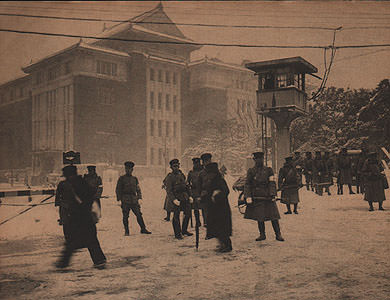
So, second lieutenant Otaka inserted real bullets into his middle-sized Mauser pistol.  Then he headed for the Imperial Palace, leading his platoon to guard the Palace in the center of Tokyo.  It was snowing.

Otaka set a commanding post at the Nijyubashi bridge to supervise soldiers patrolling in the precinct of the Palace.   Then, lieutenant Nakahasi accompanied by second lieutenant Imaizumi came to the Nijyubashi bridge to enter the Palace premises where the Emperor lived and maybe was already at work.  However the two officers familiar to Otaka did not look very normal at all to Otaka.

Imaizumi whispered into the ear of Otaka with a quivering voice: "I have done a terrible thing."  In fact, some soldiers led by Nakahashi and Imaizumi launched a surprise attack on the residence of Finance Minister Takahashi who was shot to death.  It was part of a large scale coup attempt planned by nationalists and carried out by radical young officers who led several platoons to occupy the central part of Tokyo in the morning of February 26.

Otaka, without knowing the occurrence of the on-going coup attempt, looked at Nakahashi who looked like nothing less than full alert.  Nakahashi said, "Let me pass here into the Palace!"  Otaka ordered his soldiers to set bayonets to their rifles.  Nakahasi's face turned to horribly aggressive and threatening, shouting, "What these bayonets for?"  Soldiers stepped back.  Otaka pulled up his pistol.  Nakahashi instantly took out his large-size Browning pistol that emitted smell of gunpowder as it had been used to kill Finance Minister Takahashi.  The two pistols were poised between the two Army officers.

Then suddenly Nakahashi looked like losing energy.  He turned away, leaving the post at the Nijyubashi bridge, the main entrance to the Imperial Palace.  Otaka stood there without moving for some time.  He found that the field in the Palace became all white, covered by falling snow.

The coup failed eventually.  It was the Emperor himself that put an end to this bloody attempt by insurgent military units to take over the Imperial Government.  The Emperor clearly stated to ministers and generals so much surprised and confused that those units were his enemy as they had already killed some ministers and high-ranking officers of the Imperial Government.

Those young, insurgent Army officers wanted to eradicate "bad" ministers and politicians to establish a new government with old generals who understood their motivation to improve the society of Japan, especially helping poor farmers in local regions.  But they were defined as an imperial enemy by the Emperor.  Army and Navy commanders promptly mobilized troops and military ships, aiming guns of tanks and cannons of naval ships at insurgent units of soldiers occupying the prime minister office, the Tokyo metropolitan police headquarters, areas around the National Diet building, etc.  Without actual exchanges of fires, the insurgent officers and soldiers led by them surrendered.    


Today, it is said that if the languishing and determinate insurgent officers entered the Imperial Palace to directly meet the Emperor, the situation could have been different.  The radical young officers might have forced the Emperor to accept at least some part of their requests, while outer regular forces could not attack the insurgents who put the Emperor in their custody.  In this context, second lieutenant Otaka saved the Imperial Government in this February 26 Incident as he bravely confronted the dangerous lieutenant Nakahashi to stop him from entering the Palace.

Maybe a key to this incident is that lieutenant Nakahashi, six years senior to Otaka, had once been a teacher of Otaka in the Army academy.  To get into the Imperial Palace and reach Emperor's residence, Nakahashi had to shoot Otaka, though he refrained from it for some reason.

Truly, one man sometimes must act as a hero without knowing what is happening around him or at the center of an empire.


(This February 26 Incident, however, paved the way for militarism prevailing in the Japanese society.  Citizens who got so shocked as they observed bare execution of military forces came to concede to claims of the military, while top generals of the Imperial Army and Navy started to send radical officers overseas, specifically to the Chinese Continent to avoid internal conflicts among military forces.  As a result, the Imperial Government rapidly came under military influences, wiping away influences of political parties and democratic movements.  The Emperor who felt an acute danger in person in this Incident also came to rely on generals and politicians who suppressed this coup without realizing the dangerous direction they were advancing to.)


226_photo
http://haradatakeo.com/?p=57430

二・二六事件
http://www.tanken.com/226.html

$憂国の魔窟 護国道まっしぐら
http://ameblo.jp/moody-night/entry-10468319254.html


**** **** ****


Luk 9:8 And of some, that Elias had appeared; and of others, that one of the old prophets was risen again.

"Go, wash in the pool of Siloam" - Mad or Anti-Christ Scientists


Anti-Abe Cabinet Demonstration around the National Diet Bldg., Tokyo, in August


Mad or Anti-Christ Scientists


Most of scientists seem not to think that this universe needed God for its generation, formation, and growth.

They agree that if any of minor differences in physical conditions should have led to generation, formation, and growth of an entirely different universe than one we now live in.  But at the same time, they think that there must be an uncountable number of trials of creation of a universe, so that it is no wonder that one of these infinite number of universes came to have the suitable physical conditions that allow for generation, formation, and growth of stars, the sun, the earth, and human beings.  In this case, they think that our existence does not need God or the interference of God with physical conditions of our universe.

If there is God, they seem to think, without many trials of creation of a universe our universe should be created with optimal physical conditions for birth of mankind.  But, if there is a strong possibility that our universe was created after an infinite number of universe creation, there would be no need for God.

I think that it is strange that scientists do not think that God might take such a method of trying an uncountable number of universe creation in order to eventually produce a universe that could give birth to mankind.  It is not our business, but it is God that can choose the method.  There must be a profound reason that God deliberately took such a complicated method.  Nonetheless, for God a limitless number of trials of crating a universe may be a matter of a second if God counts time.

God, probably, created universes with five dimensions, six dimensions, and so on.  Fortunately we live in a universe spatially in three dimensions and temporally in one dimension.  But God might be enjoying other types of universe such as one spatially in one dimension and temporally in three dimensions.

Indeed, what man cannot do God can do.

    
(I rather think that God has really created a universe in which there are no prime numbers.  In this case, no robust coding of an e-mail message would be possible, though no atoms could be formed from the beginning.  Even time might not flow continually.)


**** **** ****


Joh 9:7 And said unto him, Go, wash in the pool of Siloam, (which is by interpretation, Sent.) He went his way therefore, and washed, and came seeing.
Joh 9:8 The neighbours therefore, and they which before had seen him that he was blind, said, Is not this he that sat and begged?

Sunday, September 06, 2015

"power on earth to forgive sins" - Global Terror Leading to the Third World War (WWIII)


Around Tokyo on a Rainy Sunday


Global Terror Leading to the Third World War (WWIII)


We may be already in the era of the Third World War, which is however unlike any preceding world wars.
Global terrorism index 2014, top 50 countries:
Iraq....................10  
Afghanistan.....9.39
Pakistan............9.37
Nigeria............... 8.58
Syria....................8.12 
India....................7.86
Somalia...............7.41
Yemen....................7.31
Philippines..........7.29
Thailand...............7.19 
Russia....................6.76 
Kenya......................6.58
Egypt........................6.5
Lebanon................6.4
Libya......................6.25
Columbia...............6.24
Turkey...................5.98
Congo, Republic.....5.9
Sudan.....................5.77
South Sudan........5.6
Algeria....................5.52
Mali..........................5.29
Bangladesh........5.25
Nepal....................5.23
China....................5.21 
Central Africa....5.19
UK...........................5.17 
Iran.........................4.9
Greece.................4.73
US...........................4.71 
Indonesia.............4.67
Israel.....................4.66 
Mexico..................4.66
etc.
http://www.statista.com/statistics/271514/global-terrorism-index/
Even France that suffered a terrible terror attack several months ago in Paris is not ranked high in this data.

The United Nations must view the world as being in WWIII so as to take appropriate countermeasures.  But who are the enemies?  We can easily admit that we are in another global war, but if we define our enemies as terrorists of any sorts, can we win this war simply.  I mean that there are more responsible people than terrorists directly engaged in acts of terror.

For example, in the morning of September 11, 2001, George H.W. Bush was meeting with a brother of Osama bin Laden in New York for some business talk.  After the 9/11 Terror, his son, namely President George W. Bush, launched the War on Terror, specifically, aiming at Iraq as well as Afghanistan, though Saddam Hussein had no direct link to Al Qaeda.  And, this War on Iraq led to the rise of Islamic Nation eventually through the complex process of the War and the withdrawal of the US military forces from Iraq in 2011.

Ironically, now the major EU nations such as Germany, France, and the UK are forced to take in hundreds of thousands of refugees from Islamic nations being devastated by terror and civil wars.  Indeed, Europeans must respond to this challenge.  If they should fail, the overt Third World War might start in or from Europe like WWI and WWII.

For example, NATO might finally try to occupy the Middle East to settle the matter once and for all, while Russia, China, and Iran take the opposite stance.


But if the Middle East and the Islamic world should start to fully adopt Christianity-based democracy after WWIII, Russia and China would still remain as potentially threatening factors.


**** **** ****


Mat 9:6 But that ye may know that the Son of man hath power on earth to forgive sins, (then saith he to the sick of the palsy,) Arise, take up thy bed, and go unto thine house.

Saturday, September 05, 2015

"they should be tormented five months" - History, a Kind of God


Around Tokyo


History, a Kind of God


When Christ Jesus came to this world, ancient Israel was not in glory at all.

Palestine was ruled by Romans at the time, though there was a king of Israelites who was subject to Rome.  Elite Judaists spoke Greek while Judaist priests were around the great tabernacle in Jerusalem.

Ancient Israel was then a tributary state of the Roman Empire.  After having observed organizational mighty and pragmatic efficiency of troops of Alexander the Great and Caesar, Israelites came not to have a dream of defeating Greeks and Romans to make Israel a glorious leading nation in the world.  Judaists were then living unlike descendants of Abraham, Moses, and even King David.  What is worse, they were living as sinful as Romans.

Then Christ Jesus appeared to make them turn their hearts to God.

As the history tells, owing to the great and holy work of Christ Jesus, the tribe of Judaists has been secured to this day.  They were not lost in history but could survive.  Descendants of Abraham, Moses, and even King David have not perished but established their base for survival most firmly after WWII.

But, as the crisis of the tribe of Judaists was so grave 2000 years ago, Christ Jesus had to take a special strategy for survival of Judaists.  Specifically, Christ Jesus created a new religion today called Christianity.  In order to make it possible for Judaists to live next 2000 years, Christ Jesus must have thought that He had to formulate a new religion, Christianity, as an extension of Judaism.

This is one view of the history, a Judaism-centric view.

In another view, we may think that God created Judaism and Christianity as precursors of Islam.  The true aim of God is the creation of Islam, so that Judaism and Christianity are now useless.

Or at least, we should not accept a view that God created Judaism, Christianity, and Islam as precursors for present globalization of money economy and commercialism.  Look at the wealthy class Judaists, Christians, and Muslims, and then you may think they are closer to one another than to poor people of the same religion, respectively.

Judaism, Christianity, Islam and finally Global Money Economy!  It is outrageous!

Judaism, Christianity, Islam and finally the Kingdom of God!  It is very truthful.  And, this must be the history, since history is a kind of God.


**** **** ****


Rev 9:5 And to them it was given that they should not kill them, but that they should be tormented five months: and their torment was as the torment of a scorpion, when he striketh a man.

"there appeared unto them Elias with Moses" - Episodes about Old Popular Singers in Japan


Around Tokyo


Episodes about Old Popular Singers in Japan


In the evening sky I saw a jet streak colored pink by the setting sun.  Most part of the sky was covered by rainy clouds, but westward the pale sky was open.

I was thinking about a female singer.  Misora Hibari (1937-1989) was the most successful singer in Japan after WWII.  She recorded 1,500 songs till her death at 52 in 1989 since late 1940s while taking part in more than 150 movies.  She was highly praised in her style of singing Japanese popular ballad with strong and sentimental moods.  Though she was not a kind of beauty who would win a beauty contest, her songs aroused romantic and sometimes sentimental emotions in the hearts of a Japanese audience so deeply.  Misora Hibari was the number one female singer in Japan from late 1940s to 1980s.

But it is said that she had a strong connection to one of the heads of the largest gangster syndicates in Japan.  When singers and players performed on a local theater, they were usually requested to pay reasonable respect for a major gangster group that controlled show business in the local area.  Accordingly entertainment personalities reportedly have some sort of connection with gangsters even today.  Decades ago, such association was more frequent.  In this social environment, Misora Hibari reportedly came to be supported by the head of the Yamaguchigumi syndicate called Taoka whose stronghold was Kobe.

Misora Hibari was not friendly to other entertainers.  She seldom associated with other singers and actors/actresses, though she briefly married an actor to soon get divorced.  However, there was one exception, since there was another very popular female singer in Japan after WWII: Shimakura Chiyoko (1938-2013).  Shimakura was one year younger than Hibari, but when Shimakura was a junior high-school student, Misora was a successful singer already.

However, as time went by, Misora came to feel friendship with Shimakura.  And they became good friends for each other.  When Misora got ill to be hospitalized, only Shimakuea was allowed to visit Misora in person among many people in concerned with show business.

Once Shimakura hurt her eye, as a tape a fan threw to her on stage hit the eye.  So, she received medical treatment from an eye doctor.  She was cured of the eye injury well, and she felt indebted to him, so that years later she became a guarantee of this medical doctor for his financial transaction, etc.  Unfortunately, it forced Shimakura to take on the big debt, 400 million yen ($4 million) at the rate in 1970s.

It became big news at the time: a very popular singer terribly indebted due to her position as a guarantee for an acquaintance.  Then a rich woman appeared offering a help.  She said that she would take over Shimakura's debts, since she was very rich and had many friends among influential people.  So, Shimakura entrusted debt management to the woman, even allowing her to manage Shimakura's show activities.  It also became big news that a rich fan helped Shimakura out of the debt hell.

However, it later turned out that the rich woman was a common-law wife of a certain gangster syndicate.  Shimakura's debts were not decreased, but rather the amount of debts increased.  The rich woman took incomes from Shimakura's performance as well as her condominium room.  When Shimakura realized it, she cut the connection with the rich woman to be financially saved eventually.

Indeed, the entertainment industry or show business is contaminated so badly by entertainers' connections with gangsters or the like.  Even such female singers as Misora Hibari and Shimakura Chiyoko who enjoyed high popularity all over Japan, receiving many big awards, were not exceptional.  Singers and actors/actresses of generations younger than Misora and Shimakura must have the same problem.

Maybe the color of the jet streak reminded me of old female singers for some reason.  But the sky was not clear blue, which is expected in the late summer or at the beginning of autumn.

Entertainment business belongs to commercialism.  Commercialism needs idols and icons.  Indeed, the Bible tells us to  exercise caution on idols.  Therefore, we should regard all the performing artists as anti-Christ.  But if we request the general public to follow this teaching, gangsters might come to hurt us.  Yet, Christ Jesus said that it is better to enter Heaven even if we lose one arm or one foot in a fight against evil.

Thinking so, I was watching the sky without any attraction but the pink jet streak on the street without any drama.  But I remembered that I just passed by a young girl, an hour before, who looked like a famous actor as she had been in her junior-high school days.  There are many young people who must learn the Bible.


**** **** ****


Mar 9:4 And there appeared unto them Elias with Moses: and they were talking with Jesus.
Mar 9:5 And Peter answered and said to Jesus, Master, it is good for us to be here: and let us make three tabernacles; one for thee, and one for Moses, and one for Elias.

Thursday, September 03, 2015

"the works of God should be made manifest" - Material World Cursed by God


Ginza, Tokyo


Material World Cursed by God


There are many countries and many peoples in the world.  But wealthy people and super-wealthy people are not distributed evenly, equally, or fairly.

According to Credit Suisse Group, the US is the runaway leader in the statistics on wealthy and super-wealthy classes.


(http://ameblo.jp/orange54321/entry-11966597510.html)

Accordingly, sins and crimes caused by material wealth and financial enrichment must be seen in a concentrated manner in the US.

For advanced countries listed in the above figures, each number of victims of crimes per its population (in 2005) is as follows:

Country      Number of Criminal Victims per Population (%)
---------------------------------------------------------------
UK.................21.0
US.................17.5
Canada..........17.2
Australia........16.3
Germany........13.1
Italy...............12.6
France............12.0
JAPAN...............9.9

(Source: UN Interregional Crime and Justice Research Institute and UN Office on Drugs and Crime)


The general impression is that wealth in the US seems to be linked to the Anglo-Saxon network, covering the US, the UK, Canada, and Australia.  Evil activities and aspects of these countries look like resulting in huge accumulation of wealth in the US.  I mean that without this Anglo-Saxon network the US cannot probably possess such a huge amount of wealth.

Compared with these traditionally Anglo-Saxon countries, the continental European countries, especially Romance-language speaking countries, look less radical in sacrificing others in the process of accumulating wealth.  But, Germany, a kind of successor of Germanic people, looks less modest than Italy and France influenced by Roman Empire heritage.

And Japan is far more peaceful than other advance countries with great wealth.

If money is an enemy of mankind and hence wealth is an enemy of God, the US is predominantly the country with the largest number of sinful rich men.  And the Anglo-Saxon predominant countries are also so sinful.  Therefore the current globalization of economy, business, culture, and social systems led by the US and other Anglo-Saxon predominant countries is so sinful and dangerous.


However there is another interesting statistics:

Country        The Ratio (%) of Underground Economy to GDP (2007)
----------------------------------------------------------------
Russia...............52.00
Brazil.................43.00
S. Korea.............29.40
Italy....................27.40
Germany............16.70
Canada...............16.60
France................15.70
Australia.............15.00
China...................14.30
UK.......................13.20
JAPAN.................12.10
US..........................9.00

(Source: The World Bank)


Remarkably, the US looks relatively the most honest country, followed by Japan,  among major countries in making its economy transparent as much as possible.

The only hope of our material world, probably, being cursed by God might be this honesty of the US.


**** **** ****


Joh 9:3 Jesus answered, Neither hath this man sinned, nor his parents: but that the works of God should be made manifest in him.

Wednesday, September 02, 2015

"letters to Damascus to the synagogues" - Expressions in Emperor's Statement to End WWII


Ginza, Tokyo


Expressions in Emperor's Statement to End WWII


Even Christ Jesus referred to the Old Testament when teaching His disciples or other people.  The Old Testament was authentic material for Christ Jesus and His followers.

In Japan, what the elite people, such as politicians, leading journalists, scholars, etc., sometimes refer to is Chinese classics.  And there have been long traditions of studying Chinese classics in Japan.  Even the Nihon Shoki (the Chronicles of Japan), the oldest book of classical Japanese history and myths compiled by the imperial court in 720 , referred to a Chinese history book written in the third century.

In the past or before the modernization of Japan, not only noble men but also samurais were requested to learn Chinese classic books and various types of Chinese philosophy.  When the imperial court or a samurai government issued documents, they often contained special expressions taken from Chinese classics.

Accordingly, when the Empire of Japan surrendered to the US military forces in August 1945, the imperial statement to announce the end of the war to the Japanese people was drafted by some high-ranking official close to the prime minister.  He thought that the draft should be upgraded by adding some sophisticated expressions taken from Chinese classical books.  Then he consulted a few experts (of course Japanese scholars) in Chinese classics and finally got approval in a Cabinet meeting.

And, on August 15, the Emperor's reading this statement, without modification, was aired by radio to the Japanese people, though it was recorded in recording discs in the night of August 14.  So, in this announcement there were some difficult classical expressions for ordinary Japanese people, though they could understand the whole meaning of this imperial rescript declaring the termination of the war.

One of the experts of Chinese classics this high-ranking official, namely the Cabinet Secretary, consulted was  Masahiro Yasuoka (1898-1983), who added some key Chinese classical expressions to the draft.  Though not all of his modifications were approved by a Cabinet meeting subsequently held to authorize the statement, Yasuoka's idea and influence was evident in the words the Emperor read.

Imperial Rescript
August 14, 1945
 
To Our good and loyal subjects:
After pondering deeply the general trends of the world and the actual conditions obtaining in Our Empire today, We have decided to effect a settlement of the present situation by resorting to an extraordinary measure.
 
We have ordered Our Government to communicate to the Governments of the United States, Great Britain, China and the Soviet Union that Our Empire accepts the provisions of their Joint Declaration.

To strive for the common prosperity and happiness of all nations as well as the security and well-being of Our subjects is the solemn obligation which has been handed down by Our Imperial Ancestors, and which We lay close to heart. Indeed, We declared war on America and Britain out of Our sincere desire to ensure Japan's self-preservation and the stabilization of East Asia, it being far from Our thought either to infringe upon the sovereignity of other nations or to embark upon territorial aggrandizement. But now the war has lasted for nearly four years. Despite the best that has been done by every one - the gallant fighting of military and naval forces, the diligence and assiduity of Our servants of the State and the devoted service of Our one hundred million people, the war situation has developed not necessarily to Japan's advantage, while the general trends of the world have all turned against her interest. Moreover, the enemy has begun to employ a new and most cruel bomb, the power of which to do damage is indeed incalculable, taking the toll of many innocent lives. Should We continue to fight, it would not only result in an ultimate collapse and obliteration of the Japanese nation, but also it would lead to the total extinction of human civilization. Such being the case, how are We to save the millions of Our subjects; or to atone Ourselves before the hallowed spirits of Our Imperial Ancestors? This is the reason why We have ordered the acceptance of the provisions of the Joint Declaration of the Powers.

We cannot but express the deepest sense of regret to our Allied nations who have consistently cooperated with the Empire towards the emancipation of East Asia. The thought of those officers and men as well as others who have fallen in the fields of battle, those who died at their posts of duty, or those who met with untimely death and all their bereaved families, pains Our heart night and day. The welfare of the wounded and war-sufferers, and of those who have lost their home and livelihood are the objects of Our profound solicitude. The hardships and sufferings to which Our nation is to be subjected hereafter will be certainly great. We are keenly aware of the inmost feelings of all ye, Our subjects. However, it is according to the dictate of time and fate that We have resolved to pave the way for a grand peace for all the generations to come by enduring the unendurable and suffering what is insufferable.

Having been able to safeguard and maintain the structure of the Imperial State, We are always with ye, Our good and loyal subjects, relying upon your sincerity and integrity. Beware most strictly of any outburst of emotion which may engender needless complications, or any fraternal contention and strife which may create confusion, lead ye astray and cause ye to lose the confidence of the world. Let the entire nation continue as one family from generation to generation, ever firm in its faith of the imperishableness of its divine land, and mindful of its heavy burden of responsibilities, and the long road before it. Unite your total strength to be devoted to the construction for the future. Cultivate the ways of rectitude; foster nobility of spirit; and work with resolution so as ye may enhance the innate glory of the Imperial State and keep pace with the progress of the world.

The 14th day of the 8th month of the 20th year of Showa
(The original is of course in Japanese.  For convenience only this English version will be referred to.)

Specifically, Yasuoka put expressions from some Chinese classics to "pains Our heart night and day" and "pave the way for a grand peace for all the generations to come" in addition to other minor parts.  Especially, the latter expression is important in that it clearly meant the end or termination of the war.  (The former expression meant extreme sadness or remorse of the Emperor.)

However, there was another phrase Yasuoka wrote but was further modified in the Cabinet meeting, which was "it is according to the dictate of time and fate."  It did not reflect Ysuoka's intention.  Yasuoka originally wrote "it is according to the justice and right cause of our nation."  He meant that the reason why the Empire would terminate the war was that it was a right thing in light of the justice for the Empire.

Yasuoka wanted to emphasize that the Empire of Japan would not simply surrender because the course of the war and the situations for the Empire were so hopeless but because termination of the war was a right thing taking into account the justice and the cause the Empire had pursued; it was not a simple surrender resulted from a trend of the war.

However, in the Cabinet meeting, Prime Minister Suzuki and other ministers of the Imperial Government did not include this expression.  Some of them even said that there was nor such a word in Chinese-Japanese character dictionaries as "according to the justice and right cause."

Yasuoka reportedly got angry when he knew that ministers changed the expression from the imperial statement, since he had strongly emphasized to the Cabinet Secretary that the phrase  "it is according to the justice and right cause of our nation" was paired with another, "pave the way for a grand peace for all the generations to come."  

After WWII, Masahiro Yasuoka became the most influential mentor to conservative politicians, including some prime ministers such as Eisaku Sato.  Yasuoka's knowledge in Chinese ancient philosophy was respected even by top business leaders who needed some spiritual backbone.

But, what Yasuoka was most proud of was an episode that the Emperor directly talked to Yasuoka in an imperial garden party held years after WWII, saying, "Yasuoka, I appreciate your work at the end of the war."


So, to fully understand what the Japanese elite want to mean, you might have to sometimes learn Chinese classics.


**** **** ****


Act 9:1 And Saul, yet breathing out threatenings and slaughter against the disciples of the Lord, went unto the high priest,
Act 9:2 And desired of him letters to Damascus to the synagogues, that if he found any of this way, whether they were men or women, he might bring them bound unto Jerusalem.

Tuesday, September 01, 2015

"and came into his own city" - How Truly WWII Ended for Japan

Anti-nuclear protesters' tent in front of a government ministry, Tokyo


How Truly WWII Ended for Japan


In July 1945, the Potsdam Declaration was issued by the US and its allied forces to request the Empire of Japan to surrender. But the key to acceptance of the Declaration by the Empire was whether the Emperor could keep substantially his safety and status after the demanded surrender even if it looked unconditional surrender nominally.

After enumerating items to apply to Japan after the surrender, for example, "we do not intend that the Japanese shall be enslaved as a race or destroyed as a nation, but stern justice shall be meted out to all war criminals, including those who have visited cruelties upon our prisoners," the Declaration used the term "unconditional surrender": "We call upon the government of Japan to proclaim now the unconditional surrender of all Japanese armed forces, and to provide proper and adequate assurances of their good faith in such action. The alternative for Japan is prompt and utter destruction."


The Imperial Government eventually accepted this demand after the Hiroshima/Nagasaki atomic bomb attacks and the Soviet forces invasion of Manchuria in August 1945, but the situation in Tokyo was not so simple.

First of all, die-hard and fanatic military officers still occupied leading positions in the Imperial Headquarters that actually controlled all the Imperial Army and Navy forces.  Though the Empire had lost battles in the Philippines, Iwojima, and Okinawa (inherent part of Japan) against the US military forces, especially Army militaristic officers wanted to continue the war even on the mainland Japan.

Those officers, especially those leading the Department of Imperial Army General Staff, even planned to move the Emperor deep into mountains in Honsyu Island for preparation of the final and desperate battle against coming US troops expected to land around Tokyo in a few months.  However, the Emperor had no intention to leave the Imperial Palace in Tokyo, though the main palace building had been already burnt down by a US air raid in May 1945.

The Imperial House of Japan had not traditions of warriors for more than 1000 years, though their ancestors had been also warriors in ancient days.  Accordingly, Showa Emperor was far more a court noble than a military man or a samurai.  He had no intention to fight and die like those desperate officers.  The Emperor reportedly began to seriously think about how to put an end in the war since the destruction of the main imperial palace building.

But how could the Emperor persuade those radically militaristic military officers to accept his will?  There was a fear that those officers driven to the desperate corner might carry out a coup to replace Showa Emperor with one of his brothers or any imperial family member.

And, how could the Emperor secure his status and the status of the Imperial Family when the Empire unconditionally surrendered?

These two difficult issued made the war continue even after the the Hiroshima/Nagasaki atomic bomb attacks and the Soviet forces invasion of Manchuria.

Put simply, in the last days of the Empire of Japan in August 1945, there was the Emperor, who now wanted to stop the war, in the center of Tokyo surrounded by die-hard, bellicose, and dangerous samurai-type Imperial Army officers who held leading positions in the Department of Imperial Army General Staff and were determined to fight and die in the mainland of Japan.

But, if the Emperor had been able to get secret information that the US Government had no intention to arrest and persecute the Emperor or abolish the Imperial House of Japan after the expected surrender of the Empire, the Emperor himself could have strongly persuaded those Army officers, including the Imperial Army Minister, to accept the Potsdam Declaration and surrender to the US military forces.  And, Showa Emperor could do it actually.

And, we may say it is how truly WWII ended for Japan.


Nonetheless, some experts in the modern history of Japan say that the Emperor could not have obtained such information as he was just staying in the Imperial Palace in Tokyo without special staff to work diplomatically and secretly and means of communications to foreign leaders.  At least, Showa Emperor, though nominally the supreme commander of the Imperial military forces, did not have such staff and means he could freely use without interference of the Imperial military, they argue.  However, it is now getting common understanding among experts and scholars concerned that the Emperor had some aids and means to get such information secretly.

As the acceptance of the Potsdam Declaration by the Imperial Government was announced internationally through the Japanese Ambassador to Switzerland on August 14 (domestically on August 15), it is not difficult to think that the main stage of the secret diplomatic activities that eventually gave assurance of fulfilling his request to the Emperor was Switzerland.  Actually, the Japanese Ambassador to Switzerland and other Imperial officers and officials stationed in Switzerland, etc. played key parts in secret communications with American counterparts.  And one of those Americans was Allen Dulles who later became the Director of CIA.    

In addition, Joseph Clark Grew, the former US Ambassador to the Empire of Japan, contributed to the US policy not to make the Emperor account for war responsibility.  There were some American bureaucrats who also helped Tokyo understand the American stance on this issue about the Imperial House through radio broadcasting from Washington DC.  Furthermore, Henry Lewis Stimson, the Secretary of War, persuaded some hard-liner US officials and eventually President Truman to allow Japan to maintain its Imperial system.  He also reportedly prevented a US atomic bomb attack on Kyoto, since Kyoto was a historically culture center of Japan.

As conclusion, though it is true that Hiroshima and Nagasaki atomic bombings by the US military contributed to the end of war with the Empire of Japan, the Emperor needed the information that would assure securement of his safety and status and the Imperial system in Japan.  With this conviction, he could overwhelm the desperate militaristic officers determined to fight US troops till their death with support from loyal politicians and generals.


That looks why Showa Emperor respected profoundly American friends after WWII.  This tradition can be still seen in the present Emperor and Imperial House.  For them, American friends seem to be more important than US nuclear weapons to defend Japan and their status, good or bad.


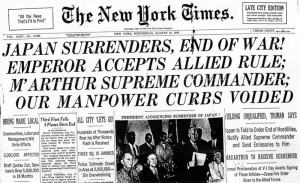
Japan Surrenders!
http://www.paultarver.com/a-prisoner-of-japan-a-pows-own-story/


**** **** ****


Mat 9:1 And he entered into a ship, and passed over, and came into his own city.
Mat 9:2 And, behold, they brought to him a man sick of the palsy, lying on a bed: and Jesus seeing their faith said unto the sick of the palsy; Son, be of good cheer; thy sins be forgiven thee.

Monday, August 31, 2015

"the Son of man must suffer many things" - Accepted Death of Believers


Tokyo


Accepted Death of Believers 


Christ Jesus said to love our neighbors as much as we love ourselves after loving God with all the resources we have.

If mutual love among neighbors in any community is exercised with love to neighbors equal to that to individually themselves, there should come true peace in the community.  If mutual love among nations in the world is established with love equal to that to individually themselves, there should come true peace in the world.

But, in most cases, people are afraid of others; people cannot trust others; and people want to first protect themselves before helping others.  How can they be convinced that they don't have to be afraid of their neighbors; they can trust their neighbors; and they have no need to protect themselves before helping others?

If a Judaist tries to behave as a good neighbor to an Islamic terrorist, he might be killed by the terrorist.  If a Muslim tries to behave as a good neighbor to a Western colonialist, he might be enslaved by the European or American.  If a European or American tries to behave as a good neighbor to a rich Judaist, he might be exploited financially.  But is it what Christ Jesus demands of us?  It seems to be.

So, all the good neighbors can be killed, enslaved, or exploited by bad neighbors.  And, they would all die out in their suffering caused by their bad neighbors.  And then what would happen?  All the bad neighbors should start to kill, enslave, and exploit one another, leading to annihilation of mankind.  On the earth, there would be none but the Bible with the world of Christ Jesus: "Love one another."

To a human point of view, it is crazy.  We cannot totally accept it.  But to the eye of God, it might be no problem.  Love He demands has been realized, which is the matter for God.  God might think that He has achieved his goal for which He created mankind.  Mutual love among the mankind has been practiced by some of them, though others have perished to fall into the hell.  He will welcome all the good neighbors in Heaven.

The point at issue is that believers of God or Allah have to be first of all good neighbors to their neighbors who can be their enemies.  If such believers should be killed by bad neighbors, they would be accepted by God.

But, if any Muslim killed their neighbors who happened to be his enemies with suicide bombing, can he be accepted and welcomed into Heaven?  If any Judaist killed his neighbors who happened to be his enemies with superior weapons, can he be accepted and welcomed into Heaven?   If any European or American killed his neighbors who happened to be his enemies with an advanced weapon system, can he be accepted and welcomed into Heaven?      

When you die, you have to be, preferably, killed by your bad neighbors without killing them while being a good neighbor to them.  This is the very condition Christ Jesus has set for a man to be allowed into Heaven.  Accordingly, suicide bombing is an act of madness.


Probably, a million years later, mankind might be all gone, dying out.  But, Christ Jesus alone, coming back to the world, might stand on the earth.  Looking up to the sky and down to the ground, He might say, "Everything is over with good souls in Heaven and bad souls in the hell!"

And then, God might start to create another mankind on the earth for the sole purpose of making them love their neighbors as much as they individually love themselves after loving God with all the resources they have.


The underlying idea is that it is not mankind that created this universe, the earth, and mankind themselves.  You may think all happened to come to exist by chance.  Then the chance must be God.  Or, you may think all happened to come to exist through an uncountable trials of randomness.  Then what has made possible the uncountable trials of randomness must be God.

God must have something that is reflected in moral character of every man, but He must also have something beyond our understanding.

If we are allowed to see even one facet of His infinite aspects, our mind cannot probably bear it.  We might go mad.


http://a.glcdn.co/images/web/series2/about-jesus-640-360.jpg


**** **** ****


Mar 8:31 And he began to teach them, that the Son of man must suffer many things, and be rejected of the elders, and of the chief priests, and scribes, and be killed, and after three days rise again.

Sunday, August 30, 2015

"was driven of the devil into the wilderness" - A French Film Produced during WWII


Around Tokyo


A French Film Produced during WWII


There were four men as major players in the French film produced during German occupation of France in WWII.  But also there was one woman connected with the three.

The first man was a villain working also as a private scribe (the time of the story was set around the early 19th century or so).  The second man was an actor who respected Shakespeare.  The third one was a pantomime artist.  And the last one was a noble man.

The villain was an old acquaintance and a kind of business partner of the woman, a beauty.  The Shakespeare-admiring actor happened to know her on the street while he was going to a theater to be hired.  The pantomime artist discovered his talent through an episode involving the villain and the beauty when they picked a pocket of a passerby in front of the theater, though they were not arrested, where he and his father were hired.

Subsequently, the Shakespeare-admiring actor was hired by the theater and the beauty also started to take some minor part in the theater.  And the pantomime artist came to fall in love with the beauty, though she had already started to live in an apartment house with the .Shakespeare-admiring actor.  The villain, knowing the relationship between the two, tried to kill the actor, but as the smart actor offered some big money to the villain, they became a kind of friends.

Meanwhile, the noble man happened to see her in the stage to be enchanted by her outlook.  And, he later happened to get her as she needed somebody to help her out of suspicion of a conspiracy with the villain in a crime, though she was not involved in this case.  For the noble man's name sake, she could get rid of arrest by the police.  Then, the beauty left Paris with the noble man for India, Scotland, etc.

The poor artist married the daughter of the theater owner.  However, several years later, the beauty and the noble man came back to Paris.  She frequently visited the theater to watch  from a box seat the pantomime artist, who now became a kind of star for his excellent performance as a white silent comedian.  The villain also found that the beauty returned to Paris, while the Shakespeare-admiring actor also became very successful in another theater.

As the story went on, the villain came to hate the noble man as he was insulted by the noble man when he dared to go and see the beauty in the residence of the couple.  On the other hand, the pantomime artist spent a night with the beauty.  In the morning, the artist's wife found the room where the two stayed and confronted the beauty to take the heart of her husband back, in vain.  But, the beauty decided to leave Paris again.  The pantomime artist overwhelmed by love to the beauty ran on the street of Paris after the carriage she got into.  But Paris was in carnival and the street was so crowded.

Around the same time, the villain killed the noble man, though he gave up flight from the homicide scene, namely a sauna for rich men in Paris.  So, the beauty would soon know the tragedy that happened to her patron.

In this story, only the Shakespeare-admiring actor who was acting Othello with his face painted black at the time when the tragedy was happening seemed to get rid of the trouble.

This movie is still ranked No.1 or 2 in French film ranking today.

But who is the most sinful in this story?  At least, the beauty is sinful.


I suppose that that is why the Bible never describes that Christ Jesus met with any beauty.


**** **** ****


Luk 8:29 (For he had commanded the unclean spirit to come out of the man. For oftentimes it had caught him: and he was kept bound with chains and in fetters; and he brake the bands, and was driven of the devil into the wilderness.)
Luk 8:30 And Jesus asked him, saying, What is thy name? And he said, Legion: because many devils were entered into him.

Friday, August 28, 2015

"Then said Jesus unto them" - An Example of Japanese Ukiyoe Prints


Tokyo


An Example of Japanese Ukiyoe Prints


Once there was a very unique a Japanese ukiyo-e print artist called Sya-raku.  He produced his works only in 10 months from 1794 to 1795 in the Edo era when the samurai shogun governed Japan.

His works were unique even to Japanese fans of ukiyo-e print art or pictures of everyday life in the Edo Period.  At the time, the kabuki play was one of big entertainments for citizens of Edo, the political capital of Japan at the time, which is now Tokyo.  Accordingly, ukiyo-e print artists depicted kabuki actors with enthusiasm.  Their works were sold well like pictures of movie stars of today.  Sya-raku also portrayed kabuki actors.  However, he did not try to simply make those actors look good and cool, but he emphasized characters and personalities of actors even to a degree where they looked odd or ugly.

And, since Sya-raku soon disappeared after 10-month professional activities, his works were somewhat forgotten and neglected.  Meanwhile, the samurai regime fell through a civil war, putting an end to national isolation of Japan.  And, westernization of the Japanese society started in 1860s.

As Japan opened the nation, Japanese art works came to be widely introduced into Europe and the US.  In this trend, ukiyo-e print art became very popular among artists and art fans in Europe.  And, German collector Julius Kurth wrote a book about Sha-raku in 1910, in which he appraised Sharaku's portraits as high as those of Rembrandt and Velázquez.

Responding to high reputation of Sha-raku in Europe, Japanese turned anew their eyes to Sha-raku and discovered extraordinary artistic merit in his works.  Today, Sha-raku is admitted to be one of the greatest artists in the samurai-ruled Edo Period when Japan was governed by the Tokugawa shogun between 1603 and 1868.  And, the most popular print of Sha-raku's works was the one titled Third-Generation Otani Oniji Acting Guy Edo-be.

三世大谷鬼次の奴江戸兵衛
Third-Generation Otani Oniji Acting Guy Edo-be
https://www.adachi-hanga.com/ukiyo-e/items/sharaku027/

In a certain kabuki play, this guy called Edo-be is going to attack a subordinate samurai, called Ippei, to rob him of money.  His determination to do evil is well depicted in his face and hands.  This print, produced in early days of Sha-raku's activities, is regarded as the best of his 150 works.

The most controversial point in this work is the hands of Edo-be.  Some critics say that Sya-raku failed to express the hands well in proportion.  Others say that Sya-raku was not good at drawing human hands.  Or, even a notable Japanese artist once said, "It is an unbelievable mistake.  Sha-raku was a poor portrait artist, though his works are so impressive."  However, in other works, Sya-raku depicted hands of kabuki players so well.

イメージ 2
http://blogs.yahoo.co.jp/gonewiththe3/28800493.html


Sya-raku could draw hands of men well.  But why did he present such deformed hands in Third-Generation Otani Oniji as Guy Edo-be?  To know truth, we have to understand that this work was originally produced in a pair with First-Generation Ichikawa Omezo Acting Guy Ippei.


市川男女蔵の奴一平
First-Generation Ichikawa Omezo Acting Guy Ippei
https://www.adachi-hanga.com/ukiyo-e/items/sharaku026/

While Edo-be is ready for attacking Ippei, Ippei is also preparing for a fight, drawing a sword.  Facing the sword, Edo-be must feel extreme danger, trembling and shuddering.  But his will to carry out an evil act is so determined.  Under this mental conflict, Edo-be's hands start to shake nervously.  This movement is what Sya-raku wanted to express.  So, it looks rather natural when the prints are shown side by side.

三世大谷鬼次の奴江戸兵衛 市川男女蔵の奴一平

The mystery is now solved.  Sya-raku presented the strange formation of Edo-be's hands on purpose; it is not a mistake or a failure.  It shows a dynamic and nervous motion of Edo-be's hands before Ippei's sword being drawn.

Today, some experts support this view.  Even a psychologist named Iwao Akita has strongly argued this idea, even asserting that Edo-be is a self-portrait of Sya-raku himself (http://www.amazon.co.jp/%E5%86%99%E6%A5%BD%E3%81%AE%E6%B7%B1%E5%B1%A4-NHK%E3%83%96%E3%83%83%E3%82%AF%E3%82%B9-No-1213-%E7%A7%8B%E7%94%B0-%E5%B7%8C/dp/4140912138).  They argue that these deformed hands make this work the most valuable one among Sya-raku's works.  The hands so disproportionate and amateurish are a result of exerting genius by Sya-raku.


There are many things in this world that could be only fully understood in a pair with their other half.  If there is a mystery in something, it may be well solved when viewing it in a pair with its other half.

For example, the Kingdom of God may be well understood when thinking about it in a pair with the hell or this real world contaminated by money and human desire.


In addition, there has been another mystery about identity of Sya-raku who disappeared from the ukiyu-e print market after only 10-month engagement.  But it is now widely believed that Sya-raku was a samurai who served a certain samurai lord as an expert in Noh dramas.  The Japanese  dramatic art Noh is sometimes called No-gaku.  And the same kanji letter meaning music, fun, or easiness applies to both raku of Sya-raku and gaku of No-gaku.  Sya means copying.

This samurai was named Saito Jyuro-be.  Sya-raku's full name was Tojyu-sai (or Tosyu-sai) Sya-raku.  And, Saito Jyu of the samurai name can be simply transposed to Tojyu-sai that means a goodman of an east country.


Finally, I think it is also a mystery why in a work Tosyu-sai Sya-raku depicted a samurai holding a sword in an impossible manner.  Spatial configuration of his right hand and fingers is strange.  With the thumb and the index finger touching each other at their tips in such formation, you cannot hold a sword.

東洲斎写楽『石井源蔵』木版画
http://item.rakuten.co.jp/seibidou/10081317433500/


**** **** ****


Joh 8:28 Then said Jesus unto them, When ye have lifted up the Son of man, then shall ye know that I am he, and that I do nothing of myself; but as my Father hath taught me, I speak these things.

Wednesday, August 26, 2015

"O ye of little faith?" - The Ji-syu School of Japanese Buddhists


The Pacific Coast 100 km west of Tokyo


The Ji-syu School of Japanese Buddhists


There was once a Buddhist saint in Japan who traveled and preached like Christ Jesus, leading his disciples and wearing rags.


In 1274 and 1281, Mongolians or descendants of Genghis Khan who had occupied China to establish the Yuan dynasty in 1271, tried to invade Japan, in vain twice.

At the time Japan was ruled by the first samurai regime established by Minamoto-no Yoshitomo and his clan called Genji and succeeded by his successor, the Hojyo clan.  These samurais set the political capital of Japan in Kamakura, 80 km west of present-day Tokyo, while the Emperor still presided ritually in Kyoto 500 km west of Kamakura.

Though Yoshitomo was a shogun, the head of the samurai class, Hojyo chiefs did not suceed power as a shogun but deputy of the shogun.  The Hojyo clan controlled all over Japan, except Hokkaido and Okinawa, from Kamakura.  Their rule continued from about 1190 to 1333.  This samurai regime was uniquely appraised by its brave and successful wars against invading Mongolians and accompanying Koreans.  The wars are emphatically taught in history class in Japanese schools as "Mongol Invasion Attempts," since typhoons called kamikaze contributed to the victory of the samurai government of Kamakura.

In March 1282, a band of poor people led by a Buddhist priest in rags approached a checking point before the city of Kamakura.  Then, samurai guards came to stop them, telling them sternly that beggars and tramps were not allowed to enter Kamakura.  And, a samurai leader hit the vagabond-like priest twice with a cane.

At the time Kamakura was the most prosperous city in East Japan, but it was full of poor people in addition to samurais and merchants.  The Kamakura government was restricting inflow of people into the city.

Now, the shabby Buddhist priest being hit twice by the cane said to the samurai, "I have been preaching for poor people traveling the nation.  But I thought the future of my mission was dependent on my missionary work to disseminate nenbutsu (Buddhist invocation and prayers to the Buddha) in Kamakura, the center of the nation.  But if it is impossible, I will rather die here."

Then, the samurai leader said, "It is not banned to preach outside Kamakura."  Accordingly, the Buddhist priest and his band moved to the sea coast around Kamakura to practice their version of the Buddhism: Chanting namidabutsu only could even save souls (without knowing contents of Buddhist scriptures).

This Buddhist priest was called Ippen, a samurai-turned Buddhist priest.  Ippen traveled from West Japan to East Japan, preaching his version of Buddhism.  He taught farmers and other poor people to practice nenbutsu for salvation.  Ippen did not try to become a high-ranking priest who resided in a big temple and received a high title and rank from Buddhist authorities in Kyoto or Nara, the traditional cultural and religious center of Japan.

While preaching to poor farmers, Ippen came to adopt a method of dancing and chanting nenbutsu.  This method was called Odori Nenbutsu (dancing prayers to the Buddha).  Followers and believers were dancing and chanting in an opening or on a makeshift stage in a village all day long.  He led a band of 20 or so followers to visit local villages mostly between Kyoto and Kamakura.  But almost in every village they visited they were welcomed by farmers and they practiced their mission.

Today, successors of Ippen continue their mission as the Ji-syu denomination, though they have temples and do not travel any more to villages for practice the chanting and dancing.

From a cultural point of view, Ippen's mission was very significant as some of his disciples painted scenes of Ippen's mission work in pictures.  They were compiled in a picture scroll.  They showed customs, costumes and manners of living of ordinary people 800 years ago.   Such material is traditionally rare in Japan.  Realistic description had not been so popular and common in Japan till modernization started in Japan in 1860s.  Though the Picture Scroll of Ippen was created for a religious reason, it is a very precious historic work.

What I pay attention to is that like the Kamakura government fought invading Mongolians twice, it also hit Ippen, trying to enter Kamukara, twice.  It means, in my interpretation, that though Japan or samurai rulers could expel foreign powers to secure it, subsequently they had to fully tackle the Japanese versions of the Buddhism, which Ippen's Ji-syu represented, that were emerging actively in the Kamakura era.

However, samurais seem to have failed to fully respect the Buddhism as Ippen was rejected by Kamakura samurais.  And this failure had a significant influence in following eras in the Japanese history.  It was related to the coming of the age of provincial wars in Japan (1457-1615) and the national seclusion under the Tokugawa samurai regime (1639-1854) to prevent an influence of Christianity on the Japanese society.

  
Last night, I had a dream in which somebody turned my attention to Ji-syu.  So, I wrote some here concerning Ippen, the founder of the Jisyu Buddhist school.

In addition, "Ji" of Ji-syu is expressed with a kanji character that means time in Japanese; "Syu" means a school or a denomination.
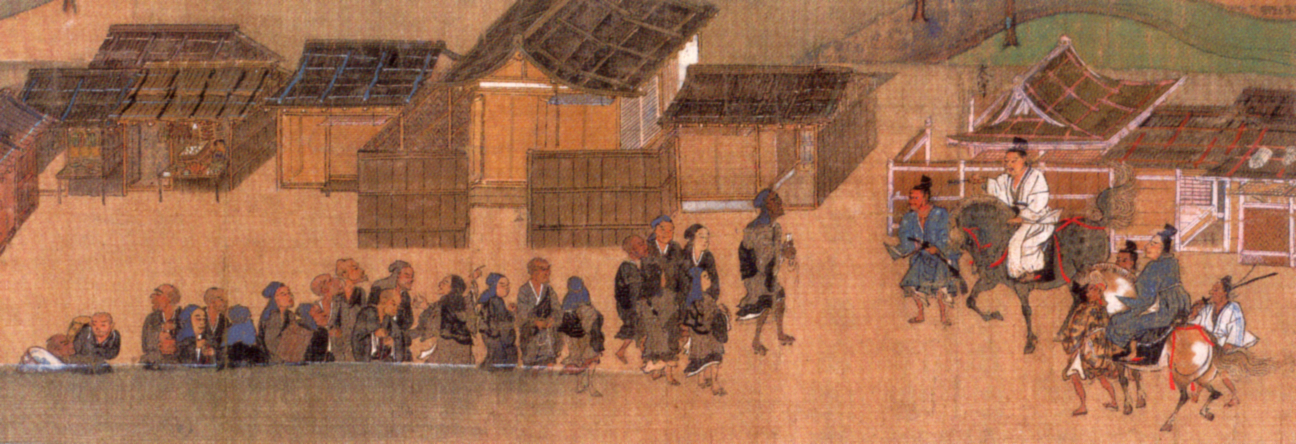


taimen
Ippen leading his band and facing samurai guards before Kamakura (Ippen Picture Scroll)
http://www.jishu.or.jp/yugyouji-engi/ippensyounin-hujisawa


イメージ 1
Dancing and chanting nenbutsu for the Buddha on a makeshift stage (Ippen Picture Scroll)
http://blogs.yahoo.co.jp/yunitake2000/47456795.html
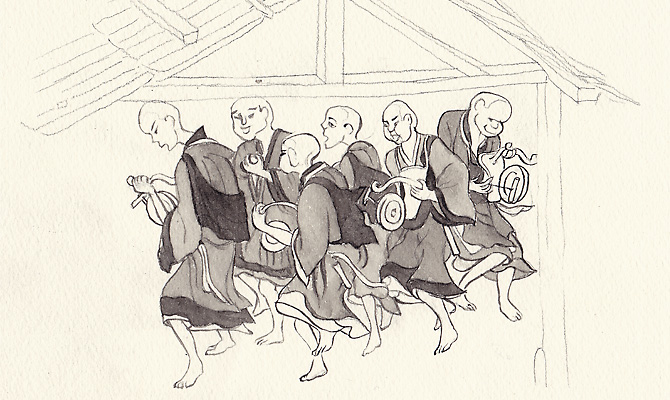


踊り念仏
Illustration of dancing and chanting nenbutsu for the Buddha
http://www.muryoukouji.or.jp/odori-nenbutsu.html


bon4
Dancing and chanting nenbutsu for the Buddha in the Edo era (the 17th to 19th century)
http://www.enopo.jp/watching/7090-10-61185149.html


**** **** ****


Mat 8:26 And he saith unto them, Why are ye fearful, O ye of little faith? Then he arose, and rebuked the winds and the sea; and there was a great calm.

Tuesday, August 25, 2015

"Lord, save us: we perish" - A Reversed Image of a Reversed Object


Island on the Pacific Coast 100 km west of Tokyo


A Reversed Image of a Reversed Object 


I was sitting in a fast food shop, reading a newspaper.

Behind my chair was a wall on which a round clock was hung.  And, there on the wall opposite me was a mirror.  I watched the mirror to see the clock just fully reflected on its surface.  Numbers of the clock looked opposite, and the second hand was moving counter-clockwise in the mirror.  I happened to realize that I had never observed that the second hand of a clock in the mirror was rotating fully 360 degrees counter-clockwise.

There is nothing inside the mirror.  Light is just reflected on its surface very honestly, so that an image looks opposite horizontally.  We are seeing an image of an object reflected by the surface of a mirror.  That reflection makes the object opposite horizontally to the original object.

If we observe any event by ourselves, we can comprehend it as it is.  But if we learn the event from somebody else while he is reflecting the event in his mind, we may judge it based on an image of the event reversed by him.

I was watching the image of the clock horizontally reversed.  But, if I had not realized the very existence of the mirror, I might have believed that this shop had a clock horizontally opposite to normal ones.  With just one simple device called a mirror, something that does not exist in this world comes to emerge as if it did exist.  And, if we do not realize existence of the mirror, we cannot judge if it is real or not.

When we judge the world and any human matters, we may make a similar mistake.  Everything we conceive in the world is reflected by many and various mirrors.  We have to know what kinds of mirrors exist around us or between us and the society.

But what if a mirror itself was reversed?  It could show what we want to see as it is.  Then there might be rather confusion; we have to make a difference between a real object and its image.  But what if a real object was reversed?

Then I read a column in the newspaper on the desk in front of me.

Once in an entrance interview to a naval academy of the Imperial Japanese Navy, a unique question was asked: if a rope circling the earth was prolonged by 3 meters (9.8 feet or so), how high it will be above the ground to circle the earth without a slack.  Each applicant was requested to calculate the answer in his head.  The answer is 48 cm (19 inches)

So, if you add only 3 meters to 40,075 km of a rope running on the ground around the earth, you can have an influence on every point on the earth by automatically lifting the rope by almost 0.5 meters.  This scale of 3 m is what an individual can handle, though it is impossible to manipulate the whole length of 40,075 km.  Even Columbus would be find it difficult with an egg in his hand.

Subsequently, I folded the newspaper and left the fast food shop where I paid 100 yen ($1) for a cup of iced coffee and another 100 yen for an apple pie bar.  Each custom usually paied 500 yen or more for foods and a drink.  But, a shop staff girl saw me off with a polite attitude just like she had showed it when she took order from me.  

So, I thought that if a homeless man had 200 yen, he could at least take iced coffee and an apple pie bar.  And, I believe that shop staff would show pleasant attitudes to him, since he is going to pay 200 yen.

And, in the fast food shop, when the homeless man saw a mirror, he might find him very rich.


http://www.kitoka.com/04kagu/tokei.html


**** **** ****


Mat 8:24 And, behold, there arose a great tempest in the sea, insomuch that the ship was covered with the waves: but he was asleep.
Mat 8:25 And his disciples came to him, and awoke him, saying, Lord, save us: we perish.
Mat 8:26 And he saith unto them, Why are ye fearful, O ye of little faith? Then he arose, and rebuked the winds and the sea; and there was a great calm.

Sunday, August 23, 2015

"he asked him if he saw ought" - A Summer Trip with a Hidden Angel of Death


Pacific Coast around Tokyo


A Summer Trip with a Hidden Angel of Death

I was thinking about life and death sitting in a train.  And, a decent old man with a summer hat and mourning dress-like dark clothes was sitting on an opposite couch, reading a book.

I was thinking that God should send an angel of death to a man destined to soon face his own death prior to his death.  Then he has to stand before God for the final judgment.  Most of people would be condemned to the hell.  Subsequently Satan should appear to such people, requesting their souls since they must have sold their souls for wealth and happiness in this world to Satan.  I wondered if Satan would rather appear before the last judgment or immediately after their death.

I was sitting in the train for almost one and a half hours.  Finally, the decent old man got off the train.  I was thinking how anyone can design elementary particles, electrons, and photons (light) so that they form atoms, molecules, chemical compounds, rocks, stones, clouds, plants, animals, and finally human beings that have souls working above the material world.  Only God can design such physical conditions to create living things and human beings eventually.

In the train, almost every passenger was using smart phones.  Only children and parents were happily talking to one another, since they are in summer holidays.  Therefore, a great amount of electric magnetic fields and radio waves were flying, floating, and vibrating in the air of the car of the train where I was sitting.  Then I started to think how can our brains produce souls and spirits to imagine God, Heaven, angles, and other spiritual entities with belief and confidence.

Our material brains must be a kind of smartphones.  On the display of a smartphone, we can retrieve a picture of, say, Mt. Fuji, through Internet connection.  It can be live images of the mountain being taken by a video camera set around Mt. Fuji and being sent to the smartphone in real time.  Mt. Fuji is a real thing.  But its image on the display is not a real thing.  However, we can check a real state of Mt. Fuji in real time.  This scheme can apply to Heaven and our brains.  Heaven is a real entity, existent in the spiritual universe, and we can see it in our brains like a smartphone showing Mt. Fuji.

Watching landscapes along a railway line out of the window, I thought that the summer always comes every year while many people are dying every year.  However, I didn't see any ominous things in this journey, though a train delayed for 13 minutes in a 2-hour return trip to home.

When I got back home, a TV program presented a documentary about the new volcanic island in the process of building up, covering and absorbing adjacent Nishinoshima Island in the Pacific Ocean 1,000 km south of Tokyo.  A scientist said it was not an ordinary process of creation of a volcanic island.  It is a rare case that the process of creation of a volcanic island resembles that of creation of a continent, since this volcanic island contains light rocks like a continent though volcanic islands are usually made of heavy rocks.  Accordingly, this new volcanic island would not sink into magma to disappear in the ocean eventually.  Japan is expected to have a new territory in the Pacific Ocean near the Ogasawara Islands.

The volcano of this new-born island looks like a miniature version of Mt. Fuji, though Mt. Fuji does not emit smokes like this new one.  However, a million years later, present Mt. Fuji might be gone after a big eruption, while this new volcano becomes 4,000 meters high to be a successor of Mt. Fuji for the future Japanese.  Indeed, it was undersea volcanic activities one million years ago that paved the way for building up of Mt. Fuji, though it was 100,000 years ago that Mt. Fuji was actively and decisively formed.  

Finally, it is not unlucky to live and die in a country where Mt. Fuji exists, I reckoned.


In addition, I saw a little angel like a small child in the train, and she said, "Where are you going?" watching me walking an aisle in a car.  I said in the mind, "I read the Bible which indicated a place."


**** **** ****


Mar 8:22 And he cometh to Bethsaida; and they bring a blind man unto him, and besought him to touch him.

Mar 8:23 And he took the blind man by the hand, and led him out of the town; and when he had spit on his eyes, and put his hands upon him, he asked him if he saw ought.
Mar 8:24 And he looked up, and said, I see men as trees, walking.